Short Answer
On the morning of April 12, 1955, a crowd of scientists, physicians, and reporters packed the Rackham Auditorium at the University of Michigan in Ann Arbor. They had come to hear Dr. Thomas Francis Jr., director of the Poliomyelitis Vaccine Evaluation Center, deliver the results of the largest field trial in medical history. For two years, more than 1,800,000 children had participated in testing a vaccine developed by Jonas Salk, a former student of Francis. The nation held its breath. Polio, the dreaded disease that struck children without warning, had become a national nightmare, and the announcement that morning would change everything. As Francis took the stage, the room fell silent. He spoke for ninety minutes, and when he finished, the world had a new phrase: “safe, effective, and potent.”
What Happened?
The Salk polio vaccine trials were unprecedented in scale and significance. The field trial, directed by Dr. Thomas Francis Jr. at the University of Michigan School of Public Health, evaluated the efficacy of a vaccine developed by Jonas Salk, who had been Francis’s postgraduate student. The trials involved over 1,800,000 children, making them the largest medical experiment ever conducted at the time.
- 1941–1947: Francis joined the University of Michigan’s Public Health Department in 1941, and Salk followed the next year, having been mentored by Francis at New York University. Salk left in 1947 for the University of Pittsburgh, where he developed the polio vaccine.
- 1953–1954: Francis designed and directed a two-year national field trial to test the vaccine’s safety and efficacy.
- April 12, 1955: At 10:20 a.m. Eastern Standard Time, the University of Michigan Information and News Service released a press statement: “POLIO VACCINE EVALUATION RESULTS — FOR RELEASE AT 10:20 E.S.T. ANN ARBOR: The vaccine works. It is safe, effective,…”
- Same day: Dr. Francis announced the results to a crowd at Rackham Auditorium, concluding that the vaccine was up to 90% effective in preventing paralytic polio.
- Immediate aftermath: The Ann Arbor News ran the headline “Vaccine will end polio as a major health threat,” and the first vaccines were shipped to Ann Arbor, where they were stored at the police department in a refrigerator locked with a chain.
The announcement was made in Ann Arbor because of the key role the University of Michigan had played in the vaccine’s development. Francis, who had earlier developed a flu vaccine, was the ideal leader for the evaluation, and his former student Salk had built on that work to create the killed-virus vaccine.
How It Was Seen at the Time
Contemporaries understood the announcement as a turning point in the fight against a disease that had terrorized American families for decades. The language used was triumphant and hopeful. Dr. Francis’s words—”safe, effective, and potent”—were repeated in newspapers and broadcasts across the country. The Ann Arbor News headline captured the prevailing mood: “Vaccine will end polio as a major health threat.”
“The vaccine works. It is safe, effective,…” — University of Michigan Information and News Service, April 12, 1955
The announcement was not just a scientific report; it was a public spectacle. The Rackham Auditorium was filled with scientists and reporters, and the press release was timed for maximum impact. People were desperate to save their children from polio, and the news brought an overwhelming sense of relief. The fact that the vaccine was stored at the police department with a chain around the refrigerator underscores the public’s anxiety and the perceived value of the vaccine.
Historical Snapshot
| Aspect | Detail |
|---|---|
| Date | April 12, 1955 |
| Place | Rackham Auditorium, University of Michigan, Ann Arbor, Michigan |
| People | Dr. Thomas Francis Jr. (director of the Poliomyelitis Vaccine Evaluation Center), Dr. Jonas Salk (developer of the vaccine), and over 1,800,000 child participants |
| What Happened | Francis announced that the Salk polio vaccine was up to 90% effective in preventing paralytic polio |
| Why It Mattered | The announcement marked the beginning of the end of polio as a major public health threat in the United States |
Contemporary Newspaper Coverage
The press played a crucial role in shaping public perception of the vaccine trials. The University of Michigan’s own press release, issued on April 12, 1955, was the first official word. It read: “POLIO VACCINE EVALUATION RESULTS — FOR RELEASE AT 10:20 E.S.T. ANN ARBOR: The vaccine works. It is safe, effective,…” The release was distributed to newspapers and wire services, and within hours, headlines across the country echoed the message.
The Ann Arbor News, the local paper, ran the headline “Vaccine will end polio as a major health threat” on the same day. The tone was one of unqualified optimism. The New Yorker later described the scene: “On the morning of April 12, 1955, an epidemiologist named Thomas Francis, Jr., took the stage of the Rackham Auditorium, at the University of Michigan, in Ann Arbor. Short and portly, in his mid-fifties, with a long face and a close-clipped mustache, Francis was there to deliver a ninety-minute lecture on the vaccine field trial he had just completed.”
“Vaccine will end polio as a major health threat.” — The Ann Arbor News, April 12, 1955
The coverage was not just factual; it was celebratory. Reporters emphasized the scale of the trial—over 1,800,000 children—and the dramatic setting of the announcement. The press release itself was carefully crafted to convey certainty and hope, using the phrase “safe, effective, and potent” that would become iconic.
What People Feared
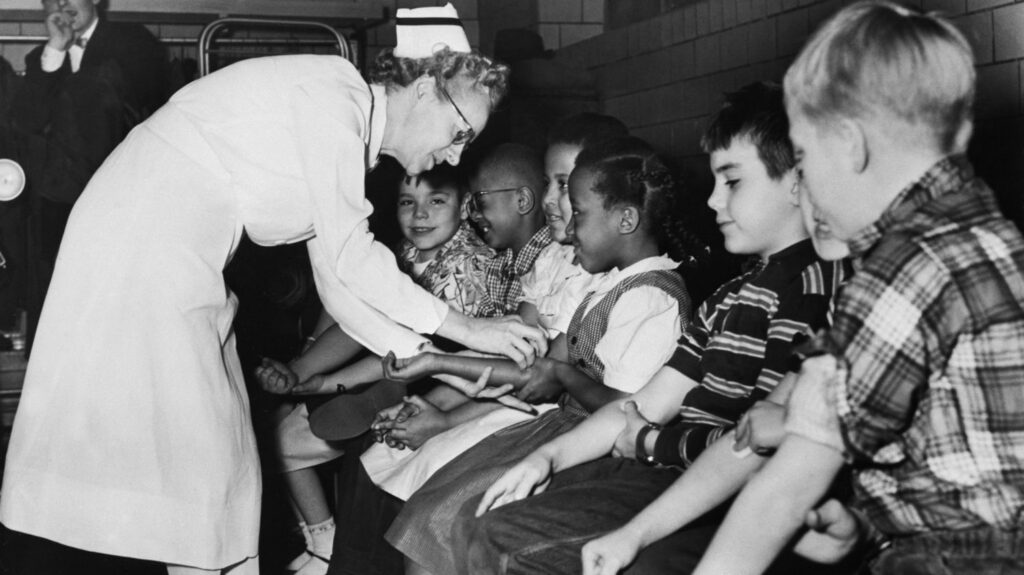
Before the announcement, fear of polio was pervasive. The disease struck children without warning, causing paralysis and sometimes death. Parents were desperate to protect their children, and the vaccine trials were seen as a last hope. The fear was so intense that when the first vaccines were sent to Ann Arbor in 1955, they were stored at the police department in a refrigerator locked with a chain around it. This detail, recorded by the Ann Arbor District Library, illustrates the public’s anxiety and the perceived value of the vaccine.
There were also fears about the vaccine’s safety. The killed-virus vaccine was a new approach, and some worried about potential side effects. The fact that the trials involved over 1,800,000 children was both a source of hope and a cause for concern. The announcement of “safe, effective, and potent” was designed to allay these fears, and it largely succeeded.
What People Expected Would Happen Next
Contemporaries expected that the vaccine would bring an end to polio as a major health threat. The Ann Arbor News headline said it directly: “Vaccine will end polio as a major health threat.” This was not just a hope; it was a prediction. The success of the trials led to immediate plans for mass vaccination campaigns. The vaccine was shipped to communities across the country, and parents lined up to have their children immunized.
People also expected that the triumph would restore a sense of normalcy. Summers, which had been marked by polio outbreaks and closed swimming pools, would no longer be a time of dread. The announcement was seen as a victory of science over a terrifying disease, and there was widespread confidence that the vaccine would deliver on its promise.
Aftermath
In the immediate aftermath of the announcement, the Salk vaccine was distributed rapidly. The first doses were sent to Ann Arbor, where they were stored at the police department under lock and key. Within months, millions of children were vaccinated. The incidence of paralytic polio dropped dramatically, and by the 1960s, the disease was virtually eliminated in the United States. The success of the trials also established a model for large-scale clinical research and public health campaigns.
The announcement also cemented the reputations of Francis and Salk. Francis, who had directed the evaluation, was hailed as a master of epidemiology. Salk became a national hero, though he never patented the vaccine, choosing to give it away for the public good. The University of Michigan’s role in the trials was celebrated, and the Rackham Auditorium became a symbol of medical progress.
How Historians See It Today
Modern historians view the Salk vaccine trials as a watershed moment in the history of medicine and public health. The trials were not only a scientific achievement but also a social and political event. They demonstrated the power of large-scale collaboration between universities, government agencies, and private foundations. The announcement on April 12, 1955, is often cited as the moment when the public’s faith in science was at its peak.
Historians also note the complexity of the trials. The vaccine was not without problems; in 1955, a faulty batch from one manufacturer caused cases of polio, leading to a temporary halt in vaccinations. However, the overall success of the trials overshadowed these setbacks. The legacy of the trials is seen in the global effort to eradicate polio, which continues today. The phrase “safe, effective, and potent” remains a standard for vaccine evaluation, and the Ann Arbor trials are remembered as a model of rigorous scientific inquiry.
The Salk polio vaccine trials in Ann Arbor were more than a medical breakthrough; they were a moment of collective relief and hope. The primary sources—the press release, the newspaper headlines, and the eyewitness accounts—capture the fear and desperation of a nation, and the joy of a solution. The announcement on April 12, 1955, did not just change the course of medicine; it changed the way Americans thought about the future. The vaccine worked, and the world was never the same.
FAQ
How effective was the Salk polio vaccine according to the 1955 announcement?
Dr. Thomas Francis Jr. announced that the vaccine was up to 90% effective in preventing paralytic polio, based on the field trials involving over 1,800,000 children.
Why was the announcement made in Ann Arbor, Michigan?
Ann Arbor was the site of the Poliomyelitis Vaccine Evaluation Center at the University of Michigan, directed by Dr. Thomas Francis Jr. The university had played a key role in the vaccine's development, and Francis had mentored Jonas Salk.
What was the public reaction to the vaccine announcement?
The public reacted with overwhelming relief and hope. The Ann Arbor News headline declared 'Vaccine will end polio as a major health threat,' and the vaccine was so highly valued that initial doses were stored at the police department under lock and key.






Leave a Reply