
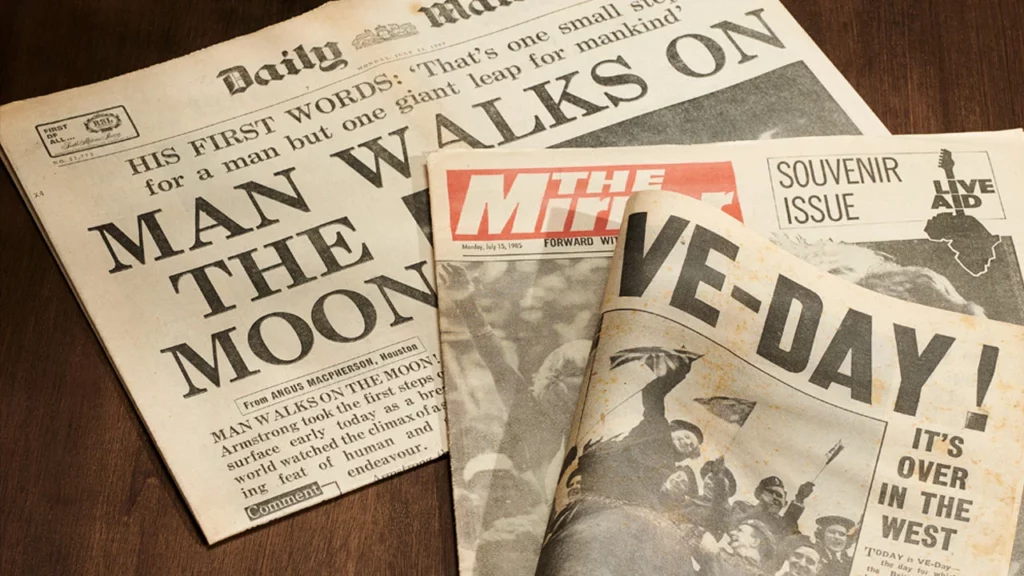
Short Answer
Historical newspapers can tell us who won an election, when a ship arrived, what a politician said, how much a house cost, which businesses operated on a particular street, and how journalists described events as they unfolded.
But newspapers can reveal something even more valuable.
They can show us what people at the time were being told about their world.
That distinction matters.
A newspaper published during a war may report that an enemy army has been destroyed.
The army may not actually have been destroyed.
Yet the article can still provide important historical evidence.
It tells us that readers encountered that claim. It may reveal government propaganda, editorial assumptions, incomplete wartime information, political loyalties, or the speed with which rumors traveled.
Historical newspapers therefore should not be treated simply as repositories of facts.
They are primary sources produced within particular political, commercial, technological, and cultural environments.
The Library of Congress specifically identifies historic newspapers as primary-source material and provides extensive newspaper collections through programs such as Chronicling America. Its guidance describes these newspapers as a way to examine historical and everyday events as they were reported at the time.
Used carefully, newspapers can help historians reconstruct not only what happened, but also how events were reported, interpreted, advertised, debated, and remembered while history was still unfolding.
Are Historical Newspapers Primary Sources?
Historical newspapers often function as primary sources when researchers study the period in which they were published.
Suppose you are researching the presidential election of 1896.
A newspaper printed in October 1896 could provide primary evidence about:
- campaign arguments,
- political endorsements,
- public speeches,
- political cartoons,
- advertisements,
- election predictions,
- issues editors considered important.
The Library of Congress includes newspapers within its primary-source research materials, while the National Archives explicitly lists newspapers among written documents that can be analyzed as historical evidence.
But there is an important distinction.
A newspaper is primary evidence of what the newspaper published.
That does not automatically make every statement inside it a verified description of reality.
Newspapers Tell Us What Was Reported, Not Necessarily What Happened
Consider a fictional headline:
REBELS COMPLETELY DEFEATED — CAPITAL SAFE
Suppose historians later determine that rebel forces were not defeated at all.
Does that make the newspaper useless?
No.
The article might still help answer questions such as:
- What did readers believe was happening?
- What information had reached the city?
- Was the newspaper supporting the government?
- Was censorship operating?
- Were authorities attempting to reassure the population?
- How quickly did more accurate reports appear?
This leads to one of the most important rules for using newspapers as primary sources:
Separate the fact that something was reported from the question of whether the report was true.
“The newspaper reported that the rebels had been defeated” is a different historical claim from “the rebels had been defeated.”
That difference should remain visible in careful historical writing.
Why Historical Newspapers Are So Valuable
Newspapers preserve an extraordinary mixture of historical material.
A single issue might contain:
- political news,
- international dispatches,
- local events,
- advertisements,
- business notices,
- court reports,
- birth announcements,
- marriage notices,
- obituaries,
- property sales,
- weather reports,
- letters to the editor,
- editorials,
- cartoons,
- entertainment listings,
- prices,
- shipping information.
Library of Congress research guides emphasize this variety, noting that historic newspapers contain material ranging from news and editorials to advertisements, reviews, biographical pieces, and obituaries.
For historians, that makes newspapers useful for far more than political history.
They can illuminate everyday life.
Newspapers Preserve the Everyday World
History books tend to concentrate on events later judged important.
Newspapers had to fill pages every day or every week.
As a result, they preserved thousands of details that might otherwise have disappeared.
Imagine researching life in a small American town in 1905.
The newspaper might tell you:
which stores existed,
what products they advertised,
what concerts were scheduled,
who visited from another town,
which streets were being repaired,
what property was sold,
which organizations held meetings,
which diseases concerned residents,
and what local disputes occupied public attention.
The National Endowment for the Humanities has described historical newspapers as important records of civic, legal, cultural, and everyday community life.
Sometimes the seemingly insignificant sections become the most valuable evidence.
Advertisements Are Historical Evidence
An advertisement should not be read as an objective product review.
Its purpose is to sell.
Yet advertisements can provide extraordinary evidence about:
- prices,
- consumer goods,
- technology,
- transportation,
- medicine,
- fashion,
- housing,
- employment,
- gender expectations,
- consumer aspirations.
Suppose an advertisement claims:
THE PERFECT TONIC FOR EVERY NERVOUS AILMENT
The advertisement is poor evidence that the medicine actually cured those ailments.
But it may be excellent evidence for studying:
how the product was marketed,
which health concerns advertisers appealed to,
and
what kinds of claims were considered commercially persuasive.
The same source can therefore be unreliable for one historical question and highly valuable for another.
Classified Advertisements Can Reveal Social History
Small advertisements are especially useful.
Researchers can use them to investigate:
- job opportunities,
- wages,
- housing,
- domestic labor,
- lost property,
- transportation,
- secondhand markets,
- services,
- commercial networks.
For example, repeated employment notices can help researchers examine which occupations were associated with particular genders or social groups.
Property advertisements can reveal how neighborhoods were marketed.
Shipping notices can show commercial connections between ports.
Historical newspaper research therefore should not stop at major headlines.
Sometimes the smallest type on the page contains the richest social history.
Obituaries and Personal Notices
Newspapers can also be valuable for biographical and genealogical research.
Obituaries may provide:
- names,
- occupations,
- relatives,
- residences,
- religious affiliations,
- military service,
- community organizations.
Marriage, birth, funeral, anniversary, and travel notices may help reconstruct family and community networks.
But these sources require the same criticism as other newspaper content.
An obituary may contain family traditions that were never independently verified.
Socially prominent people may receive long notices while marginalized people receive little or no coverage.
What a newspaper records—and whom it considers worthy of recording—is itself historical evidence.
Editorials Are Different From News Reports
One of the easiest mistakes is treating every newspaper item as though it represents the same kind of evidence.
It does not.
Before quoting something, determine what you are reading.
Is it:
- a news report,
- editorial,
- advertisement,
- letter,
- press release,
- political cartoon,
- syndicated column,
- reprinted article?
The National Archives’ written-document framework specifically asks researchers to identify the document type before analyzing authorship, audience, purpose, context, and evidentiary value.
An editorial openly attempts to interpret or persuade.
A news report may present itself as factual reporting but still reflect editorial selection, limited information, political assumptions, or reporting conventions.
Both are useful.
They simply answer different questions.
Newspapers Have Perspectives
There is no newspaper published from nowhere.
Every newspaper existed within a particular community and had:
- owners,
- editors,
- writers,
- readers,
- advertisers,
- financial interests,
- political circumstances.
Historical newspapers were sometimes openly associated with political parties, causes, religious groups, ethnic communities, or reform movements. Library of Congress guidance for the National Digital Newspaper Program notes that historical papers were often created for particular audiences and could have specific political or social orientations.
This does not make them bad sources.
It makes perspective part of the evidence.
How to Investigate a Newspaper’s Perspective
Before relying heavily on a newspaper, investigate the publication itself.
Ask:
Who owned it?
Who edited it?
Where was it published?
Who was its likely audience?
Did it have known political affiliations?
Was it associated with a particular ethnic, religious, labor, or commercial community?
Who advertised in it?
Who were its competitors?
Chronicling America’s contextual information can help with this. Library of Congress guidance notes that title essays can provide information about a newspaper’s history, publishers, audience, scope, and historical role.
Knowing the newspaper can completely change how you interpret the article.
Compare Newspapers With Different Perspectives
Suppose you are researching a strike.
Do not read only one newspaper.
Compare:
a business-oriented paper,
a labor newspaper,
a mainstream metropolitan daily,
and a local paper from the affected town.
The same strike might be described as:
a dangerous disturbance
in one paper,
a legitimate workers’ protest
in another,
and
a commercial disruption
in a third.
Those differences can reveal how groups competed to define the event.
Library of Congress materials explicitly encourage comparing newspapers and perspectives when examining historical bias and political reporting.
The disagreement is not noise.
It may be your evidence.
Seek Newspapers Produced by the Communities You Are Studying
Mainstream newspapers do not necessarily provide the best—or only—view of every community.
Historical newspaper collections include papers created within African American, Native American, immigrant, labor, religious, and foreign-language communities.
These sources can reveal issues and perspectives that mainstream publications ignored or represented very differently.
For example, Library of Congress guidance on Native American newspapers notes that mainstream papers could frame issues through the perspective of white editors or U.S. institutions, while Native newspapers provide different viewpoints.
Using multiple press traditions can transform a research project.
Instead of studying only what outsiders said about a community, historians may be able to investigate what members of that community published for themselves.
Historical Language Matters When Searching Newspapers
One of the most important practical lessons in newspaper research is:
People in the past may not have used the terminology we use today.
Imagine searching nineteenth-century newspapers using only a twenty-first-century phrase.
You may find very little.
That does not mean newspapers ignored the subject.
They may have used different terminology.
The NEH’s historical newspaper search guidance demonstrates this problem clearly in its race and ethnicity thesaurus: modern search terms can miss enormous quantities of material because terminology changed across time.
Researchers should therefore build a vocabulary list before searching.
Include:
- older terminology,
- alternative spellings,
- abbreviations,
- formal names,
- informal names,
- names of organizations,
- names of important individuals.
Historical research often becomes much easier once you start searching with the language of the period.
Names Change Too
Suppose you are searching for information about a person.
Their name might appear as:
William Henry Thompson
William H. Thompson
W. H. Thompson
Wm. Thompson
Mayor Thompson
or simply:
Thompson
Organizations change names.
Cities change names.
Street names change.
Countries and political territories change.
Even spelling conventions change.
Do not assume one search phrase will find everything.
Create several possible variations.
OCR Makes Historical Newspapers Searchable—But Not Perfectly
Digital newspaper databases often rely on optical character recognition, or OCR.
OCR software attempts to convert scanned newspaper images into machine-readable text.
That allows millions of pages to become keyword searchable.
But old newspapers are difficult materials for OCR.
Historical typography, damaged pages, poor microfilm, unusual columns, faded ink, decorative fonts, and older typefaces can cause errors. NEH guidance notes that Chronicling America’s OCR may contain substantial mistakes, particularly because many newspaper images originate from imperfect microfilm copies.
This has an important implication:
No search result does not necessarily mean no article exists.
The computer may simply have failed to recognize the words correctly.
Never Trust OCR as a Perfect Transcription
Suppose the original newspaper says:
President Roosevelt arrived yesterday.
OCR might interpret damaged type as something like:
Prcsident Rooseveit arnved yestcrday.
A keyword search for “President Roosevelt” might miss the article.
When you find an important article, always inspect the page image rather than relying only on OCR text.
OCR is a discovery tool.
The scan is closer to the historical newspaper itself.
NEH documentation specifically describes OCR as an imperfect interpretation of newspaper page images and notes how digitization quality affects searchability.
Search Broadly Before Searching Precisely
A useful newspaper-search strategy is to begin broad and narrow gradually.
Suppose you are investigating a 1912 textile strike.
You might begin with:
textile strike
Then try:
mill strike
mill workers
labor trouble
strikers
factory strike
Then add:
location,
company name,
union name,
organizer names.
Library of Congress search guidance recommends changing terms, broadening searches, and relaxing date or geographic restrictions when a search produces too few results.
Do not assume the wording in your research question will match historical newspaper language.
Search Around the Date, Not Only on the Date
Suppose an event occurred on May 6, 1910.
Do not search only newspapers dated May 6.
A newspaper may not have published that day.
News may have arrived too late for that edition.
Later reports may correct the first account.
Useful searches might cover:
May 1–5 — anticipation and background.
May 6–7 — immediate reporting.
May 8–15 — corrections, reactions, consequences.
Weeks later — investigations and commentary.
Library of Congress newspaper-research guidance specifically recommends reading articles published several days after an event because additional information becomes available after the initial reports.
This practice is especially important for fast-moving events.
The First Report Is Often Not the Best Report
Breaking news has always been difficult.
Early newspaper reports may contain:
- uncertain casualty numbers,
- misspelled names,
- incorrect locations,
- rumors,
- contradictory eyewitness accounts,
- official claims later revised.
Historians should therefore trace how reporting develops.
Imagine the reports after a disaster:
Day One
100 FEARED DEAD
Day Two
DEATH TOLL MAY REACH 60
Day Four
AUTHORITIES CONFIRM 32 DEATHS
The changing numbers tell you something about both the disaster and the production of news.
Do not silently select the first number you find.
Follow the story.
Newspapers Frequently Reprinted Material
Historical newspapers routinely exchanged, copied, syndicated, and reprinted material.
That means ten newspapers repeating the same claim do not necessarily represent ten independent reports.
NEH-supported research into nineteenth-century newspapers has documented extensive reprinting networks through which texts circulated among publications.
When several newspapers contain nearly identical wording, ask:
Where did the story originate?
Look for phrases such as:
“according to the Associated Press,”
“from our correspondent,”
“as reported by…,”
“telegraphed from…,”
“from the New York…”
Tracing the information chain matters for corroboration.
Ten Newspapers Can Sometimes Equal One Source
Imagine this chain:
Eyewitness → Reporter → Wire Service → Newspaper A → Newspapers B–J
Ten newspapers publish the story.
At first glance you have ten confirmations.
In reality, they may all depend on the same witness.
Historical corroboration works best when sources are genuinely independent.
Compare newspaper reporting with:
- private letters,
- diaries,
- official records,
- photographs,
- court testimony,
- government documents,
- physical evidence,
- other independent newspapers.
The National Archives recommends exactly this broader evidentiary move: after analyzing a document, researchers should ask which additional evidence is needed to understand the event or subject.
Headlines Need Special Caution
Headlines are designed to attract attention and summarize stories quickly.
They may exaggerate, simplify, or frame an event more dramatically than the article itself.
Always read beyond the headline.
A headline might say:
CITY IN PANIC
while the article provides evidence of panic in only one neighborhood.
Similarly:
WORKERS DEMAND REVOLUTION
may summarize remarks made by only one speaker.
When using newspapers historically, distinguish:
the headline’s framing
from
the article’s evidence.
Both can be historically useful.
Read What Is Beside the Article
A digitized search result often takes researchers directly to one article.
That convenience can remove the surrounding newspaper page from view.
Whenever possible, zoom out.
Look at:
- neighboring articles,
- advertisements,
- page placement,
- column position,
- headline size,
- illustrations.
A short item buried on page eight communicates something different from a front-page banner headline.
An advertisement appearing beside a political story might reveal something about the commercial environment in which the newspaper operated.
The newspaper page itself is an historical object.
Do not reduce it entirely to searchable text.
Page Placement Can Be Evidence
Editors decide what appears prominently.
Imagine two newspapers covering the same political scandal.
Newspaper A places it across the front page.
Newspaper B gives it four lines on page six.
That difference may reveal editorial priorities.
Similarly, repeated attention can matter.
One isolated article shows that a subject appeared.
Twenty front-page articles over three months may suggest sustained editorial importance.
Historians can therefore study not only what newspapers said, but also how much attention they gave a subject.
Silence Can Be Evidence—but Use It Carefully
Suppose Newspaper A devotes extensive coverage to a protest.
Newspaper B barely mentions it.
That silence might be significant.
Perhaps Newspaper B opposed the movement.
Perhaps editors considered the event unimportant.
But other explanations are possible:
the relevant issue may be missing,
the event occurred after deadline,
the archive may be incomplete.
Absence is therefore not automatically proof of deliberate suppression.
Historical arguments based on silence require especially careful investigation.
Newspapers Can Contain Harmful Historical Language
Historical newspapers reflect the language and prejudices of their time.
Researchers may encounter racist, antisemitic, sexist, colonial, xenophobic, or otherwise dehumanizing terminology and imagery.
NEH’s Chronicling America guidance explicitly warns that historical newspapers can contain offensive and outdated language reflecting systems of prejudice and discrimination.
That material may be essential evidence when studying historical racism, propaganda, representation, or social attitudes.
But reproducing such language unnecessarily can also repeat the harm.
When quoting offensive historical language:
- make sure the wording is genuinely necessary,
- identify who used it,
- provide context,
- avoid presenting it as neutral terminology.
Historical fidelity does not require careless repetition.
Use Newspapers to Study Representation
A newspaper can reveal not only events but how people and groups were represented.
Consider descriptions such as:
mob
crowd
patriots
agitators
rebels
freedom fighters
These words are not interchangeable.
They frame the people being described.
One newspaper’s:
dangerous mob
may be another newspaper’s:
peaceful demonstrators.
Comparing terminology can expose political and cultural assumptions.
This is one of the strongest uses of newspapers as primary sources.
Separate Reporting From Reality
Whenever you write from newspaper evidence, pay attention to your verbs.
Instead of:
Three thousand demonstrators attacked police.
consider:
The newspaper reported that approximately three thousand demonstrators confronted police.
Then corroborate the claim.
Similarly:
Instead of:
Residents supported the mayor.
write:
The newspaper’s editorial argued that residents supported the mayor.
Small wording changes prevent a source’s claims from quietly becoming your own conclusions.
Historical Newspapers Can Reveal Public Debate
Newspapers are especially useful for studying controversies.
Researchers can trace:
- arguments,
- counterarguments,
- letters,
- political advertisements,
- speeches,
- editorials,
- endorsements.
Following coverage across weeks or months can reveal how debates changed.
Which arguments disappeared?
Which slogans appeared?
Which events changed the discussion?
Which voices received space?
Instead of treating newspaper articles as isolated fragments, researchers can reconstruct conversations over time.
Newspapers Can Reveal What Editors Thought Readers Cared About
Newspapers are commercial and cultural products.
Editors choose stories partly because they believe readers will find them important, useful, entertaining, frightening, or interesting.
Advertisements likewise reflect assumptions about potential customers.
This means newspapers can help historians investigate:
What was considered newsworthy?
What concerns were expected to attract attention?
Which products were assumed to be desirable?
Which social behaviors were considered remarkable?
These questions transform newspapers from factual databases into evidence of cultural priorities.
How to Evaluate a Historical Newspaper Article
A practical evaluation can follow this sequence.
1. Identify the Newspaper
Record:
- title,
- city,
- date,
- edition,
- page.
Then investigate the newspaper’s history.
2. Identify the Type of Content
Is it:
- reporting,
- editorial,
- advertisement,
- letter,
- obituary,
- notice,
- cartoon?
Different genres require different interpretations.
3. Identify the Author or Information Source
Is a reporter named?
Was it written by an editor?
Is it attributed to a wire service?
Did it come from another newspaper?
Is the author anonymous?
4. Determine the Audience
Was this:
- a national newspaper,
- local community paper,
- party newspaper,
- labor paper,
- ethnic press publication,
- specialist commercial paper?
Audience shapes content.
5. Reconstruct the Context
What was happening when the article appeared?
What information was available at that point?
6. Identify Perspective
Look at:
- adjectives,
- labels,
- headlines,
- assumptions,
- omissions,
- political language.
7. Separate Claims From Evidence
Which statements are:
- directly observed,
- quoted,
- attributed,
- rumored,
- editorial inference?
8. Corroborate
Find:
- another newspaper,
- official records,
- correspondence,
- photographs,
- eyewitness accounts,
- later investigations.
9. Follow the Story Forward
Check later issues for:
- corrections,
- updated figures,
- reactions,
- retractions,
- new evidence.
10. Ask What the Article Can Actually Prove
This is the most important step.
Perhaps the article proves that an event was reported.
Perhaps it helps demonstrate contemporary attitudes.
Perhaps independent evidence allows you to use it as support for what actually occurred.
Do not make the source carry more weight than it can support.
The National Archives recommends this same general progression: identify the document, examine its parts, investigate purpose and historical context, and then use it alongside additional evidence.
A Worked Example
Imagine researching a fictional labor demonstration in 1910.
You find this headline:
RIOTOUS STRIKERS TERRORIZE BUSINESS DISTRICT
A weak research approach would be:
The strikers terrorized the business district.
A historian does more work.
Step 1: Identify the newspaper
You discover that it is owned by a businessman with investments in several local factories.
Interesting—but not sufficient to dismiss the report.
Step 2: Read the entire article
The article says that two store windows were broken and several thousand demonstrators marched through downtown.
Step 3: Identify sourcing
The claims about violence come primarily from police officials.
Step 4: Compare another newspaper
A labor paper describes the demonstration as peaceful except for a brief confrontation with police.
Step 5: Find another source
Court records show three arrests for property damage but no major injuries.
Step 6: Interpret
You might conclude:
Newspapers framed the demonstration differently according to their political and economic perspectives. The business-oriented paper emphasized disorder, while the labor publication emphasized peaceful participation. Surviving legal evidence indicates some property damage but does not by itself support the more sweeping claim that the business district was “terrorized.”
Now the newspapers are doing what primary sources should do.
They are helping you build an argument rather than supplying one automatically.
Where to Find Historical Newspapers
A major free resource for U.S. research is Chronicling America, produced through the National Digital Newspaper Program, a partnership between the Library of Congress and the National Endowment for the Humanities. It provides searchable access to millions of digitized historic newspaper pages from across the United States and its territories, with collection coverage extending through 1963.
The Library of Congress also maintains broader newspaper holdings covering thousands of U.S. and international titles in digital, print, and microfilm formats.
Researchers may also find digitized newspapers through:
- state libraries,
- university libraries,
- historical societies,
- national libraries,
- subscription newspaper databases,
- local archives.
No single database contains every surviving newspaper.
When one collection produces nothing, search library catalogs and newspaper directories for other holdings.
Digital Search Has Changed Newspaper Research
Before large-scale digitization, newspaper research often required researchers to know approximately when something happened and then scroll manually through reels of microfilm.
Full-text search has transformed that process.
Researchers can now locate obscure:
- names,
- addresses,
- businesses,
- quotations,
- organizations,
- incidents
across enormous collections.
But digital convenience creates its own danger:
assuming search results represent everything that exists.
OCR errors, incomplete digitization, spelling changes, missing issues, and modern terminology can all create invisible gaps.
A database is not the historical record.
It is an interface to a selected and imperfectly searchable portion of it.
Common Mistakes When Using Historical Newspapers
Mistake 1: Treating every article as factual
Newspapers contain rumors, mistakes, persuasion, and incomplete reports.
Mistake 2: Reading only one newspaper
One publication gives you one editorial environment.
Compare perspectives.
Mistake 3: Trusting the headline
Read the entire article.
Mistake 4: Ignoring publication history
Learn about ownership, audience, editors, and political context.
Mistake 5: Searching only modern terminology
Use language appropriate to the historical period. NEH’s historical newspaper guidance demonstrates how modern terminology can miss large portions of relevant material.
Mistake 6: Assuming no search result means no evidence
OCR can fail.
Try variations and inspect nearby issues.
Mistake 7: Counting reprints as independent confirmation
Trace where stories originated.
Mistake 8: Ignoring advertisements
Advertisements may reveal economic and cultural information unavailable in the news columns.
Mistake 9: Quoting without context
Always record newspaper title, date, page, and article context.
Mistake 10: Using newspapers alone
Compare newspaper evidence with other primary and secondary sources.
Frequently Asked Questions
Are historical newspapers primary sources?
Yes, they often function as primary sources when used as evidence about the period in which they were produced. The Library of Congress includes historic newspapers among its primary-source collections, and the National Archives includes newspapers among written documents suitable for primary-source analysis.
Are old newspaper articles reliable?
Sometimes, but not automatically. Reliability depends on the specific claim, reporting conditions, information available at the time, publication perspective, sourcing, and corroborating evidence.
A newspaper can be highly reliable for showing what was published while being less reliable about whether the reported event happened exactly as described.
Are newspaper editorials primary sources?
Yes, when researchers use them as evidence about contemporary political arguments, attitudes, editorial positions, or public debate.
They are interpretive texts, but they can still function as primary historical evidence for the period in which they were written.
Are newspaper advertisements primary sources?
Yes. Historical advertisements can provide primary evidence about products, prices, marketing, consumer culture, gender roles, health claims, housing, employment, and numerous other aspects of social and economic history.
Can newspapers be biased?
Yes. Newspapers are produced by particular editors, owners, reporters, and institutions and may reflect political, commercial, social, or community perspectives. Library of Congress resources explicitly encourage examining historical newspaper bias and comparing publications.
How can I tell whether a historical newspaper was politically biased?
Research its owners, editors, audience, endorsements, affiliations, and editorial positions. When available, contextual newspaper histories or title essays can help identify the publication’s historical role and readership.
Why do newspaper databases miss names I know are there?
OCR errors are a common reason. Historical newspapers are particularly difficult for optical character recognition because of old typefaces, page damage, microfilm quality, complex layouts, and other scanning problems.
Should I trust newspaper OCR text?
Use it for searching and discovery, but verify important passages against the scanned newspaper page. OCR is a machine-generated interpretation and can contain substantial errors.
Why should I read newspapers from several days after an event?
Initial reporting may contain uncertain or incomplete information. Later articles may include corrected figures, additional witnesses, official findings, and further context. Library of Congress guidance recommends following newspaper coverage beyond the first reports.
What is Chronicling America?
Chronicling America is the Library of Congress’s major digital historic newspaper resource developed through the National Digital Newspaper Program with the National Endowment for the Humanities. It provides free access to millions of digitized American newspaper pages.
Should I cite the OCR text or the newspaper image?
For serious research, verify the wording against the original page image and cite the newspaper issue and page rather than treating uncorrected OCR as authoritative transcription.
Can two newspapers reporting the same story count as corroboration?
Sometimes, but first determine whether the reports are independent. Historical newspapers frequently reprinted or syndicated content, so multiple articles can trace back to the same original report.
A Simple Newspaper Research Checklist
Before using a historical newspaper article, ask:
About the publication
What newspaper is this?
Where was it published?
Who owned or edited it?
Who was its audience?
About the item
Is this news, opinion, advertising, or something else?
Who wrote it?
Where did the information come from?
About timing
How soon after the event was it published?
Did later reporting change the story?
About perspective
Which words frame the event?
Whose voices appear?
Whose voices are absent?
About corroboration
Do independent newspapers agree?
What do non-newspaper sources say?
About digital access
Could OCR have missed relevant material?
Have I checked the scanned page?
About your argument
Finally ask:
Am I using this article as evidence of what happened, or evidence of how events were reported and understood?
That last distinction prevents many historical errors.
Final Takeaway: Read Newspapers as Both Information and Artifacts
Historical newspapers can be among the richest primary sources available.
They provide dates, names, speeches, reports, prices, advertisements, obituaries, political arguments, local gossip, images, and thousands of details about everyday life.
But their greatest historical value appears when researchers stop treating newspapers as neutral databases of facts.
A newspaper is also an artifact.
It was created by particular people.
For particular readers.
At a particular moment.
Using the information available at that moment.
Within a particular political, cultural, and commercial environment.
That means historians should read historical newspapers on two levels.
First:
What information does this newspaper provide about the event?
Then:
What does the way this newspaper reported the event tell us about the society that produced it?
Compare publications.
Follow stories over time.
Investigate ownership and audience.
Search using historical terminology.
Treat OCR as a tool rather than a perfect transcription.
Distinguish news from editorials and advertisements.
Trace reprinted information back toward its source.
And corroborate important factual claims with independent evidence.
The National Archives’ approach to primary-source analysis provides a useful summary of the method: identify the document, examine who created and received it, reconstruct why it was produced and what was happening at the time, then place it alongside other evidence before forming conclusions.
Used this way, a historical newspaper becomes far more than yesterday’s news.
It becomes evidence of what people knew, what they were told, what they argued about, what they bought, what they feared, what they ignored—and how they saw their world before anyone knew what history would eventually make of it.




Leave a Reply