

Short Answer
Reading a primary source is easy.
Reading one like a historian is much harder.
Imagine finding a letter written by a soldier during a war. You could read the words, identify what happened, pull out an interesting quotation, and move on.
A historian approaches the same letter differently.
Who wrote it?
When?
Where was the writer?
Who was expected to read it?
What did the writer know at that moment?
What might the writer have misunderstood?
Was the letter meant to inform, reassure, complain, persuade, impress, or conceal?
What was happening beyond the writer’s field of vision?
Do other sources describe the same events differently?
And perhaps most importantly:
What historical claim can this document actually support?
That difference separates ordinary reading from historical reading.
Historians do not simply collect statements from old documents and assume that those statements describe the past accurately. They treat surviving sources as evidence produced under particular circumstances.
The American Historical Association notes that historians work from partial primary sources that can support multiple explanations of an event. Historical arguments therefore depend on interpretation rather than simple extraction of facts.
A useful framework developed through Stanford’s historical-thinking research identifies four closely related practices:
sourcing, contextualization, corroboration, and close reading.
The Library of Congress offers a complementary process built around Observe, Reflect, and Question, while the National Archives encourages researchers to identify perspective, context, audience, purpose, and additional evidence.
Together, these approaches provide an excellent foundation for learning how historians actually investigate primary evidence.
Historical Reading Is Not the Same as Ordinary Reading
When people normally read a book, article, or website, they tend to begin with the content.
They ask:
What does this say?
Historians often begin somewhere else.
They ask:
Who is saying this, when, and under what circumstances?
The American Historical Association has described this approach as reading a document almost “backwards”: before accepting its claims, historians examine authorship, date, and context.
That change in reading order is extremely important.
Consider these statements:
The enemy army has almost collapsed.
Our new medicine provides remarkable results.
The demonstration attracted only a small crowd.
Each statement might be true.
But imagine discovering that:
- the first came from wartime propaganda;
- the second came from an advertisement produced by the manufacturer;
- the third came from a government official opposing the demonstration.
Suddenly the source of the statement becomes part of its meaning.
Historians therefore read both:
what a source says
and
the circumstances that caused someone to say it.
The Historian’s Primary Source Workflow
A practical method can be organized into seven stages:
- Identify the source
- Source it
- Contextualize it
- Read it closely
- Analyze perspective and purpose
- Corroborate it
- Turn it into historical evidence
These stages overlap.
Historical reading is rarely a rigid sequence. A detail discovered during close reading may require more contextual research. A contradictory document may force you to reconsider the first source. New evidence may change your interpretation entirely.
That is normal.
Historical investigation is iterative.
Step 1: Identify What You Are Looking At
Before interpreting a primary source, identify the source itself.
Ask:
- What kind of source is this?
- Is it complete?
- Is it an original, reproduction, transcription, translation, excerpt, or scan?
- Are there annotations?
- Who preserved it?
- Does it belong to a larger collection?
The National Archives begins its document-analysis process similarly by asking researchers to “meet the document” before interpreting its meaning. Its worksheets distinguish among letters, speeches, court documents, newspapers, advertisements, reports, memoranda, emails, government records, and many other source types.
This matters because different sources were created in different ways.
A private diary was not produced for the same reason as a census.
A census was not created like a newspaper advertisement.
A photograph does not preserve evidence in the same way as a courtroom deposition.
A political poster communicates differently from an accounting ledger.
Understanding the genre and format of the source provides your first clue about how to read it.
Step 2: Source the Source
Sourcing means investigating where a source came from before accepting what it says.
At minimum, determine:
Who created it?
When was it created?
Where was it created?
For whom was it created?
These simple questions can transform interpretation.
Stanford’s historical-thinking framework treats sourcing as one of the central disciplinary practices historians use when evaluating documents.
Who Created It?
Authorship matters because creators occupy particular positions in society.
Ask about the author’s:
- occupation,
- social position,
- political allegiance,
- institutional role,
- religious affiliation,
- economic interests,
- relationship to the event,
- access to information.
Suppose you are studying working conditions in a nineteenth-century factory.
You find four sources:
- a factory owner’s letter,
- a worker’s testimony,
- an inspector’s report,
- a labor organizer’s pamphlet.
All four may be primary sources.
But they do not provide identical perspectives.
Each person occupied a different position within the same historical system.
The goal is not immediately to decide which person was “right.”
First determine where each person stood.
Step 3: Ask When the Source Was Created
Timing can dramatically affect reliability and meaning.
Was the source created:
- during the event?
- immediately afterward?
- several years later?
- after the outcome was already known?
Imagine two accounts of a battle.
The first is a diary entry written that night.
The second is a memoir written forty years later.
The diary may preserve immediate impressions but incomplete information.
The memoir may benefit from decades of hindsight but suffer from memory distortion, later political concerns, reputation management, or knowledge of how the event ultimately turned out.
Neither automatically outranks the other.
They provide different forms of evidence.
A useful historian’s question is:
What could this person reasonably have known at the moment this source was created?
That question helps prevent hindsight from being projected backward onto historical actors.
Step 4: Identify the Audience
Who was supposed to see the source?
This can completely change its meaning.
Compare:
a private diary
with
a campaign speech
with
a confidential memorandum
with
a newspaper advertisement.
A person may express very different ideas in private than in public.
A politician speaking before supporters may emphasize success.
The same politician writing privately to an adviser may acknowledge serious problems.
A business advertisement may promise exceptional quality while internal correspondence discusses defects.
A military communiqué intended for the public may emphasize victory while an internal field report records shortages and casualties.
The National Archives explicitly encourages source readers to identify intended audiences because audience helps reveal why a source was created and how its message may have been shaped.
When reading a primary source, therefore ask:
Who was meant to hear this?
Then ask:
How might that audience have influenced what was said?
Step 5: Determine Purpose
Historical documents were usually created to do something.
A petition asks authorities to act.
A newspaper attempts to inform or persuade readers.
A propaganda poster tries to influence behavior.
A census categorizes populations.
A court deposition records testimony.
A business ledger tracks transactions.
A personal letter communicates with another person.
A memoir may preserve memory, justify decisions, shape reputation, or explain a life.
Purpose matters because it influences what creators include and exclude.
The National Archives’ perspective-analysis framework asks researchers to consider specifically why a primary source was created.
Do not reduce this to:
The author had a purpose, therefore the source is unreliable.
Instead ask:
How does its purpose affect the kind of evidence it provides?
An advertisement’s desire to sell a product makes it questionable evidence for whether the product actually worked.
But that same advertisement may be outstanding evidence for studying:
- marketing techniques,
- consumer aspirations,
- gender roles,
- visual culture,
- popular health beliefs,
- prices,
- language,
- commercial competition.
Reliability is always connected to the claim you are trying to establish.
Step 6: Contextualize the Source
A source becomes much more meaningful when placed inside its historical world.
Contextualization means reconstructing the political, cultural, economic, intellectual, technological, religious, and social circumstances surrounding the source.
Stanford’s work on historical reading defines contextualization as placing documents within their temporal and spatial setting.
The Historical Thinking Project similarly emphasizes that primary sources need to be placed in historical context before researchers make inferences from them.
Ask:
- What was happening when this source was created?
- What events preceded it?
- What information was available?
- What laws or institutions shaped people’s choices?
- What social assumptions were widespread?
- What words had meanings different from today?
- What options were imaginable to people at the time?
Without context, modern readers can easily misunderstand historical evidence.
Avoid Presentism
One danger historians encounter is presentism: interpreting the past primarily through today’s assumptions and categories.
Historical perspective does not require approving of everything people in the past believed or did.
It requires understanding their world before explaining their actions.
The Historical Thinking Project defines historical perspective-taking as understanding the social, cultural, intellectual, and emotional settings that shaped people’s lives while recognizing that different historical actors could hold conflicting beliefs.
For example, instead of asking only:
Why didn’t people simply do what we would do today?
ask:
What choices did they believe were available to them?
And:
What social, legal, economic, or intellectual conditions shaped those choices?
This produces historical explanation rather than retrospective judgment alone.
Step 7: Observe Before You Interpret
One of the simplest but most useful habits is separating observation from interpretation.
The Library of Congress builds its primary-source method around:
Observe → Reflect → Question.
Suppose you are examining a photograph.
Observation:
Twelve people are visible. Ten appear to be wearing uniforms. Two vehicles are parked behind them. A damaged building is visible in the background.
Interpretation:
The photograph probably shows soldiers after a battle.
Those are not the same statement.
The first describes what you can see.
The second makes an inference.
The inference might be reasonable—but it needs testing.
Perhaps the people are police officers.
Perhaps the building was damaged years earlier.
Perhaps the photograph was staged.
Separating what you observe from what you infer makes historical reasoning more disciplined.
Step 8: Read Closely
Once you understand the source’s origin and context, examine its content carefully.
For written sources, pay attention to:
- recurring words,
- unusual phrases,
- emotional language,
- assumptions,
- contradictions,
- euphemisms,
- classifications,
- statistics,
- names,
- dates,
- places,
- silences,
- changes in tone.
Stanford’s historical-thinking framework includes close reading alongside sourcing, contextualization, and corroboration.
Do not merely ask:
What is the main idea?
Ask:
How is the argument constructed?
Which words carry unusual weight?
What does the writer assume the audience already knows?
What is treated as obvious and therefore left unexplained?
Where does the writer become defensive or emotional?
Sometimes the most revealing historical evidence appears in details the creator never intended future historians to notice.
Read Against the Grain
Historians sometimes distinguish between reading a source with the grain and against the grain.
Reading with the grain means understanding the source on its own terms:
What was its creator trying to communicate?
Reading against the grain asks different questions:
What can this source reveal unintentionally?
Consider a nineteenth-century prison report written by administrators.
Reading with the grain might tell you:
- how officials described prison policy,
- what problems they identified,
- what reforms they claimed to implement.
Reading against the grain might reveal:
- assumptions about class,
- racial classifications,
- attitudes toward punishment,
- institutional fears,
- administrative blind spots,
- prisoners’ lives visible only indirectly.
A source often contains more historical evidence than its author intended to provide.
Bias Does Not Make a Source Useless
Beginning researchers often ask:
Is this source biased?
Usually, the answer is some version of yes.
Every source has a perspective.
The National Archives emphasizes that people’s backgrounds, beliefs, and experiences shape their points of view whenever they create records.
That does not mean all claims are equally unreliable.
Nor does it mean objectivity is impossible.
A better series of questions is:
- What is the creator’s perspective?
- What interests might influence the creator?
- What information did the creator possess?
- What might the creator want the audience to believe?
- Which claims can be independently checked?
- What might the creator be unable or unwilling to see?
Bias itself can become evidence.
A racist newspaper editorial, for example, may be terrible evidence for objectively describing the people it attacks.
Yet it can be extremely valuable evidence for studying prejudice, political rhetoric, media culture, or attempts to mobilize public opinion.
Ask What the Source Can and Cannot Tell You
Every source has evidentiary limits.
Suppose a soldier writes:
Everyone in our regiment believes the general is incompetent.
What can you reasonably conclude?
Possibly:
The writer believed dissatisfaction with the general was widespread.
Can you conclude:
Every soldier believed the general was incompetent?
No.
The document does not support that stronger claim by itself.
This distinction is fundamental.
Historians continually ask:
What is the strongest claim this evidence can reasonably support?
Do not force the source to answer questions it cannot answer.
Step 9: Corroborate the Evidence
One of the most important historical-reading habits is refusing to let one source carry an argument that can be tested against others.
Corroboration means comparing sources.
Stanford’s historical-reading framework defines corroboration around comparing accounts and evidence across multiple sources rather than evaluating each document in isolation.
Suppose a newspaper claims that 100,000 people attended a protest.
A historian might compare that claim with:
- photographs,
- police estimates,
- organizers’ reports,
- transportation records,
- aerial images,
- competing newspapers,
- eyewitness accounts.
If independent evidence points toward a similar estimate, confidence increases.
If the evidence conflicts, the disagreement becomes historically interesting.
When Sources Disagree
Contradictions are not necessarily research failures.
They are often opportunities.
Ask:
Why do these sources disagree?
Possible explanations include:
- different viewpoints,
- different access to information,
- different audiences,
- political interests,
- memory problems,
- geographic distance,
- differences in timing,
- deliberate deception,
- different definitions,
- simple human error.
Suppose one eyewitness says a crowd was peaceful while another describes widespread violence.
Do not automatically choose one.
Perhaps they stood in different locations.
Perhaps the event changed over several hours.
Perhaps one observer had political reasons to characterize it differently.
Perhaps both descriptions contain partial truths.
Historical interpretation emerges from explaining differences, not merely eliminating them.
Independence Matters in Corroboration
Ten sources do not necessarily equal ten independent witnesses.
Imagine ten newspapers all reporting the same claim.
At first this looks like impressive confirmation.
But closer inspection reveals that nine copied the tenth through a wire service.
You effectively have one original information chain, not ten independent ones.
This is why provenance matters even when comparing sources.
Always ask:
Are these sources genuinely independent?
The same principle matters for:
- copied chronicles,
- government reports,
- syndicated newspapers,
- repeated rumors,
- social-media posts,
- statistics copied between publications.
Quantity without independence can create an illusion of corroboration.
Step 10: Investigate What Is Missing
Historical sources preserve some voices far better than others.
Governments create enormous archives.
Large businesses preserve corporate records.
Political leaders generate speeches and correspondence.
People with limited literacy, wealth, institutional access, or legal power may leave much thinner records.
Historians therefore ask:
Whose perspective survives here?
and:
Whose perspective does not?
The National Archives’ primary-source perspective framework specifically encourages researchers to seek perspectives missing from the source under examination.
Absence can sometimes be meaningful.
But historians must be careful.
A missing document does not automatically prove that something did not happen.
The record itself may be incomplete.
Documents may have been:
- destroyed,
- discarded,
- censored,
- lost,
- never created,
- deliberately withheld,
- preserved selectively.
The archive is evidence, but it is not a perfect recording of everything that occurred.
Step 11: Pay Attention to the Archive Itself
When possible, do not study a document as though it appeared from nowhere.
Look at:
- collection title,
- record group,
- folder,
- creator,
- archival description,
- neighboring documents,
- catalog notes,
- dates,
- provenance.
A single letter may belong to months of correspondence.
A government memo may sit inside a much larger investigative file.
A photograph may belong to a series that radically changes its interpretation.
Archival relationships can tell you why records were created and how they functioned.
The American Historical Association’s standards also use “documents” broadly to encompass many surviving forms of historical evidence—not merely written texts, but images, artifacts, statistics, oral recollections, audiovisual sources, and the built and natural environments.
Historical reading therefore goes beyond reading words on a page.
It means investigating records as historical objects.
Step 12: Read Images Like Documents
Photographs feel immediate, which can make them deceptively persuasive.
Never assume:
The camera cannot lie.
Instead ask:
- Who took the photograph?
- When?
- Why?
- Was it staged?
- Who appears?
- Who does not?
- Where is the photographer standing?
- What lies outside the frame?
- Has the photograph been cropped?
- Is the caption contemporary?
- Who selected the image for publication?
The National Archives provides separate analysis frameworks for photographs, posters, maps, cartoons, artwork, videos, sound recordings, written documents, and artifacts because different media preserve different kinds of information.
A photograph does not simply show reality.
It preserves a selected view of reality.
Read Maps Critically
Maps also look authoritative.
Yet maps involve choices.
Ask:
- Who produced the map?
- For what purpose?
- What boundaries are emphasized?
- What names are used?
- What information is omitted?
- What scale was chosen?
- Which political claims are implied?
A colonial map, military map, property map, transportation map, and tourist map can represent the same territory very differently.
Maps are simultaneously geographic tools and arguments about space.
Read Statistics Historically
Numbers can appear more objective than words.
But historical statistics require interpretation too.
Ask:
- Who collected the data?
- Why?
- How were categories defined?
- Did definitions change?
- Who was counted?
- Who was omitted?
- How accurate was data collection?
- Were respondents motivated to answer inaccurately?
A census category may reveal something about population.
It may also reveal how a state classified its population.
Historical data should therefore be analyzed as both information and a product of the institutions that created it.
Read Newspapers Carefully
Contemporary newspapers can be extraordinarily valuable primary sources.
They can reveal:
- public arguments,
- breaking news,
- advertisements,
- prices,
- cultural attitudes,
- political campaigns,
- social events,
- language,
- rumors.
But contemporaneity does not guarantee factual accuracy.
When reading a newspaper, ask:
Is this reporting, opinion, advertising, correspondence, or a copied dispatch?
Then ask:
What can I verify elsewhere?
A newspaper can be excellent evidence for what readers were being told even when it is imperfect evidence for what actually happened.
That distinction is crucial.
Read Memoirs Differently From Diaries
A diary entry and a memoir may describe the same event.
But they are not the same kind of testimony.
A diary written during an event may capture:
- uncertainty,
- immediate emotions,
- rumors,
- incomplete information.
A memoir written decades later may incorporate:
- hindsight,
- later knowledge,
- fading memory,
- retrospective explanations,
- reputation management.
Neither is automatically more useful.
Ask what kind of historical question each is better suited to answer.
Distinguish a Claim From Evidence
A common mistake is confusing:
Someone said X
with:
X happened.
Suppose a diplomatic cable states:
The opposing government intends to invade within three weeks.
The document establishes strong evidence that:
someone within the diplomatic system reported or believed an invasion was likely.
It does not, by itself, prove that the opposing government actually intended to invade.
That requires additional evidence.
Historians constantly distinguish between:
- what the source itself demonstrates, and
- the broader historical claim researchers want to make.
This prevents evidence from being stretched beyond its limits.
Fact, Interpretation, and Inference
A useful reading habit is marking statements mentally as:
Observation
Something directly identifiable in the source.
The letter is dated March 3, 1917.
Claim by the Creator
Something the creator asserts.
The writer says food shortages are widespread.
Historical Inference
A conclusion you draw.
Food shortages may have been contributing to public unrest.
Inference is not a weakness.
Historical interpretation depends on inference.
The Historical Thinking Project explicitly describes primary-source use as making inferences from evidence after placing sources in context.
The key is making the path from source to inference visible and defensible.
Ask Better Questions of Primary Sources
Weak historical questions often produce weak analysis.
Instead of asking only:
What does the document say?
ask:
Why does the author describe the event this way?
Instead of:
Was the writer biased?
ask:
How did the writer’s position shape what could be seen and said?
Instead of:
Is the source reliable?
ask:
Reliable for which claim?
Instead of:
Which source is correct?
ask:
Why might these sources disagree?
Instead of:
What happened?
also ask:
How did different people understand what was happening?
The Library of Congress makes questioning a core part of primary-source investigation specifically because good questions push researchers toward further evidence and deeper analysis.
A Practical Historian’s Checklist
Before using a primary source in an article or research project, work through these questions.
Source
Who created it?
What kind of source is it?
When and where was it created?
Is this the complete source or an excerpt?
Audience
Who was expected to see it?
Was it private, public, confidential, official, or commercial?
Purpose
Why was it created?
What did the creator want to accomplish?
Context
What was happening at the time?
What could the creator reasonably have known?
What historical assumptions shaped the source?
Perspective
What was the creator’s social or institutional position?
What interests, experiences, or beliefs might matter?
Content
What does the source explicitly say or show?
Which details are particularly revealing?
What assumptions appear beneath the surface?
Limits
What does the source not tell us?
Which people or perspectives are missing?
Corroboration
What other sources support this account?
What evidence contradicts it?
Are the confirming sources genuinely independent?
Evidence
Finally:
What claim can this source reasonably support?
That final question is the difference between collecting quotations and building history.
Example: Reading a Soldier’s Letter Like a Historian
Imagine discovering this fictional letter dated July 1916:
We are doing very well here. Everyone remains cheerful, and I expect the fighting will be finished soon. Tell Mother there is nothing to worry about.
An ordinary reading might conclude:
The soldiers were optimistic and conditions were good.
A historian would slow down.
Source
It is a personal letter written by a soldier.
Date
July 1916.
Audience
The soldier’s family.
Purpose
To communicate with relatives, perhaps also to reassure them.
Close Reading
The words “nothing to worry about” are particularly interesting.
Why did the writer feel a need to say that?
Context
What military operations were taking place?
Could soldiers reveal military information in letters?
Was mail censored?
Corroboration
What do the writer’s diary, fellow soldiers’ letters, unit records, casualty reports, and medical records reveal?
Revised Interpretation
Instead of saying:
The unit was cheerful and safe,
a more defensible conclusion might be:
The soldier presented an optimistic picture of conditions to his family, perhaps reflecting genuine confidence, an attempt to reassure relatives, or both. Additional evidence is needed to determine the unit’s actual circumstances.
That is historical reading.
Example: Reading a Political Speech Like a Historian
Suppose a politician announces:
Our economic program has created unprecedented prosperity for every citizen.
Do not simply fact-check the sentence and stop.
Ask:
Who delivered the speech?
Was an election approaching?
Who was in the audience?
Which economic indicators were available?
Which groups benefited?
Which groups did not?
What did political opponents say?
What do employment, wage, tax, trade, and household data reveal?
Even if the claim proves exaggerated, the speech remains historically useful.
It may tell you what political leaders wanted citizens to believe and which achievements they thought would persuade voters.
Example: Reading Propaganda Like a Historian
Propaganda is often dismissed because it is obviously persuasive.
For historians, however, propaganda can be exceptionally rich evidence.
Ask:
- Who produced it?
- Who was targeted?
- What emotions does it appeal to?
- Who is portrayed as heroic?
- Who is portrayed as dangerous?
- What symbols appear?
- What behavior is encouraged?
- What assumptions about the audience are embedded in the message?
Propaganda may tell you less about whether its claims were factually correct and much more about how authorities or organizations attempted to shape public perception.
Reliability Is Not All-or-Nothing
Avoid labeling sources simply:
reliable
or
unreliable.
Historical reliability is often claim-specific.
A wartime propaganda poster might be:
poor evidence for enemy military strength,
but
excellent evidence for the government’s propaganda strategy.
A memoir might be:
uncertain evidence for the exact wording of a conversation fifty years earlier,
but
excellent evidence for how the author later remembered and presented that event.
A census might be:
strong evidence for recorded population categories,
while also being
evidence of the government’s classification system, rather than a perfect representation of people’s identities.
Ask:
Reliable for what?
That one question improves primary-source analysis enormously.
Primary Sources Do Not “Speak for Themselves”
It is tempting to introduce a historical quotation with:
The document speaks for itself.
It rarely does.
Documents require interpretation.
Researchers decide:
- why a source matters,
- what context it belongs in,
- which words deserve attention,
- how it compares with other evidence,
- what conclusions can be drawn.
The AHA describes professional historical work as interpreting surviving evidence within larger bodies of scholarship rather than treating records as self-explanatory.
Historical interpretation is therefore not something added after evidence.
It is the process through which sources become historical evidence.
Sources Are Not the Past
This distinction is essential.
A diary is not the past.
A photograph is not the past.
A newspaper is not the past.
A government archive is not the past.
They are surviving traces of the past.
Some experiences generated thousands of records.
Others left almost none.
Some documents survived accidentally.
Others survived because institutions deliberately preserved them.
Some voices dominate archives.
Others appear only indirectly.
Historians build interpretations from these incomplete remains.
That is why certainty should match evidence.
How Historians Handle Uncertainty
Good historical writing does not hide uncertainty.
It expresses different levels of confidence.
Compare:
The meeting definitely occurred on Monday.
with:
The available correspondence indicates that the meeting probably occurred on Monday.
or:
One later account places the meeting on Monday, although no contemporary record has yet been identified.
Those statements communicate very different evidentiary situations.
Useful historical phrases include:
- the evidence suggests,
- the document indicates,
- according to,
- contemporary reports claimed,
- surviving records show,
- it is possible,
- it is likely,
- the evidence remains inconclusive.
Careful qualification is not weakness.
It tells readers exactly how far the evidence reaches.
From Primary Source to Historical Argument
After reading several sources, the historian’s job changes.
The question becomes:
What argument best explains the evidence?
A strong historical argument should account for:
- evidence supporting it,
- evidence complicating it,
- contradictory sources,
- alternative explanations,
- limitations in the surviving record.
The AHA notes that historical writing involves sifting sources and constructing interpretations grounded in evidence rather than simply collecting information.
The process can be represented simply:
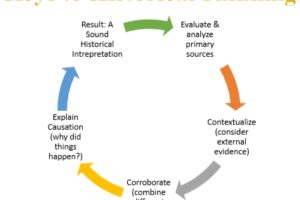
Question → Sources → Context → Comparison → Interpretation → Argument
Then, when new evidence appears:
Reconsider the argument.
History is not weakened when interpretations change in response to better evidence.
That is how evidence-based inquiry is supposed to work.
The Five Questions to Remember
If you remember nothing else from this guide, ask these five questions whenever you encounter historical evidence:
1. Who made this?
Identify the creator and their relationship to the event.
2. Why was it made?
Understand audience and purpose.
3. What was happening at the time?
Reconstruct historical context.
4. What do other sources say?
Corroborate.
5. What can this source actually prove?
Keep your conclusions proportional to the evidence.
These five questions will take you surprisingly far.
Frequently Asked Questions
What does it mean to read like a historian?
Reading like a historian means treating documents as evidence rather than simply accepting their content. Historians investigate authorship, context, audience, purpose, language, perspective, and relationships among multiple sources before reaching conclusions. Stanford’s historical-reading framework particularly emphasizes sourcing, contextualization, corroboration, and close reading.
What are sourcing, contextualization, and corroboration?
Sourcing investigates who created a source and under what circumstances.
Contextualization places it within its historical time and place.
Corroboration compares it with other evidence.
These practices are central components of Stanford’s research on disciplinary historical reading.
What is close reading in history?
Close reading means examining the language, claims, details, assumptions, tone, and structure of a source carefully rather than extracting only its apparent main idea. It works alongside sourcing, contextualization, and corroboration.
How does the Library of Congress recommend analyzing primary sources?
The Library of Congress uses an Observe, Reflect, Question framework. Researchers identify details, develop and test interpretations, generate questions, and use those questions to guide further investigation.
How can you tell whether a primary source is reliable?
Do not ask only whether the whole source is reliable. Ask whether it is reliable for the specific claim you want to establish. Investigate the creator’s access to information, purpose, audience, perspective, context, internal consistency, and corroboration from independent evidence.
Can a biased source still be useful?
Yes. Perspective does not automatically destroy historical value. A highly partisan source may be weak evidence for some factual claims but excellent evidence for studying political beliefs, prejudice, propaganda, rhetoric, or attempts to influence an audience. The National Archives explicitly encourages readers to analyze how background, beliefs, and experience shape source perspective.
Why do historians compare multiple sources?
Because every source offers limited evidence. Comparing independent sources helps researchers test claims, discover disagreements, identify missing perspectives, and construct stronger interpretations. Corroboration is consequently a major historical-reading practice.
What should you do when two primary sources contradict each other?
Do not automatically discard one. Investigate why they disagree. Consider differences in time, location, access to information, audience, purpose, perspective, memory, terminology, and possible incentives. The disagreement may itself provide important historical evidence.
Is an eyewitness always the best source?
No. Eyewitnesses can possess valuable firsthand knowledge but also limited visibility, incomplete information, emotional involvement, faulty memory, or personal interests. Eyewitness testimony should be contextualized and compared with additional evidence.
What is the biggest mistake people make with primary sources?
One of the biggest mistakes is treating a source’s statement as equivalent to a historical fact.
The source says X proves first that someone recorded or communicated X.
Whether X actually happened may require substantially more evidence.
Final Takeaway: Read the Source, Then Read Around It
Reading primary sources like a historian means resisting the temptation to ask only:
What does this document say?
Instead ask:
Who created it?
Why?
For whom?
Under what circumstances?
What could the creator know?
What assumptions shaped the source?
What does it leave out?
What do other sources say?
What conclusion does the evidence genuinely support?
The Library of Congress encourages readers to move from observation to reflection and questioning. The National Archives emphasizes source type, perspective, context, audience, purpose, and further evidence. Stanford’s historical-reading research emphasizes sourcing, contextualization, close reading, and corroboration. Together, these methods point toward the same principle: historical understanding is built by questioning evidence rather than merely consuming information.
Primary sources bring us close to earlier lives, but closeness is not the same as certainty.
A letter gives us one person’s words.
A photograph gives us one frame.
A newspaper gives us one presentation of events.
A government record gives us one institution’s categories and procedures.
A memoir gives us remembered experience.
Each source opens a window onto the past.
But every window has a frame.
To read like a historian is to examine both the view and the frame.
Research Foundation
This guide draws primarily on historical-reading and primary-source analysis frameworks from the Library of Congress, the U.S. National Archives and Records Administration, Stanford’s historical-thinking research, the American Historical Association, and the Historical Thinking Project. The approaches differ somewhat in terminology but consistently emphasize contextual interpretation, source perspective, questioning, comparison, and evidence-based argument.



Leave a Reply