
Short Answer
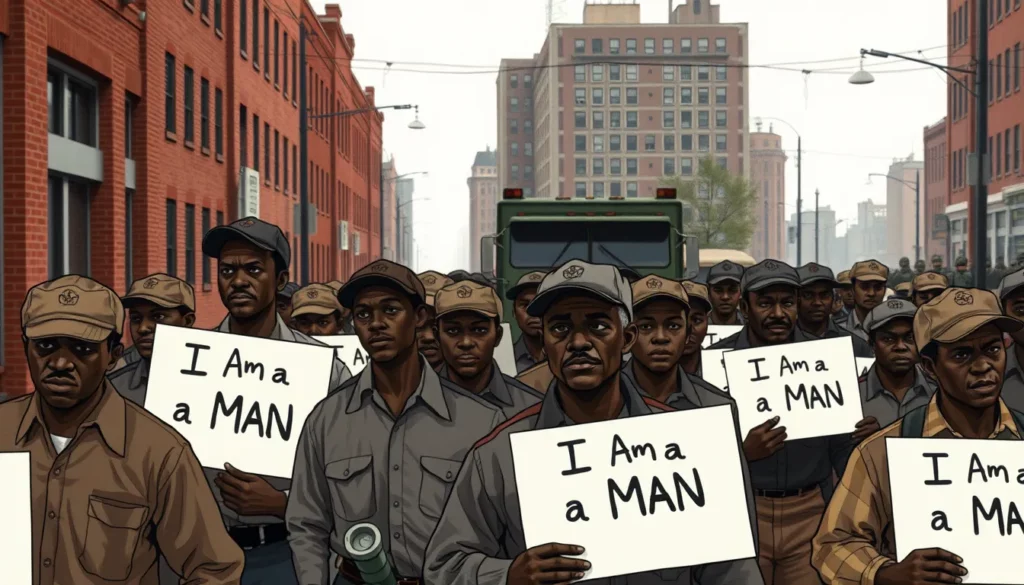
In the first months of 1968, Memphis, Tennessee, was a city on edge. The winter rains had turned the streets into muddy rivers, and the stench of uncollected garbage hung over the neighborhoods where the city’s black sanitation workers lived. These men, many of them veterans of World War II and Korea, worked ten-hour days hauling tubs of filth for wages so low they qualified for food stamps. On February 1, two of them, Echol Cole and Robert Walker, were crushed to death when a malfunctioning compactor triggered on a truck they had been ordered to ride in because of the rain. Eleven days later, 1,300 black sanitation workers walked off the job, carrying placards that read “I Am a Man.” They demanded union recognition, safer equipment, and a living wage. The city’s young mayor, Henry Loeb, refused to budge. Into this standoff stepped Martin Luther King Jr., who saw the strike as a test of his Poor People’s Campaign and the nation’s commitment to economic justice. What followed would end with King’s assassination and a legacy that still shapes America’s struggle for racial and economic equality.
What Happened?
On February 1, 1968, Memphis sanitation workers Echol Cole and Robert Walker were crushed to death by a malfunctioning garbage truck. The city had ordered workers to ride in the back of the truck during heavy rain, a practice that violated safety codes. The deaths were the latest in a long pattern of neglect. On February 12, more than 1,100 of the city’s 1,300 black sanitation workers began a strike, organized by T. O. Jones and supported by the American Federation of State, County, and Municipal Employees (AFSCME). They demanded recognition of their union, better safety standards, and a decent wage. Mayor Henry Loeb, who had taken office in January, rejected their demands outright.
- February 11: More than 700 workers attend a union meeting and unanimously vote to strike.
- February 22: The City Council, pressured by a sit-in of workers and supporters, votes to recognize the union and recommends a wage increase. Mayor Loeb rejects the vote, insisting only he has the authority.
- February 23: Police use mace and tear gas against nonviolent demonstrators marching to City Hall. The black community is galvanized.
- February 24: 150 local ministers form Community on the Move for Equality (COME), led by Rev. James Lawson, committing to nonviolent civil disobedience.
- March 18: Martin Luther King Jr. addresses a crowd of about 25,000 at Mason Temple, the largest indoor gathering of the civil rights movement. He pledges to return to lead a protest.
- March 28: King leads a march that turns violent. Youths loot downtown shops, and a 16-year-old is killed by police. Loeb calls for martial law and 4,000 National Guard troops. King is whisked away.
- April 3: King returns to Memphis and delivers his “I’ve Been to the Mountaintop” speech at Mason Temple.
- April 4: King is assassinated on the balcony of the Lorraine Motel.
The assassination sparked national mourning and a wave of riots in over 100 cities. President Lyndon Johnson declared a national day of mourning. In Memphis, the strike continued until April 16, when the city agreed to recognize the union and raise wages. The settlement was a victory for the workers, but it came at an immense cost.
How It Was Seen at the Time
Contemporaries saw the Memphis strike as far more than a labor dispute. For the city’s black community, it was a fight for dignity. The placards reading “I Am a Man” captured the essence of the struggle: a demand for basic respect and humanity. For Mayor Loeb, the strike was illegal and a challenge to his authority. He insisted that the city could not bargain with a union that had broken the law. For Martin Luther King Jr., Memphis was a proving ground for his Poor People’s Campaign, a chance to unite labor and civil rights around economic justice. The national press often framed the events as a racial conflict, with headlines emphasizing violence and disorder. But many observers, including King, saw a deeper moral crisis.
“You are demonstrating that we can stick together. You are demonstrating that we are all tied in a single garment of destiny, and that if one black person suffers, if one black person is down, we are all down.” — Martin Luther King Jr., March 18, 1968
“We’ve got to give ourselves to this struggle until the end. Nothing would be more tragic than to stop at this point in Memphis. We’ve got to see it through.” — Martin Luther King Jr., April 3, 1968
Historical Snapshot
| Aspect | Detail |
|---|---|
| Date | February 12 – April 16, 1968 (strike); April 4, 1968 (assassination) |
| Place | Memphis, Tennessee |
| People | Echol Cole, Robert Walker, T. O. Jones, Henry Loeb, Martin Luther King Jr., James Lawson, 1,300 sanitation workers |
| What Happened | A strike by black sanitation workers over unsafe conditions and low pay; King’s involvement; his assassination. |
| Why It Mattered | Exposed economic injustice; marked a shift in the civil rights movement; catalyzed national mourning and legislation. |
Contemporary Newspaper Coverage
The Memphis Commercial Appeal and the Memphis Press-Scimitar covered the strike daily. Early headlines focused on the disruption to city services, with one Commercial Appeal headline on February 13, 1968, reading “Sanitation Workers Strike; City Hall Is Picketed.” The tone was often critical of the strikers. National outlets like The New York Times sent reporters. On March 29, 1968, The New York Times reported: “A march by several thousand Negroes in support of striking sanitation workers erupted into violence today…” The coverage often highlighted the racial tensions and the threat of riots. But some reporters, like those from the black press, including the Memphis World and the Chicago Defender, framed the strike as a righteous struggle for human rights. The Commercial Appeal’s editorial page questioned the legality of the strike, though it stopped short of endorsing the mayor’s hard line.
“Dr. King told the crowd, ‘We are all tied in a single garment of destiny.’” — The New York Times, March 19, 1968
Different Perspectives
Sanitation Workers
The workers saw themselves as fighting for their very lives. “I Am a Man” was not just a slogan; it was a demand for recognition. Many had served in the military and resented being treated as less than men. They wanted union recognition, safety, and a wage that could support a family.
Mayor Loeb and City Government
Loeb, a wealthy businessman elected in 1967, viewed the strike as illegal and a threat to his authority. He refused to recognize the union, insisting that only he had the power to do so. He called for martial law during the March 28 violence and blamed outside agitators for the unrest.
Black Community and Clergy
The black community rallied behind the workers. Rev. James Lawson, a veteran of the Nashville sit-ins, formed COME to organize support. Black ministers preached about the strike from their pulpits, and students marched alongside workers. For many, the strike was a moral issue, not just an economic one.
National Civil Rights Leaders
King and the SCLC saw Memphis as a test case for the Poor People’s Campaign. King believed that the civil rights movement had to address poverty and economic exploitation. Other leaders, like Roy Wilkins of the NAACP and Bayard Rustin, also came to support the strikers. But some, like King’s aides, worried about the rising influence of Black Power advocates like the Invaders, who they believed were inciting violence.
What People Feared
At the time, many feared that the strike would collapse and the workers would be forced back without concessions. Others feared violence. The March 28 march turned into a riot, and people worried that the city would explode. Mayor Loeb feared a breakdown of law and order and called in the National Guard. King feared that the nonviolent movement was losing its moral authority.
“Like anybody, I would like to live a long life. Longevity has its place. But I’m not concerned about that now. I just want to do God’s will.” — Martin Luther King Jr., April 3, 1968
There were also fears of communist infiltration, a common trope of the era, though no evidence supported it.
How Historians See It Today
Historians now view the Memphis sanitation workers’ strike as a pivotal moment in the civil rights movement. At the time, it was often seen as a local labor dispute complicated by racial tensions. But scholars like Michael Honey, in his book Going Down Jericho Road, argue that the strike revealed the deep connections between race and class in America. The assassination of King in Memphis marked a turning point: it signaled the end of the nonviolent, integrationist phase of the movement and the rise of the Black Power era. Modern historians also emphasize the agency of the sanitation workers themselves, who organized and sustained the strike for over two months. They note that the strike was not just about wages but about dignity and respect. The “I Am a Man” signs have become iconic symbols of the struggle for human rights. Contemporary interpretations often focused on King’s role, but today historians highlight the leadership of local figures like T. O. Jones and James Lawson.
The Memphis sanitation workers’ strike of 1968 was a moment when the struggle for civil rights and economic justice converged. The primary sources—the placards, the speeches, the newspaper headlines, the eyewitness testimonies—show a city and a nation at a crossroads. The workers’ demand for dignity, summed up in the simple phrase “I Am a Man,” resonated far beyond Memphis. Martin Luther King Jr.’s assassination there cast a long shadow, but it also galvanized the Poor People’s Campaign and inspired future generations of activists. Today, the strike is remembered not only as a tragedy but as a testament to the power of collective action. The sources remind us that the fight for justice is never over, and that ordinary people, when united, can force a nation to confront its conscience.
FAQ
What caused the Memphis sanitation workers' strike of 1968?
The immediate cause was the February 1, 1968, deaths of Echol Cole and Robert Walker, who were crushed by a malfunctioning garbage truck. But the strike was also the culmination of years of poor pay, unsafe working conditions, and racial discrimination against black city employees.
What role did Martin Luther King Jr. play in the strike?
King came to Memphis to support the strikers and to highlight the connection between civil rights and economic justice. He led a march on March 28 that turned violent, and he returned on April 3 to deliver his 'I've Been to the Mountaintop' speech. He was assassinated the next day.
How did the strike end?
The strike ended on April 16, 1968, when the city agreed to recognize the union and raise wages. However, the victory was overshadowed by King's assassination and the national mourning that followed.
What was the significance of the 'I Am a Man' slogan?
The slogan expressed the workers' demand for basic human dignity and respect. It became a powerful symbol of the struggle for civil rights and economic justice.











Leave a Reply