
Short Answer
Two eyewitnesses describe the same protest.
One says police attacked without warning.
The other says demonstrators began throwing objects first.
A military commander reports that an operation succeeded.
A soldier’s diary describes confusion and retreat.
A newspaper announces that thousands attended a political rally.
Police estimate several hundred.
An official memoir claims its author opposed a controversial decision from the beginning.
Private letters written at the time suggest otherwise.
Which account should a historian believe?
The answer is rarely:
whichever source sounds most convincing.
Historians work with a past preserved unevenly through letters, diaries, photographs, newspapers, government files, oral histories, court testimony, statistics, artifacts, and many other kinds of evidence. Those sources frequently disagree.
Contradiction is therefore not an exceptional problem in history.
It is part of the normal work of historical research.
The U.S. National Archives emphasizes that primary sources reflect the personal, social, political, and economic perspectives of the people who created them and that researchers must confront contradictions and limitations when judging reliability.
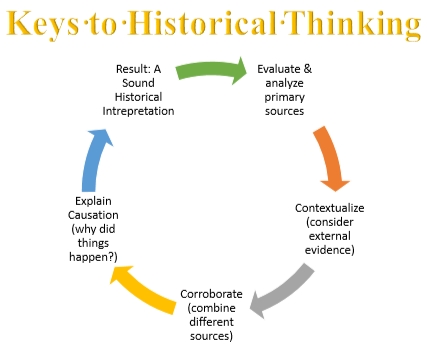
Stanford’s historical-thinking framework identifies sourcing, contextualization, corroboration, and close reading as central techniques for evaluating historical evidence.
The Library of Congress similarly defines corroboration as comparing important details across multiple sources to identify points of agreement and disagreement.
The goal is not to make disagreement disappear.
It is to determine:
Why do the sources disagree?
Which parts of each account are well supported?
What could each source realistically know?
What independent evidence can test the competing claims?
And how certain can we reasonably be?
Conflicting Accounts Are Normal in History
Historical events are experienced from different positions.
A battle looks different to:
a general at headquarters,
a soldier in a trench,
a doctor in a field hospital,
and a civilian watching from several miles away.
A strike looks different to:
workers,
factory owners,
police,
journalists,
and nearby residents.
Different accounts do not automatically mean that someone lied.
People can observe different parts of an event.
They may possess different information.
They may use words differently.
They may write at different times.
They may remember differently.
They may also have different reasons for describing what happened.
The National Archives describes historical interpretation as necessarily tentative because surviving sources reflect the perspectives of participants while historians themselves must decide how those incomplete and sometimes contradictory materials fit together.
The historian’s job is therefore not simply to choose a winner.
It is to investigate the disagreement.
Historians Do Not Take a Vote
Imagine five witnesses.
Four say a demonstration began peacefully.
One says violence began almost immediately.
A simple approach might conclude:
Four against one. The demonstration must have begun peacefully.
Historians do not normally evaluate evidence by majority vote.
The lone witness might have been standing beside the location where the first confrontation occurred.
The other four might have been several blocks away.
Or the opposite may be true.
Perhaps the lone witness had a political motive to exaggerate violence.
Perhaps the four witnesses copied one another’s stories.
The important questions are:
How did each source know what it claimed to know?
and:
Are the accounts genuinely independent?
Numbers matter only after the relationships among the sources are understood.
Start by Defining the Exact Disagreement
Before deciding which account is stronger, identify precisely what the sources disagree about.
This sounds obvious, but many apparent contradictions disappear once the claim is defined carefully.
Suppose two witnesses say:
Witness A
The troops retreated at sunset.
Witness B
The troops remained in position until darkness.
Are those statements actually incompatible?
Perhaps sunset occurred at 7:30 p.m. and darkness at approximately 8 p.m.
One witness may use “retreated at sunset” loosely.
Another may mean that some troops remained until full darkness.
Instead of immediately labeling the sources contradictory, break their claims into components:
- Which troops?
- Which location?
- Approximately what time?
- What does “retreat” mean?
- What does “remained in position” mean?
Historical disagreement must first be specified before it can be evaluated.
Step 1: Source Every Account
The first major question is:
Where did this account come from?
Stanford’s historical-reading framework calls this sourcing—examining authorship and the circumstances of a document’s creation before accepting its claims.
For every conflicting source, record:
- creator,
- date,
- place,
- source type,
- intended audience,
- purpose.
Suppose three accounts describe an uprising.
Source A
A government report written by the local governor.
Source B
A private letter from a participant in the uprising.
Source C
A newspaper article published 500 miles away.
All three may contain useful evidence.
But they stand in very different relationships to the event.
Step 2: Ask Who Was in a Position to Know
One of the most useful historical questions is:
How could this person know what they claim to know?
Suppose a soldier writes:
Our entire army is retreating.
Was the soldier able to see the entire army?
Probably not.
The soldier may have directly observed:
My unit is retreating.
The broader statement may be an inference.
Now imagine a headquarters report describing movements across several units.
It may have broader information but less direct contact with battlefield conditions.
Neither source automatically wins.
They possess different kinds of access.
Historians evaluate access claim by claim.
Proximity Matters
Ask where the source creator was.
For eyewitness testimony:
How close were they?
What could they see?
Was their view obstructed?
How long were they present?
A person standing beside an event may know more about local details than someone farther away.
But proximity alone is not enough.
A person in the middle of chaos may have worse overall information than an observer positioned somewhere with a wider view.
Historical proximity is therefore not simply:
closer = better.
It is:
Was this source well positioned to know this particular thing?
Institutional Position Matters Too
A government minister may not witness a battle personally but could receive reports from across an entire front.
A local soldier may know exactly what happened in one trench but nothing about events twenty miles away.
Similarly:
a police officer may have access to arrest records,
a journalist may have spoken to multiple witnesses,
a hospital administrator may know casualty figures,
and a participant may know what happened within a crowd.
Historical authority is claim-specific.
Different sources may be best for different questions.
Step 3: Establish When Each Account Was Created
Timing matters enormously.
Consider two sources.
Source A
A diary entry written the evening of the event.
Source B
A memoir written forty years later.
The diary has advantages.
It is close in time.
It may preserve immediate impressions before later narratives developed.
But it also has limitations.
The writer may not yet know what happened elsewhere.
The memoir has the opposite problem.
The writer knows how events turned out and may have learned much more.
But memory, hindsight, reputation, and later interpretation may shape the account.
Neither is automatically superior.
They preserve different layers of evidence.
Contemporary Evidence Can Contain Immediate Errors
Suppose a newspaper reports on the morning after a battle:
ENEMY ARMY DESTROYED
Three days later it reports:
ENEMY WITHDRAWS IN GOOD ORDER
The first report is closer to the event.
That does not make it more accurate.
Early information is often incomplete.
Historians therefore ask:
What could realistically have been known when this source was created?
A contemporary source may be especially useful for reconstructing what people believed at that moment, even when later evidence disproves its factual claims.
Later Accounts Have Hindsight
A politician writing thirty years after a revolution knows:
which groups succeeded,
which leaders became famous,
which events historians now consider important.
That knowledge can reshape a narrative.
Events that appeared minor at the time may become pivotal in memory.
Uncertainty may disappear.
The American Historical Association emphasizes context, complexity, and contingency as central aspects of historical thinking precisely because people in the past did not know how events would eventually turn out.
Whenever later testimony conflicts with contemporary evidence, hindsight deserves careful consideration.
Step 4: Identify Audience
People describe events differently depending on who they expect to read or hear them.
Compare a commander’s:
private diary
with:
official report
with:
public speech.
The private diary might say:
The operation was disastrous.
The official report might say:
Our forces completed an orderly withdrawal.
The public speech might say:
Our troops displayed extraordinary courage.
These accounts may appear contradictory.
But they were created for different purposes.
The National Archives explicitly recommends identifying intended audience when assessing primary-source perspective because audience can shape what information a creator emphasizes or omits.
Step 5: Identify Purpose and Incentives
Ask:
What did this person want to accomplish by producing this account?
Possible purposes include:
- informing,
- persuading,
- defending,
- accusing,
- reassuring,
- justifying,
- recording privately,
- avoiding punishment,
- claiming credit.
Suppose a military commander writes an official explanation after losing a battle.
The document may contain valuable operational information.
But the commander also has an incentive to defend their decisions.
A soldier writing privately may have fewer reputational concerns.
But the soldier may possess far less information about the broader operation.
Once again:
no source automatically wins.
Purpose changes how evidence should be weighed.
Motive Does Not Automatically Disqualify a Source
A common mistake is reasoning:
This person had a motive, therefore the account is false.
That is too crude.
Nearly every historical source exists for a reason.
Instead ask:
Which parts of the account could this motive plausibly influence?
A general defending a reputation might minimize strategic mistakes.
That does not mean the general necessarily invented the weather, location, date, or identities of officers present.
Source criticism works best when applied to specific claims, not entire documents labeled trustworthy or untrustworthy.
Step 6: Separate Observation From Hearsay
Historical accounts routinely mix several kinds of information.
Consider:
I saw several buildings burning. We heard that rebels had set fire to the entire district. Everyone says hundreds are dead.
There are at least three evidentiary levels here.
Direct observation
Several buildings were burning.
Hearsay
The rebels supposedly started the fires.
Rumor
Hundreds were reportedly dead.
If another witness disputes the death toll, the disagreement does not undermine the writer’s direct observation of burning buildings.
Historians break accounts apart instead of treating every sentence as one indivisible package.
Step 7: Compare Specific Details
This is corroboration.
The Library of Congress defines corroborating as examining important details across multiple sources to identify agreement and disagreement.
Create a comparison table.
| Question | Source A | Source B | Source C |
|---|---|---|---|
| Time | 8 p.m. | after sunset | 8:15 p.m. |
| Crowd size | 5,000 | 2,000 | unknown |
| Violence began | after police advance | before police advance | could not see |
| Location | central square | north entrance | east street |
This often reveals something important:
Sources rarely disagree about everything.
Perhaps all agree on:
- approximate time,
- general location,
- existence of a crowd.
They disagree only about:
- crowd size,
- who initiated violence.
Now the historian knows which questions require additional evidence.
Agreement Can Establish a Baseline
Suppose six independent sources disagree about who started a confrontation.
But all six agree that:
a crowd had assembled by 7 p.m.,
police arrived around 7:30,
and violence occurred shortly afterward.
Those points of convergence create a relatively strong baseline.
The unresolved question becomes narrower:
What happened between police arrival and the first violence?
Corroboration therefore does more than choose between sources.
It helps map:
what is relatively secure
versus
what remains disputed.
Step 8: Determine Whether Sources Are Independent
This is one of the most overlooked steps.
Imagine seven newspapers all report:
10,000 people attended the rally.
That appears to be seven corroborating sources.
But suppose all seven copied a single wire-service dispatch.
You actually have one underlying estimate repeated seven times.
Similarly, three memoirs might repeat a famous anecdote originally published decades earlier.
Apparent agreement is only powerful when the sources have independent access to the evidence.
Ask:
Could Source B have copied Source A?
Could both depend on Source C?
Did these witnesses discuss the event together?
Was there a common official briefing?
The information genealogy matters.
Independent Sources Deserve Special Attention
Imagine:
a private diary,
an independently produced newspaper report,
and an administrative record
all mention the same event without evidence that they influenced one another.
Their agreement is stronger than three newspapers reproducing identical language.
This does not make the shared claim certain.
But independence generally strengthens corroboration.
Step 9: Look for Different Types of Evidence
Conflicts between written accounts can sometimes be tested with evidence neither writer controlled.
Suppose two people dispute the size of a crowd.
Possible additional evidence includes:
photographs,
maps,
venue capacity,
transportation records,
ticket sales.
Suppose witnesses dispute when a ship sank.
Researchers might use:
radio transmissions,
ship logs,
weather data,
survivor accounts,
physical evidence.
The Library of Congress encourages researchers to use multiple types of primary sources because different formats can supply different perspectives and help corroborate information.
The strongest evidence network is often cross-format, not merely many versions of the same kind of source.
Documentary Evidence Can Correct Memory
Imagine a witness recalls:
The meeting happened on Tuesday.
A dated agenda, telegram, and newspaper report all place it on Wednesday.
The witness might still accurately remember:
who attended,
what was discussed,
or how people reacted.
But the documentary evidence makes Wednesday much more likely.
Historical evaluation does not require rejecting the entire witness.
It means assigning different confidence to different parts of the testimony.
Physical Evidence Can Reframe Written Testimony
Written testimony may also be tested against:
archaeology,
architecture,
ballistics,
forensic evidence,
environmental records,
and other material traces.
Historical investigation is not limited to documents.
The National Archives’ preserved congressional investigation of the Kennedy assassination, for example, describes investigators combining testimony with specialized evidence from pathology, ballistics, handwriting, photography, acoustics, and other fields rather than relying on eyewitness claims alone.
The general methodological lesson is useful even far outside forensic history:
Use whatever independent evidence can legitimately test the claim.
Step 10: Evaluate Internal Consistency
Read each account carefully.
Does the source contradict itself?
Does chronology make sense?
Do claims change within the document?
Suppose a memoir says:
I never spoke to the minister that week.
Thirty pages later:
When I met the minister on Thursday…
That contradiction deserves investigation.
But internal consistency must also be used carefully.
A perfectly consistent story can still be false.
People can rehearse inaccurate stories.
An inconsistent account can contain many accurate observations.
Internal consistency is one factor, not a verdict.
Specificity Can Help—but It Can Also Mislead
Detailed accounts often feel more credible.
A witness remembers:
the exact time,
specific words,
clothing,
weather,
street names.
Detail can sometimes indicate strong memory or access.
But vividness is not proof.
Later retelling can add precision that did not exist initially.
Historians therefore ask:
Can these specific details be independently verified?
A precise but unsupported claim is not automatically stronger than a cautious one.
Step 11: Test Claims Against Historical Context
Context can help determine whether an account is plausible.
Suppose a supposed 1850 letter mentions a technology not introduced until 1870.
Something is wrong.
Perhaps:
the date was cataloged incorrectly,
the letter is a later copy,
or the source is not authentic.
Less dramatically, context can test social and institutional claims.
If someone reports crossing a border freely at a moment when official records show it was completely sealed, the discrepancy needs explanation.
Context does not replace direct evidence.
It helps identify claims requiring further investigation.
But Do Not Reject Surprising Evidence Merely Because It Is Surprising
Historical evidence sometimes overturns previous assumptions.
Do not reason:
This contradicts what historians believed, therefore the source must be wrong.
Instead test it.
Who created it?
Is it authentic?
Do additional records support it?
Could previous scholarship have missed something?
Good historical reasoning allows evidence to challenge existing interpretations.
The AHA describes historical thinking as requiring corroboration, assessment of competing views, and willingness to revise conclusions rather than clinging to certainty.
Step 12: Distinguish Facts From Interpretations
Consider two reports of a march.
Source A
Five thousand patriots marched peacefully through the capital.
Source B
A threatening mob of roughly five thousand extremists occupied the city’s main avenue.
The sources appear dramatically opposed.
But look closer.
They may agree that:
approximately 5,000 people marched,
through the capital,
along the main avenue.
Their disagreement concerns interpretation:
patriots versus extremists
and
peaceful march versus threatening occupation.
Historians should separate:
shared observable claims
from
political characterization.
This often turns apparent factual contradiction into evidence about competing perspectives.
Loaded Language Is Evidence
Words such as:
mob
freedom fighters
terrorists
patriots
rebels
are interpretive labels.
If two sources use different labels for the same group, historians should not automatically choose one.
Instead ask:
What political position does the vocabulary reveal?
The disagreement in language may itself be historically significant.
Step 13: Consider Differences in Definition
Sometimes sources appear to disagree because they count differently.
Imagine casualty reports:
Source A
1,200 casualties
Source B
750 casualties
Before assuming one is wrong, ask:
Does “casualties” mean:
dead only?
dead and wounded?
dead, wounded, and missing?
Does one count civilians?
Does one count deaths occurring later?
Definitions matter.
Historical statistics often depend on categories.
Before comparing numbers, make sure the sources are actually measuring the same thing.
Crowd Estimates Are Especially Difficult
Historical reports often provide dramatically different crowd sizes.
Police say:
20,000.
Organizers say:
100,000.
A newspaper says:
50,000.
Do not average them and declare:
56,667 people attended.
Instead investigate:
- physical area,
- crowd density,
- aerial photographs,
- transportation data,
- organizer methodology,
- police methodology.
The numbers may reflect both genuine estimation difficulty and political incentive.
Mathematical precision does not compensate for weak underlying evidence.
Step 14: Examine Silence and Omission
Suppose one military report describes a successful operation but never mentions heavy casualties documented elsewhere.
The silence may be important.
But absence must be treated carefully.
Perhaps casualty information was handled in a separate report.
Perhaps the author did not yet know.
Perhaps the document had a different administrative purpose.
A missing statement is not automatically proof of concealment.
Instead ask:
Would we reasonably expect this source to mention the information if the creator knew it?
Silence becomes stronger evidence when the omission itself is difficult to explain.
Step 15: Ask Whose Accounts Are Missing
Conflicting surviving accounts may still share a major limitation.
Imagine investigating a colonial conflict through:
government reports,
military correspondence,
settler newspapers.
These sources may disagree vigorously with one another.
Yet all may exclude the perspectives of the colonized population.
The Library of Congress encourages researchers confronted by one perspective to seek the other side—or multiple other sides—rather than assuming the surviving documentary debate represents the full range of experience.
The question is not only:
Which surviving account is correct?
It is also:
Whose account did the archive fail to preserve?
Conflicting Sources May Both Be Partly Right
This is one of the most important possibilities.
Imagine two witnesses.
Witness A
The square was peaceful at 2 p.m.
Witness B
The square was violent at 4 p.m.
No contradiction exists if conditions changed.
Or:
Witness A
Police attacked the crowd.
Witness B
Demonstrators attacked police.
Perhaps different confrontations occurred at different ends of the square.
Historical events develop over time and space.
Many contradictions disappear once chronology and geography are reconstructed more precisely.
Conflicting Accounts Can Describe Different Scales
A factory manager says:
Production increased.
A worker says:
Our department produced less.
Both could be correct.
Overall factory production may rise while one department declines.
A general says:
Our forces advanced.
A soldier says:
We retreated.
The army might advance overall while one unit falls back.
Always identify the scale:
individual,
unit,
district,
city,
nation.
Sources at different scales can appear contradictory while describing compatible realities.
Sometimes One Account Really Is Better Supported
Historical nuance does not mean refusing ever to decide.
Sometimes evidence strongly favors one account.
Suppose:
Source A
A memoir written forty years later claims an official attended a secret meeting.
Other evidence
A dated diary places the official hundreds of miles away.
Travel records confirm the journey.
Several independent letters mention the official’s absence.
No contemporary evidence places them at the meeting.
In that case, historians can reasonably conclude that the memoir is probably mistaken about the person’s presence.
Historical caution does not require pretending every account deserves equal weight.
Minority Accounts Can Sometimes Be Correct
The reverse also happens.
Imagine ten official reports repeating that no civilians were killed.
One private medical record lists civilian casualties.
Later hospital registers, photographs, and burial records confirm those deaths.
The minority source was more accurate.
This illustrates why historians do not decide truth by counting documents.
A widely repeated account can originate from a single incorrect official statement.
Authority Is Not the Same as Accuracy
An official document may appear more credible because it looks formal.
A handwritten diary may appear less authoritative.
But bureaucratic status does not guarantee truth.
Official reports can contain:
errors,
self-protection,
propaganda,
incomplete information.
Private accounts can also contain errors and bias.
The National Archives emphasizes that primary sources of all kinds reflect the viewpoints and limitations of their creators.
Judge the evidence, not the stationery.
A Worked Historical Example: Conflicting Titanic Testimony
The sinking of the Titanic provides an excellent illustration of how conflicting historical accounts survive.
National Archives records include testimony produced in legal proceedings after the disaster.
White Star Line chairman J. Bruce Ismay repeatedly maintained that navigation decisions belonged to Captain Edward Smith and characterized his own role aboard the ship in limited terms.
Other survivors supplied evidence that complicated that account.
Elizabeth Lines reported overhearing a conversation between Smith and Ismay concerning the ship’s progress and arrival time, while Emily Ryerson’s testimony also conflicted with parts of Ismay’s version. Survivor depositions additionally differed in their descriptions of events surrounding the sinking.
What should the historian do?
Not simply say:
Ismay lied
or:
the passengers were correct.
Instead investigate:
When was each testimony recorded?
Where was each witness?
What exactly did they hear or observe?
Did they have reasons to shape their testimony?
What independent ship records exist?
What do other survivors report?
Which particular claims can each source support?
The disagreement itself directs the research.
Why Conflicting Eyewitness Testimony Is Especially Common
Chaotic events create fragmented observation.
Battles,
shipwrecks,
riots,
assassinations,
natural disasters,
mass demonstrations
unfold rapidly.
A National Archives educational discussion of primary sources specifically notes how eyewitness accounts and other historical records can contain contradictions, requiring users to evaluate the extent to which individual sources are reliable.
The lesson is not:
eyewitnesses are useless.
It is:
eyewitnesses are situated.
Every witness sees from somewhere.
Historians Build a Hierarchy of Claims, Not a Hierarchy of People
It is tempting to decide:
Source A is reliable.
Source B is unreliable.
That approach is often too broad.
A better method is:
Source A
Strong evidence about the writer’s own unit.
Weak evidence about the entire army.
Source B
Strong evidence about official policy.
Weak evidence about how ordinary civilians experienced that policy.
Source C
Strong evidence about public reporting.
Uncertain evidence about whether the underlying rumor was true.
This claim-by-claim approach is much more precise.
Create an Evidence Matrix
For complex research, build a simple matrix.
| Claim | Source A | Source B | Source C | Other Evidence | Confidence |
|---|---|---|---|---|---|
| Meeting occurred | Yes | Yes | Yes | Agenda | High |
| Smith attended | Yes | No | Unknown | Travel record says absent | Low |
| Violence began at 3 p.m. | 3:00 | 3:20 | approx. 3 | Newspaper 3:10 | Moderate |
| Crowd exceeded 10,000 | 20,000 | 8,000 | 12,000 | Photo estimate | Moderate |
This prevents one dramatic document from dominating the investigation.
It also makes uncertainty visible.
Rank Confidence, Not Sources
A useful system is:
High confidence
Several independent sources or strong physical/documentary evidence agree.
Moderate confidence
Evidence points in one direction but remains incomplete or somewhat contradictory.
Low confidence
The claim depends mainly on one disputed account.
Unknown
The surviving evidence does not allow a defensible conclusion.
The AHA has recently emphasized that historical thinking requires comfort with provisional conclusions rather than creating false certainty where the record remains incomplete.
“Unknown” is a legitimate historical answer.
Historians Should Be Willing to Leave Questions Unresolved
Sometimes the evidence never produces a clear winner.
Perhaps:
all eyewitnesses had poor visibility,
key records disappeared,
surviving sources depend on rumors,
and physical evidence cannot resolve the dispute.
The responsible conclusion may be:
The surviving evidence does not establish which account is correct.
That is not failure.
The AHA’s guidance on historical thinking emphasizes that historians work with partial evidence and must remain open to revising conclusions when new evidence appears.
Certainty should never exceed the evidence.
How Historians Write About Uncertain Evidence
Compare these sentences.
Too certain
The troops opened fire at 9:10 a.m.
Better when evidence conflicts
Several witnesses placed the first shots shortly after 9 a.m., although surviving accounts disagree about the precise time.
Or:
Police reports attributed the first violence to demonstrators, while participant testimony blamed officers; the surviving evidence does not clearly establish who initiated the confrontation.
Good historical writing tells readers not only the conclusion but also the quality of the evidence behind it.
Useful Language for Conflicting Accounts
Historical writing often uses phrases such as:
According to…
The surviving evidence suggests…
Contemporary accounts disagree…
Several independent sources indicate…
The claim is contradicted by…
Later recollections differ from contemporary records…
The evidence remains inconclusive…
It is probable that…
It cannot be established with certainty…
These are not evasions.
They communicate evidentiary confidence.
Do Not Create False Balance
Another mistake is assuming that because two accounts exist, both deserve equal weight.
Suppose hundreds of independent records, physical evidence, photographs, and contemporary documents support one conclusion.
A single unsupported memoir written decades later claims the opposite.
Writing:
Historians are divided because there are two accounts
would misrepresent the evidence.
Fair historical analysis means examining competing claims.
It does not require pretending all claims have equivalent support.
But Do Not Dismiss Minority Evidence Just Because It Is Inconvenient
The opposite mistake is equally serious.
If a source challenges the dominant interpretation, investigate it.
Ask:
Is it authentic?
Did the creator have unusual access?
Can the claim be corroborated?
Does it expose a blind spot in official records?
The purpose of corroboration is not to defend consensus.
It is to test evidence.
Corroboration Is More Than Finding Agreement
Beginning researchers often think corroboration means:
find another source that says the same thing.
That is only part of it.
The Library of Congress historical-thinking materials define corroboration through comparison: identifying both agreement and disagreement among sources.
Real corroboration asks:
Where do these accounts overlap?
Where do they differ?
Why?
Are the sources independent?
Which additional evidence could test the disagreement?
Contradiction is therefore part of corroboration, not its opposite.
A Practical Step-by-Step Method
When two or more historical accounts conflict, use this workflow.
1. Write Down the Exact Claims
Avoid vague summaries.
Identify precisely what each source says.
2. Identify the Source
Record:
- creator,
- date,
- location,
- document type.
3. Establish Access
Ask:
How could this person know?
4. Determine Timing
Was the account produced:
immediately,
days later,
or decades later?
5. Analyze Audience
Who was expected to receive it?
6. Analyze Purpose
Why was the account created?
7. Separate Observation From Hearsay
Mark which claims were witnessed directly.
8. Compare Details
Find specific points of:
agreement,
disagreement,
and uncertainty.
9. Test Independence
Determine whether sources could have copied or influenced one another.
10. Add Different Evidence
Use:
photographs,
records,
maps,
statistics,
artifacts,
or additional witnesses.
The Library of Congress and Stanford historical-thinking materials both emphasize comparing multiple sources and perspectives rather than reading documents in isolation.
11. Reconstruct Chronology and Geography
Could sources describe:
different times,
places,
groups,
or phases
of the same event?
12. Evaluate Claim by Claim
Do not assign one reliability label to an entire person or document.
13. State Confidence
Decide whether each conclusion is:
high confidence,
probable,
possible,
or unresolved.
Example: Conflicting Accounts of a Protest
Imagine three sources.
Police report
Demonstrators attacked officers at approximately 6:15 p.m., forcing police to respond.
Protester’s diary
Police suddenly moved into the crowd without warning around six.
Shopkeeper’s letter
I heard shouting after six and saw people running, but I could not see how the trouble started.
How should a historian proceed?
First: Do not choose yet.
Each source occupies a different position.
Second: map the evidence.
The police report claims demonstrators initiated violence.
The protester claims police initiated it.
The shopkeeper confirms disturbance but cannot identify who started it.
Third: ask about location.
Where were the police author and protester?
Fourth: look for independent evidence.
Photographs?
Medical records?
Newspaper reporters?
Court testimony?
Fifth: narrow the conclusion.
Even if the initiator remains uncertain, the sources may allow a relatively strong conclusion that a serious confrontation began shortly after 6 p.m.
Historical knowledge can advance even when one disputed detail remains unresolved.
Example: Conflicting Battle Reports
Suppose a general reports:
Enemy resistance collapsed before noon.
A soldier writes:
They were still firing heavily when we withdrew at 2 p.m.
At first glance, one must be wrong.
But investigate location.
Perhaps the general referred to the enemy’s central position.
The soldier fought on the left flank.
The accounts may describe different parts of the battlefield.
Or perhaps the general’s report exaggerated success.
To decide, compare:
maps,
unit diaries,
enemy reports,
casualty records,
orders,
other soldiers’ letters.
Never assume contradiction before reconstructing scale.
Example: Conflicting Memories
Suppose a political leader’s memoir says:
I opposed the plan immediately.
A private letter written during the meeting says:
I believe we should proceed.
For the question:
What position did the leader hold at the time?
the contemporary private letter probably deserves substantial weight.
For the question:
How did the leader later want the decision remembered?
the memoir becomes extremely valuable.
The sources conflict factually but answer different historical questions.
Sometimes the Conflict Is the History
Historians often begin by asking:
Which account is correct?
But sometimes the more interesting question becomes:
Why did different groups remember the event differently?
Imagine a battle commemorated as a heroic victory by one community and a tragedy by another.
The disagreement may reveal:
national identity,
political memory,
trauma,
commemoration.
A conflict between accounts can itself become the object of historical study.
Historians Also Disagree With One Another
Primary sources are not the only things that conflict.
Historians can examine the same body of evidence and reach different conclusions.
Why?
They may:
emphasize different sources,
ask different questions,
interpret causation differently,
or have access to evidence unavailable to earlier scholars.
The National Archives reminds researchers that written history is itself interpretation rather than a perfectly neutral reproduction of the past.
Historical disagreement therefore continues even after sources have been collected.
New Evidence Can Change the Balance
Suppose historians debate an event for decades.
Then:
an archive opens,
a private diary appears,
or new archaeological evidence is discovered.
The evidentiary balance can change.
Historical conclusions are therefore provisional.
This does not mean history is merely opinion.
It means historical arguments remain accountable to available evidence.
Common Mistakes When Evaluating Conflicting Accounts
Mistake 1: Believing the Official Source Automatically
Official documents have perspectives too.
Mistake 2: Trusting the Eyewitness Automatically
Being present does not mean seeing everything.
Mistake 3: Counting Sources
Five copied accounts do not necessarily outweigh one independent source.
Mistake 4: Choosing the Most Detailed Story
Detail can be persuasive without being accurate.
Mistake 5: Calling One Entire Source Reliable
Reliability is often claim-specific.
Mistake 6: Ignoring Time and Place
Apparent contradictions may describe different moments or locations.
Mistake 7: Averaging Conflicting Numbers
Two weak estimates do not become strong evidence when averaged.
Mistake 8: Assuming Contradiction Means Someone Lied
Different access, memory, terminology, or perspective may explain disagreement.
Mistake 9: Forcing a Conclusion
Some disputes remain unresolved.
Mistake 10: Treating Every Side as Equally Supported
Historical fairness does not require false equivalence.
A Historian’s Conflicting-Accounts Checklist
When two historical sources disagree, ask:
Source
Who created each account?
Timing
When was each created relative to the event?
Location
Where was each creator?
Access
What could each person realistically know?
Audience
Who was expected to read or hear it?
Purpose
Why was it created?
Observation
Which claims are firsthand?
Hearsay
Which claims came from other people?
Independence
Could one account have influenced another?
Agreement
Which details do multiple sources share?
Contradiction
Exactly which claims conflict?
Context
Does chronology, geography, or historical context explain the difference?
Other Evidence
What photographs, records, objects, statistics, or additional testimony can test the claims?
Missing Perspectives
Whose evidence has not survived or has not yet been examined?
Confidence
Finally ask:
What is the strongest conclusion the surviving evidence allows?
That final question matters more than finding a single “best” document.
Frequently Asked Questions
Why do historical accounts conflict?
Accounts may differ because witnesses occupied different locations, possessed different information, created their accounts at different times, remembered events differently, used different definitions, or had different political and personal interests. Contradiction is common enough that the National Archives treats recognizing and evaluating conflicting evidence as a core primary-source skill.
What is corroboration in history?
Corroboration means comparing evidence across multiple sources to identify agreement and disagreement and determine which claims receive independent support. Library of Congress historical-thinking guidance explicitly defines corroboration in these terms.
How do historians decide which source is most reliable?
They examine authorship, access to information, date, audience, purpose, independence, context, internal consistency, and agreement with additional evidence. Stanford’s historical-thinking framework organizes many of these practices under sourcing, contextualization, corroboration, and close reading.
Is an eyewitness more reliable than a later historian?
Not automatically.
An eyewitness may have direct experience but limited information. A later historian may have access to hundreds of records and perspectives but lacks firsthand experience.
Each source has different strengths.
Are official records more reliable than personal accounts?
Not necessarily.
Official records may provide systematic information but can contain institutional bias, errors, omissions, or self-protective reporting. Personal sources can also contain mistakes. Both require evaluation.
What if five sources agree and one disagrees?
Determine whether the five are independent.
If all five repeat one original report, their numerical advantage is misleading.
Then investigate the dissenting source’s access and supporting evidence.
Can two conflicting accounts both be true?
Yes.
They may describe different locations, moments, groups, or scales of the same event.
Historical events are often complex enough to support apparently contradictory experiences.
What if historians cannot determine which account is correct?
They should say so.
Historical inquiry sometimes produces probabilities rather than certainty. The AHA emphasizes the importance of remaining open to provisional conclusions when evidence is partial or competing.
Does conflicting evidence mean history is subjective?
Historical interpretation is involved, but that does not make every explanation equally defensible. Historians test interpretations against evidence through sourcing, contextualization, corroboration, and comparison.
Can new evidence change historical conclusions?
Yes. Newly opened archives, newly discovered documents, material evidence, or better methods can strengthen, weaken, or overturn previous interpretations. Historical conclusions remain answerable to evidence.
Why shouldn’t historians simply pick the most credible witness?
Because credibility varies by claim.
Someone may be excellent evidence for events immediately around them and poor evidence for what happened elsewhere.
Why are conflicting accounts useful?
They expose different perspectives, reveal areas of uncertainty, identify questions requiring further research, and can sometimes show how different groups experienced or remembered the same event.
What Historians Are Really Doing
When accounts conflict, historians are not conducting a personality contest.
They are reconstructing information pathways.
They want to know:
Who saw what?
Who heard what?
Who told whom?
When?
Under what circumstances?
Which information was independent?
Which was repeated?
Which claims survived comparison with other evidence?
This transforms contradiction from an obstacle into a research map.
The Goal Is Not Perfect Certainty
Historical research rarely ends with the complete elimination of ambiguity.
Documents disappear.
Witnesses die.
Archives contain gaps.
Some perspectives were never recorded.
The American Historical Association describes the historian’s habit of mind as one that seeks corroboration, evaluates competing views, and remains willing to change conclusions when evidence demands it.
The National Archives likewise stresses that primary sources expose researchers to contradictions, point of view, limits of reliability, and the tentative nature of interpretation.
That is not a weakness of history.
It is intellectual discipline.
Final Takeaway: When Sources Disagree, Investigate the Disagreement
Conflicting historical accounts should not make us throw up our hands and conclude:
Nobody knows anything.
Nor should they tempt us to choose whichever source fits the story we already prefer.
Instead, contradiction is a signal:
look closer.
Define exactly what the sources disagree about.
Source each account.
Determine where its creator stood.
Ask what they could realistically know.
Establish when the account was produced.
Identify audience and purpose.
Separate direct observation from hearsay.
Compare specific details.
Determine whether apparently supporting sources are independent.
Introduce photographs, statistics, official records, material evidence, and other forms of corroboration.
Check chronology and geography.
Consider missing voices.
Then build conclusions claim by claim.
Sometimes one account will emerge as much better supported.
Sometimes both will prove partly correct.
Sometimes the disagreement will turn out to concern interpretation rather than facts.
And sometimes the evidence will remain insufficient.
The Library of Congress captures the central practice in a deceptively simple question:
What do other pieces of evidence say?
That question lies at the center of historical investigation.
Because history rarely survives as one perfectly coherent voice.
It reaches us through fragments:
one person’s diary,
another person’s testimony,
a government report,
a photograph,
a newspaper,
a later memory.
Those fragments do not always agree.
The historian’s task is not to silence their disagreement.
It is to understand why they differ, where they converge, what each can legitimately tell us, and how much confidence the surviving evidence deserves.
In that sense, conflicting accounts are not merely a difficulty historians must overcome.
They are one of the clearest reminders that every historical event was experienced from somewhere—and that understanding the past requires seeing it through more than one pair of eyes.










Leave a Reply