Short Answer
In the summer of 1937, Madrid was a city of sandbags, sirens and hunger. Martha Gellhorn, a twenty-eight-year-old American journalist, arrived with a typewriter and a commission from Collier’s Weekly. She had already written about the American Depression and had traveled Europe; now she entered a war that many foreigners saw as a rehearsal for a larger European conflict. For readers at home, Spain was a distant ideological battlefield. For Gellhorn, it was a place where ordinary people queued for bread under shellfire and where the wounded were carried past cafés whose windows had been blasted out. Seven years later, in June 1944, she would again be on the edge of an invasion, this time barred from official accreditation because she was a woman. She talked her way onto an American hospital ship, locked herself in a bathroom, and crossed the Channel to Normandy. Her career from Spain to Normandy was not a single event but a running argument about who had the right to witness war, and what kind of suffering counted as news.
What Happened?
Martha Ellis Gellhorn was born on 8 November 1908 in St. Louis, Missouri, to Edna Fischel Gellhorn, a suffragist, and George Gellhorn, a German-born gynecologist. She left Bryn Mawr College without graduating and went to Paris, where she worked briefly for the United Press bureau before returning to the United States. In the early 1930s she wrote for The New Republic, covered fashion for Vogue, and worked as a field investigator for the Federal Emergency Relief Administration, documenting Depression-era poverty. Her first collection of stories, The Trouble I’ve Seen, appeared in 1936.
- 1936: Gellhorn met Ernest Hemingway during a Christmas family trip to Key West. She was hired by Collier’s Weekly to report on the Spanish Civil War, and the pair traveled to Spain together.
- 17 July 1937 to November 1938: Gellhorn filed seven dispatches from the Spanish battlefront for Collier’s. They dealt largely with the condition and anguish of civilians rather than with military strategy alone.
- Christmas 1937: Gellhorn and Hemingway spent Christmas in Barcelona, then a Republican-held city under the pressure of war.
- Spring 1938: Months before the Munich Agreement, Gellhorn was in Czechoslovakia, reporting on the consolidation of Nazi power and the fears of a wider war. She later drew on this experience for her novel A Stricken Field (1940).
- 1940: Gellhorn married Hemingway. She continued to report from Finland, Hong Kong, Burma, Singapore and England as the Second World War spread.
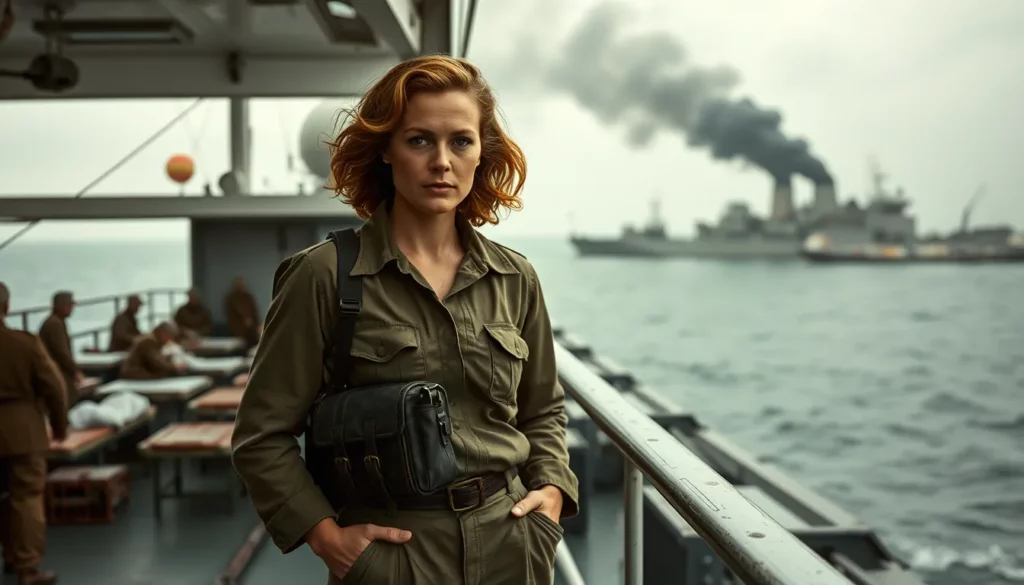
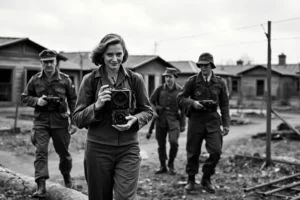
- June 1944: Gellhorn applied to the British government for press accreditation to cover the Normandy landings. Her application, like those of other female journalists, was refused. She drove to the south coast of England, claimed to be a nurse, and was allowed onto an American hospital ship bound for France. She locked herself in a bathroom and crossed the Channel as a stowaway. Going ashore with a medical team near Omaha Beach, she helped recover wounded soldiers. She was subsequently arrested and stripped of her war correspondent accreditation.
- After Normandy: Gellhorn hitched a flight to Italy and continued filing reports for Collier’s. She was among the first journalists to report from Dachau after the concentration camp was liberated.
Some reference works describe Gellhorn as the only woman correspondent to land at Normandy on D-Day, 6 June 1944. Other accounts place her going ashore two days later. The securely documented core is that she reached the Normandy beachhead without official accreditation, crossed on a hospital ship, and went ashore with a medical team. The disagreement over the exact date reflects the confusion of the beachhead and the later compression of her story into a single dramatic claim.

How It Was Seen at the Time
Contemporaries saw Gellhorn through several lenses at once. Collier’s readers encountered a correspondent who wrote about the human debris of war rather than only about troop movements. In Spain, the conflict was widely understood as a contest between democracy and fascism, and foreign correspondents were watched for signs of which side the wider world would support. Gellhorn’s dispatches were read in that frame, but her emphasis fell on civilians: the hungry, the displaced, the wounded, the bereaved. By 1944, the Normandy invasion was the largest news story in the world. Correspondents competed for scarce places, and official accreditation was the price of admission. Gellhorn’s unauthorised crossing was seen by some colleagues as a stunt and by others as a necessary act of witness. Military authorities saw a breach of regulations. Gellhorn saw a story that would otherwise be closed to her.
“I followed the war wherever I could reach it.” — Martha Gellhorn
The sentence, recalled later, captures how she wanted her career to be understood: not as a series of assignments but as a sustained attempt to reach the places where war was being experienced. At the time, her sex made that attempt both newsworthy and suspect. A woman correspondent in Spain was a novelty to some readers and an inconvenience to some officials. A woman stowing away on a hospital ship in 1944 was, in the eyes of the military, a security problem. In the eyes of many readers, she was a witness who had refused to be kept away.
Historical Snapshot
| Aspect | Detail |
|---|---|
| Date | Spanish Civil War dispatches: 17 July 1937 to November 1938. Normandy crossing: June 1944. |
| Place | Spain, especially Madrid and Barcelona; later England and the Normandy beachhead near Omaha Beach. |
| People | Martha Gellhorn; Ernest Hemingway; Collier’s Weekly editors; Republican civilians; American medical teams; British press accreditation officials. |
| What Happened | Gellhorn reported the Spanish Civil War with a focus on civilian suffering, then covered the spread of World War II. Denied accreditation at Normandy because she was a woman, she stowed away on a hospital ship, went ashore with a medical team, and was arrested. |
| Why It Mattered | Her career exposed the barriers facing women war correspondents and helped establish civilian experience as a central subject of war reporting. |
Eyewitness Accounts
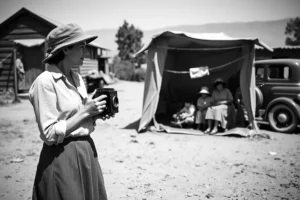
Gellhorn’s Collier’s dispatches are themselves eyewitness testimony. She wrote from Republican Spain not as a military analyst but as a reporter moving among civilians, refugees and medical workers. Her copy emphasized queues, bombardments, exhaustion and the ordinary routines that war disrupted. The dispatches were addressed to American readers who might never see Spain, and their authority rested on her presence in the streets and hospitals where the war was being lived.
Her account of the Normandy crossing is equally an eyewitness record. She claimed to be a nurse to board the hospital ship, locked herself in a bathroom to avoid discovery, and went ashore with a medical team to help recover wounded soldiers. The story is memorable because it is concrete: a woman with no accreditation, a ship, a locked door, a beachhead, a medical stretcher. It is also revealing about how she worked. When the official route was closed, she found another route and then reported what she saw.
“War happens to people, one by one. That is all I have really to say.” — Martha Gellhorn, from her later collection The Face of War
Different Perspectives
Gellhorn
Gellhorn’s perspective was that war reporting should begin with the people who endured it. Her Spanish dispatches dwell on civilians rather than on generals. Her Normandy crossing was an assertion that the biggest story of the war should not be reserved for officially accredited men. She did not present herself as a neutral observer above the conflict; she presented herself as a witness whose job was to make distant readers see what she had seen.
Hemingway and the Correspondents’ Circle
Hemingway was already a famous novelist when he and Gellhorn went to Spain. Their partnership gave her access and attention, but it also threatened to make her career legible only as an appendage to his. Gellhorn had published journalism and fiction before their marriage and continued to report after it. The correspondents’ circle was competitive, male-dominated and often skeptical of women in the field. Gellhorn’s later insistence on her own route through the war can be read as a response to being constantly paired with Hemingway.
Military Authorities
British and American military authorities saw press accreditation as a system of control. It decided who could move with forces, who could use official transport and who could be held responsible for security. Gellhorn’s application was refused because she was a woman, not because she lacked professional experience. When she boarded the hospital ship under a false claim, the authorities saw a violation of military regulations. Her arrest and loss of accreditation followed from that view.
Spanish Civilians
For many Republican civilians, foreign correspondents were among the few outsiders able to publicize their plight. Gellhorn’s dispatches were addressed to an American audience, and they translated the war into images of hunger, bombardment and displacement. Civilians did not necessarily see correspondents as neutral. They saw them as witnesses whose account might affect foreign sympathy and aid. Gellhorn’s focus on civilian suffering placed her, at least imaginatively, on the side of the people who had to remain in the cities under fire.
What the Sources Got Wrong
Several errors have attached themselves to Gellhorn’s Normandy story. The most persistent is that she was an accredited D-Day correspondent. She was not. Her application for press accreditation was refused, along with those of other female journalists, and she reached the beachhead by boarding a hospital ship under a false claim. She was later arrested and stripped of her accreditation. The drama of the story depends on that illegality, not on official permission.
- Error: Gellhorn landed with assault troops on 6 June 1944. Correction: The better-documented route is the hospital ship and the medical team. Accounts differ on whether she went ashore on D-Day or two days later.
- Error: Gellhorn was a nurse. Correction: She claimed to be a nurse to board the ship. She was a journalist without accreditation.
- Error: Hemingway made Gellhorn’s career. Correction: She had already published journalism and fiction, including The Trouble I’ve Seen, before their marriage. Her Spanish assignment came from Collier’s, and her reporting had its own focus on civilian suffering.
- Error: Gellhorn’s war reporting ended at Normandy. Correction: She continued to report in Italy and elsewhere, and she was among the first journalists to report from Dachau after its liberation.
What People Feared
In Republican Spain, civilians feared aerial bombardment, artillery, hunger and a fascist victory that would bring reprisals. Foreign correspondents feared censorship and being kept away from the front. Gellhorn’s dispatches register those fears indirectly, through the details of daily life under siege: the search for food, the sound of planes, the wounded in the streets. In 1944, the fears were different but equally concrete. Gellhorn feared missing the invasion. Military authorities feared security breaches from unauthorised civilians in a combat zone. Female journalists feared being excluded from the biggest story of the war.
Not every fear was borne out. The hospital ship was not attacked, and Gellhorn was arrested rather than shot. But the fears shaped behaviour. They explain why she lied about being a nurse, why she locked herself in a bathroom, and why the military treated her presence as a problem to be removed rather than a story to be facilitated.
Common Misconceptions
Gellhorn’s journey from Spain to Normandy shows how war reporting is shaped by access. In Spain, she had a commission and used it to write about civilians. At Normandy, she had no commission and used a false identity to get close to the story. The difference between the two assignments is not a difference in courage but a difference in the gates that were open to her. Her dispatches and later recollections remind us that the history of war correspondence is also a history of who is allowed to look, who is turned back, and who finds another way in.
FAQ
Was Martha Gellhorn at D-Day?
Gellhorn reached the Normandy beachhead in June 1944 without official accreditation. She boarded an American hospital ship by claiming to be a nurse, crossed the Channel as a stowaway, and went ashore with a medical team. Accounts differ on whether she landed on 6 June or two days later, but she was present in the immediate Normandy operations and was later arrested for breaching military regulations.
Why was Martha Gellhorn denied press accreditation at Normandy?
She applied to the British government for accreditation to cover the Normandy landings, but her application was refused, as were those of other female journalists. Official policy barred women from accredited combat coverage at that point. Gellhorn responded by finding an unauthorised route to the beachhead.
What did Martha Gellhorn report from Spain?
Gellhorn filed seven dispatches from the Spanish battlefront for Collier's Weekly between July 1937 and November 1938. They concentrated on the condition and suffering of civilians rather than on military strategy alone, describing hunger, bombardment, displacement and medical care in Republican-held areas.
Was Martha Gellhorn married to Ernest Hemingway?
Yes. Gellhorn met Hemingway in 1936 and married him in 1940. They divorced in 1945. She had already worked as a journalist and published fiction before the marriage, and she continued to report independently during and after it.
Did Martha Gellhorn report from Dachau?
Yes. She was among the first journalists to report from Dachau after the concentration camp was liberated in 1945. Her later career continued through conflicts in Vietnam, the Middle East and Central America.




Leave a Reply