
Short Answer
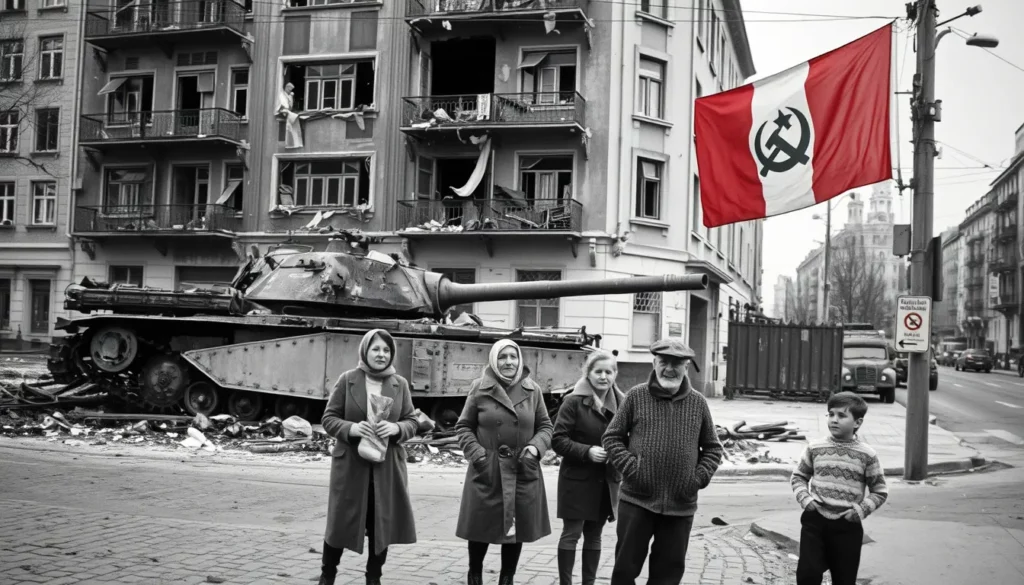
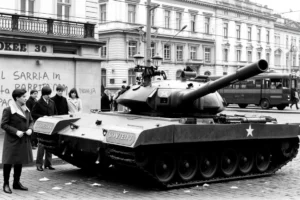
Before dawn on Sunday, 4 November 1956, Budapest woke to artillery. The trams that usually clattered along the Nagykörút stood still; in the tenement blocks of Pest families filled bathtubs with water, hid papers, and listened to a radio that had spent twelve heady days speaking of neutrality, free elections and a free press. By mid-morning Soviet tanks were in the streets and Imre Nagy’s voice had gone off the air. The city that emerged from that autumn — some 1.8 million people among burnt-out tanks at Corvin köz, shopfronts boarded against a hard winter, candles in flats whose windows had been blown out — is the subject of this article. Its scope is deliberately narrow: Budapest, not the countryside; the period from November 1956 to the consolidation of the mid-1960s, when János Kádár’s regime began to speak of its rule as ordinary. It is a history not only of tanks and trials but of queues, wages, waiting lists for flats and the sound of a jamming signal on the radio at evening.
What Happened?
The revolution began on 23 October 1956 with a student demonstration at the Bem József statue, from which a list of sixteen demands was carried through the city; by evening a crowd had attempted to seize the Radio building and the Stalin statue on Dózsa György út had been pulled down. Soviet troops entered Budapest overnight. Fighting continued until a ceasefire on 28 October and the withdrawal of Soviet units from the capital on 30 October, by which time Imre Nagy had formed a coalition government, the ÁVH security police had been dissolved, and a multi-party system had been announced. On 1 November Nagy declared Hungary neutral and withdrew from the Warsaw Pact; on 3 November the Soviet delegation at Tököl arrested the Hungarian military delegation, including General Pál Maléter.
- 4 November 1956: Operation Whirlwind. Soviet forces — some fifteen to seventeen divisions, with thousands of tanks — attack Budapest and other centres. János Kádár announces a “Revolutionary Workers’–Peasant Government” on radio from eastern Hungary.
- 7 November: Kádár returns to Budapest; the party paper reappears within days as Népszabadság.
- 11 November: the last organised armed resistance ends in the city.
- November–December 1956: workers’ councils and general strikes; on 4 December a women’s demonstration at Hősök tere is fired upon.
- December 1956 – 1957: mass arrests, internments, and several hundred deportations to the Soviet Union; show trials of workers’ council leaders and young fighters.
- 16 June 1958: Imre Nagy, Pál Maléter and József Szilágyi are hanged in secret; the burials are unmarked.
- 1959–1961: forced collectivisation of agriculture; consolidation of the Kádár system at home and at the United Nations.
- 1963: a general amnesty and an agreement with the UN Secretary-General quietly removes the “Hungarian question” from the international agenda.
Repression was broad rather than indiscriminate. Contemporary records and later archival counts indicate roughly 22,000–26,000 people were subjected to political proceedings, some 13,000 were interned, and several hundred were executed, with estimates ranging from about 230 to 400. The workers’ councils, the last institutional remnant of 1956, were broken by decree in the winter of 1956–57. Material recovery was slower: rubble was cleared largely by volunteer brigades, factories restarted with improvised machinery, and the first prefabricated housing estates rose on the city’s edges in the late 1950s and 1960s.
How It Was Seen at the Time
Two vocabularies collided over the same twelve days. In the official press the events were an ellenforradalom — a counter-revolution staged by “Horthyist-fascist” remnants and incited by Western radio — and the phrase was used to deny the word “revolution” any legitimacy for a generation. Among ordinary Budapesters the words were forradalom and szabadságharc: revolution, freedom fight, the same terms used of 1848. The émigré press in Vienna and Munich used them too, and it was under those words that some 200,000 people left the country.
The mood of the months that followed was not simple despair. Diarists record disbelief that the West had not come, relief at surviving, shame at having signed statements, and a grim, practical settling-in. The regime’s own self-description shifted within a few years: at the 1961 party congress Kádár distilled the new line into a sentence that Budapesters repeated with varying degrees of irony.
“Today at dawn Soviet troops attacked our country with the intention of overthrowing the legal and democratic Hungarian government. Our troops are still fighting. The government is at its post. I make this known to the people of our country and to the world public.” — Imre Nagy, Radio Budapest, 4 November 1956
“Whoever is not against us is with us.” — János Kádár, Hungarian Socialist Workers’ Party congress, 1961
Abroad, Budapest became a moral symbol almost overnight, and the comparison with 1848 was made everywhere in the Western press. But contemporaries also saw the irony that Soviet tanks entered Budapest in the same week that Anglo-French forces landed at Suez; many Western editors treated the two together, to the lasting bitterness of Hungarian exiles.
Historical Snapshot
| Aspect | Detail |
|---|---|
| Date | 4 November 1956 (attack); repression to 1963; consolidation through the 1960s |
| Place | Budapest, Hungarian People’s Republic |
| People | János Kádár, Imre Nagy, Pál Maléter, József Szilágyi; Soviet commanders under Marshal Rodion Malinovsky; Cardinal József Mindszenty in the US Legation |
| What Happened | Soviet forces crushed the revolution, installed the Kádár government, and oversaw arrests, internments and executions; the city was rebuilt and everyday life re-regulated under party supervision |
| Why It Mattered | It set the template for “goulash communism”: political obedience exchanged for relative material comfort, and made Budapest the most relaxed capital in the Soviet bloc by the late 1960s |
Daily Life
Work and money
The working day was long and the wage modest; the state sector set pay scales, and the party’s claim to legitimacy rested increasingly on delivery rather than doctrine. From the late 1950s the second economy was tolerated in practice: the maszek (private artisan) plumber, electrician or hairdresser, and fusizás, the informal job done on state time with state materials, became a normal part of urban survival. “Socialist brigades” at factories competed for banners and bonuses; May Day parades remained compulsory theatre.
Home and the panel block
Housing was the great grievance and the great prize. Thousands of families lived in subdivided flats with in-laws, or in damp rooms on the outskirts, waiting years for a council flat. The state’s answer, from the late 1950s, was the lakótelep: estates of prefabricated panel blocks, technically modern and socially anonymous, allocated partly by seniority and partly by loyalty. Domestic life narrowed to the kitchen and the television; Hungarian Television began regular broadcasting in 1957, though a set remained a luxury for years.
The rules of speech
Everyday conversation was governed by an unspoken tariff. Travel inside the country required the blue slip known as the kék cédula for those without a passport; foreign travel was controlled but, from the mid-1960s, easier for Hungarians than for most of the bloc. The press carried Népszabadság, the evening Esti Hírlap, the satirical Ludas Matyi, and women’s magazines full of recipes and consumer advice. Listening to Szabad Európa Rádió was a collective evening ritual, punctuated by the jamming signal. In the 1960s this system of cultural rationing acquired a nickname among journalists — the “three T’s”: tiltott, tűrt, támogatott, banned, tolerated, supported.
Eyewitness Accounts
Contemporary testimony from Budapest survives in three clusters. The first is the private diary. Excerpts published from a Budapest diarist’s notebook of the weeks after the Soviet entry describe a capital wandered through on foot — ruined shopfronts, burned vehicles, the strange quiet of curfew, the search for bread and coal — a record kept not for publication but because writing was a way of staying sane.
The second cluster is refugee testimony. The UN Special Committee on the Problem of Hungary, denied entry to the country, took evidence in Vienna and elsewhere from people who had crossed the Austrian border in November and December 1956, and its 1957 report remains one of the densest collections of first-person detail about the fighting and the first weeks of occupation. The third is oral history: interviews recorded decades later by Hungarian archives with people who had been children, students, workers and soldiers in 1956, which capture the texture of the aftermath — the informer in the stairwell, the job lost after a careless remark, the relative who did not come home.
“The Committee is unable to find any justification for the presence of Soviet troops in Hungary, and concludes that the Kádár government was installed by Soviet armed force.” — paraphrase of the finding of the UN Special Committee on the Problem of Hungary, 1957
No single eyewitness speaks for the city. Diarists tend to be educated and reflective; refugees were self-selected by the decision to leave; the later interviewees speak with hindsight. Reading them together is the only honest method.
Contemporary Newspaper Coverage
The Hungarian press was muzzled within days. Szabad Nép, the party daily, gave way in early November 1956 to Népszabadság, which reported the “counter-revolutionary” events in a language of restoration and fascist plots, announced the formation of the workers’ militia, and printed resolutions of factory meetings endorsing the new government. Soviet papers — Pravda and Izvestia — presented the intervention as fraternal assistance requested by Hungarian workers against counter-revolutionary gangs, a framing repeated in the Hungarian provincial press for years.
Western coverage was vast and sympathetic. The New York Times, The Times of London, the Manchester Guardian and Le Monde ran daily front-page reports, maps of the fighting districts and profiles of the “freedom fighters”; editorials across the political spectrum compared Budapest to 1848 and condemned the Soviet action. The émigré Hungarian-language papers in Vienna, Munich and London printed eyewitness dispatches from refugees. Broadcasters — Szabad Európa Rádió, the BBC Hungarian Service, Voice of America — were for many Budapesters a more immediate source than any newspaper, and their tone has been debated ever since: RFE denied inciting armed resistance, while critics inside and outside the United States argued that its broadcasts had fed expectations of Western help.
What People Feared
In the first weeks the fears were concrete. Families expected mass deportation to the Soviet Union, a fate remembered from 1945 and revived by rumours of sealed cattle trucks; they feared the return of the ÁVH in a new uniform, and the knock at night. There were fears of a general settling of scores, of denunciation by neighbours, of children punished at school for a parent’s politics. Some feared a new war: in the autumn of 1956 many Budapesters genuinely expected the great powers to collide over Hungary, and listened to foreign radio for signs of it.
After the first winter the fears grew quieter and more bureaucratic: loss of a job, refusal of a passport, a child denied a university place because of the family’s “class background” or, after 1956, because of a parent’s record. The worst case — that the regime would execute tens of thousands — did not materialise, but the arrests were wide enough to make the fear rational. Kádár’s later formula, that the sons should not pay for the sins of the fathers, was heard by many as both a promise and a warning.
How Historians See It Today
Contemporaries read the aftermath through the categories of the Cold War: liberation, betrayal, or counter-revolution. Historians since 1989 have worked with the interior ministry archives, court records and the records of the workers’ councils, and the picture has shifted in three ways. First, the repression has been documented more precisely and, in some respects, found to be more systematic than was known abroad in 1957. Second, the “consolidation” is now understood as a bargain made earlier and more deliberately than the old image of an accidental thaw suggested: the amnesty of 1963, the New Economic Mechanism of 1968 and the tolerance of the second economy were calculated instruments of stability. Third, social historians have turned to everyday life — housing, consumption, informers, leisure — and have shown how the Kádár system was sustained less by terror after 1963 than by the management of daily inconvenience and the selective granting of privileges.
The biggest historiographical shift concerns agency. The older émigré narrative cast the Hungarian people as unanimous and the regime as wholly alien; newer work emphasises negotiation, adaptation, cynicism and small compromises, without which the stability of the 1960s cannot be explained.
Budapest after 1956 is a city that learned to live with what it could not change. The sources — the diary kept by candlelight, the refugee’s statement taken in an Austrian barracks, the terse communiqué in Népszabadság, the UN committee’s report — do not agree with one another, and that disagreement is the history. What they record together is a population that had seen the West fail to arrive, and that then built a life of queues, second jobs, panel flats and carefully measured speech. The grey comfort of the 1960s was not amnesia; it was a settlement, made by people who remembered exactly what had happened, and who had learned what it cost to say so.
FAQ
How many people were killed in Budapest after the Soviet attack of 4 November 1956?
The fighting of 4–11 November 1956 killed several thousand Hungarians nationwide, with the majority of casualties in Budapest; the dead included civilians, fighters and bystanders. Soviet losses were officially recorded by the Soviet Ministry of Defence as 669 killed, 1,450 wounded and 51 missing. Precise figures were disputed for decades because the Hungarian authorities published only partial data, and modern counts draw on hospital records, cemetery registers and the UN Special Committee's testimony.
Why did the West not intervene to help Hungary in 1956?
The United States and its allies condemned the intervention at the United Nations and took in roughly 200,000 refugees, but they were unwilling to risk a general war over Hungary. The Suez crisis, which peaked in the same days, absorbed Western attention and diplomatic energy. Contemporary Budapesters listened to foreign radio for signals of help that never came; later historians have criticised the tone of some broadcasts, particularly those of Radio Free Europe, though the station denied encouraging armed resistance.
What was 'goulash communism' and when did it begin in Budapest?
The term describes the Kádár regime's post-1956 bargain: political obedience and membership of the Warsaw Pact in exchange for rising living standards, tolerated private enterprise in services, and a cultural life less rigid than elsewhere in the bloc. Its foundations were laid with the 1963 amnesty and the partial rehabilitation of daily life, and its economic expression was the New Economic Mechanism of 1968, which gave enterprises more autonomy and accepted a substantial second economy.










Leave a Reply