
Short Answer
On the evening of August 11, 1965, the corner of 116th Street and Avalon Boulevard was ordinary until it was not. A California Highway Patrol officer stopped a black motorist, twenty-one-year-old Marquette Frye, on suspicion of drunk driving. Within minutes Frye’s mother and brother arrived, a crowd gathered, and a routine arrest became a struggle; a struggle became a rumor. By nightfall rocks and bottles were flying, and South Los Angeles was entering six days that would be called the Watts Riots, the Watts Rebellion, and, by some who lived through it, an uprising. The events were experienced at street level: residents watched police lines form, reporters worked under curfew, shopkeepers tried to protect their stores, and National Guardsmen occupied corners. This article follows the record left by those voices—contemporary newspapers, official reports, and eyewitness testimony—to reconstruct what people in 1965 knew, feared, and expected. The scope is the August 11–17 disturbance and its immediate coverage, not the entire history of Watts.
What Happened?
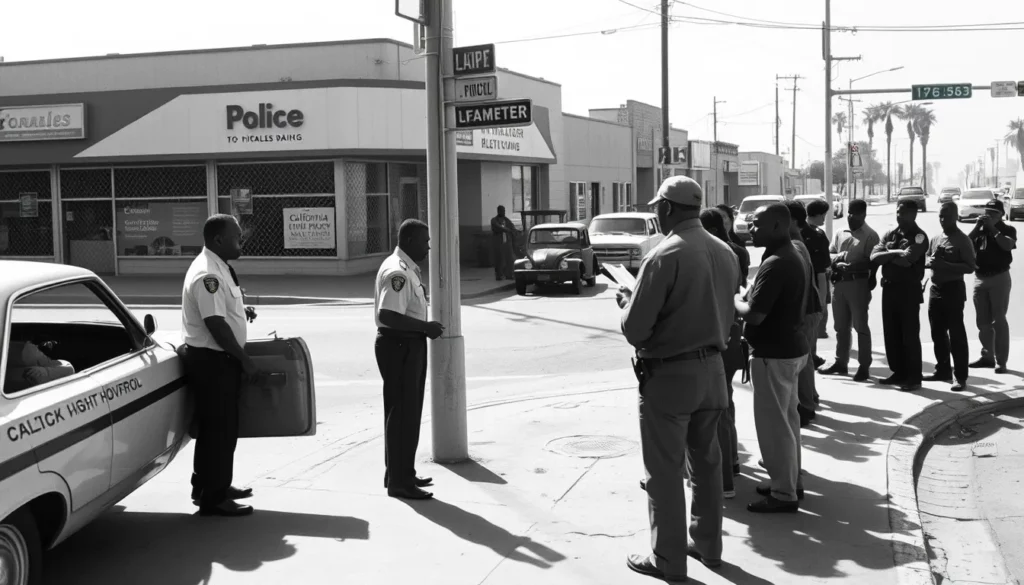
The disturbance began with a traffic stop. Highway Patrol Officer Lee W. Minikus stopped Marquette Frye near 116th and Avalon, and Frye was arrested on suspicion of drunk driving. A struggle broke out when officers tried to take Frye into custody; his mother, Rena Frye, and brother Ronald intervened. A crowd of several hundred gathered, and rumors—including claims of police brutality—spread through the street. Rocks and bottles were thrown, windows were broken, and the violence expanded through the night.
- August 11, evening: The traffic stop and arrest of Marquette Frye; his mother and brother arrive; a crowd gathers; rocks and bottles are thrown.
- August 11–12: Looting and arson spread along Avalon Boulevard and nearby streets; police send reinforcements; rumors and press briefings mix with direct observation.
- August 13: Governor Pat Brown declares a state of emergency and orders the California National Guard to Los Angeles.
- August 14–16: Guard troops enforce curfews; police and Guard units exchange gunfire with suspected snipers; arrests mount and fear spreads.
- August 17: Order is restored; the Guard begins to withdraw.
By the time the disturbance ended, 34 people had been killed, more than 1,000 had been injured, several thousand had been arrested, and roughly $40 million in property had been damaged or destroyed. The violence was concentrated in South Los Angeles, but it spread beyond the neighborhood officially labeled Watts.

How It Was Seen at the Time
For officials and most daily newspapers, the first frame was “riot.” Police Chief William H. Parker and Governor Brown spoke of lawlessness and insurrection; front pages emphasized snipers, fire, and mob action. But the language was contested even then. Residents who spoke to reporters described police harassment, joblessness, bad housing, and a sense that the traffic stop was the last straw. Black activists and some ministers called it a rebellion against conditions, not simply criminality. The prevailing mood among reporters and officials was shock: Los Angeles had imagined itself immune to the kind of civil violence then associated with other American cities. The Los Angeles Times later tried to answer the question many readers were asking—why?—with a series and an editorial whose titles were themselves arguments.
“The View From Watts” — Los Angeles Times, seven-part series, October 10–17, 1965
“Watts: A Time for Action” — Los Angeles Times editorial, October 1965
The titles show a shift from bare incident reporting to explanation and prescription.
Historical Snapshot
| Aspect | Detail |
|---|---|
| Date | August 11–17, 1965 |
| Place | Watts and surrounding South Los Angeles, especially along Avalon Boulevard and 116th Street |
| People | Marquette Frye, Rena Frye, Highway Patrol officers, Los Angeles police, National Guardsmen, residents, reporters, business owners |
| What Happened | A traffic stop and arrest sparked a six-day civil disturbance marked by rock throwing, looting, arson, police and Guard deployment, curfews, and gunfire. |
| Why It Mattered | It exposed deep racial and economic grievances in Los Angeles and became a national symbol of urban unrest and police-community conflict. |
Contemporary Newspaper Coverage
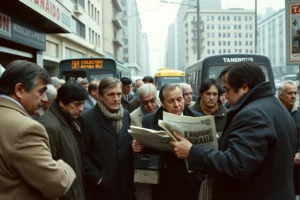
In the first days, the Los Angeles Times and other dailies ran front-page stories emphasizing violence, sniper fire, and official statements. The coverage was shaped by curfews, police lines, and briefings; reporters often worked from what they could see at intersections and what officials told them. The most revealing coverage came after the fires. From October 10 to 17, 1965, the Times ran “The View From Watts,” a seven-part series that sent reporters back into the neighborhood to let residents, workers, and officials describe conditions. The same period carried the editorial “Watts: A Time for Action.” The series did not overturn the paper’s law-and-order framework, but it gave more space to Black residents’ grievances than the daily riot stories had. The Los Angeles Sentinel, the city’s Black weekly, provided an alternative forum, treating the events as a warning about housing, jobs, and police-community relations.
“Watts: A Time for Action” — Los Angeles Times, 1965
Reporters worked under curfew and police lines; their copy mixed direct observation with official briefings and street rumor. That mixture is itself evidence of how the events were understood in real time.
Eyewitness Accounts
Contemporary eyewitness testimony survives mostly in fragments: a sentence in a news story, a quoted resident at a police line, a reporter’s notebook detail. The Watts disturbance did not produce the kind of diary or letter collections that later historians could mine. The fullest published eyewitness collection is retrospective: for the fortieth anniversary in 2005, the Los Angeles Times gathered nine people who had witnessed the events—a rioter, a business owner, a Highway Patrol officer, a National Guardsman, ordinary residents, and a newspaper reporter—and asked them to recount six days that changed their lives. Those recollections are not contemporaneous, and memory has reshaped them, but they preserve the emotional geography of the event.
“The divisions are still there, 40 years later.” — Los Angeles Times, August 11, 2005
Read alongside the 1965 stories, such testimony shows how differently the same street could be remembered: as a battleground, as a neighborhood abandoned, as a lesson in police power, or as a rebellion.
Different Perspectives
Residents
Many residents described the traffic stop as a familiar humiliation rather than an isolated incident. They spoke of police stops, joblessness, overcrowded housing, and stores that charged high prices. Some joined the disorder; others sheltered indoors, condemned the violence, or tried to protect neighbors. Their testimony does not fit a single category of “rioter” or “victim.”
Reporters
Reporters saw a city they thought they knew become unfamiliar. Daily journalism emphasized official briefings and visible destruction; the Times’ October series tried to explain causes after the fires were out. The tension between deadline reporting and later explanation is visible in the shift from incident stories to the question “why?”
Police and National Guard
Police and guardsmen described a breakdown of order and feared coordinated snipers. They operated under curfews and rules of engagement that many found ambiguous. Their accounts emphasize danger, fatigue, and the difficulty of distinguishing residents from suspects in dark streets and housing projects.
Business Owners
Shopkeepers saw years of work destroyed in hours. Some armed themselves or guarded their stores; others blamed police for failing to protect them. Their losses became part of the public argument over whether the events were criminality, rebellion, or both.
What the Sources Got Wrong
Contemporary coverage and official statements contained errors and distortions that shaped public understanding.
- “Watts” as a precise place. The label suggested a single neighborhood, but the violence spread through a much larger section of South Los Angeles. Many people arrested did not live in Watts, and the symbolic name obscured the geography of the disturbance.
- Outside agitators. Some officials and newspapers speculated that outside radicals had organized the violence. The McCone Commission later found no evidence of a coordinated conspiracy, although the rumor persisted.
- The sniper war. Contemporary accounts often described an organized sniper campaign. Later evidence showed scattered shooting and real danger, but not the coordinated network that many feared and some reporting implied.
- Rumor as fact. Early crowd rumors and press briefings repeated claims that were never reliably substantiated, while the deeper grievances that residents described were often treated as background rather than news.
How Historians See It Today
Modern historians generally describe the events as an uprising or rebellion rather than a simple riot, while noting that contemporaries used both languages. Scholarship emphasizes segregated housing, employment discrimination, the recent passage of Proposition 14, and tense police-community relations. The McCone Commission’s 1965 report, Violence in the City—An End or a Beginning?, acknowledged deep grievances but emphasized law enforcement and social programs; later historians have been more critical of the structural causes and of the official response. Public memory remains split, as the Times noted on the fortieth anniversary:
“To many, the events that began in Watts on Aug. 11, 1965, remain a riot, pure and simple — a social breakdown into mob rule and criminality. To others, they were a revolt, a rebellion, an uprising — a violent but justified leap into a future of black self-empowerment.” — Los Angeles Times, August 11, 2005
The historiographical shift does not erase the violence or the suffering; it changes the questions historians ask about causation, policing, and the voices that were heard—or missed—in 1965.
The primary sources do not allow us to recover a single “true” voice of Watts in 1965. They show instead a chorus: residents who spoke through reporters, officers who saw a breakdown of order, guardsmen who feared snipers, business owners who counted losses, and journalists who first reported a riot and then, weeks later, asked why. That shift—from incident to explanation—is the most revealing thing the record contains. It reminds us that the words used to name an event are part of its history. The Watts disturbance was violent and destructive; it was also a warning about segregation, policing, and poverty that contemporaries could read in the ashes if they chose to. The sources preserve both the warning and the ways it was missed.
FAQ
What started the Watts Riots in 1965?
The disturbance began on August 11, 1965, when California Highway Patrol officers stopped and arrested Marquette Frye, a 21-year-old Black motorist, near 116th Street and Avalon Boulevard. A crowd gathered as Frye’s mother and brother intervened, and rumors of police brutality helped turn the arrest into six days of violence, looting, and arson.
How many people died in the Watts Riots?
Contemporary records count 34 people killed during the August 11–17, 1965, disturbance. More than 1,000 people were injured, several thousand were arrested, and property damage was estimated at about $40 million.
Why is it called both a riot and a rebellion?
Officials and most daily newspapers called the events a riot, emphasizing lawlessness and destruction. Many residents, activists, and later historians have used “rebellion” or “uprising” to emphasize the underlying grievances—police abuse, unemployment, housing segregation, and poverty—that fueled the violence.



Leave a Reply