
Short Answer
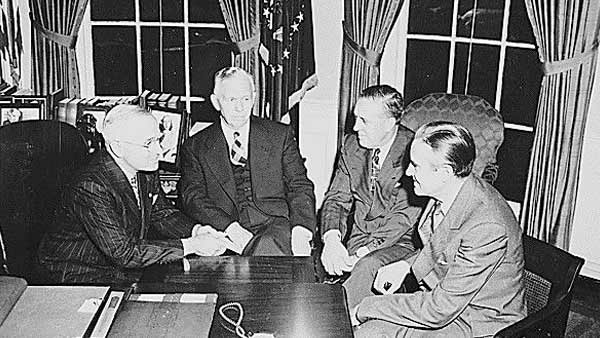
In June 1947, as Europe lay in ruins, a former general turned Secretary of State stepped to the podium at Harvard University. The world situation, George C. Marshall said, was “very serious.” He spoke of the enormous complexity of the problem, the difficulty for the common citizen to grasp the plight of long-suffering peoples, and the need for a program to restore the confidence of the European people. The speech was broadcast over radio and published in newspapers across the continent. It would become the seed of the European Recovery Program—commonly known as the Marshall Plan—a massive aid effort that would pour billions of dollars into rebuilding Western Europe. But at the time, nothing was certain. Americans were weary of foreign entanglements, many congressmen were isolationists, and the Soviet Union watched with suspicion. The plan was not a foregone conclusion; it was the product of intense debate, propaganda, and a desperate need to prevent the spread of communism.
What Happened?
On June 5, 1947, Secretary of State George C. Marshall delivered a speech at Harvard University, outlining the need for a comprehensive European recovery program. He stated, “I need not tell you gentlemen that the world situation is very serious. That must be apparent to all intelligent people.” He emphasized the enormous complexity of the problem and the difficulty for the American public to comprehend the plight of the European people. Marshall proposed that the United States provide aid to help Europe rebuild its economy and infrastructure, but he insisted that the initiative must come from Europe itself.
Following the speech, European nations, led by France and the United Kingdom, quickly organized to draft a recovery plan. In July 1947, representatives of sixteen European countries met in Paris to develop a joint proposal. The Soviet Union and its satellite states refused to participate, seeing the plan as a tool of American imperialism. In December 1947, President Harry S. Truman submitted the Economic Cooperation Act to Congress. The bill was fiercely debated throughout early 1948. Isolationist Republicans, such as Representative Howard Buffett of Nebraska, attacked the plan as “Operation Rathole,” and condemned the “barrage of propaganda” used to promote it. Despite the opposition, the Economic Cooperation Act passed in April 1948, establishing the Economic Cooperation Administration (ECA) to administer the aid. Between 1948 and 1952, the United States sent approximately $13 billion in economic and technical assistance to sixteen European countries, ranging from machinery and food to raw materials and technical expertise. The plan also included a productivity drive, as seen in the Netherlands, where American public diplomacy promoted industrial efficiency and modernization. By the early 1950s, European industrial output had surpassed prewar levels, and the Marshall Plan had become a symbol of American generosity and a bulwark against communism.
How It Was Seen at the Time
Contemporaries were sharply divided. Many Americans, especially those in the Midwest and rural areas, were suspicious of foreign entanglements. The Chicago Tribune, the “civic bible” of many isolationists, argued against the plan. Representative Howard Buffett of Nebraska called it “Operation Rathole,” and complained about the “barrage of propaganda” drenching the country. He also accused the Truman administration of “tricks of political terrorism” to gain passage. On the other side, supporters of the plan, including President Truman and many internationalists, saw it as a moral obligation and a strategic necessity. Truman said in April 1948, “In all the history of the world, we are the first great nation to feed and support the conquered.” The plan was also seen as a way to contain the Soviet Union and to create stable, democratic allies. As Marshall said in his speech, “The consequences of a weakened and disrupted Europe could be disastrous for the American economy as well as for the political stability of the world.” The prevailing mood was a mixture of hope and anxiety—hope that Europe could recover, anxiety about the cost and the Soviet threat.
Different Perspectives
American Isolationists
Isolationist congressmen like Howard Buffett and Fred Busby of Illinois were vocal opponents. They argued that the Marshall Plan was a waste of American money and a dangerous step toward permanent foreign commitments. Buffett called it “Operation Rathole” and spoke of the “barrage of propaganda” that was being used to gain passage. He and his colleagues feared that the plan would lead to a permanent welfare state and drag the United States into European affairs. Their perspective was rooted in an older American tradition of avoiding foreign wars and alliances.
European Leaders and Citizens
European governments, particularly in France and Britain, welcomed the plan as a lifeline. The Netherlands, for example, became a focus of the productivity drive, as American public diplomacy sought to modernize Dutch industry. According to the research on the Netherlands, the Marshall Plan was not just about money; it was also about transferring American management techniques and ideas. European workers and factory managers were exposed to American productivity methods, and the plan was seen as a way to raise living standards and build a modern economy. However, there was also skepticism, especially among communist parties in France and Italy, who saw the plan as a tool of American imperialism.
The Soviet Union
The Soviet Union rejected the Marshall Plan and forced its satellite states to do likewise. The Soviet leadership, as reported in contemporary sources, viewed the plan as a threat to its influence in Eastern Europe. The Soviet Union countered with the Molotov Plan, a system of bilateral trade agreements that aimed to tie Eastern Europe to the Soviet Union. This division solidified the emerging Cold War.
What People Feared
At the time, there were widespread fears of a new economic depression and the spread of communism. The memory of the Great Depression was still fresh, and many worried that a weakened Europe would collapse into chaos, leading to the rise of communist parties in France, Italy, and other countries. Marshall himself noted that the “plight of the long-suffering peoples” could lead to reactions that would affect their governments and the peace of the world. The fear of Soviet expansion was real. The Soviet Union had already installed communist governments in Eastern Europe, and there was concern that Greece and Turkey would fall. The Marshall Plan was seen as a way to prevent this. There were also fears that the American economy would suffer if Europe could not buy American goods. The plan was also presented as a way to create a stable and prosperous world order. However, some feared that the plan would lead to American overreach and a permanent military-industrial complex. These fears were not unfounded, as the plan did lead to a permanent American presence in Europe.
What People Expected Would Happen Next
Many contemporaries were cautiously optimistic. They expected that the aid would help Europe rebuild, but they were not sure of the outcome. Some predicted that the plan would fail, that the money would be wasted, and that Europe would remain weak. Others believed that the plan would succeed and that Europe would become a strong ally. Marshall himself, in his speech, said that the program should be a “combined effort” and that the United States would provide support, but the initiative had to come from Europe. The plan’s supporters expected that it would contain communism and create a stable and prosperous Europe. They also expected that the United States would benefit economically from the expansion of trade. The plan was also expected to strengthen the Western alliance. In the short term, the plan did help to stabilize Europe, but the long-term effects were not fully foreseen. The plan contributed to the creation of the European Union, but that was not the immediate expectation. The plan also led to the formation of NATO in 1949, which was a military alliance that would not have been possible without the economic cooperation.
Key Documents
- “The Marshall Plan” speech (June 5, 1947) – Secretary of State George C. Marshall’s speech at Harvard University, which proposed the aid program. This speech is the foundational document of the Marshall Plan.
- Economic Cooperation Act of 1948 (April 3, 1948) – The law that established the Economic Cooperation Administration and authorized the aid. It was signed by President Truman.
- Report of the Paris Conference (July 1947) – The European response to Marshall’s proposal, outlining the European needs and commitments.
- Truman’s Address to Congress (December 1947) – The president’s message urging Congress to pass the Economic Cooperation Act.
Aftermath
The Marshall Plan operated from 1948 to 1952. By the end of the program, the economic output of the participating countries had increased significantly. The plan had not only rebuilt factories and roads but also modernized industrial practices, as seen in the Netherlands where American public diplomacy promoted productivity. The plan also had a profound political effect: it helped to strengthen the democratic institutions and to create a sense of European solidarity. The plan is widely credited with laying the foundation for the European Union. It also contributed to the division of Europe, as the Soviet Union and its allies rejected the plan. The plan also led to the creation of the Organization for European Economic Cooperation (OEEC), which later became the OECD. The Marshall Plan was considered a success, and it became a model for later foreign aid programs. In the short term, the plan provided immediate relief, but the long-term effects were more significant.
How Historians See It Today
Historians today generally view the Marshall Plan as a turning point in the Cold War. They emphasize that the plan was not just an act of charity, but also a strategic tool to contain communism and to create a stable and friendly European market. However, historians also note that the plan was not the sole cause of European recovery; the European nations themselves had the will to rebuild, and the United States also provided other forms of aid. Some historians argue that the plan’s impact was more psychological than economic, as it gave Europeans a sense of hope and a stake in the American-led system. The plan also had a significant impact on the American economy, as it opened new markets for American goods. The recent scholarship, such as the study of the productivity drive in the Netherlands, highlights the cultural dimension of the plan, showing how American ideas about management and efficiency were exported. Historians also note that the plan was not a purely altruistic act; it served American interests in the Cold War. The plan’s legacy is complex, but it is widely considered a successful example of foreign policy.
In conclusion, the Marshall Plan was a moment when the United States decided to engage with the world in a new way. The contemporary sources reveal a debate, a mix of fears and hopes, and a careful effort to win hearts and minds. The plan not only rebuilt Europe but also reshaped the American role in the world. The primary sources—speeches, congressional debates, and propaganda—show us how people at the time understood the stakes and the challenges. They remind us that history is not just a series of events but a series of choices made by people with hopes, fears, and expectations.
FAQ
What did the Marshall Plan actually do?
The Marshall Plan provided about $13 billion in economic and technical aid to sixteen European countries from 1948 to 1952. It helped rebuild infrastructure, modernize industry, and stabilize currencies. It also included a productivity drive that transferred American management methods. The plan aimed to prevent the spread of communism and create a stable, prosperous Europe.
Why did some Americans oppose the Marshall Plan?
Isolationist politicians like Representative Howard Buffett opposed it as 'Operation Rathole,' believing it was a waste of money and would drag the U.S. into foreign entanglements. They also criticized the 'propaganda' used to gain support. Others feared it would lead to a permanent American presence in Europe and an increase in government spending.













Leave a Reply