
Short Answer
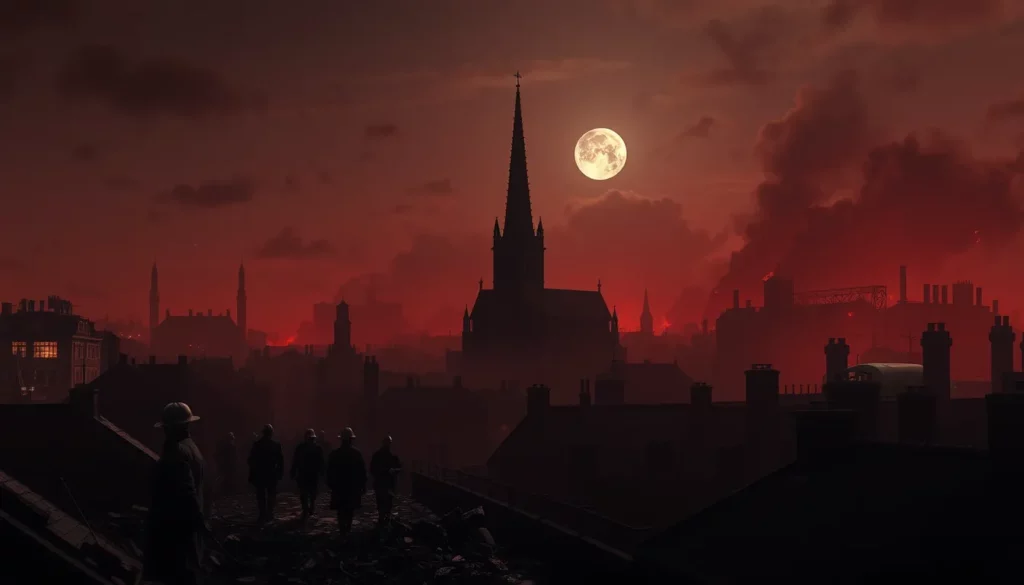
On the night of 14 November 1940, the moon over Coventry was bright enough to silver the roofs and make the city’s factory chimneys stand out against a cloudless sky. Coventry was not London. It was a Midlands engineering city of motor works, aircraft components, and armament factories, and by 1940 it had become a target in the Luftwaffe’s campaign against British industry and civilian morale. The raid that followed—the Germans called it Unternehmen Mondscheinsonate, Moonlight Sonata—turned the medieval centre into a furnace and left the shell of St Michael’s Cathedral open to the sky. This article concentrates on the major raid of 14–15 November 1940, the episode most people mean by “the Coventry Blitz,” while noting that Coventry was bombed on other occasions before and after that night.
What Happened?
By November 1940 Coventry was a legitimate military target in German planning. Its factories produced engines, aircraft parts, machine tools, and armaments; its rail links fed the Midlands industrial belt. The Luftwaffe had already raided the city earlier in the year, but the November operation was designed as a concentrated attack by a large force of bombers.
British intelligence had fragments of warning. On 9 November an Enigma decrypt revealed that an unusual bombing operation was being planned under the codename Moonlight Sonata, timed for the next full moon and possibly divided into three parts. On 12 November a Luftwaffe prisoner of war told a stool-pigeon that a heavy raid at maximum strength was to be carried out between 15 and 20 November, with Coventry and Birmingham named as targets. A captured map suggested London and south-east England instead, and earlier beam transmissions over the Midlands had proved to be practice. On 13 November the prisoner was interrogated again and confirmed three separate attacks in the industrial district of England.
- 9 November 1940: An Enigma decrypt refers to an unusual operation, Moonlight Sonata, linked to the full moon.
- 12 November 1940: A captured Luftwaffe prisoner names Coventry and Birmingham as possible targets; beam bearings intersect over Wolverhampton, Birmingham, and Coventry, but are discounted as practice.
- 14 November 1940, 1300 hours: German beam transmissions begin; by 1500 airborne intercept establishes that the beams intersect over Coventry.
- 14 November 1940, evening: The raid begins. Pathfinders from KG100 mark the target with incendiaries, and waves of bombers attack through the night.
- 15 November 1940, morning: Fires continue to burn; rescue parties search ruins; the cathedral and much of the city centre are destroyed.
The Air Staff alerted the Prime Minister on 14 November to the possibility of a major raid, but the warning was still general enough that London remained a strong possibility. Churchill arranged to be in London rather than in the country. At 1500, however, the beams confirmed Coventry as the target. The beam jammers were switched on, but they made no difference to KG100’s accuracy—possibly because the wrong audio modulating frequency was used, or, equally possibly, because a bright moonlit night made navigation simple once the pathfinders had dropped incendiaries. The fires could be seen by aircraft from hundreds of miles away.
Anti-aircraft defences had been strengthened earlier in November, but they could not cope with the numbers of aircraft. Although 121 fighter sorties were despatched, only 11 enemy aircraft were sighted, only two were engaged, and only one was damaged. Almost a third of the city was flattened. The official figure cited by GCHQ is 568 people killed, with hundreds more injured. The medieval cathedral was hit, as were factories, homes, shops, and public buildings. The raid was not three separate attacks; Coventry was unlucky enough to be at the top of the target list on a cloudless night.
How It Was Seen at the Time
Contemporaries did not know the Enigma story, nor could they see the full pattern of German planning. What they experienced was a long night of incendiaries, high explosive, and fire, followed by a morning of smoke and rubble. The Ministry of Information chose this occasion to make use of the press to expose what it presented as the senseless brutality of the Nazi attack. The reporting of destroyed homes and, especially, the ruined cathedral brought scorn on the enemy from many quarters and made Coventry an international symbol of civilian endurance.
The language of the time was the language of the Blitz: “raid,” “shelter,” “incendiary,” “warden,” “salvage,” and “spirit.” Officials spoke of a heavy raid and of the need to keep production going; civilians spoke of the cathedral, the fires, and the dead. The prevailing mood was a mixture of shock, defiance, and grim expectation that more raids would follow. Coventry was seen as a test of whether British cities could take punishment and continue to work.
“if further information indicates Coventry, Birmingham or elsewhere, we hope to get instructions out in time.” — Air Staff assessment, 14 November 1940.
The most famous contemporary response came not from a newspaper but from the ruined cathedral itself. Provost Richard Howard chalked the words “Father Forgive” on the wall of the destroyed chancel, a gesture that was both a prayer and a public statement. At the time, Coventry’s ordeal was understood as a deliberate assault on an industrial city and on the morale of ordinary people.
Historical Snapshot
| Aspect | Detail |
|---|---|
| Date | 14–15 November 1940 |
| Place | Coventry, Warwickshire, England |
| People | Luftwaffe bomber crews; Coventry civilians; ARP wardens and fire services; Provost Richard Howard; British intelligence officers and Air Staff |
| What Happened | A major Luftwaffe raid, codenamed Moonlight Sonata, devastated the city centre and cathedral; 568 people were killed and hundreds injured; almost a third of the city was flattened. |
| Why It Mattered | The raid became a symbol of the Blitz, raised questions about forewarning and civil defence, and was later mythologised as a deliberate sacrifice to protect Ultra. |
What People Knew at the Time
Contemporary knowledge was partial and often uncertain. Officials had signals intelligence and prisoner-of-war information, but the evidence pointed to several possible targets. The public knew only that a heavy raid had occurred and that Coventry had suffered badly. The table below contrasts what was known or believed then with what later evidence has established.
| What People Knew Then | What We Know Now |
|---|---|
| A heavy raid was expected somewhere in the Midlands, but the exact target was uncertain. | Enigma decrypts and prisoner-of-war testimony pointed to Coventry and Birmingham; beam transmissions confirmed Coventry at 1500 on 14 November. |
| Jamming was believed to disrupt German navigation and protect the city. | The jammers were ineffective, possibly because of the wrong audio modulating frequency or because the clear moonlit night made visual navigation easy. |
| Casualty figures were provisional and confused in the first reports. | The official figure is 568 killed, with hundreds more injured; almost a third of the city was flattened. |
| The raid was seen as a terror attack on civilians and an industrial city. | Historians treat it as part of the Luftwaffe’s broader campaign against British industry and morale, with Coventry’s cathedral and press coverage making it uniquely symbolic. |
| Coventry was a singular martyr city. | Coventry was one of many bombed British cities, but its ordeal became an international symbol because of the cathedral, the scale of destruction, and the Ministry of Information’s decision to publicise it. |
Contemporary Newspaper Coverage
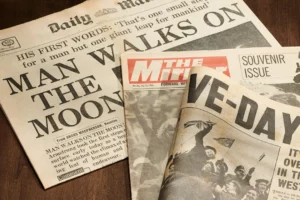
The raid broke the usual reticence of wartime reporting. The Ministry of Information chose this occasion to use the press to expose the destruction of homes and the cathedral, and newspapers responded with detailed dispatches and sombre editorials. On 16 November 1940, The Times carried reports under the heading “Coventry Raid,” and other national and local papers emphasised the ruined cathedral, the civilian dead, and the city’s determination to carry on.
“Coventry Raid.” — headline in The Times, 16 November 1940.
Coverage overseas was also prominent. The New York Times and other foreign papers gave the raid wide attention, helping to make “Coventry” a name known around the world. The tone was shocked but defiant: condemnation of the bombing of civilians was mixed with praise for the city’s spirit and with official assurances that production would continue. Newspapers did not yet know the intelligence story, and they did not report the Enigma warnings. They reported what could be seen: fire, ruin, and survival.
Eyewitness Accounts
Provost Richard Howard of Coventry Cathedral was an eyewitness to the destruction of his church and city. His response became one of the most enduring primary-source traces of the raid. Standing amid the ruins, he chalked words on the remaining wall of the chancel, and he insisted that the destruction of the building did not mean the destruction of the Church.
“Father Forgive.” — chalked by Provost Richard Howard on the ruined chancel wall, 15 November 1940.
“The Cathedral is destroyed, but the Church is not.” — Provost Richard Howard, November 1940.
Other contemporary testimonies describe the same sequence of events: the drone of aircraft, the crack of incendiaries, the spread of fire, the collapse of masonry, and the smell of smoke. Civil defence workers, firefighters, and ordinary residents spent the following days searching ruins and salvaging what could be saved. Their accounts emphasise not only the physical destruction but also the strange quiet of the morning after, as the city took stock of what had happened.
What the Sources Got Wrong
- The myth that Coventry was sacrificed to protect Ultra. This is not supported by the evidence. The Enigma decrypts were ambiguous, the prisoner-of-war information pointed to more than one target, and the beams were not confirmed over Coventry until 1500 on 14 November. The official history by F. H. Hinsley treats the episode as a failure of warning and defence, not a deliberate sacrifice.
- The idea that the raid came without any warning. There were warnings, but they were general and conflicting. The public was not told the details, and the defences could not cope with the scale of the attack.
- The belief that the cathedral was the principal target. The cathedral was hit and became the symbol of the raid, but the attack was aimed at the city’s industrial and communications infrastructure and at civilian morale. Factories, homes, and utilities were also destroyed.
- The assumption that jamming protected the city. Contemporary officials hoped that beam jamming would disrupt German navigation. In practice, it did not prevent KG100’s pathfinders from marking the target accurately.
How Historians See It Today
Modern historians treat the Coventry Blitz as part of the wider Luftwaffe campaign against British cities in 1940–41. They emphasise the industrial target, the morale objective, and the limitations of British civil defence and night-fighter defences. The forewarning story has been carefully reconstructed by intelligence historians, above all in Hinsley’s official history, which dissects the Enigma decrypts, the prisoner-of-war evidence, and the beam confirmations. The “sacrifice” myth persists because the Ultra secret was kept for decades and because the raid was so destructive that later observers looked for a deliberate explanation.
Historians also stress the role of publicity. The Ministry of Information’s decision to allow full reporting helped make Coventry a symbol of the Blitz and of civilian resilience. The ruined cathedral, the chalked words “Father Forgive,” and the image of a city carrying on became part of British wartime memory. At the same time, scholars caution against treating Coventry as unique: London, Liverpool, Birmingham, and other cities suffered repeated raids. Coventry’s particular place in memory comes from the cathedral, the scale of destruction in a relatively small centre, and the way the event was reported and remembered.
On the morning of 15 November 1940, Coventry’s people faced a city of smoke and rubble. Within days the King visited, and the work of rescue, salvage, and repair began. The raid did not break the city’s industrial effort, but it left a deep mark on its people and on the wider British understanding of what bombing could do to a modern industrial city.
The primary sources leave a double impression: the meticulous calculations of air staffs and intelligence officers, and the human wreckage of a city centre. The words chalked on the cathedral wall remain the most direct testimony to how contemporaries understood the raid—as a moment of destruction that demanded a response of forgiveness, endurance, and reconstruction.
FAQ
Did the British know that Coventry was going to be bombed?
British intelligence had warnings, but they were ambiguous. Enigma decrypts and a prisoner-of-war interrogation pointed to a possible heavy raid on Coventry or Birmingham, and German beam transmissions were confirmed over Coventry at 1500 on 14 November 1940. That was too late for the city’s defences to prevent the attack, and the evidence does not support the claim that Coventry was deliberately sacrificed to protect Ultra.
What was Operation Moonlight Sonata?
Moonlight Sonata was the German codename for the major Luftwaffe raid on Coventry on the night of 14–15 November 1940. It was timed for the full moon and used pathfinder aircraft and incendiary bombs to mark and devastate the city centre.
How many people died in the Coventry Blitz?
The official figure cited by GCHQ is 568 people killed, with hundreds more injured. Almost a third of the city was flattened, and Coventry Cathedral was destroyed.




Leave a Reply