
Short Answer
Quick Snapshot
London in 1940 was a capital transformed by war. After the uneasy months of the Phoney War, the defeat of France in June brought invasion fears and, from late summer, mass air attack. This article uses the phrase London in 1940 to mean the civilian experience of the London Blitz, especially from the first major raid on 7 September to the devastating incendiary attack of 29 December, as recorded in diaries, letters, newspapers, and photographs.
The raids fell heaviest on the East End docks, the City, and riverside districts, but the whole metropolis was drawn into the rhythm of sirens, shelters, blackout, and civil defence. On 7 September 1940 the Luftwaffe launched a major daylight assault and followed it with night bombing; thereafter Londoners learned to read the sky, the sirens, and the morning streets for signs of what had happened overnight. The 29 December raid, often called the Second Great Fire of London, left St Paul’s Cathedral silhouetted amid smoke and became one of the war’s most enduring images.
Diaries and letters show not a single heroic narrative but many private ones: exhaustion, anger, jokes, grief, rumours, and the small domestic struggles that continued amid bombardment. Newspapers, though censored and eager for morale stories, printed official communiques, shelter notices, casualty information, and human-interest reports. Together these sources preserve the Blitz as it was lived, argued over, and remembered by the people who endured it.
"London was ours from the hour the blacked-out night hid its beauty until the morning siren signalled the coming day." — Joan Bright Astley, quoted in London Was Ours.
London in 1940
London was then a vast, polycentric city rather than the neatly bounded capital familiar to modern maps. The County of London covered the inner boroughs, while Greater London stretched into Middlesex, Essex, Kent, and Surrey. The Thames remained the city’s working spine: docks, wharves, warehouses, railways, and factory districts lined the river, especially in the East End and Bermondsey. To the west lay the West End’s shops, theatres, hotels, and government offices; to the north and south, dense terraces, suburban estates, and railway suburbs housed millions of workers and commuters.
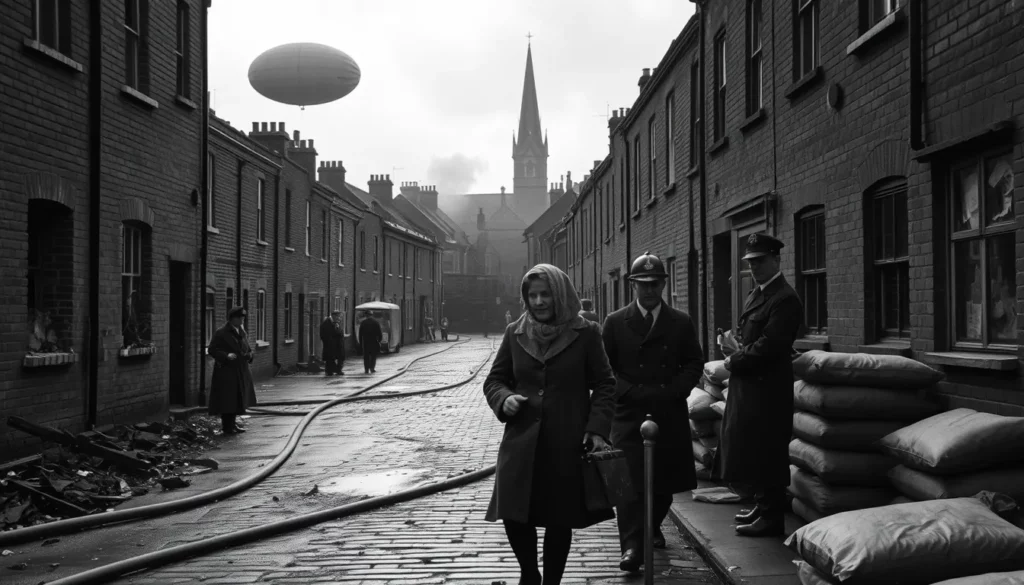
The climate in 1940 added to the city’s hardships. The early months brought a cold winter, and London’s familiar fogs and smoke-laden air sometimes mingled with blackout conditions. By late summer, warm weather made shelter life stifling, while autumn rains turned bombed streets to rubble and mud. The visual atmosphere was one of sandbags, barrage balloons, shuttered windows, painted kerbs, and dimmed lamps. Air-raid sirens, the drone of aircraft, and the crunch of glass underfoot became ordinary sounds. The blackout was not merely a precaution; it reshaped streets, shops, transport, and social life.
Population & Economy
Before the war, Greater London’s population was roughly 8.6 million, with about 4.1 million in the County of London. By 1940 evacuation, military service, and the return and departure of civilians had made any precise count difficult. The city remained diverse: dockworkers and casual labourers in the East End, a large Jewish community in Stepney and Whitechapel, Irish and Commonwealth residents, refugees from Nazi Europe, and a broad middle class of clerks, shopkeepers, civil servants, and professionals. The Blitz drove many families out to safer suburbs and reception areas, but thousands stayed or returned to protect homes and jobs.
The economy was increasingly a war economy. The Port of London, though disrupted, still handled essential goods; railways and lorries moved supplies; engineering works, clothing factories, printing houses, food processing plants, and munitions firms converted to wartime production. Finance and insurance continued in the City, while government offices expanded. Rationing began on 8 January 1940 for bacon, butter, and sugar, and later extended to meat and tea. Queues, ration books, and shortages became part of daily budgeting. Wages rose in some war industries, but prices, rents, and the cost of disruption pressed hard on poorer families. Women entered factories, buses, canteens, and civil defence in growing numbers.
Government & Politics
London had no Mayor of London in 1940. Administration was divided among the London County Council, the City of London Corporation, the metropolitan boroughs, and ad hoc wartime bodies. Civil defence was coordinated through the London Civil Defence Region, with air-raid precautions wardens, rescue parties, fire services, first-aid posts, and rest centres. On 10 May 1940 Winston Churchill became prime minister, leading a coalition government. John Anderson was initially Home Secretary and Minister of Home Security; in October Herbert Morrison took over both roles and became a powerful voice for London’s wartime administration.
Politics operated under emergency conditions. The Defence Regulations gave government wide powers over labour, property, movement, and information. Censorship shaped what newspapers could print, and local elections were postponed. Yet local politics did not disappear: borough councils argued over shelter provision, bomb damage, evacuation, and the treatment of the homeless. The Communist Party and pacifist groups faced suspicion, while trade unions negotiated wartime conditions. Public debate often focused less on ideology than on fairness: who had shelters, who received compensation, who was doing the dangerous work, and whether the poor were bearing an unequal share of the bombing.
Industry
London’s industry was varied and deeply embedded in its neighbourhoods. The docks and riverside works handled food, timber, coal, and raw materials; nearby factories processed sugar, flour, tobacco, and chemicals. Clothing and footwear trades clustered in the East End and north London. Printing and publishing remained important around Fleet Street and Holborn. Engineering and electrical firms produced components, tools, and military equipment, while transport workshops kept buses, trams, and trains running. The City’s banks, insurance houses, and commodity markets continued, often with staff moved to temporary offices outside London.
War production changed the workplace. Factories ran longer shifts, employed more women, and trained workers in new skills. Small workshops were drawn into subcontracting for aircraft, vehicles, and uniforms. Bomb damage disrupted production, but the pressure to keep going was intense. Diarists noted both the pride and the strain of war work, as well as the danger of commuting through blacked-out streets after long shifts.
Education
London’s schools were badly disrupted. Many children had been evacuated in September 1939, and further waves left in 1940 as bombing began. Some schools closed, others reopened in safer buildings, and many were used as rest centres, shelters, or civil defence posts. Teachers struggled to maintain lessons amid absent pupils, damaged buildings, and the psychological strain of raids. The London County Council, a major education authority, tried to keep schooling going where possible, but attendance was erratic.
Adult education and universities also adapted. The University of London and its colleges scattered some activities, stored materials, and coped with staff and student service. Literacy was high by 1940, and printed matter remained central to public information: posters, pamphlets, newspapers, and official notices advised citizens on shelters, gas masks, salvage, and rationing. For children, the war itself became a form of grim education, teaching them the geography of shelters, the meaning of sirens, and the sight of damage close to home.
Transportation
London’s transport system was large, crowded, and vulnerable. The Underground carried workers, shoppers, and service personnel; buses, trams, and trolleybuses served routes above ground; mainline railways brought commuters and goods into the city. The Thames remained a working artery for barges and ships. Blackout rules made travel difficult: vehicle lights were masked, street lighting was extinguished or reduced, and pedestrians risked accidents in the dark. Stations and shelters became nightly refuges for those whose homes lacked protection.
The Underground also became a symbol of the Blitz. Although government initially discouraged deep-shelter use, Londoners increasingly occupied tube stations at night, sleeping on platforms and stairs. Some stations were closed after bomb damage, and the Balham disaster of 14 October 1940 showed how dangerous the war could be even underground. Transport workers kept services running under difficult conditions, often repairing tracks and vehicles after raids.
Everyday Life
Daily life in 1940 was organised around uncertainty. Families queued for rationed food, patched clothes, and checked blackout curtains before dark. Many slept in Anderson shelters in gardens, Morrison shelters indoors, public shelters, or tube stations. Others stayed home and took their chances. Waking after a raid meant clearing debris, checking on neighbours, and finding ways to work or shop around closed streets.
Housing conditions varied sharply. Poorer families often lived in older terraces and crowded lodgings, while wealthier Londoners had more space and access to cars or country retreats. Bombing exposed these inequalities. Rest centres, the Women’s Voluntary Service, and local authorities provided blankets, tea, and temporary accommodation, but the homeless often faced bureaucratic confusion. Entertainment offered relief: cinemas, theatres, pubs, radio, dance halls, and libraries remained important where they could operate. Church services, street gossip, and letters from evacuated relatives sustained social ties. Humour, rumour, and fatalism helped people manage fear.
Major Events
The year opened with rationing and the continuation of the Phoney War, but events moved quickly after May. The German invasion of the Low Countries and the fall of France brought invasion fears to London. The Battle of Britain was fought in the skies over southern England in summer and autumn, and London became both a target and a symbol. On 7 September 1940 the Luftwaffe launched a major daylight raid on the capital and followed it with heavy night bombing. Raids continued through the autumn, hitting docks, railways, factories, and residential streets.
On 15 September, later commemorated as Battle of Britain Day, London saw heavy daylight attacks and fierce air fighting. On 14 October a bomb at Balham tube station caused heavy casualties and shocked sheltering Londoners. On 29 December, German incendiaries started fires across the City and surrounding districts in a raid remembered as the Second Great Fire of London. St Paul’s Cathedral survived, but many buildings were destroyed. These events made 1940 a defining year in London’s wartime memory.
What Newspapers Were Reporting
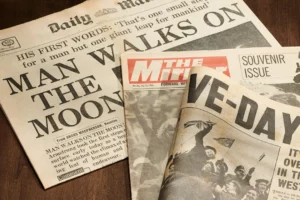
London newspapers such as The Times, the Daily Express, the Daily Mirror, the Evening Standard, and local papers like the East London Advertiser covered the Blitz under censorship and paper restrictions. They printed official communiques about raids, civil defence notices, shelter information, and appeals for blood donors, salvage, and fire watchers. Reports often emphasised morale and resilience, but they also carried lists of casualties, damaged streets, and disrupted transport.
Newspapers described royal visits to bombed areas, the work of ambulance and rescue crews, and the experiences of ordinary people made homeless overnight. They advised readers on blackout rules, gas masks, and ration books. Because precise military information was censored, newspapers often blurred the line between news and propaganda. Yet they remain valuable evidence of what the public was told, what was officially considered important, and how the Blitz was presented as a test of national character.
What People Were Talking About
Private accounts reveal concerns that newspapers often softened. Londoners discussed the safety of shelters, the behaviour of neighbours, rumours about spies and fifth columnists, the cost of food, and the fairness of evacuation. They argued about whether the rich were avoiding danger, whether looting was increasing, and whether enough was being done for the homeless. Diarists recorded the small details of scarcity, as in Anthony Heap’s entry for 17 December 1940:
"As in the last war we are now reduced to saccharine to supplement the sugar ration, our small stock of sugar is getting very much diminished." — The London Diary of Anthony Heap.
People also talked about fear and fatigue, but often with irony. The morning after a raid, neighbours compared damage, exchanged news of casualties, and tried to resume routine. Letters to evacuated relatives described empty streets, damaged shops, and the strange quiet after the all-clear. Mass Observation diarists and letter-writers recorded gossip about Churchill, the royal family, and the conduct of the war, while also noting the ordinary kindnesses that helped people endure.
Historical Photographs
The visual record of London in 1940 is extensive. City of London police photographers Arthur Cross and Fred Tibbs produced remarkable images of bomb damage in the City, often taken soon after raids. Their photographs show shattered office blocks, rubble-filled streets, damaged landmarks, and the disciplined work of rescue services. Press photographers recorded shelters, sandbagged buildings, barrage balloons, and civilians picking through wreckage. The famous image of St Paul’s Cathedral wreathed in smoke, taken by Herbert Mason on 29 December 1940, became an icon of survival.
These photographs are not neutral. They were selected, cropped, and published for particular purposes: to document damage, to reassure, to inspire, or to warn. They nevertheless preserve details that words miss: clothing, gestures, architecture, and the physical texture of ruin. Collections held by The London Archives, the Imperial War Museums, and newspaper archives allow historians to compare official images with private accounts.
Documents & Primary Sources
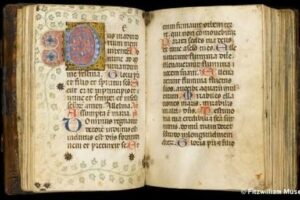
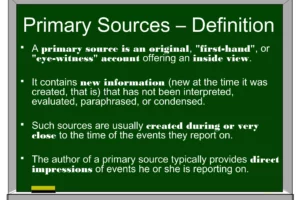
Historians of London in 1940 rely on a wide range of primary sources. Diaries and letters are especially valuable for private experience; the Anthony Heap diary, held by The London Archives, records raids, shelter life, rationing, and theatre-going. Mass Observation files capture everyday observations and public opinion. Official records include air-raid reports, civil defence logs, borough council minutes, and the London County Council bomb damage maps, which chart destruction at the level of individual properties.
Newspapers provide contemporary reporting and advertising, while photographs by Cross and Tibbs and press photographers supply visual evidence. Letters to relatives, evacuation records, ration books, posters, and oral histories add further detail. These sources must be read critically: diaries can be selective, newspapers censored, and photographs staged or framed. Taken together, however, they allow a rounded reconstruction of a city under bombardment.
1940 Timeline
| Date | Event |
|---|---|
| 8 January | Food rationing begins in Britain, including bacon, butter, and sugar. |
| 10 May | Winston Churchill becomes prime minister as Germany invades the Low Countries. |
| 22 June | France signs an armistice with Germany; invasion fears intensify in London. |
| 10 July | The Battle of Britain begins. |
| 7 September | First major daylight raid on London; night bombing follows. |
| 15 September | Heavy daylight attacks and fierce air fighting on Battle of Britain Day. |
| 14 October | Bombing at Balham tube station causes heavy casualties. |
| 29 December | Major incendiary raid known as the Second Great Fire of London. |
What Changed Next
The Blitz continued into 1941, with further heavy raids on London and other British cities until May. Londoners adapted to repeated disruption, but the cumulative strain was severe. Evacuation, shelter construction, and civil defence became more organised. The experience of 1940 helped shape postwar expectations of welfare, housing, and state responsibility for civilian safety. Bomb damage maps and rebuilding plans pointed toward the postwar reconstruction of London, including the County of London Plan and later projects such as the Lansbury Estate.
By 1945 the city had changed profoundly. The Blitz did not break London, but it scarred its streets and its people. The diaries, letters, newspapers, and photographs of 1940 remain essential evidence of how a great city endured the first months of sustained aerial attack.
Sources
- Bell, Amy Helen. London Was Ours: Diaries and Memoirs of the London Blitz. London: I.B. Tauris, 2008. Review: https://doi.org/10.5860/choice.46-5252
- The London Archives. London in the Second World War exhibition. https://www.thelondonarchives.org/visit-us/exhibitions/london-in-the-second-world-war
- Imperial War Museums. The Blitz. https://www.iwm.org.uk/history/the-blitz
- The National Archives. The Blitz. https://www.nationalarchives.gov.uk/education/resources/the-blitz/
- Mass Observation Archive, University of Sussex. https://www.massobservation.amdigital.co.uk/
FAQ
What was the population of London in 1940?
About 4.1 million people lived in the County of London, while Greater London had roughly 8.6 million before wartime evacuation. The 1940 figure is uncertain because evacuation and military service changed the population.
What major events happened in London in 1940?
Key events included the start of food rationing in January, Churchill becoming prime minister in May, the first major Blitz raid on 7 September, Battle of Britain Day on 15 September, the Balham tube disaster on 14 October, and the 29 December incendiary raid.
What primary sources are available for studying London in 1940?
Researchers use diaries such as Anthony Heap's, Mass Observation files, letters, newspapers, LCC bomb damage maps, air-raid reports, civil defence records, and photographs by Cross and Tibbs and press photographers.
How did daily life in London in 1940 differ from today?
Londoners faced blackout rules, rationing, air raids, shelter life, censorship, and disrupted transport and schooling. Everyday life was shaped by scarcity and danger in ways that have no direct modern equivalent.



Leave a Reply