
Short Answer
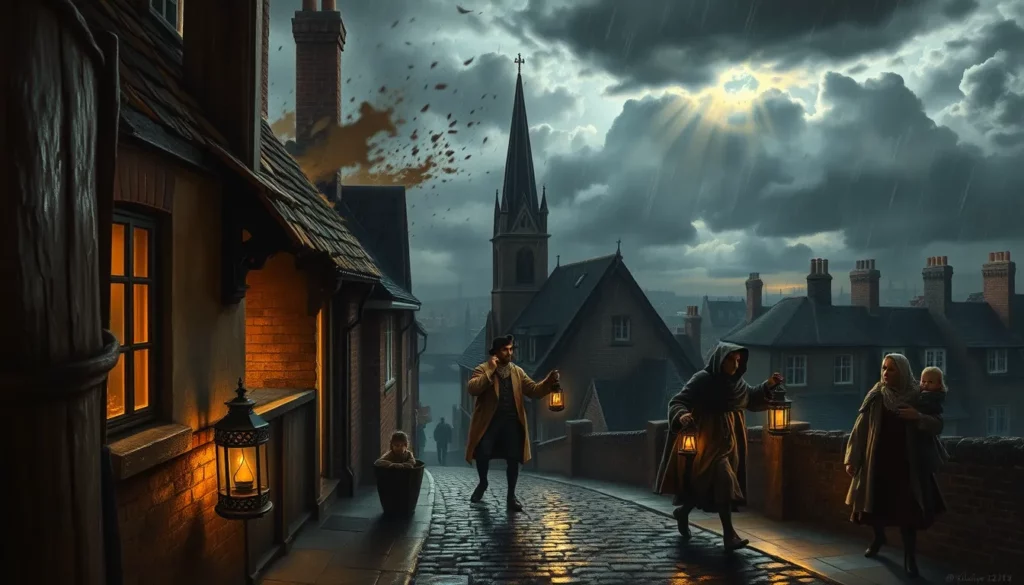
On the night of 26 November 1703 the wind over southern England rose out of the south-west and did not stop rising. By two in the morning tiles were flying through the streets of London, chimney stacks were down, and families who had gone to bed in ordinary weather stood in the road in their shirts. At St James’s Palace, where chimneys came down, Queen Anne was persuaded to leave her chamber; the tide was driven up the Thames over Westminster; and on the Goodwin Sands a squadron of the fleet was being beaten to pieces. Within weeks a pamphleteer named Daniel Defoe was advertising in the newspapers for eyewitness accounts — from clergymen, sea captains and country gentlemen — and asking, in effect, the question this article answers: how do you turn scattered human testimony into a trustworthy account of what the weather actually did?
The scope of this article is the method, not the storm as such. It concerns the practical reconstruction of a past event from historical weather records: instrumental readings, official notices, newspaper reports, ships’ logs, letters, diaries and printed compilations. The Great Storm of 1703 is used throughout as a worked example, because it is unusually well documented for its date and because its documentation exposes, very clearly, both the power and the limits of such records.
What Happened?
The tempest of 26–27 November 1703 — 7–8 December by the Gregorian calendar used on the Continent — is the best-documented weather event of its century in England. It was a deep Atlantic depression that crossed the south of Britain overnight, and the record of it survives in three kinds of evidence: instrumental readings, official and commercial print, and private testimony gathered after the fact. The chronology below is a compression of those sources.
- 24–25 November 1703. South-westerly gales damage shipping on the south coast; observers in several counties note falling barometers.
- Evening of 26 November. The wind strengthens sharply after dark; by midnight it is storm-force across the West Country, Wales and the Bristol Channel.
- Roughly 2 a.m. to 5 a.m., 27 November. The height of the storm over southern England and the Midlands. Roofs, chimneys and trees come down; the Thames is driven over its banks at Westminster; damage is reported from the Low Countries as well.
- 27 November. Henry Winstanley’s Eddystone Lighthouse is swept away with its keeper and workmen — Winstanley among them.
- 27 November. A squadron lying on the Goodwin Sands is destroyed; some thirteen men-of-war are lost and more than a thousand seamen drown.
- Late November–December 1703. Parish officers, shipowners and insurers begin compiling losses; collections are made for survivors and for the families of the drowned.
- Late December 1703. Defoe advertises in the London Gazette for written accounts from correspondents across the country.
- 1704. The Storm is published in London: a compilation of letters, reports and commentary, and the first substantial attempt in English to reconstruct a weather event from testimony gathered systematically.
Every line above is itself an interpretation. The times are local civil times, recorded by people without synchronised clocks. The casualty figures are aggregates of partial lists. The “event” has been defined in advance — a window of about thirty hours over a defined area — and a different window would produce a different account. That is the ordinary condition of weather reconstruction, and the rest of this article describes how it is done.
How It Was Seen at the Time
Contemporaries had two vocabularies for the storm and used both at once. The first was providential. Clergy read the wind as a judgment on a sinful nation, and the language of sermons and fast-day rhetoric — “the hand of God,” “a dreadful visitation” — saturates the printed literature of the winter of 1703–04. The second vocabulary was that of natural philosophy. Barometers were already common among the gentry; observers corresponded about the fall of the mercury as readily as about damage to their outbuildings.
Defoe’s own position is instructive for anyone using his book as a source. He was a Dissenter and a journalist, and he argued that the storm must be understood from natural causes while still calling it a warning. He also reached instinctively for the superlative, and this is the habit that most often misleads the later reader.
“the greatest, the longest in duration, the widest in extent, of all the tempests and storms that history gives any account of since the beginning of time” — Daniel Defoe, The Storm (1704)
That claim is not a measurement. It is a rhetorical frame that structured how the evidence was collected: correspondents were asked to supply instances of unprecedented damage, and they largely obliged. Contemporary readers took the storm to be exceptional, and the record they left is shaped by that expectation.
Historical Snapshot
| Aspect | Detail |
|---|---|
| Date | 26–27 November 1703 (Old Style); 7–8 December 1703 (New Style) |
| Place | Southern England, Wales, the Bristol Channel, the Thames estuary, the Downs and the Low Countries |
| People | Henry Winstanley, lighthouse keeper; Daniel Defoe and his correspondents; Queen Anne; naval and merchant seamen; parish clergy and churchwardens |
| What Happened | A deep Atlantic depression crossed southern Britain overnight; the Eddystone Lighthouse and a squadron on the Goodwin Sands were destroyed; thousands of houses, churches and ships were damaged or lost |
| Why It Mattered | It produced the first large-scale, deliberately organised collection of eyewitness weather testimony in English, and it became a benchmark against which later storms were measured |
Contemporary Newspaper Coverage
England in 1703 had a small, young and highly derivative press. The London Gazette, the official paper printed twice a week, carried government notices and restrained reports of public business. The Daily Courant, founded in 1702 and usually described as Britain’s first daily newspaper, reprinted foreign and domestic intelligence in a single folio sheet. Alongside them ran the partisan weekly post-boys and flying-posts, which traded in ship lists, casualty notices and advertisements.
For the reconstructor, the press is an index of what was being claimed rather than a measuring instrument. A Gazette notice establishes that a thing was officially acknowledged on a date; it does not establish that the thing happened as described. The commercial papers, hungry for copy, reprinted each other’s paragraphs almost verbatim, so three “independent” reports of a wrecked ship may trace back to one letter from one port.
The most valuable newspaper document of the whole event is an advertisement rather than a report. Defoe’s appeal for accounts, inserted in the London Gazette in the last days of December 1703, asked gentlemen and clergy across the country to send him written observations of what they had seen. It converted a scattered body of private memory into a single archive — and it is the reason later historians can compare Devon with Yorkshire, or a barometer reading in Norwich with a tide mark in the Thames.
Letters & Diaries
The Storm is, in substance, an edited archive of letters. Clergymen, schoolmasters, merchants and naval officers wrote in with accounts of the hour the wind peaked, the direction it came from, the state of the mercury, the damage to their parish, and the ships they had seen lost. Defoe trimmed, ordered and harmonised these accounts, and the modern reader must constantly ask where the correspondent stops and the editor begins.
Diaries are the more intimate record. A country gentleman who noted “the wind very high, the barometer low” on a particular morning was not writing for posterity; he was keeping a habit. That ordinariness is precisely what makes such entries useful, because they are less shaped by the desire to produce a memorable narrative than a letter written for publication. Diaries also supply the details that no newspaper carried: the price of tiles after the storm, the neighbours who sheltered in the church, the number of days the roads were impassable.
Two technical cautions govern all such material. First, dates in letters and diaries are local civil dates, and in 1703 England still used the Julian calendar while much of Europe used the Gregorian — an eleven-day discrepancy that has repeatedly led to the storm being dated 7–8 December in one source and 26–27 November in another. Second, times are approximate. “About two in the morning” is an honest estimate, not an observation, and a reconstruction that plots such times on a map must say so.
Official Reports
Official records for 1703 are fragmentary but indispensable. Admiralty and naval accounts list the ships lost and the men drowned; parish registers and churchwardens’ books record deaths and the cost of repairs to steeples and roofs; the Crown issued a brief authorising collections for the relief of sufferers, which generated its own paper trail of sums raised and distributed. These documents are sober, administrative and incomplete: they record what someone was prepared to pay for, not the weather itself.
The later history of official observation shows why such records matter so much to reconstruction. From 1724 the Royal Society, under its secretary James Jurin, coordinated a correspondence network of observers taking daily readings with comparable instruments — an early attempt to make weather recordable in a standard way. In 1854 the Board of Trade established a Meteorological Department under Robert FitzRoy, and after the wreck of the Royal Charter in the storm of October 1859, FitzRoy began issuing the first public storm warnings in 1861. Each of these developments changed what a weather record is: from a private observation, to a networked one, to an official forecast.
What the Sources Got Wrong
- The death toll was inflated in circulation. Printed and manuscript estimates in the weeks after the storm ran to figures well beyond what the parish and naval returns can support; modern accounts generally settle somewhere between 8,000 and 15,000 lives lost, with the uncertainty stated rather than hidden.
- Ship losses were double-counted. Because papers copied one another, the same vessel could appear three times under three spellings of her name. Any reconstruction that counts notices rather than distinct ships will overstate the fleet losses.
- The dating was, and remains, confused. Old Style and New Style dates are used interchangeably in older literature, so the same storm is dated 26–27 November in English sources and 7–8 December in Continental ones.
- “Hurricane” was a description, not a classification. Contemporaries called any violent wind a hurricane; the 1703 storm was an extratropical cyclone. Reading the word as a modern meteorological category is an anachronism.
- The famous boast may be anecdote. The story that Winstanley wished to be inside his lighthouse in the greatest storm that ever blew is repeated in later tellings but is not securely documented in contemporary testimony.
- Defoe edited his witnesses. The Storm is a work of compilation as much as of reportage; correspondents’ letters were abridged, reordered and sometimes moralised, so quotations taken from the printed book are quotations from Defoe’s edition of a witness, not from the witness directly.
How Historians See It Today
Modern scholarship treats the 1703 storm as a case in historical climatology rather than as a moral tale. Documentary evidence — letters, diaries, parish records, ships’ logs, printed notices — is converted into systematic indices of damage and wind direction, and those indices are then compared with instrumental series where any exist. The climatologist Hubert Lamb reconstructed the storm’s track and probable depth from exactly this kind of testimony, and his work remains the standard starting point.
What has changed is the surrounding technology. Reanalysis products such as the Twentieth Century Reanalysis, which reaches back to 1836, and ERA-20C, which begins in 1900, allow weather fields to be reconstructed for later periods with model assistance. Neither reaches 1703. For events before the nineteenth century, the documentary record is not a supplement to instrumental data — it is the only data there is. International efforts such as the Atmospheric Circulation Reconstructions over the Earth initiative and volunteer data-rescue projects have accordingly concentrated on finding, photographing and digitising exactly the sort of manuscript observations that Defoe solicited in 1703.
The historiographical shift, in short, has been from the anecdotal to the systematic: from repeating Defoe’s superlatives to asking what his correspondents could actually have observed, with what instruments, at what hour, and by whose calendar.
The lesson of the 1703 storm is that weather reconstruction is an act of disciplined reading rather than of retrieval. Defoe’s correspondents left a remarkable archive, but it is an archive shaped by the questions he asked them and by the superlative he wanted them to confirm. Used carefully — with dates converted, times qualified, duplicates removed and editorial hands acknowledged — those letters and notices can establish, within stated limits, what the night of 26 November 1703 was actually like. Used carelessly, they merely repeat a very old claim that no storm had ever been worse.
FAQ
What is the single most important step in reconstructing a past weather event?
Defining the question precisely before searching. “Was the afternoon ceremony wet?” and “Was that month wetter than usual?” require entirely different evidence, time windows and levels of certainty. Fix the place, the local date, the start and end times, and the specific weather quantity — rainfall amount, rainfall occurrence, temperature or wind — and write down the calendar convention you are using. Only then should the records be assembled.
Why is the Great Storm of 1703 used as a model example?
Because it produced the first large-scale, deliberately organised collection of eyewitness weather testimony in English. Daniel Defoe advertised in the London Gazette in December 1703 for written accounts from clergy and gentlemen across the country, and published the results as The Storm in 1704. The surviving material — letters, parish records, newspaper notices and naval returns — shows every stage of the reconstruction process, including its failures, in unusual detail.
Can modern reanalysis datasets be used to check a pre-1800 weather event?
Generally no. The Twentieth Century Reanalysis extends back to 1836 and ERA-20C to 1900. For the 1703 storm and other early events there is no model-based weather field to compare against, so the documentary record is the only evidence available. Reanalysis products are also model-assisted estimates rather than direct observations, and must not be treated as equivalent to a station gauge even for the periods they cover.
How should conflicting contemporary accounts be handled?
Explain the conflict rather than choosing the account that suits the desired narrative. Check whether the witnesses were describing the same place, hour and quantity; check whether one report derives from the other through newspaper copying; and check whether one is a first-hand observation and the other hearsay. Where the discrepancy cannot be resolved, state it as part of the finding — an acknowledged uncertainty is more valuable than a false precision.


Leave a Reply