
Short Answer
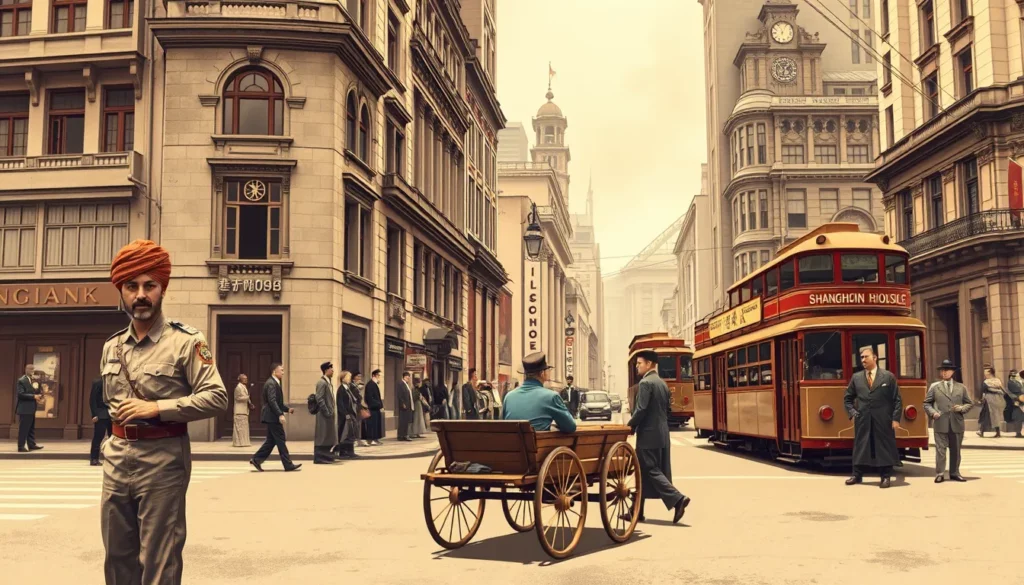
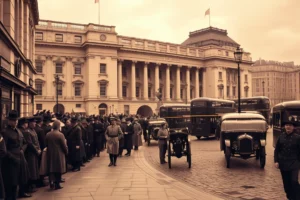
On an ordinary weekday morning in 1936, a walker at the corner of Nanking Road and the Bund could watch the whole machinery of Shanghai pass by: turbaned Sikh constables of the Shanghai Municipal Police directing traffic, rickshaw pullers hauling passengers toward the racecourse, trams crowded with clerks, and behind them the stone façades of the Hongkong and Shanghai Bank and the Chinese Maritime Customs House. A few hundred yards north, across Soochow Creek, lay Chinese-governed Chapei — a different jurisdiction, with different laws, taxes and police. Shanghai in the 1930s was not one city but three: the International Settlement, the French Concession, and the Chinese Municipality of Greater Shanghai. Together they held well over three million people, making Shanghai one of the largest cities on earth, and certainly the most unequal. In the same week that the Cathay Hotel’s dance band played for tiffin, refugees from the Yangtze delta were nailing together huts of bamboo and matting on the Settlement’s northern fringes — and a Japanese army was preparing to move south.
What Happened?
The Shanghai of the 1930s was the product of the treaty system. After 1842 foreign powers had acquired land in Shanghai where they exercised extraterritorial rights, and by the 1930s the International Settlement — administered by the ratepayer-elected Shanghai Municipal Council (SMC), British-dominated but internationally staffed — and the French Concession had become self-governing municipal entities inside China. They ran their own police, courts, fire brigades, public utilities, schools and health departments. The Chinese majority inside the Settlement had no vote in SMC elections and only limited representation. Around them, the Nationalist government, which had established the Municipality of Greater Shanghai in 1927, built its own modern city government in Chapei and Nantao, complete with a civic centre, a hospital and a stadium.
The decade’s rhythm was set by war, migration and money:

- 1930–1931: The Settlement’s population passes one million. The SMC, alarmed by the spread of penghu qu (hut-dwelling areas), adopts a quota-based clearance programme aimed at demolishing ten per cent of hut dwellings each year. In the same year the Feetham Report, commissioned by the SMC, examines the Settlement’s constitutional future and concedes that its anomalous status cannot last forever.
- January–May 1932: Japanese naval forces attack Chinese-held Chapei after anti-Japanese boycotts; the Chinese 19th Route Army resists for weeks. Tens of thousands of Chinese civilians flee across the creek into the Settlement and French Concession. A truce is signed on 5 May 1932, leaving Chapei in ruins.
- 1934–1935: The silver crisis and the Nationalist currency reform of November 1935 unsettle Shanghai’s banks and factories. The city’s skyline reaches its pre-war peak with the Park Hotel and the Bank of China building.
- 13 August 1937: Full-scale battle erupts in Shanghai. Chinese and Japanese forces fight street by street; the SMC declares the Settlement neutral. Chinese troops withdraw in mid-November, and the foreign concessions become an enclave surrounded by Japanese-occupied territory.
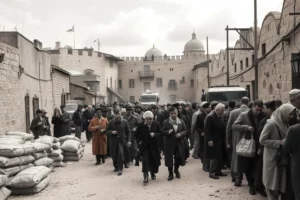
- 1937–1941: The gudao, or “Isolated Island,” period. Hundreds of thousands of refugees pour into the Settlement and French Concession. Relief committees open camps in schools, factories and public buildings. From 1938 Jewish refugees from Germany, Austria and Poland begin arriving in Hongkew, the only place in the world then requiring no visa. Assassination and bombing campaigns between rival Chinese political factions make 1939 the bloodiest year for terrorism in the city’s history.
- 8 December 1941: Japanese troops enter the International Settlement, ending foreign municipal rule.
How It Was Seen at the Time
Contemporaries understood Shanghai as a paradox rather than a place. Foreign journalists and travel writers called it the “Paris of the East” and, less flatteringly, the wickedest city in the world; the SMC preferred to describe the Settlement as a “model municipality,” pointing to its paved roads, filtered water, hospitals and low foreign mortality. Chinese nationalists described it as a semi-colony — a foreign bridgehead on Chinese soil — and demanded the return of the concessions. Reformers of every nationality described the hut districts as a scandal.
Foreign residents voiced their discomfort in the letters columns of the local English-language press, where slums were complained of as an eyesore and an embarrassment:
“…offensive to the eye…” — phrase used by foreign residents writing to the Shanghai newspapers about the hut dwellings on the Settlement’s edges, as recorded in Shanghai Municipal Council records of the 1930s.
Yet the same sources show the ambiguity of the moment. The SMC’s own officers justified demolition in the language of public health and fire risk, not aesthetics: thatched huts without drainage were described as breeding grounds for epidemic disease and as tinder for the conflagrations that periodically swept the Chinese districts. Chinese residents, meanwhile, pointed out that the huts existed because the Settlement’s factories paid wages that could buy nothing better, and that clearing them merely pushed the poor elsewhere. By 1937 the dominant mood among Shanghai’s foreign community was no longer confidence but a brittle, defensive optimism: the Settlement had survived 1932, it had kept out of the 1937 war, and many believed its international status would protect it again.
Historical Snapshot
| Aspect | Detail |
|---|---|
| Date | 1930–1941, with the decisive turning points in 1932, 1937 and 1939 |
| Place | Shanghai: the International Settlement, the French Concession, and the Chinese Municipality of Greater Shanghai (Chapei and Nantao) |
| People | Roughly 1.2 million Chinese and some 40,000 foreigners in the International Settlement on the eve of the 1937 war; the Shanghai Municipal Council and its police; French municipal authorities; Chinese residents and refugees; Japanese military and consular officials; foreign journalists and missionaries |
| What Happened | A foreign-administered treaty port became the refuge of a nation at war, absorbing wave after wave of Chinese migrants and refugees while its municipal authorities struggled to house, police and clear the resulting slums |
| Why It Mattered | Shanghai was the test case of the treaty system: a modern city governed by foreigners inside a sovereign state, and the model for later debates on extraterritoriality, refugee relief and urban planning in China |
Contemporary Newspaper Coverage
Shanghai had one of the densest press landscapes in Asia. The British-owned North-China Herald, the American China Press and Shanghai Evening Post and Mercury, the French-language Journal de Shanghai, and the great Chinese dailies Shenbao and Xinwen Bao all competed for a reading public that spanned nationalities. Coverage of the refugee crisis in the winter of 1937–38 was extensive and often highly specific: reporters described camps by address and capacity, listed the numbers fed per day, and appealed for donations of cotton quilts and rice. The foreign press treated the 1937 battle as a spectacle visible from the rooftops of the Settlement — correspondents watched the Chinese lines at Chapei burn from the roof of the Cathay Hotel — while the Chinese press, operating under Japanese pressure and SMC censorship, struggled to report the war at all.
The tone varied sharply. The North-China Herald combined humanitarian sympathy with a persistent editorial defence of the Settlement’s neutrality; the Chinese papers dwelt on the suffering of refugees and the humiliation of foreign rule. After 1937 the Japanese military demanded pre-publication censorship of Chinese-language newspapers in the concessions, and the SMC, anxious to preserve its neutrality, suppressed anti-Japanese material in the press it licensed. Contemporary readers knew that what they read was incomplete.
Eyewitness Accounts
Few visitors left better accounts than the British writers W. H. Auden and Christopher Isherwood, who reached Shanghai in 1938 while collecting material for Journey to a War. What they recorded was not the Bund of the guidebooks but the refugee city behind it: the crowded camps, the hospital wards, and the sheer scale of displacement. Auden’s sonnet sequence In Time of War, written from that journey, opens one poem with a line that catches the era’s helplessness:
“They are and suffer; that is all they do…” — W. H. Auden, In Time of War (1939), written after his 1938 journey through wartime China.
The American journalist Emily Hahn, who lived in Shanghai through the late 1930s, wrote in her memoir China to Me (1944) of a city where the foreign community’s pleasures — race meetings, dinner parties, servant-keeping — continued almost unchanged within a few streets of destitution, and where an air raid could be watched from a rooftop with a cocktail in hand. Ernest O. Hauser, a correspondent for American and European papers, published Shanghai: City for Sale in 1940 as an eyewitness indictment of the city’s politics, documenting the workings of gangsters, Japanese agents and municipal administrators with whom he had dealings. Missionary and Red Cross workers who ran the camps left the most detailed testimony of all: case notes, feeding returns and letters home describing families living eight to a hut.
Daily Life
Daily life in 1930s Shanghai was organised around the boundary lines. A Chinese clerk living in a shikumen lane house might work in a Settlement office, send his children to a Chinese school in Chapei, and cross two police jurisdictions on his morning tram ride. Rents, wages and food prices differed from district to district; so did the hours of curfew and the licensing of rickshaws, street hawkers and brothels. Nanking Road and the Bund formed the showcase of foreign Shanghai, with department stores — Wing On, Sincere, Sun Sun — advertising imported fabrics, gramophones and refrigerators in the Chinese-language press.
Beyond the shop windows the material conditions were harsh. A typical hut in the penghu qu was built of bamboo poles with matting walls and a thatched roof, perhaps eight by fifteen feet in floor area, with no drainage and no running water; residents could barely stand upright inside. Rickshaw pullers, dock labourers and mill hands lived on rice, vegetables and salted fish, and the poorest depended on the charity of native-place associations and temples. At the other end of the scale, the Shanghai Club on the Bund served the longest bar in the world, the Race Club held its spring and autumn meetings, and the Cathay Hotel’s ballroom offered a floor show that visiting Hollywood performers rated against any in Asia.
Different Perspectives
The Shanghai Municipal Council and foreign ratepayers
The SMC presented itself as a small, efficient government doing a difficult job under permanent siege. Its annual reports dwell on sewage, roads, epidemic control and police strength; its council minutes show a body convinced that the Settlement’s prosperity depended on neutrality and on not provoking either the Chinese government or the Japanese military. To foreign ratepayers the concession was a commercial asset and a civic achievement; to its critics it was a machine for protecting property.
Chinese residents and the Nationalist state
Chinese residents paid most of the Settlement’s rates but had no share in its government. Nationalist officials in Nanking treated the concessions as an affront to sovereignty and pressed for their return, while Shanghai’s Chinese-language press campaigned against the slum clearances, the licensing of opium and prostitution, and the police treatment of Chinese demonstrators. When the SMC demolished huts, Chinese opinion saw a foreign administration displacing Chinese families to improve the foreign residents’ view.
The Japanese military
Japanese spokesmen insisted that the Settlement harboured anti-Japanese agitators and Nationalist agents, and demanded that the SMC suppress Chinese resistance activity. After 1937 Japanese checkpoints ringed the concessions, searches and arrests became routine, and the Settlement’s neutrality survived only on Japanese sufferance.
Refugees
For the hundreds of thousands who crossed into the Settlement in 1932 and 1937, the foreign concessions meant safety, however grudging. Refugee testimony from the camps emphasises the loss of home and livelihood rather than politics: the difficulty of finding work, the constant fear of being moved on, and the strange experience of living under foreign police in a Chinese city.
Numbers at the Time
| Figure | Detail and source |
|---|---|
| Population of the International Settlement, 1937 | About 1,180,000 Chinese and 39,750 foreigners, according to Shanghai Municipal Council returns |
| Population of Greater Shanghai, mid-1930s | Over three million, by municipal estimates — among the largest urban populations in the world |
| Refugees in organised camps, early 1938 | More than 200,000 registered in Settlement camps, with several hundred thousand more sheltering with relatives or in the streets, by relief committee figures |
| Jewish refugees in Shanghai, 1938–1941 | Roughly 17,000–20,000, most of them housed in Hongkew, according to refugee aid society records |
| Hut-dwelling clearance quota, from 1931 | Ten per cent of hut dwellings to be demolished annually, per Shanghai Municipal Council policy |
The 1930s taught Shanghai’s residents that a city can be modern and fragile at the same time. The settlements built Asia’s most advanced urban infrastructure, and they did so on a foundation of exclusion — of Chinese ratepayers from political power, of the poor from decent housing, and eventually of the city’s very survival from the decisions of foreign armies. The primary sources record both sides without resolving them: the municipal report measuring progress in feet of road laid, the refugee’s letter describing a hut eight feet square. When Japanese troops entered the International Settlement on 8 December 1941, the treaty port ended; what remained was the memory of a place where the twentieth century’s promises of modernity, asylum and self-government had all been tested at once.
FAQ
What were the 'International Settlements' in 1930s Shanghai?
Strictly there was one International Settlement, administered by the Shanghai Municipal Council, alongside a separate French Concession. Both were foreign-governed districts inside China, established under the treaty system, with their own police, courts, taxes and public services. Chinese residents formed the overwhelming majority of the population but had no meaningful share in the government of the International Settlement.
Why did so many refugees go to Shanghai in the 1930s?
The foreign concessions were the safest places in the region during the 1932 and 1937 fighting, because the Japanese did not occupy them until December 1941. Chinese civilians fleeing Chapei, the Yangtze delta and the wider war zone crossed into the Settlement and French Concession by the hundred thousand. From 1938 Shanghai also became the last open door for Jewish refugees from Germany, Austria and Poland, because no visa was required to enter.
What was the 'Isolated Island' period?
After Chinese forces withdrew from Shanghai in November 1937, the foreign concessions remained unoccupied but were entirely surrounded by Japanese-controlled territory. Chinese contemporaries called this the gudao, or 'isolated island', a period running until the Japanese entered the International Settlement on 8 December 1941. It was marked by refugee relief, gangland assassinations, censorship and a strange, defiant boom in nightlife and publishing.
How did the Shanghai Municipal Council deal with slums?
From 1931 the Council adopted a quota system aimed at demolishing ten per cent of hut dwellings each year, justifying it on grounds of fire risk and epidemic control. Police reports show that demolition was carried out with force only when resistance could not be managed otherwise, and that cleared residents were usually left to find shelter elsewhere rather than rehoused.










Leave a Reply