
Short Answer
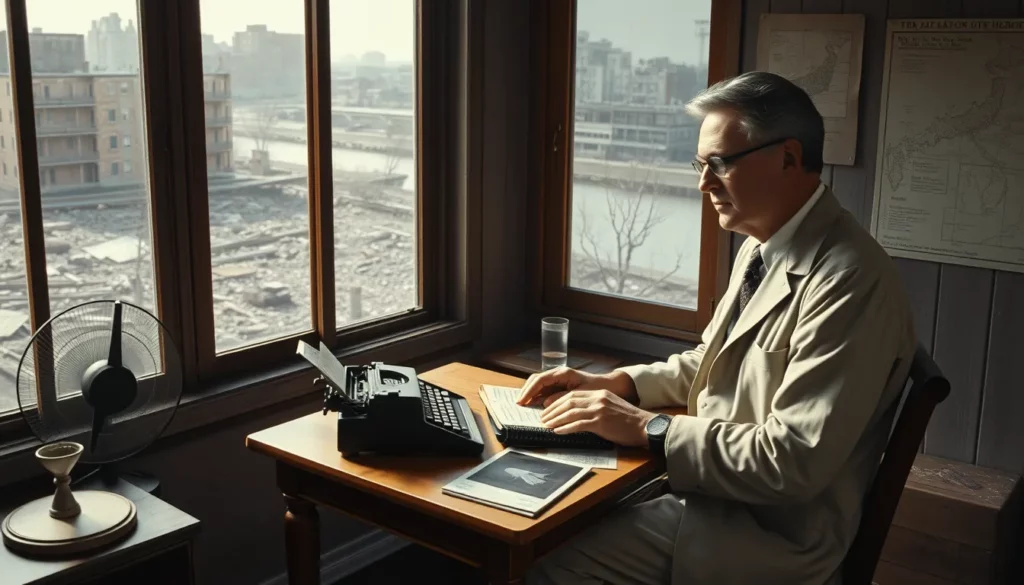
On the morning of August 31, 1946, readers who picked up the new issue of The New Yorker found no cartoons, no fiction, no “Talk of the Town.” The editors had warned that the entire number “will be devoted entirely to just one article on the almost complete obliteration of a city by one atomic bomb.” A year after the United States had dropped atomic bombs on Hiroshima and Nagasaki, Americans had seen maps, mushroom clouds, official announcements, and photographs of broken roofs and rubble. They had heard far less about what the bomb had done to human bodies and human lives. John Hersey, a former Time and Life correspondent and Pulitzer Prize-winning novelist, had spent three weeks in Hiroshima that May. His article followed six survivors—a clerk, a pastor, a Jesuit priest, a widow, and two doctors—through the morning of August 6, 1945, and the days that followed. In quiet prose, it placed readers beside the wounded in a riverside grove and inside hospitals where radiation sickness baffled physicians. This article explains how Hersey reported “Hiroshima,” what contemporaries understood from it, and why its publication became a turning point in American memory of the atomic bomb.
What Happened?
Hersey’s “Hiroshima” did not appear in a vacuum. On August 6, 1945, a B-29 Superfortress, the Enola Gay, dropped a uranium bomb nicknamed Little Boy on Hiroshima. The blast and fires destroyed much of the city; tens of thousands died at once, and more died in the following weeks and months from burns, injuries, and radiation. On August 9, a second atomic bomb struck Nagasaki. Japan announced surrender on August 15, and the war ended formally on September 2. Under the U.S. occupation, access to the bombed cities was controlled, and press reports were subject to censorship. Official accounts often emphasized the bomb’s destructive power and the speed with which it ended the war; the human details of radiation sickness and prolonged suffering were slower to reach American readers.
John Hersey was born in Tientsin, China, in 1914 to missionary parents. He graduated from Yale in 1936 and became a foreign correspondent for Time and Life, reporting from Asia, Italy, and the Soviet Union. In 1944 he won the Pulitzer Prize for his novel A Bell for Adano. In May 1946, on assignment for The New Yorker, he went to Hiroshima and spent about three weeks interviewing survivors. He selected six people whose experiences he could reconstruct in detail:

- Miss Toshiko Sasaki, a young clerk injured by falling debris and left waiting for treatment.
- Rev. Kiyoshi Tanimoto, a Methodist pastor.
- Father Wilhelm Kleinsorge, a German-born Jesuit priest.
- Mrs. Hatsuyo Nakamura, a widow with young children.
- Dr. Masakazu Fujii, a physician whose private hospital was wrecked.
- Dr. Terufumi Sasaki, a surgeon at the Red Cross Hospital.
The resulting article ran in four chapters in the August 31, 1946, issue of The New Yorker. It was not a statistical survey or a policy argument. Hersey used plain description, elapsed time, and close attention to ordinary objects—a tin of crackers, a ruined sewing machine, a hospital corridor—to show how the bomb had entered and shattered daily life. The issue was immediately notable; it was later published as a book and became one of the most widely read works of American journalism about the atomic age.
How It Was Seen at the Time
For many American readers in 1946, the atomic bomb was still a public event before it was a human one. Victory headlines, government statements, and photographs of ruins had framed it as a new force in warfare. The New Yorker’s editors believed that gap in understanding was dangerous. In the issue’s announcement they wrote that “few of us have yet comprehended the all but incredible destructive power of this weapon, and that everyone might well take time to consider the terrible implications of its use.” Hersey’s article answered that need not with argument but with intimacy.
Contemporary readers encountered a narrative that seemed almost unbearably calm. Hersey did not shout. He described burns, diarrhea, hair falling out, purple spots on skin, and the strange silence of the wounded. One passage became especially associated with the article:
“The hurt ones were quiet; no one wept, much less screamed in pain; no one complained; none of the many who died did so noisily; not even the children cried; very few people even spoke.”
The effect was to make Japanese survivors visible as individuals with names, habits, families, and jobs. At a time when wartime propaganda had encouraged Americans to see the enemy in abstract terms, Hersey’s six survivors were particular people. The article did not tell readers what to think about the decision to use the bomb. It showed them what the bomb had done. That restraint was part of its power. The issue became a topic of conversation and was soon reprinted in book form, carrying the testimony beyond The New Yorker’s usual readership.
Historical Snapshot
| Aspect | Detail |
|---|---|
| Date | August 31, 1946 |
| Place | New York City (publication); Hiroshima, Japan (subject) |
| People | John Hersey; The New Yorker editor William Shawn; six Hiroshima survivors |
| What Happened | The New Yorker devoted an entire issue to Hersey’s four-chapter article “Hiroshima.” |
| Why It Mattered | It brought the human cost of the atomic bomb—burns, radiation sickness, grief, and survival—to a mass American readership. |
Contemporary Newspaper Coverage
The primary publication was a magazine, The New Yorker, rather than a newspaper, but its arrival was treated as a press event. The August 31, 1946, issue carried Hersey’s article as the whole number. The editors’ announcement was explicit about why they had surrendered an entire issue to one story:
“The New Yorker will be devoted entirely to just one article on the almost complete obliteration of a city by one atomic bomb.”
The magazine’s ordinary mix of reporting, criticism, fiction, and humor disappeared. For readers accustomed to the magazine’s urbane voice, the substitution was itself a signal that the atomic bomb demanded a different register. Hersey’s prose avoided official jargon. It did not begin with tonnage, blast radius, or casualty tables. It began with people and followed them through time. Newspaper and wire-service readers had already encountered casualty figures and descriptions of ruin, but Hersey’s sustained narrative offered something different: a way to stay with the victims rather than turn away after the first paragraph. The demand for copies and the swift book publication showed that the article had reached beyond the magazine’s normal audience.
At the same time, the coverage should not be romanticized as an immediate end to censorship. The occupation authorities still controlled access to Hiroshima and Nagasaki, and official reports continued to shape what could be verified. Hersey’s achievement was to work within those limits and to make the human evidence impossible to dismiss.
Eyewitness Accounts
Hersey’s article is built from survivor testimony, and its most disturbing passages are often the least rhetorical. Rev. Kiyoshi Tanimoto described the injured he encountered:
“They had great burns … yellow at first, then red and swollen with skin sloughed off and finally in the evening suppurated and smelly.”
Father Wilhelm Kleinsorge, the German Jesuit, suffered from what doctors then did not fully understand. Hersey records that Kleinsorge “complained that the bomb had upset his digestion and given him abdominal pains”; his white blood count rose to seven times normal, and he ran a temperature of 104 degrees. Mrs. Hatsuyo Nakamura, whose husband had died in the war, struggled to care for her children while suffering nausea and weakness. Miss Toshiko Sasaki waited for treatment with a badly damaged leg. The two doctors, Fujii and Sasaki, moved through scenes of death and injury, treating patients with whatever supplies remained.
What Hersey captured was not only physical injury but social rupture: families separated, neighbors searching, doctors exhausted, and the living uncertain whether the apparently uninjured would soon die. The article’s eyewitness material made radiation sickness a human experience rather than a rumor. Readers learned that the bomb’s violence did not end when the fires went out.
What the Sources Got Wrong
The most significant errors and omissions of 1945–46 were not simple fabrications but failures of official and journalistic framing. Early official accounts and censored press dispatches tended to emphasize the bomb’s blast effect, the scale of destruction, and the claim that it had shortened the war. They gave less attention—or actively minimized—the lingering effects of radiation. In the first months after the attacks, American readers could find photographs of shattered Hiroshima and Nagasaki and statements from military officials, but the suffering of survivors was often reported through numbers or vague references to “atomic illness.” The U.S. occupation’s control over access to the cities made independent verification difficult.
Hersey’s article did not invent radiation sickness; it made it concrete. It showed patients with fevers, nausea, hair loss, and blood disorders at a time when some officials and even some physicians were uncertain how to describe them. Modern research has confirmed the long-term health consequences of radiation exposure and has documented the scale of suffering more fully. The sources were therefore not wrong about the bomb’s power, but they were misleading by omission: they allowed Americans to understand the bomb as a spectacular weapon while leaving the human aftermath in shadow. Hersey’s reporting corrected that emphasis, though it too was selective: six survivors could not represent every victim, and his focus on a particular group left other stories, including those of Korean forced laborers and colonial subjects, largely outside the American frame.
Aftermath
The immediate aftermath of publication was a widening of the audience. The New Yorker issue drew intense attention, and Hiroshima was issued as a book by Alfred A. Knopf in 1946. It circulated through libraries, schools, and discussion groups. Readers who had followed the war through headlines now encountered the bomb through the experience of a clerk, a pastor, a widow, and a doctor. The article helped shift public language from triumphalism toward unease and moral questioning. It did not reverse American nuclear policy, and it did not end censorship in occupied Japan, but it made the human cost of atomic warfare part of the common American vocabulary.
Hersey’s later career took him in many directions, but Hiroshima remained the work with which he was most identified. In 1985 he returned to the subject in a new edition, adding a final chapter that followed the survivors into later life. By then the article had become a historical document in its own right—evidence of what Americans were permitted to know in 1946 and of what one reporter chose to show them.
How Historians See It Today
Historians now generally treat Hiroshima as a landmark of narrative journalism rather than the first report from the bombed city. Journalists had already described the ruins, and official reports had already measured the blast. Hersey’s innovation was formal: he slowed the story down, followed six lives across time, and trusted concrete detail to carry moral weight. Scholars often credit the article with helping to create a postwar American vocabulary for the atomic age—one in which the bomb was not only a weapon of victory but a source of human suffering and existential fear.
Modern scholarship also places the article in a critical frame. Hersey wrote for an American audience in the early Cold War, and his choice of six “ordinary” survivors reflected the access and conventions of his moment. The article’s restraint, so powerful to contemporary readers, has been analyzed as a deliberate literary strategy that avoided direct political argument. Historians note that it did not settle debates over the bombing’s morality or necessity; instead, it changed the terms in which ordinary readers could imagine the bomb’s victims. Its reputation has endured because it joins reportage to novelistic craft without abandoning the documentary record.
Hersey’s Hiroshima teaches a double lesson about primary sources. The official record can tell us what a government measured and chose to release; eyewitness testimony tells us what a weapon did to a body, a family, and a city. Hersey did not have to exaggerate. He had only to listen closely and write plainly. The article’s endurance lies in that plainness: a reader in 1946, and a reader now, can still see the wounded in the riverside grove and hear the unnerving quiet. It remains a reminder that the most consequential reporting often does not add a new argument but restores a missing human face to an event already declared historic.
FAQ
Was John Hersey the first journalist to report on Hiroshima?
No. Other journalists and newsreels had reported on the bomb’s aftermath, but Hersey’s 1946 New Yorker article was distinctive for its sustained, human-centered narrative of six survivors. It did not introduce the event but changed how many Americans understood its human cost.
Why did The New Yorker devote an entire issue to Hiroshima?
The editors believed few Americans had grasped the weapon’s destructive power and its implications. They gave Hersey’s article the whole issue to force readers to confront the human testimony without the usual distractions of a magazine.
Did Hersey’s article end U.S. censorship in occupied Japan?
No. Occupation authorities continued to control access and information, but Hersey’s reporting made the human effects of radiation and burns widely known and increased pressure for a fuller public accounting.










Leave a Reply