
Short Answer
Quick Snapshot
In April 1974 Lisbon was the capital of Western Europe’s longest-lived authoritarian regime. The Estado Novo, or New State, had governed Portugal since the 1920s; after António de Oliveira Salazar’s incapacitation in 1968, Marcello Caetano presided over a system still marked by censorship, a political secret police, colonial war, and restricted elections. The city was a port capital of trams, crowded tenements, government offices, cafés, and official ceremony, but also of fear and rumour.
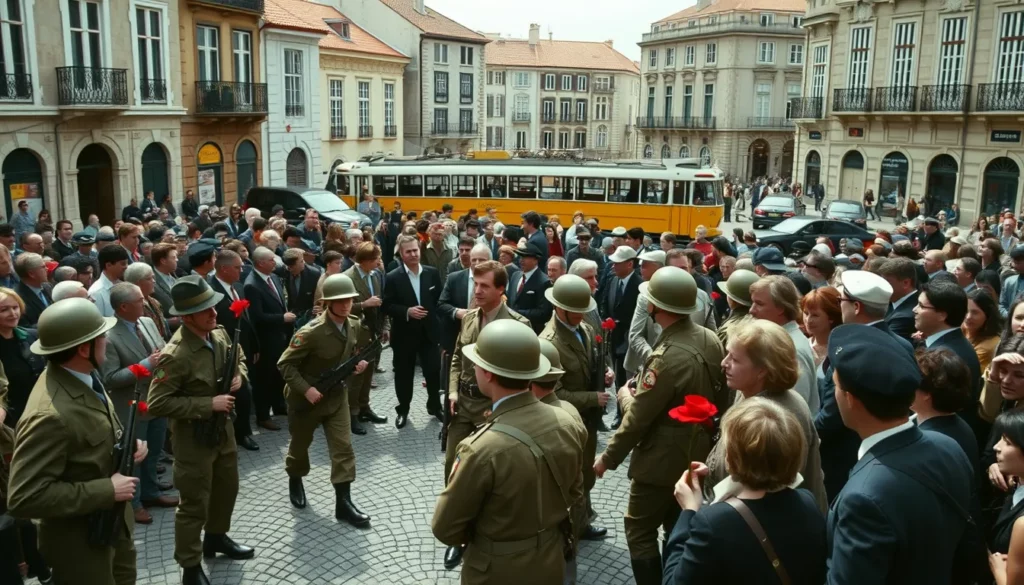
On the morning of 25 April 1974, officers of the Armed Forces Movement, the MFA, began a coup that rapidly became a popular uprising. Armoured vehicles moved through Lisbon, crowds gathered, and soldiers were soon carrying red carnations in their rifle barrels. By the end of the day Caetano had surrendered at the Largo do Carmo, the dictatorship had collapsed, and Lisbon had become the centre of a new political experiment.
The year that followed was not simply a festival of freedom. The end of censorship and the secret police opened public life, but colonial wars, food prices, wages, housing, decolonisation, and rival political projects made 1974 a year of hope and uncertainty. Contemporary newspapers, photographs, and eyewitness accounts capture a city stunned by the speed of change and uncertain about what would come next.
Lisbon in 1974
Lisbon sits at the mouth of the Tagus, built across steep hills that run down to the river. In 1974 its old neighbourhoods, Alfama, Mouraria, Bairro Alto, and the Baixa, were dense with narrow streets, tiled façades, small shops, and tram lines. The broad Avenida da Liberdade and the Praça do Comércio framed the formal capital; the docks, railway stations, and ferries linked it to the Atlantic economy and to the south bank. The bridge over the Tagus, then still named Ponte Salazar, was renamed Ponte 25 de Abril after the revolution.
The atmosphere in early 1974 was contradictory. Official Portugal still staged ceremonies and censorship, while families worried about sons and husbands drafted into the colonial war in Angola, Mozambique, and Guinea. The political police, PIDE, later DGS, was a visible and feared presence. Yet Lisbon also had a lively press, cinema, football, fado, and café culture. After 25 April the city’s public spaces became forums: crowds gathered at Rossio, outside newspaper offices, at barracks, and in front of prisons.
Contemporary photographs show a capital still physically old-fashioned: cars of the 1960s, trams, men in suits and caps, women in modest dresses, soldiers in olive drab, and buildings blackened by smoke and sea air. The revolution did not modernise Lisbon overnight; it revealed the city as it was, with its poverty, its provincial bureaucracy, and its sudden appetite for politics.
Population & Economy
Lisbon’s municipality had roughly 760,000 inhabitants in the early 1970s, while Greater Lisbon, including the south bank and neighbouring municipalities, approached 1.5 million people. The city was growing through rural migration, and its population was younger than much of rural Portugal. In 1974 the first retornados, Portuguese settlers returning from Africa, had not yet arrived in large numbers; their movement would become a major social issue as decolonisation advanced.
The Lisbon economy rested on the port, commerce, banking, insurance, government service, and light manufacturing. The metropolitan area included shipbuilding and heavy industry, notably at Lisnave and in the Barreiro area, as well as textiles, food processing, cork, printing, chemicals, glass, construction, and tourism. Dock labour was important, but wages were low and many families depended on several incomes. Inflation and shortages were already troubling consumers before April; after the revolution, strikes and political uncertainty added to economic anxiety.
Prices were quoted in escudos. A coffee cost only a few escudos, and basic foodstuffs were cheap by later standards, but rents, transport, and fuel consumed a large share of ordinary wages. The colonial war absorbed nearly 40 per cent of the national budget by the early 1970s, a burden that shaped both taxation and public investment. In 1974 Lisbon’s economy was not collapsing, but it was under strain, and the new government faced immediate pressure to raise wages, control prices, and restore confidence.
Government & Politics
Before 25 April Lisbon was governed through appointed municipal and civil authorities loyal to the Estado Novo. There was no elected mayor in the modern democratic sense. President Américo Tomás and Prime Minister Marcello Caetano headed the national regime, while PIDE/DGS policed dissent. Political opposition existed, but it was forced underground or into cautious legal channels. The MFA coup destroyed this system with unexpected speed.
On 25 April Caetano surrendered at the Largo do Carmo to General António de Spínola, a former colonial commander whose prestige gave the coup an early figurehead. A Junta de Salvação Nacional took power, and the old president and prime minister were deposed. Key military figures included Spínola, Francisco da Costa Gomes, Otelo Saraiva de Carvalho, and Salgueiro Maia, the officer whose armoured column entered Lisbon and surrounded the Carmo barracks. On 15 May a First Provisional Government took office under Adelino da Palma Carlos, with Spínola as President of the Republic; Vasco Gonçalves later replaced Palma Carlos in July.
Political life exploded. Communists, Socialists, Social Democrats, Christian Democrats, and radical left groups competed for public attention. Workers’ commissions, neighbourhood committees, and student groups emerged. The revolution was broadly left-leaning in its rhetoric, but its direction was contested. Lisbon cafés and newspaper offices buzzed with arguments about democracy, socialism, decolonisation, and the role of the military. Fear of a right-wing reaction, and fear of communist influence, were both present in 1974.
Industry
Lisbon’s industry was inseparable from its port and its metropolitan hinterland. Dock work, warehousing, shipping agencies, and customs employed thousands. The city itself had printing houses, food and drink processing, tobacco manufacturing, soap and chemical works, glassworks, textiles, cork preparation, and construction firms. Across the Tagus, the shipyards and industrial complexes of Almada, Barreiro, and Setúbal formed part of Greater Lisbon’s economic world.
The revolution empowered workers in many factories and offices. Strikes and worker commissions demanded higher wages, better conditions, and the removal of authoritarian managers. In some workplaces employees occupied premises or challenged owners. These movements were strongest in the Lisbon industrial belt and in services such as banking and insurance. Contemporary reports describe a mixture of genuine grievance, political mobilisation, and uncertainty about legal authority.
Small workshops and family businesses remained common in the old neighbourhoods: cobblers, tailors, carpenters, café owners, and market traders. Tourism was modest but growing, especially along the Estoril coast. In 1974, however, political crisis overshadowed commercial planning, and investors waited to see whether the new regime would stabilise.
Education
Lisbon was Portugal’s educational centre. The Universidade de Lisboa and the Universidade Técnica de Lisboa, including the Instituto Superior Técnico, trained lawyers, doctors, engineers, teachers, and civil servants. The city had a relatively high literacy rate compared with rural Portugal, though educational opportunity remained unequal. Secondary and technical schools prepared students for administration, commerce, and industry, while the old regime controlled curricula and limited political expression.
After 25 April, students and teachers pressed for reform. University faculties debated democratisation, the purge of collaborators, and the social role of education. Adult literacy campaigns and political education classes became part of the revolutionary atmosphere. The changes were uneven: some institutions moved quickly, while others remained cautious. But the principle that education should be open to criticism and political debate was one of the revolution’s most visible cultural shifts.
Transportation
Lisbon moved by tram, bus, train, ferry, and, since 1959, Metro. The Carris company operated the famous yellow trams and many buses; electric trams climbed the steep hills and connected the old districts. Trains left Santa Apolónia for the north and Rossio for Sintra, while ferries crossed the Tagus to Cacilhas and other south-bank terminals. The Ponte 25 de Abril carried road and rail traffic and, after the revolution, became a symbol of the new order.
During the coup, military vehicles and roadblocks disrupted normal movement. Crowds walked into the centre, and trams and buses were halted or diverted. The airport at Portela remained Lisbon’s gateway. Private cars were far fewer than today, and many working-class families relied entirely on public transport. In the weeks after 25 April, political meetings and demonstrations added new patterns of movement, as people travelled to rallies and gathered outside prisons and newspaper offices.
Everyday Life
Daily life in Lisbon in 1974 was shaped by scarcity, family networks, and the routines of a poor European capital. Housing in old districts was often overcrowded, with shared courtyards, outdoor washing, and rents controlled but accommodation scarce. Food centred on bread, rice, beans, potatoes, sardines, bacalhau, and inexpensive wine; coffee was a daily ritual. Queues were common, and housewives managed household budgets carefully in escudos.
Clothing was modest and practical: suits, shirts, modest dresses, overcoats, and caps for older men. Entertainment included radio, cinema, football, and fado houses. Benfica, Sporting, and Belenenses commanded loyalties. The Catholic Church remained influential, especially in family life and charity. Under the Estado Novo, public behaviour was cautious; after April, the streets filled with posters, handbills, and impromptu debates.
Families with relatives in Africa lived with the war’s daily fear. Conscription affected nearly every household. The secret police cast a shadow over conversations, and denunciation was a real concern. A retired banker later recalled the atmosphere bluntly:
You couldn’t say anything, you had half the population – well, the slogan is half the population spoke out and the other half are informers for the PIDE.
That claim was exaggerated, but it captured the fear of the time.
Major Events
The central event was the coup of 25 April 1974. MFA officers coordinated military movements from the outskirts into Lisbon, using radio broadcasts as signals. The playing of E Depois do Adeus and then Grândola, Vila Morena alerted conspirators and supporters. Salgueiro Maia’s column surrounded the Carmo barracks, where Caetano had taken refuge. The prime minister surrendered to Spínola, and the dictatorship ended.
The day was not entirely bloodless. At the PIDE/DGS headquarters on Rua António Maria Cardoso, agents fired on a crowd gathered outside, killing several demonstrators. Prisoners were freed from Aljube, Caxias, and Peniche; crowds celebrated in the streets. On 1 May 1974 Lisbon saw a vast May Day demonstration, the first free one in decades. On 15 May the First Provisional Government took office. In September, a political crisis around Spínola culminated in his resignation at the end of the month, a sign that the revolution’s direction remained contested.
What Newspapers Were Reporting
Lisbon’s newspapers, including Diário de Notícias, O Século, República, A Capital, and Diário Popular, reported the coup with astonishing speed. Censorship collapsed, and front pages carried MFA communiqués, calls for calm, news of Caetano’s surrender, and accounts of political prisoners released. The weekly Expresso and foreign correspondents, including Jon Snow of LBC, sent reports abroad describing the carnations and the crowds.
The British Observer of 5 May 1974 published Michael Davie’s report under the headline ‘Taste of freedom in a strawberry palace’. Its opening sentence captured the mood:
The lid is off, and Portugal is still stunned.
Newspapers also reported the first May Day rally, the formation of the provisional government, strikes, price fears, and the beginnings of decolonisation. Photographs showed soldiers and civilians mingling, armoured cars, and red flowers in rifle barrels.
What People Were Talking About
In cafés, queues, workplaces, and trams, Lisbon’s residents talked about freedom but also about food. One retired banker, Carlos, summed up the ambivalence:
Freedom doesn’t give you anything to eat, it’s true – but it helps a lot.
Others spoke of the secret police, denunciations, and the chance to settle scores. The fate of PIDE agents, the release of political prisoners, and the purge of the old administration were constant themes.
Former prisoner Fernando Rosas recalled the prison world that the revolution opened:
A prisoner’s imagination is ten times greater than that of the jailor!
António Vitorino remembered seeing PIDE officers beating a disabled young man near Santa Apolónia, an experience that made him leave Portugal. Such stories circulated widely after April. People also argued about the colonial war, the return of settlers from Africa, wages, rents, and whether the military should govern. Rumours of coups and foreign intervention were part of the daily conversation.
Historical Photographs
The visual record of Lisbon in 1974 is rich. David Newell-Smith, sent by the Observer, photographed Portuguese marines lounging around in Lisbon after the coup, as well as crowds, soldiers, and street scenes. Other photojournalists captured the carnations placed in rifle barrels, the surrender at Largo do Carmo, the PIDE headquarters, and the vast May Day demonstrations. Television images, including RTP coverage and foreign news reports, recorded the revolution as a media event.
These photographs show a city in transition: old cars and trams, cobbled squares, men in suits, soldiers in olive uniforms, women holding flowers, and walls newly covered with posters. They are important because they capture the mixture of improvisation and celebration that marked the days after 25 April. They also reveal the physical texture of a capital that was still poor, dense, and deeply marked by the old regime.
Documents & Primary Sources
- MFA communiqués and military orders from 25 April 1974, circulated to units and broadcast by radio.
- Radio scripts and recordings, including the signals E Depois do Adeus and Grândola, Vila Morena.
- Lisbon newspapers such as Diário de Notícias, O Século, República, and A Capital from April and May 1974.
- PIDE/DGS archives held at the Arquivo Nacional da Torre do Tombo, including surveillance files and prison records.
- Records and oral histories associated with Aljube Prison, now the Museu do Aljube Resistência e Liberdade.
- Photographs by David Newell-Smith and other press photographers, held in newspaper archives.
- Diaries, letters, posters, leaflets, and provisional government decrees from 1974.
1974 Timeline
| Date | Event |
|---|---|
| 24 April | MFA signals are broadcast; conspirators prepare military movements toward Lisbon. |
| 25 April | Troops enter Lisbon; Caetano surrenders at Largo do Carmo; PIDE headquarters fires on crowd; carnations appear in rifle barrels. |
| 26 April | Junta de Salvação Nacional is formed; political prisoners are released and old officials are detained. |
| 1 May | Lisbon holds a massive free May Day demonstration. |
| 15 May | First Provisional Government takes office; Spínola becomes President of the Republic. |
| July | Vasco Gonçalves replaces Palma Carlos as prime minister; decolonisation debates intensify. |
| September | Political crisis around Spínola culminates in his resignation at the end of the month. |
What Changed Next
After 1974 Portugal entered a turbulent transition. The revolution radicalised in 1975, with nationalisations, land reform, and fierce conflict between political factions. A constitution in 1976 established a democratic republic. Decolonisation brought hundreds of thousands of retornados to Portugal, many of whom settled in Lisbon and its suburbs, changing the city’s demography and housing market. The PIDE archives eventually became a resource for historians and victims’ families, and the Aljube prison was transformed into a museum of resistance and liberty.
Lisbon itself changed gradually. The Ponte 25 de Abril became a commonplace name, political parties opened offices, and free elections returned. The old censorship and secret police were gone, but economic modernisation was uneven. The memory of the carnations remained central to Portuguese democracy, and the fiftieth anniversary in 2024 renewed public debate about what the revolution achieved and what it left unfinished.
Sources
- BBC Radio 4, Portugal’s Carnation Revolution: Flowers of the Portuguese Revolution, by Jon Snow and Michael Rossi, https://www.bbc.co.uk/programmes/articles/6gs22t9ZGhkBbLfMsdFlv2/flowers-of-the-portuguese-revolution-by-jon-snow-and-michael-rossi
- The Observer picture archive, ‘The Carnation Revolution, 5 May 1974’, https://www.theguardian.com/world/2018/apr/29/the-carnation-revolution-5-may-1974
- Kenneth Maxwell, The Making of Portuguese Democracy, Cambridge University Press, 1995.
- Alex Fernandes, The Carnation Revolution: The Day Portugal’s Dictatorship Fell, 2024.
- Arquivo Nacional da Torre do Tombo, PIDE/DGS archives; Museu do Aljube Resistência e Liberdade, Lisbon.
FAQ
What was the population of Lisbon in 1974?
The municipality had roughly 760,000 inhabitants, while Greater Lisbon approached 1.5 million people, based on the 1970 census and contemporary estimates.
What major events happened in Lisbon in 1974?
The 25 April coup, Caetano's surrender at Largo do Carmo, the PIDE headquarters shooting, the 1 May demonstrations, the 15 May provisional government, and the September crisis leading to Spínola's resignation.
What primary sources are available for studying Lisbon in 1974?
MFA communiqués, radio scripts, Lisbon newspapers, PIDE/DGS archives at Torre do Tombo, Aljube prison records, photographs, diaries, posters, and oral histories held by archives and the Museu do Aljube.
How did daily life in Lisbon in 1974 differ from today?
Censorship, the secret police, colonial conscription, scarce consumer goods, and restricted politics shaped daily life; after April 1974 political freedom expanded, but economic uncertainty and decolonisation brought new pressures.










Leave a Reply