
Short Answer
Quick Snapshot
Belfast in 1969 was an industrial city at the head of Belfast Lough, still dominated by shipyard cranes, linen mills and tightly packed terraced streets. It was also a city divided by religion, class and housing, with Catholic west Belfast and Protestant east and north Belfast separated by mental maps as much as by streets. The year is remembered as the point when civil disturbance moved from sporadic confrontation into sustained communal violence and security-force intervention.
This article uses the phrase ‘beginning of the Troubles’ in its most common historical sense: the escalation of sectarian street violence, intimidation, displacement and military deployment in Belfast during 1969, especially in July and August. It does not treat 1969 as the whole conflict, nor as a simple origin story. Contemporary reports show a city already tense after civil rights marches, unionist counter-demonstrations and the policing crisis in Derry.
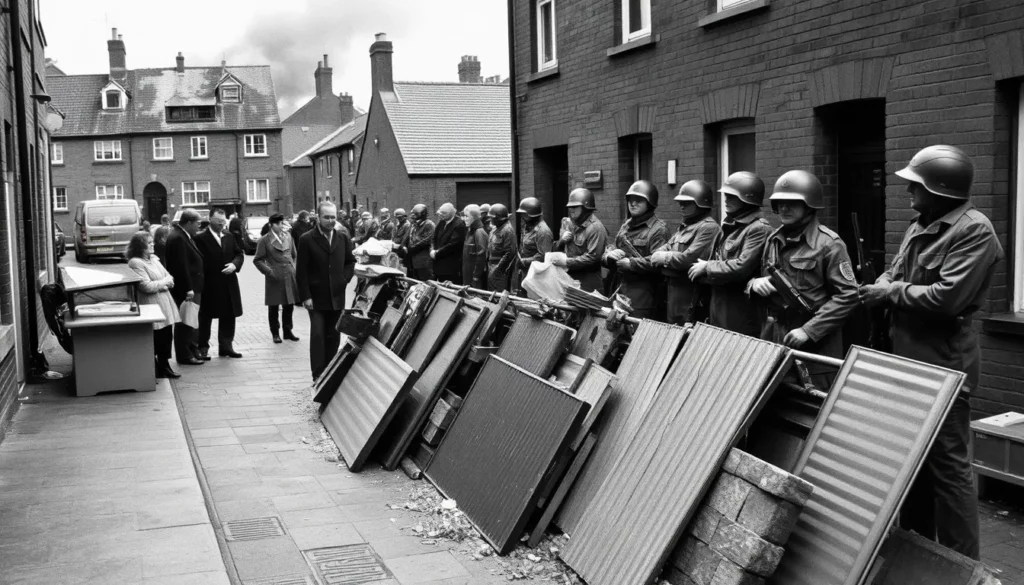
By late August, barricades had appeared in the Falls Road and Ardoyne districts, hundreds of houses and several factories had been burned or damaged, and British troops were deployed. The immediate eyewitness Seamus Brady wrote on 22 August 1969:
"Belfast today is a powder-keg."
That phrase captures the atmosphere recorded in newspapers, official papers and personal testimony.
Belfast in 1969
Belfast lies where the River Lagan enters Belfast Lough, ringed by hills and shaped by docks, railways and industry. In 1969 the city still bore the marks of its Victorian and Edwardian growth: ornate public buildings in the centre, linen warehouses, engineering works, and long rows of brick terraces stretching west and north. The climate was maritime and temperate, with damp winters and mild summers, but the political weather was far more volatile.
The city’s geography mattered. The Falls Road and Shankill Road ran near one another but were associated with Catholic and Protestant communities respectively. Ardoyne and the Crumlin Road formed another flashpoint. Divis Street, Cupar Street, Percy Street, Conway Street, Hooker Street and Bombay Street would become names in official reports and newspaper columns. The atmosphere in 1969 was one of rumour, vigilance and fear. People watched parades, police movements and the arrival of unfamiliar men in lorries or cars. Ordinary routines continued, but they were increasingly conducted in the shadow of political crisis.
Population & Economy
Belfast was the largest city in Northern Ireland, with a population commonly estimated at around 400,000 in the city itself and a larger urban area beyond the boundary. Protestants formed a majority, but Catholic communities were concentrated in particular districts, especially west Belfast. Housing shortages, overcrowding and allegations of discrimination in employment and local government were central grievances in the civil rights campaign. Population movement was already under way before August: Catholic families had begun leaving some mixed or predominantly Protestant streets after threats and intimidation.
The economy remained tied to heavy industry and textiles. Shipbuilding, engineering, linen manufacture, rope-making and tobacco were major employers. Wages were modest, and working-class households were vulnerable to layoffs and short-time work. Contemporary price lists suggest bread cost around ten pence, milk about sixpence a pint, and rents varied widely by district and housing quality. The city was not simply ‘modernising’; it was a place of skilled trades, casual labour, crowded homes and sharp social distinctions. Sectarian geography also shaped access to jobs, pubs, schools and housing.
Government & Politics
Belfast Corporation and the Northern Ireland government at Stormont were controlled by Unionist politicians. In April 1969 Terence O’Neill resigned as Prime Minister of Northern Ireland and was succeeded by James Chichester-Clark. The broader political climate was dominated by the civil rights movement, unionist resistance to reform, and the policing of demonstrations. The Royal Ulster Constabulary and the Ulster Special Constabulary, especially the B-Specials, were central and controversial institutions. Lord Grey of Naunton was Governor of Northern Ireland; Belfast’s civic leadership was Unionist, with William Duncan serving as Lord Mayor in 1968–69.
Local politics could not be separated from national crisis. Decisions taken in Stormont, London and Derry had immediate consequences in Belfast streets. The deployment of the B-Specials in August, the arrival of British troops, and the establishment of a tribunal of inquiry under Mr Justice Scarman all followed from the violence. The Scarman Tribunal later described the disturbances as acts of violence and civil disturbance requiring urgent public inquiry, covering Belfast, Derry, Armagh, Dungannon, Newry and other places.
Industry
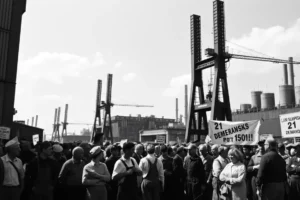
Harland & Wolff shipyard, Short Brothers aircraft works, Mackie’s engineering, Belfast Ropework, Gallaher’s tobacco factory and numerous linen mills formed the industrial backbone of the city. These workplaces were not neutral spaces: employment patterns, apprenticeships and workplace culture often reflected the sectarian division of the city. The docks and shipyard were associated with Protestant labour, while Catholic workers were concentrated in other trades and in manual employment.
The August violence struck economic as well as residential targets. Brady recorded that an area of two acres of factories along the Falls Road near Divis Street had been gutted. He also described burned-out rows of houses such as Bombay Street off the Falls Road and Hooker Street off the Crumlin Road. Industry in Belfast was thus both a source of employment and part of the physical landscape of conflict.
Education
Belfast had a well-developed but largely segregated school system. Catholic schools were maintained by the Church, while Protestant and state schools served the majority community. Queen’s University Belfast and the Belfast College of Technology provided higher and technical education, though access remained limited by class and income. The eleven-plus examination shaped children’s futures, and literacy was high by contemporary standards, but education also reproduced communal boundaries.
For young people, schools and youth clubs were places where identity was formed and where news of marches, police actions and street confrontations circulated. Teachers and clergy often tried to keep pupils away from trouble, but the events of August 1969 entered classrooms, playgrounds and homes. The destruction of St Gall’s parish school in Waterville Street, reported by Brady, showed how educational buildings could become casualties of communal violence.
Transportation
Belfast was connected by bus and rail to the rest of Northern Ireland and by ferry and air to Britain. The Ulster Transport Authority ran buses and trains; the city had a dense network of routes serving suburbs, docks and industrial districts. Private car ownership was growing but remained far below later levels, so most working-class families relied on buses, bicycles and walking. Ships and docks remained important for freight and passenger travel, while Aldergrove airport handled increasing air traffic.
In August, transport became a matter of security. Barricades blocked streets, buses were rerouted, and army vehicles moved through the city. Burning buildings and rubble made some roads impassable. For residents of the Falls and Ardoyne, the practical geography of the city contracted: shops, churches, schools and relatives might be reachable only through checkpoints or across barricades.
Everyday Life
Daily life in working-class Belfast revolved around terraced housing, family networks, local shops, churches, pubs and football. Many older houses lacked modern amenities; overcrowding was common, and outdoor toilets persisted in some districts. Food was plain and seasonal: bread, potatoes, tea, milk, bacon, cabbage and fish and chips. Clothing was modest and practical. Entertainment included cinemas, dance halls, public houses, and support for local football clubs such as Linfield and Glentoran.
The Twelfth of July parades were a central ritual for many Protestants and a source of anxiety for many Catholics. In 1969, ordinary summer routines were disrupted by political tension. Women queued for supplies, children played in streets that were later barricaded, and men organised night watches. Brady reported that nearly 35–40,000 people were behind barricades in the Falls Road and Ardoyne areas, with entry controlled after 10 pm unless identity could be established. Neighbours shared information, guarded entries and prepared to move if violence spread.
Major Events
The year began with civil rights agitation and ended with a transformed security landscape. In January, the People’s Democracy march from Belfast to Derry was attacked at Burntollet, deepening distrust. In April, O’Neill resigned and post office attacks in Belfast added to the sense of crisis. In July, Orange Order parades and loyalist meetings raised tension. Brady dated the first real trouble in Belfast to the Tuesday after 12 July, when the Shankill Defence League met in Ohio Street off the Crumlin Road and John McKeague told the crowd, "let no more Papists in here".
The decisive rupture came in August. The Derry Bogside riots of 12–14 August were followed by the mobilisation of the B-Specials and serious violence in Belfast on 14–16 August. Rioting, gunfire and arson affected west Belfast and Ardoyne. Among those killed were Patrick Rooney, Hugh McCabe, Samuel McLarnon, Michael Lynch and Herbert Roy, whose deaths were examined by the Scarman Tribunal. Houses and factories were burned, families fled, and British troops were deployed. On 27 August the Northern Ireland government established a tribunal of inquiry into the violence.
What Newspapers Were Reporting
Belfast newspapers such as the Belfast Telegraph, The Irish News and The Newsletter carried reports of riots, barricades, casualties, appeals for calm and official statements. Headlines and news columns described troops moving into affected districts, houses burning, and families seeking shelter. The press also reported compensation procedures and the work of relief services. These reports were immediate but not neutral: newspapers reflected the perspectives of their readerships and the pressures of the moment.
Brady’s eyewitness account, sent from Dundalk Military Post to the Department of the Taoiseach, offered a detailed contemporary description:
"There are nearly 35–40,000 people behind these barricades. These are fully manned each night from 9 pm by men from the different Catholic Parishes along the Falls Road and at Ardoyne. No one is allowed in after 10 pm unless one can establish one’s identity."
Such reports reveal how quickly normal policing had been replaced by communal defence and military presence.
What People Were Talking About
Conversation in Belfast in August 1969 was dominated by rumours of who had attacked whom, whether the police could protect Catholic streets, and what the B-Specials had done or intended to do. Brady reported a widespread belief that the B-Specials had misread their orders and sought revenge for Derry. He also recorded a woman’s account that RUC men had told her, "We cannot guarantee any protection." Allegations about stones thrown at an Orange procession near Unity Walk Flats were disputed; Brady claimed the allegation was untrue and cited a Unionist MP’s admission in the Belfast Telegraph.
People discussed compensation forms, legal advice and relief at St Peter’s Church, where solicitors were reportedly assisting claimants. They talked about burned homes, lost jobs and whether to stay or leave. The McKeague speech and its reply—"I leave that to yourselves"—circulated as evidence of intimidation. Behind these conversations lay fear, anger and a growing sense that the old certainties of policing and local authority had collapsed.
Historical Photographs
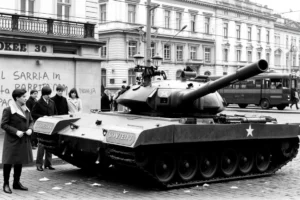
Photographs from 1969 provide a powerful visual record of Belfast’s crisis. Press photographers captured British soldiers in steel helmets standing at barricades, women and children moving through smoke-stained streets, burnt-out terraced houses, and crowds gathered outside relief centres. Images of the Falls Road, Crumlin Road and Ardoyne show makeshift barriers of furniture, paving stones and corrugated metal. Graffiti, army checkpoints and damaged factories also appear in the photographic record.
These photographs are significant because they document the physical transformation of neighbourhoods and the emergence of what later became known as peace lines. They also have limits: night-time gunfire, private intimidation and many acts of violence were poorly photographed. Historians therefore read images alongside written testimony, maps and official reports rather than treating photographs as complete evidence.
Documents & Primary Sources
The most important official source is the Report of the Tribunal of Inquiry into Violence and Civil Disturbances in Northern Ireland in 1969, chaired by Mr Justice Scarman and published in 1972. It examines Belfast riots in detail, including Divis Street, Dover Street, Percy Street, Conway Street, Cupar Street and Ardoyne, and discusses deaths, injuries, damage and intimidation. The National Archives of Ireland holds Seamus Brady’s 22 August 1969 eyewitness account, a valuable immediate testimony from a contemporary observer.
Other sources include Belfast newspaper archives, Northern Ireland government and police papers held by the Public Record Office of Northern Ireland, compensation claims, contemporary maps, photographs and oral history interviews. Each source has limitations: Brady was an eyewitness but wrote from a particular perspective; the Scarman Tribunal was thorough but assembled later; newspapers reported quickly but under pressure. Historians cross-check them to reconstruct events and everyday experience.
1969 Timeline
| Date | Event |
|---|---|
| 1–4 January | People’s Democracy march from Belfast to Derry; violence at Burntollet increases political tension. |
| April | Terence O’Neill resigns; James Chichester-Clark becomes Prime Minister of Northern Ireland; post office attacks occur in Belfast. |
| 12 July | Orange Order parades take place amid heightened sectarian tension. |
| Mid-July | Shankill Defence League meeting in Ohio Street; John McKeague’s speech and sporadic fighting in Cupar Street are reported. |
| 12–14 August | Derry Bogside riots; B-Specials are mobilised across Northern Ireland. |
| 14–16 August | Major rioting, arson and gunfire in west Belfast and Ardoyne; deaths, house burnings and factory damage; British troops deployed. |
| 22 August | Seamus Brady writes his eyewitness account of barricades and violence in Belfast. |
| 27 August | Tribunal of Inquiry under Mr Justice Scarman is established. |
| October | The Hunt Report recommends changes to policing, including the disbandment of the B-Specials. |
What Changed Next
The barricades of 1969 did not disappear. In the following years, Belfast experienced further violence, internment without trial in 1971, the Bloody Sunday killings in Derry in 1972, and the imposition of direct rule from London. The British Army’s presence became long-term. Working-class districts were reshaped by security barriers, and the city’s industrial economy entered a prolonged decline. What had seemed in August 1969 to be an emergency became, for many, a way of life.
The Scarman Tribunal documented the events but could not undo them. Its pages preserve the names of streets, the dead and the injured. Contemporary reports such as Brady’s capture the fear and improvisation of those days. Together they show how Belfast in 1969 became a city of barricades, patrols and displaced families—the opening chapter of the Troubles as many people came to know them.
Sources
- Violence and Civil Disturbances in Northern Ireland in 1969: Report of the Tribunal of Inquiry (Scarman Report), HMSO, 1972. https://cain.ulster.ac.uk/hmso/scarman.htm
- Seamus Brady, eyewitness account of events in Belfast, 22 August 1969, National Archives of Ireland, Department of the Taoiseach, 2000/6/658. https://cain.ulster.ac.uk/nai/1969/nai_TSCH-2000-6-658_1969-08-22.pdf
- CAIN, Chronology of the Conflict: 1969. https://cain.ulster.ac.uk/othelem/chron/ch69.htm
- Belfast Telegraph and The Irish News archives, August 1969 issues, Belfast Central Library newspaper collections.
- Public Record Office of Northern Ireland, Ministry of Home Affairs and Cabinet papers relating to the August 1969 disturbances.
FAQ
What was the population of Belfast in 1969?
Estimates commonly place the city population at around 400,000, with a larger urban area beyond the city boundary. The broader Belfast region was larger still, but boundary changes and census categories make exact comparison difficult.
What major events happened in Belfast in 1969?
The key events were the July tension around Orange parades and loyalist meetings, the August spread of violence from Derry to Belfast, serious rioting and arson in west Belfast and Ardoyne on 14–16 August, the deployment of British troops, the erection of barricades, and the establishment of the Scarman Tribunal on 27 August.
What primary sources are available for studying Belfast in 1969?
Researchers can use the Scarman Tribunal report, Seamus Brady's National Archives of Ireland eyewitness account, Belfast newspaper archives, Northern Ireland government and police papers in the Public Record Office of Northern Ireland, compensation claims, photographs, maps and oral histories.
How did daily life in Belfast in 1969 differ from today?
Daily life was shaped by industrial employment, segregated schools and housing, limited car ownership and no internet or mobile phones. By August, barricades, troop patrols, night watches and displacement had transformed ordinary routines in affected districts.










Leave a Reply