
Short Answer
Quick Snapshot
Seoul in 1950 was the capital of the Republic of Korea and one of the most politically and symbolically charged cities in Asia. Before June it was a crowded administrative, commercial, and educational center on the Han River; after 25 June it became the first great urban battlefield of the Korean War. This article treats Seoul as the city proper and its immediate environs during 1950, not as a complete history of the Korean War.
The North Korean invasion crossed the 38th parallel on 25 June 1950. ROK defenses collapsed, Seoul fell on 28 June, and the Hangang Bridge was blown while refugees were still crossing it. For roughly ninety days North Korean authorities occupied the city, publishing the Haebang Ilbo and reshaping local administration. UN forces landed at Inchon on 15 September and fought their way back into Seoul by late September.
On 29 September 1950 Douglas MacArthur entered the recaptured capital and declared:
“By the grace of a merciful Providence our forces fighting under the standard of that greatest hope and inspiration of mankind, the United Nations, have liberated this ancient city of Seoul.” — Douglas MacArthur, Seoul, 29 September 1950.
The city was free of North Korean control, but it was ruined, crowded with refugees, and still at war.
Seoul in 1950
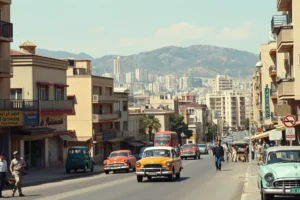
Seoul lies in a basin around the Han River, ringed by hills and mountains that made it a natural capital but also a defensible and contested ground. Namsan rose near the center; Bukhansan and other peaks framed the northern edge. The climate was continental in feel: hot, humid summers with monsoon rains, and cold, dry winters. In 1950 the city included the old palace districts, Jongno and Myeongdong, the railway and military zone at Yongsan, the river crossings at Mapo and Hangang, and dense residential neighborhoods such as Seongbuk and Seodaemun.
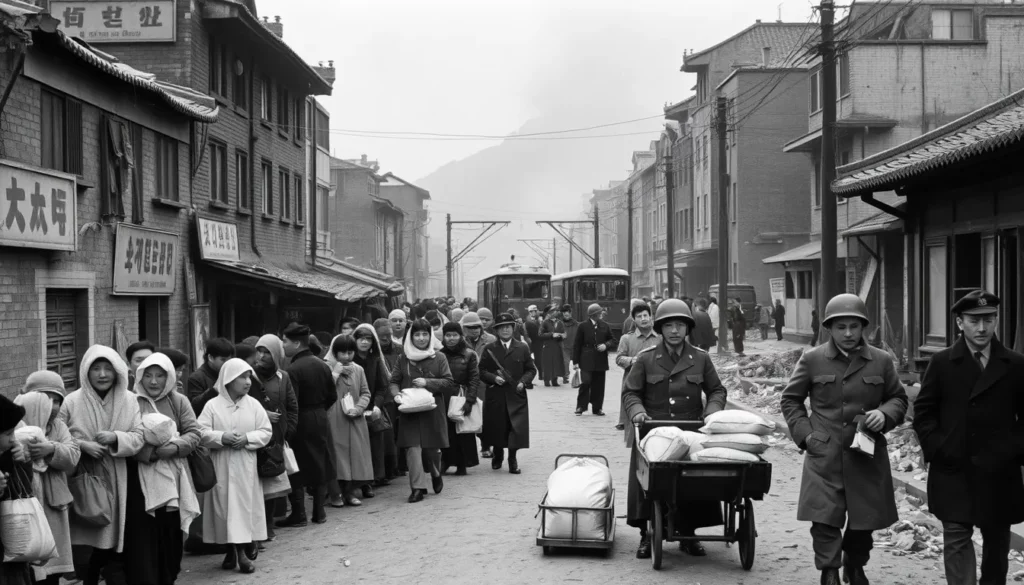
The atmosphere changed with the seasons and the front line. Before June, Seoul was a city of government offices, schoolyards, markets, trams, and newspaper presses. After the invasion it became a city of checkpoints, military vehicles, refugee queues, and uncertain rumors. The Han River, ordinarily a lifeline of transport and trade, became a barrier and a killing ground. By autumn, shell damage, burnt buildings, and displaced families marked almost every district.
Population & Economy
Prewar Seoul had an estimated population of about 1.4 million, making it the largest city in South Korea and the center of national administration. Its residents included civil servants, shopkeepers, students, factory workers, transport employees, and a small foreign community. Employment was tied closely to government, education, commerce, and light manufacturing. The city was also a magnet for migrants from the provinces, and its population swelled and contracted violently as people fled the fighting.
The wartime economy was dominated by scarcity. Inflation, disrupted transport, and the loss of markets made rice, fuel, clothing, and housing expensive and unreliable. Families relied on rationing, barter, and black-market exchanges. The cost of living rose sharply, and a sack of rice became a common measure of value. Factories and shops closed or operated intermittently, while refugees pressed into schools, temples, and private homes. By late 1950 the economy of Seoul was less an ordinary urban economy than a survival economy.
Government & Politics
Seoul was the seat of the Republic of Korea government under President Syngman Rhee. The National Assembly, national ministries, and foreign missions were concentrated there, and the city’s municipal administration was quickly overwhelmed by the emergency. Political life before June was intensely anti-communist and security-conscious, shaped by the division of Korea and by recent insurgency and border clashes. When the North Korean attack came, the government evacuated southward and Seoul’s local authority fragmented.
During the occupation, North Korean authorities established people’s committees and propaganda organs, attempting to mobilize residents and reshape local government. After the UN recapture, ROK authority returned under military conditions, and questions of collaboration and loyalty became urgent. The city was governed not by normal municipal politics but by emergency decrees, military commands, and the struggle to restore basic services.
Industry
Seoul’s industry was diverse but largely light. Textile mills, printing and publishing houses, food processing, rice milling, rubber and metal shops, and railway repair works employed thousands. The city’s role as a government center supported a large printing and stationery trade, while Yongsan and Seoul Station anchored rail-related work. Markets and small workshops supplied clothing, furniture, tools, and household goods.
The war damaged or idled much of this industrial base. Factories were converted, occupied, or destroyed; machinery was removed or wrecked; and workers were dispersed. North Korean occupation authorities tried to use some facilities for their own administration and propaganda, while UN air attacks and ground fighting further damaged the urban economy. By the end of 1950, Seoul’s industrial capacity was a shadow of its prewar state.
Education
Seoul was the educational capital of South Korea. Seoul National University, Korea University, Yonsei University, Ewha Womans University, and numerous secondary schools drew students from across the country. Literacy was rising, and the city’s schools and universities were central to national cultural and political life. Teachers, professors, and students were prominent in public debate.
The war closed schools and scattered students and faculty. Buildings were used as barracks, hospitals, or offices; classes were suspended or moved; and North Korean occupation authorities introduced propaganda and reeducation efforts. After the recapture, reopening schools became part of restoring normal life, but damaged buildings and displaced populations made that recovery slow.
Transportation
Seoul was a railway hub. Seoul Station connected the capital to Incheon, Suwon, Uijeongbu, and the wider peninsula, while Yongsan served military and freight traffic. Trams, buses, carts, and rickshaws moved people through the city, and the Han River bridges carried road and rail traffic between north and south. Movement was always vulnerable to military operations and refugee flows.
The Hangang Bridge became a symbol of the disaster of 28 June, when it was blown while civilians were still crossing, causing heavy casualties. In September, UN forces crossed the Han on pontoon ferries and amphibious vehicles under fire. Roads were choked with refugees, soldiers, and abandoned equipment, and rail service was disrupted for months.
Everyday Life
Daily life in 1950 Seoul was dominated by food, shelter, and fear. Rice and barley were rationed or bought at high prices; kimchi, salted fish, and vegetables supplemented sparse meals. Families queued for supplies, hid food from requisition, and shared housing with relatives and refugees. Hanok houses, brick homes, and crowded shelters all became temporary homes for the displaced.
Clothing mixed traditional hanbok with Western dress, but winter cold made fuel and blankets precious. Before June, entertainment included radio, newspapers, cinemas, and markets; during the occupation, propaganda, rumors, and curfews replaced ordinary public life. People worried about conscription, missing relatives, property loss, and accusations of collaboration. Social customs persisted, but they were compressed by emergency and grief.
Major Events
On 25 June 1950 North Korean forces invaded South Korea. ROK defenses collapsed, and on 28 June Seoul fell. The Hangang Bridge was blown during the retreat, killing and injuring civilians and cutting off thousands who were trying to flee south. The government moved to Daejeon and later further south, while North Korean forces consolidated control of the capital.
From late June to September, Seoul was under North Korean occupation. The occupation authorities published the Haebang Ilbo and attempted to organize residents, while Pyongyang’s Rodong Sinmun reported the capture of Seoul as a liberation. Rumors circulated that Kim Il Sung had visited the city, though later research has treated that claim with caution. Food shortages, arrests, and uncertainty shaped daily life.
On 15 September UN forces landed at Inchon. US Marines crossed the Han River on 20 September and fought through the western approaches to Seoul. By 28–29 September UN and ROK forces had recaptured the city. MacArthur’s entry on 29 September marked the restoration of ROK control, but the capital was badly damaged and the war was far from over.
What Newspapers Were Reporting
Before the fall, South Korean newspapers such as the Dong-A Ilbo and Chosun Ilbo reported the invasion, refugee flows, government appeals, and military reverses. Their offices were disrupted by the occupation, and publication was suspended or severely restricted. The press became part of the emergency, urging resistance and publishing official communiqués.
During the occupation, the Haebang Ilbo was published in Seoul under North Korean authority, presenting the occupation as liberation and carrying propaganda directed at residents. In Pyongyang, the Rodong Sinmun reported news items about occupied Seoul and the advance of North Korean forces. After the recapture, ROK newspapers returned to a ruined city and reported destruction, liberation, and the challenges of reconstruction. MacArthur’s declaration at Seoul became one of the most quoted statements of the autumn.
What People Were Talking About
Conversations in 1950 Seoul centered on survival and rumor. People discussed the alleged visit of Kim Il Sung, the behavior of occupation officials, the risk of conscription, and the fate of relatives who had fled or disappeared. The Han River disaster was remembered as a terrible warning about how quickly ordinary life could collapse. Neighbors debated who had collaborated and who had resisted.
Diaries and memoirs from the period, including Kim Seong-chil’s Yŏksa ap’esŏ and later recollections such as Park Wan-suh’s Who Ate Up All the Shinga?, record hunger, fear, sudden arrests, and the struggle to keep families together. These accounts show that political events were experienced through small daily decisions: whether to flee, what to sell, whom to trust, and how to feed children.
Historical Photographs
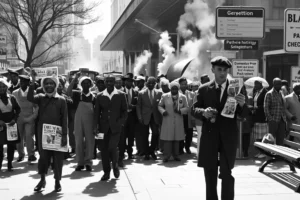
There is a substantial photographic record of Seoul in 1950. US Army Signal Corps and Marine Corps photographers documented the Han River crossings, the fighting on Hill 125 and the western approaches to Seoul, and MacArthur’s entry into the recaptured capital. News photographers and military teams also captured refugees, ruined streets, damaged buildings, and soldiers moving through the city.
These photographs are significant because they preserve the visual evidence of destruction and displacement that statistics cannot fully convey. Images of Marines under fire, civilians crossing the Han, and shattered neighborhoods show Seoul as both a military objective and a human catastrophe. Many of these images are held in US military archives and contemporary newspaper collections.
Documents & Primary Sources
Historians of Seoul in 1950 rely on a mixture of official records, newspapers, memoirs, and photographs. The most important sources include:
- Haebang Ilbo, the newspaper published in Seoul during the North Korean occupation.
- Rodong Sinmun, the DPRK newspaper that reported on occupied Seoul and the North Korean advance.
- US Army and Marine Corps operational records and official histories, including Roy E. Appleman’s South to the Naktong, North to the Yalu.
- Contemporary memoir collections such as Konan ui 90 il (90 Days of Suffering) and The Reds Take a City.
- Personal diaries and recollections, including Kim Seong-chil’s Yŏksa ap’esŏ and Hungarian diplomatic reports from the period.
1950 Timeline
| Date | Event |
|---|---|
| 25 June 1950 | North Korean forces invade South Korea. |
| 28 June 1950 | Seoul falls; Hangang Bridge is blown during the retreat. |
| July–September 1950 | North Korean occupation of Seoul; Haebang Ilbo published. |
| 15 September 1950 | UN forces land at Inchon. |
| 20 September 1950 | US Marines cross the Han River toward Seoul. |
| 28–29 September 1950 | UN and ROK forces recapture Seoul; MacArthur enters the city. |
| October 1950 | ROK government reestablishes a presence in the damaged capital. |
| December 1950 | Chinese intervention threatens Seoul again; refugees flee south. |
What Changed Next
Seoul’s ordeal did not end with the UN recapture. In early January 1951, Chinese and North Korean forces captured the city again, and the ROK government evacuated. UN forces retook Seoul on 14 March 1951, but fighting continued until the armistice in 1953. The city was left divided, ruined, and militarized, with families separated and neighborhoods destroyed.
The events of 1950 shaped Seoul’s postwar reconstruction. The capital was rebuilt as a symbol of South Korean resilience, but the memory of invasion, occupation, and the Han River disaster remained central to national identity. For historians, 1950 is the year Seoul became both a battlefield and a test of civilian survival.
Sources
- Csoma, Mózes. “Red Star over Seoul: Facts and the Myths of the Ninety-Day-Long Communist Rule over the South Korean Capital in 1950.” European Journal of Korean Studies 23, no. 1 (2023). https://doi.org/10.33526/ejks.20232301.51
- Appleman, Roy E. South to the Naktong, North to the Yalu: United States Army in the Korean War. Washington, DC: Office of the Chief of Military History, 1961. https://history.army.mil/books/korea/20-2-1/sn26.htm
- Cumings, Bruce. The Origins of the Korean War, Vol. II: The Roaring of the Cataract, 1947–1950. Princeton: Princeton University Press, 1990.
- Riley, John W., Jr., and Wilbur Schramm. The Reds Take a City: The Communist Occupation of Seoul, with Eyewitness Accounts. New Brunswick: Rutgers University Press, 1951.
- Kim Seong-chil. Yŏksa ap’esŏ [In Front of History]. Korean diary and reminiscence edition.
FAQ
What was the population of Seoul in 1950?
Prewar estimates placed Seoul at about 1.4 million people, but the population fell and shifted dramatically as refugees fled the fighting and occupation.
What major events happened in Seoul in 1950?
North Korean forces captured Seoul on 28 June, the Hangang Bridge was blown during the retreat, North Korea occupied the city for about ninety days, UN forces landed at Inchon on 15 September, and Seoul was recaptured by 29 September.
What primary sources are available for studying Seoul in 1950?
Key sources include the occupation newspaper Haebang Ilbo, the DPRK's Rodong Sinmun, US military records, memoir collections such as Konan ui 90 il and The Reds Take a City, personal diaries, photographs, and diplomatic reports.
How did daily life in Seoul in 1950 differ from today?
Daily life was dominated by war: food rationing, refugee housing, curfews, military checkpoints, disrupted schools, and fear of conscription or arrest. Modern Seoul's technology, consumer economy, and stable civilian government did not exist in 1950.










Leave a Reply