
Short Answer
Quick Snapshot
In 1965 Jakarta—then usually spelled Djakarta—was the capital of Indonesia and the nerve center of President Sukarno’s Guided Democracy. The city was hot, crowded, and politically charged. Government offices, army headquarters, foreign embassies, newspapers, universities, and the port of Tanjung Priok made Jakarta the place where national crises were announced, contested, and sometimes decided. In the early hours of October 1, 1965, the city became the stage for the abortive 30 September Movement, known in Indonesia as Gestapu, which seized and killed six army generals and several other officers. Within days, Major General Suharto had outmaneuvered the movement and begun to reshape national politics.
The coup attempt did not by itself produce the vast anti-communist massacres of 1965–66, most of which occurred in Central Java, East Java, Bali, North Sumatra, and other regions. But Jakarta was the political epicenter: it was where the army blamed the Indonesian Communist Party, where student groups demonstrated for the PKI’s destruction, where leftist offices were attacked, and where arrests, screenings, and propaganda set the tone for the violence that followed. The capital’s newspapers, radio broadcasts, and diplomatic dispatches carried the crisis to the world.
This article focuses on Jakarta as Indonesia’s capital and the political-military center of the 1965 crisis, rather than on the full national history of the mass killings. It treats the events of 1965 on their own terms, using contemporary sources and later scholarship to distinguish what was known, rumored, and disputed at the time.
Jakarta in 1965
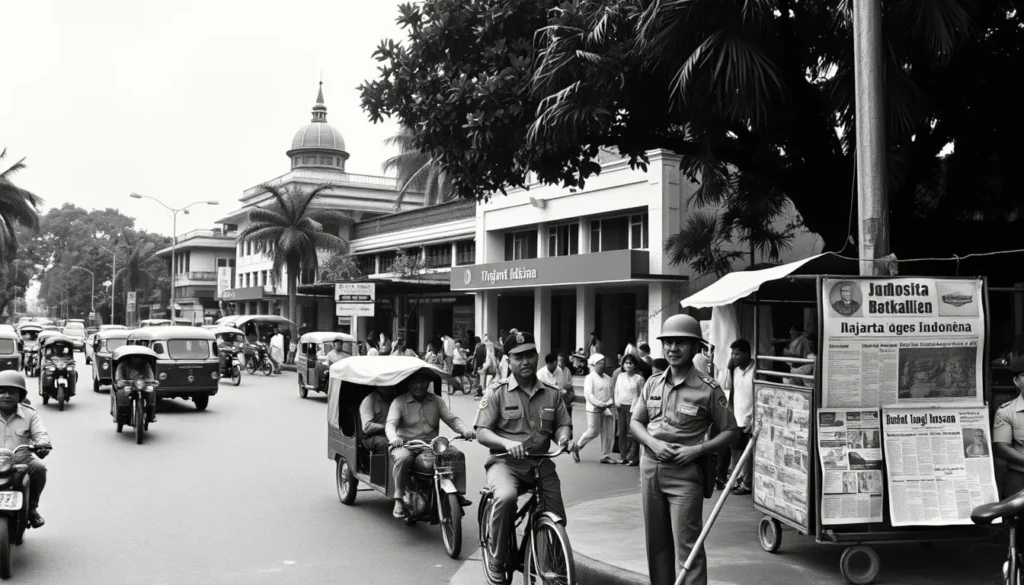
Jakarta lies on the northwest coast of Java, at the mouth of the Ciliwung River. In 1965 it was a sprawling tropical capital of kampung neighborhoods, colonial-era government buildings, Chinese shops, mosques, churches, markets, and new monuments built under Sukarno. The climate was hot and humid, with heavy monsoon rains and recurrent flooding in low-lying districts. The city’s roads were often congested with becak, bicycles, buses, and private cars, while the railway linked the capital to Bogor, Bandung, and other Javanese cities.
The atmosphere was tense. Indonesia was engaged in Konfrontasi against Malaysia, the economy was unstable, and Sukarno’s balancing act between the army and the PKI had polarized national life. Jakarta’s coffee stalls, offices, campuses, and markets buzzed with rumors about plots, foreign interference, and the president’s health. The capital was also a city of sharp inequalities: senior officials and army officers lived in leafy neighborhoods, while many migrants lived in densely packed kampung housing with limited water, sanitation, and secure employment.
Because Jakarta was the seat of government, national politics was inseparable from city life. Cabinet meetings, army conferences, embassy receptions, student rallies, and newspaper editorials all took place within a few square miles. When the crisis broke in October, it did so in a city already accustomed to political theater and anxious about food prices, inflation, and the future.
Population & Economy
Jakarta’s population was growing rapidly in the early 1960s. The 1961 census recorded about 2.97 million people in the capital region; by 1965, estimates placed the population at roughly 3.5 million, swollen by rural migrants seeking work, education, and political opportunity. The city was young, with many children and a large informal workforce. Migrants from Java and other islands lived alongside longstanding Betawi, Chinese, Arab, Dutch-speaking Eurasian, and other communities.
The economy was strained. Indonesia suffered from chronic budget deficits, foreign-exchange shortages, and accelerating inflation. By 1965 annual inflation ran into the hundreds of percent, and rice, fuel, cooking oil, and imported goods were scarce or expensive. Government salaries lagged behind prices, encouraging corruption, smuggling, and multiple jobs. The port of Tanjung Priok handled trade, but foreign exchange was tightly controlled and imports were often delayed. Markets in Jakarta’s neighborhoods reflected the crisis: rice was mixed with cassava, prices changed frequently, and families relied on informal credit and mutual help.
Employment was dominated by government service, trade, transport, construction, and small-scale manufacturing. The city had workshops, printers, food-processing firms, textile and clothing businesses, repair shops, and warehouses. Many residents worked in the informal sector as peddlers, becak drivers, porters, domestic servants, and casual laborers. For ordinary Jakartans, the political crisis was experienced through the price of rice, the availability of kerosene, and the fear of being accused or detained.
Government & Politics
Jakarta’s city government was led by Governor Henk Ngantung until late 1965, when he was replaced amid the political upheaval by Soemarno. City administration, however, was overshadowed by the national government. President Sukarno, the architect of Guided Democracy, ruled through a complex balance of the army, the PKI, and nationalist groups. The PKI was one of the largest communist parties in the world and had significant influence in unions, peasant organizations, youth groups, and cultural bodies. The army, meanwhile, was increasingly suspicious of the PKI and divided among officers loyal to Sukarno, to the army leadership, and to Major General Suharto.
In 1965 Jakarta was also a center of international diplomacy. Foreign embassies watched Sukarno’s shifts toward Peking and the PKI with concern. British, American, Australian, and other diplomats filed dispatches on the capital’s mood, the army’s moves, and the likelihood of violence. Domestic politics was conducted through mass rallies, newspaper campaigns, and back-channel negotiations. After October 1, the army rapidly asserted control over Jakarta’s radio stations, key installations, and political messaging, while Sukarno remained formally president but saw his authority eroded.
Industry
Jakarta’s industry in 1965 was modest compared with its role as a political and commercial capital. The city’s largest employers were government ministries, the army, the port, banks, trading houses, and transport services. Small and medium enterprises produced food, clothing, furniture, printed materials, and construction materials. Workshops repaired vehicles, bicycles, and machinery. Tanjung Priok was the main gateway for imports and exports, though its operations were hampered by customs controls, congestion, and foreign-exchange shortages.
Printing and publishing were politically important. Newspapers, magazines, pamphlets, and posters were produced in Jakarta and circulated nationally. The city’s markets, shops, and hotels served officials, diplomats, soldiers, and visitors. Oil and rubber from the outer islands passed through national institutions headquartered in Jakarta, even if the physical production took place elsewhere. For most residents, however, the economy meant petty trade, service work, and a daily struggle to secure food and cash.
Education
Jakarta was Indonesia’s leading educational center. The University of Indonesia had campuses and faculties in the capital, and teacher-training colleges, technical schools, Islamic institutions, and secondary schools trained the country’s civil servants, teachers, journalists, and professionals. Literacy was expanding, though it remained uneven between urban and rural areas and between generations. Students were politically active, and campus debates over socialism, nationalism, religion, and democracy mirrored national tensions.
After October 1965, students became a visible anti-communist force. The Indonesian Students’ Action Front, known as KAMI, was formed in late October and organized demonstrations demanding the banning of the PKI. Universities became sites of loyalty screenings, political intimidation, and recruitment for anti-communist campaigns. For students, the crisis meant both danger and opportunity: some joined demonstrations, some tried to stay out of politics, and some were accused because of family or organizational ties.
Transportation
Jakarta’s streets in 1965 were dominated by becak, three-wheeled passenger bicycles that carried people and goods through narrow lanes and main roads. Oplet minibuses and bemo vehicles provided public transport, alongside larger buses and shared taxis. Private cars belonged mainly to officials, army officers, diplomats, and wealthy businessmen. Bicycles were common among workers, and pedestrians filled the roadsides.
The railway connected Jakarta with Bogor and other cities, carrying commuters, students, and goods. The port of Tanjung Priok handled shipping, while Kemayoran and Halim Perdanakusuma airports served domestic and international flights. Traffic was slowed by floodwater, poor roads, and the sheer density of vehicles and pedestrians. Political demonstrations could quickly block major streets, and military checkpoints appeared after the coup attempt.
Everyday Life
Daily life in Jakarta revolved around work, markets, family, and neighborhood. Housing ranged from colonial villas and government flats to kampung houses made of wood, brick, and corrugated iron. Many families shared wells, toilets, and cooking spaces. Rice was the staple food, supplemented by cassava, vegetables, fish, tempeh, tofu, and street snacks. Food stalls and markets opened early and stayed busy late. Clothing was practical for the tropical heat: sarongs, kebaya, shirts, trousers, and batik for formal occasions.
Entertainment included radio, cinema, wayang performances, music, and neighborhood gatherings. Dangdut was emerging as a popular genre, while kroncong, gamelan, and Western music had their audiences. Religious life was diverse: mosques, churches, temples, and shrines served Jakarta’s multi religious population. Social customs emphasized gotong royong, mutual assistance, and respect for elders, but political polarization strained friendships and families.
After October 1965, everyday life was shadowed by fear. People avoided discussing politics in public, hid or destroyed photographs and documents, and worried about being placed on lists. Arrests, interrogations, and disappearances became part of the city’s atmosphere, even as markets, offices, and schools continued to function.
Major Events
The defining event was the 30 September Movement. On the night of September 30 to October 1, 1965, units associated with the movement seized and killed six army generals and several other officers. The victims included Lieutenant General Ahmad Yani and Major General R. Suprapto. General Abdul Haris Nasution escaped, though his daughter was killed and his aide, Pierre Tendean, was among those killed. The bodies were dumped at Lubang Buaya near Halim Airbase. The movement announced over radio that it had acted to protect Sukarno from a purported right-wing generals’ council.
Major General Suharto, commander of the army’s strategic reserve, refused to accept the movement’s claims. He rallied loyal units, secured Jakarta, and forced the movement’s collapse within days. The army quickly blamed the PKI, and anti-communist mobilization spread. In Jakarta, student groups demonstrated, leftist offices were attacked, and the army began arresting suspected communists and leftists. The PKI denied responsibility, but the army’s narrative dominated public discourse.
The capital did not experience the full scale of the rural massacres that later engulfed parts of Java, Bali, and Sumatra, but it became a center of detention, screening, and propaganda. The violence that followed across Indonesia killed an estimated half a million people and led to the detention of about a million more. In Jakarta, the crisis destroyed the power balance of Guided Democracy and opened the way for military-backed authoritarian rule.
What Newspapers Were Reporting
Jakarta’s newspapers were central to the crisis. Kompas, founded in June 1965, and Sinar Harapan carried official statements, army announcements, and reports on the coup attempt. The army-linked Berita Yudha and the national news agency Antara amplified the military’s account. Leftist newspapers were closed or silenced, and journalists faced pressure to conform. Headlines emphasized the recovery of order, the discovery of the generals’ bodies, and the danger of communist conspiracy.
“I have never concealed from you my belief that a little shooting would be an essential preliminary to effective change in Indonesia; but it makes me sad to think that they have begun with the wrong people.” — Sir Andrew Gilchrist, British ambassador to Indonesia, October 5, 1965
Foreign diplomats in Jakarta reported on the army’s consolidation, the uncertain fate of Sukarno, and the anti-communist purge. The Central Intelligence Agency later wrote that “in terms of the numbers killed, the anti-PKI massacres in Indonesia rank as one of the worst mass murders of the 20th century.” Such assessments were not public at the time, but they reflected the gravity of what was unfolding beyond the capital’s headlines.
What People Were Talking About
In Jakarta’s markets, offices, campuses, and coffee stalls, people talked about the generals’ killings, the mysterious 30 September Movement, and the role of the PKI. Rumors circulated about foreign involvement, Chinese weapons, a generals’ council, and Sukarno’s health. Army officers, student activists, and civil servants debated whether the PKI should be banned and whether Sukarno could survive politically. Families worried about relatives in the provinces, where anti-communist violence was spreading.
Fear of accusation became a social reality. People discussed lists of names, disappearances, and interrogations. Some destroyed membership cards, photographs, and letters. Others sought protection from military or religious patrons. Public conversation narrowed as the army’s narrative became dominant, but private doubts and anxieties remained. The crisis divided neighborhoods, workplaces, and even families.
Historical Photographs
Photographs from Jakarta in 1965 provide a visual record of the crisis. One widely reproduced image by Rory Dell, dated November 1965, shows a suspected PKI member arrested by soldiers in Jakarta. Other photographs show the funerals of the slain generals, the exhumation of bodies at Lubang Buaya, student demonstrations, damaged offices, and army checkpoints. Official photographers from Indonesia’s press and photo services, including Antara and IPPHOS, documented army ceremonies and political rallies.
These images are not neutral. Many were staged, censored, or used to legitimize the army’s narrative of a communist plot. They remain valuable evidence, but historians read them alongside captions, provenance, and the political interests of the photographers and publishers. Visual records of ordinary Jakarta life in 1965—markets, becak, schools, and kampung streets—also survive and help balance the dramatic images of crisis.
Documents & Primary Sources
- The 1961 population census and later estimates provide demographic context for Jakarta’s growth.
- City maps, administrative reports, and municipal records document Jakarta’s neighborhoods, infrastructure, and governance.
- Newspapers such as Kompas, Sinar Harapan, Berita Yudha, and the Antara Daily News Bulletin report the coup attempt, army statements, and public reactions.
- British, American, Australian, and other diplomatic dispatches describe the capital’s mood, army politics, and foreign concerns.
- Military trial transcripts from the Mahkamah Militer Luar Biasa record testimony about the 30 September Movement and subsequent purges.
- Photographs by Rory Dell, Antara, IPPHOS, and other press photographers document arrests, funerals, demonstrations, and army activities.
- Student leaflets, posters, and KAMI publications show anti-communist mobilization in Jakarta.
1965 Timeline
| Date | Event |
|---|---|
| January–September 1965 | Inflation, food shortages, and political tension deepen in Jakarta; Sukarno balances the army and the PKI. |
| August 17, 1965 | Independence Day ceremonies are held in Jakarta amid national crisis and Konfrontasi. |
| September 30–October 1, 1965 | The 30 September Movement seizes and kills six army generals and other officers; bodies are taken to Lubang Buaya near Halim Airbase. |
| October 1, 1965 | Major General Suharto rallies loyal units, secures Jakarta, and announces army control. |
| October 5, 1965 | British ambassador Sir Andrew Gilchrist writes of the crisis and the likelihood of further shooting. |
| October 1965 | Anti-PKI student demonstrations and attacks on leftist offices spread in Jakarta; army arrests and screenings begin. |
| October 27, 1965 | KAMI, the Indonesian Students’ Action Front, is formed and demands the banning of the PKI. |
| November 1965 | Arrests and interrogations continue; photographs show suspected PKI members in military custody. |
| December 1965 | The army consolidates political control in Jakarta as Sukarno’s authority weakens and anti-communist violence expands in the regions. |
What Changed Next
The events of 1965 transformed Jakarta and Indonesia. In March 1966, Sukarno was forced to transfer authority to Suharto through the Supersemar document, and the PKI was banned. The army-backed New Order regime consolidated power, imprisoned hundreds of thousands of suspected leftists, and imposed a rigid anti-communist ideology. Jakarta became the capital of an authoritarian state, with military officers in civilian institutions, strict controls on the press, and a political culture shaped by fear of communism.
The mass violence of 1965–66 left deep scars. Survivors and their families faced stigma, discrimination, and restrictions on employment and education. For decades, the official narrative blamed the PKI and celebrated the army’s role, while open discussion of the killings was suppressed. After the fall of Suharto in 1998, Indonesia began a slow and contested reckoning with this history. Jakarta remains at the center of debates over memory, justice, and human rights, even as the city has grown into a vast metropolis far different from the capital of 1965.
Sources
- Geoffrey B. Robinson, The Killing Season: A History of the Indonesian Massacres, 1965–66 (Princeton University Press, 2018).
- J.M. van der Kroef, “Origins of the 1965 Coup in Indonesia: Probabilities and Alternatives,” Journal of Southeast Asian Studies 3, no. 2 (1972).
- John Roosa, Pretext for Mass Murder: The September 30th Movement and Suharto’s Coup d’État in Indonesia (University of Wisconsin Press, 2006).
- Benedict R. O’G. Anderson and Ruth T. McVey, A Preliminary Analysis of the October 1, 1965 Coup in Indonesia (Cornell Modern Indonesia Project, 1971).
- Indonesian Army, Mahkamah Militer Luar Biasa trial transcripts, Djakarta, 1966–1968; Antara Daily News Bulletin, 1965.
FAQ
What was the population of Jakarta in 1965?
The 1961 census recorded about 2.97 million people in the Jakarta region; by 1965 estimates placed the population at roughly 3.5 million, swollen by rural migration.
What major events happened in Jakarta in 1965?
The key events were the 30 September Movement, the killing of six army generals and other officers, Major General Suharto’s counteraction, anti-PKI demonstrations, arrests, and the political consolidation that preceded the 1966 army takeover.
What primary sources are available for studying Jakarta in 1965?
Researchers use the 1961 census, city maps, newspapers such as Kompas and Antara, diplomatic dispatches, military trial transcripts, student leaflets, and photographs by Rory Dell, Antara, and IPPHOS.
How did daily life in Jakarta in 1965 differ from today?
There were no mobile phones or internet, transport relied on becak and oplet minibuses, inflation and food shortages dominated household budgets, and political fear after October 1965 shaped public behavior in ways unfamiliar to most Jakarta residents today.










Leave a Reply