
Short Answer
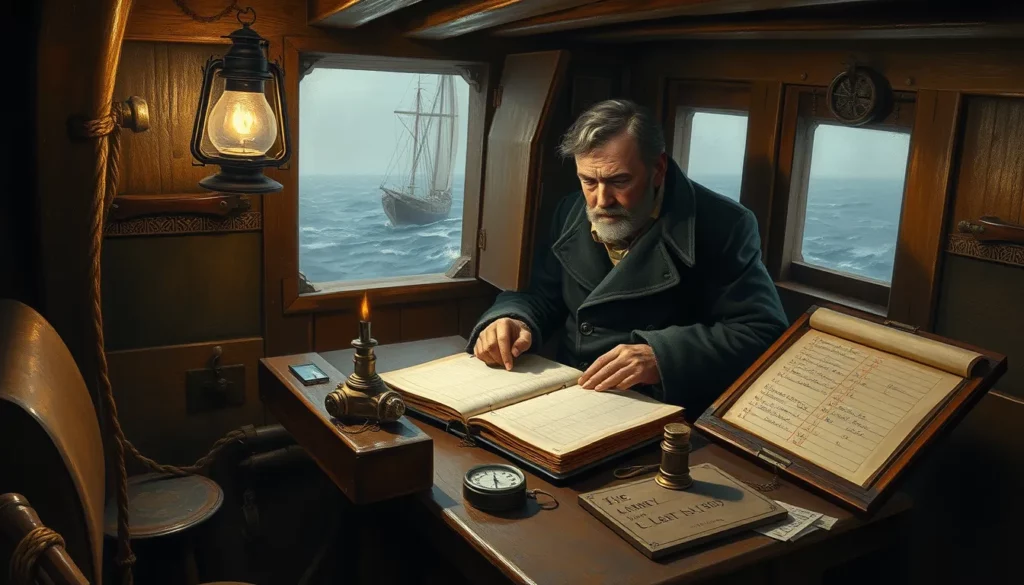
In the cabin of a Sunderland collier beating south through the North Sea in the winter of 1853, the master had a second job after navigation. On the table lay a ruled book whose columns were headed, in the order long used at sea: Hours, Knots, Fathoms, Courses, Winds, Remarks. Into the first five went numbers — the hour of the watch, the speed shown by the log line, the depth of water, the course steered, the direction of the wind. Into the last went words: a squall, a split topsail, a man who failed to turn out for his watch, a birth, a death, a quarrel. Since the Mercantile Marine Act of 1850 the keeping of such a book had been a legal duty for the masters of British merchant ships, and the book, deposited at the end of the voyage, passed into official hands.
This article is about how to read that book and its companions. “Maritime records” is used here in its common archival sense: the documentary trace left by ships and by the agencies that regulated them — log books, official logs, muster rolls, crew lists and agreements, port and customs papers, and the registers compiled from them. It does not cover charts as navigational artefacts, oral tradition, or underwater archaeology. What follows explains how these documents were made, what they can and cannot say, and how a careful reader turns a column of numbers into evidence about the past.
What Happened?
Every one of these documents was produced for a purpose that had nothing to do with history. The muster book existed because Parliament wanted money for disabled seamen; the crew list existed because the state wanted to know how many men were at sea and who might be counted, protected or pressed; the log existed because owners, insurers and courts needed to know what had happened on board when a ship was lost, a cargo was damaged or a seaman’s wages were disputed. Understanding how the paper trail was made is the first step in using it.
Before 1747 no systematic record of merchant crews was kept. What survives is incidental: State Papers, Colonial Office correspondence, Treasury papers, and the files of the High Court of Admiralty and the High Court of Delegates, in which ships appear because they were caught up in litigation, revenue disputes or war. British passenger lists, similarly, do not survive before 1890 and ceased to be kept centrally in 1960.
- 1747 — An Act of Parliament established a fund for the relief of maimed and disabled seamen, financed by sixpence a month deducted from wages. To administer it, masters had to file a muster book (or muster roll) at the port of arrival with the Seamen’s Fund Receivers. Early rolls usually give only the owner, the master, the total number of the crew and brief voyage details; occasionally they name every man and record his contribution. The calculation tables used to work out those contributions are not thought to have survived.
- 1835 — The Merchant Shipping Act replaced muster books with crew lists and agreements — not two documents but one, the agreement being the seaman’s contract and the crew list its schedule of names.
- 1850 — The Mercantile Marine Act required masters of British merchant ships to keep a log book recording events on board, including the conduct of seamen.
- October 1851 — The official log was introduced, a legal record distinct from the working ship’s log kept on deck.
- 1852 — Log books begin to appear among the deposited records. Many were later destroyed; a large share of those that survive do so because they recorded a birth or a death.
- 1855 — With the establishment of a central registry, British ships were allocated an official number, the key that unlocks crew lists from that year onwards.
- 1874 — Births and deaths at sea were henceforth transmitted to the Registrar-General of Shipping and Seamen rather than sent directly by the master.
- 1891 — Details of such events were consolidated into the indexed registers (series BT 334) still consulted today.
How It Was Seen at the Time
Contemporaries did not read these books as we do. To a master, the log was a liability as much as a record: it could be produced at a Board of Trade inquiry, used to justify stopping a seaman’s wages, or turned against the master himself if it showed a vessel hazarded or a cargo mishandled. The Merchant Shipping Acts layered penalties on failure to keep proper logs, and clerks audited them. It is no accident that the “Remarks” column, which historians mine for colour, was the column most carefully policed.
Hours. Knots. Fathoms. Courses. Winds. Remarks.
That bare sequence of headings is the whole intellectual apparatus of the genre. It tells you at once what the record was for — position, speed, depth, direction and a residual column for everything that did not fit.
To a seaman the agreement was wages. The sixpence a month for the Seamen’s Fund was entered against his name; an entry of desertion against it could cost him months of pay. He signed it, often with a mark, in a shipping office or before a shipping master, and he knew that the master wrote the narrative that would later be read against him. To the state the records were a census of manpower, and the preamble to a hundred parliamentary questions about the adequacy of the merchant marine.
The scientific reading of the log came later in the period. After the Brussels Maritime Conference of 1853, and with Robert FitzRoy installed at the Board of Trade as Meteorological Statist from 1854, printed forms and barometers were issued to merchant masters, and the “Remarks” column began to be read not as anecdote but as data for a global weather project. Contemporaries, in other words, argued about these documents constantly — over wages, insurance and safety — without ever imagining that they were writing history.
Historical Snapshot
| Aspect | Detail |
|---|---|
| Date | 1747–1960, with the decisive legislative changes falling between 1835 and 1855 |
| Place | British ports of registry and arrival and the sea routes they served; the records now chiefly at The National Archives, Kew |
| People | Masters, able and ordinary seamen, apprentices, shipowners, insurers, Board of Trade and Registrar-General clerks |
| What Happened | A statutory paper trail was created for welfare, manpower, discipline and commerce, and was inherited by later researchers as the principal record of life at sea |
| Why It Mattered | Between 1858 and the First World War the Merchant Navy kept no register of its seamen, so crew lists and agreements are often the only surviving record of an individual merchant sailor |
Key Documents
- Muster books (1747–1834) — filed at the port of arrival with the Seamen’s Fund Receivers; the main series is BT 98, with a few stray rolls in customs series such as CUST 66 and CUST 91.
- Crew lists and agreements (1835 onwards) — the seaman’s signed contract and the schedule of the crew, deposited after each voyage.
- Ship’s log — the working deck record, kept in columns, from which fair copies were made.
- Official log (from October 1851) — the legal record, which carried entries of births, deaths, marriages, misconduct, collisions, illness and disciplinary proceedings.
- Registers of births and deaths at sea — series BT 153 to BT 160 for 1854–1890, and the consolidated indexed registers BT 334 from 1891.
- Passenger lists (BT 26) — surviving lists for inbound voyages from outside Europe and the Mediterranean, 1890–1960, with a very few earlier.
Different Perspectives
The Master
The master wrote most of what survives and is therefore the loudest voice in the archive — and the least free. He answered to owners who wanted fast passages, to insurers who wanted no admissions of hazard, and to a Board of Trade that could fine him for a deficient log. His entries were read by people looking for fault, and he knew it.
The Seaman
The seaman appears in these documents mostly as a name, an age, a place of birth, a rating and a rate of pay. He had almost no chance to write the narrative himself; his account of a voyage, if it survives at all, survives in a letter or a petition, not in the log. Where he does speak — in a formal protest against the master, or in evidence at a wreck inquiry — the contrast with the official version is often stark.
The Owner and the Insurer
To the shipowner the log was commercial evidence: proof of seaworthiness, of due diligence, of the cause of damage. Underwriters read it the same way and with the opposite interest. This is why descriptions of weather, of the state of the sea and of the handling of the ship are simultaneously the most vivid and the most contested passages in the record.
The State
The Admiralty, the Board of Trade and the Registrar-General of Seamen read the same books for manpower, for statistics and for discipline. Their marginalia — numbers stamped, pages initialled, entries queried — are a record of official attention that is itself historical evidence, and should never be ignored.
What the Sources Got Wrong
The first error a researcher makes is to assume that a record exists because someone wanted the truth recorded. The second is to assume that silence means absence.
“You should not expect to find any detailed accounts of day-to-day life or the activities of crew or passengers.” — The National Archives, research guide on Merchant Navy ships’ records
“Records were kept for reasons of state and commerce, not to help genealogical research.” — Royal Museums Greenwich, Research Guide A3
- The missing crew. Muster rolls between 1747 and 1834 frequently fail to name the whole crew, giving only the master, the owner and a total headcount. A seaman’s absence from a roll is therefore not evidence that he was not aboard.
- The falsified position. Masters under pressure to make a quick passage, to conceal a deviation for smuggling, or to support an insurance claim had obvious reasons to adjust a course or a day’s run. The recorded position is a claim, not a measurement; before the general adoption of reliable chronometers, longitude could be out by degrees.
- The punitive entry. Entries concerning desertion or refusal of duty were written by the party with an interest in the outcome and could determine whether a man was paid at all.
- The borrowed name. Seamen gave false names and ages to escape debts, the press gang or a previous agreement; places of birth were often recorded vaguely as “foreign” or as the port of shipment.
- Duplicate registrations. A single death at sea might be registered under the law of the flag, the law of the next port of call, and the law of the deceased’s own country. Finding two records is not a contradiction.
- Survival bias. Many log books were destroyed in the ordinary course of administration, so the surviving sample is skewed towards voyages that recorded a birth or a death — that is, towards the exceptional voyage rather than the typical one.
Contemporary Terminology
| Term | Meaning |
|---|---|
| Muster book / muster roll | The crew record filed under the 1747 seamen’s fund; later superseded by the crew list and agreement |
| Agreement (“the articles”) | The seaman’s written contract for a voyage, signed before a shipping master, naming wages, rating and destination |
| Official log | The statutory legal record from October 1851, distinct from the working ship’s log |
| Log slate | The erasable slate on which the watch keeper noted the figures before they were copied fair |
| Remarks | The free-text column for weather, sails, incidents and conduct — the historian’s richest and least reliable column |
| Dead reckoning | Position calculated from course, speed and elapsed time without astronomical observation; often abbreviated in logs |
| Ordinary seaman / able seaman | The two standard merchant ratings, distinguished by experience and wage |
| Official number | The permanent number allocated to a British ship from 1855, essential for locating crew lists |
Related Primary Sources
- The National Archives, Kew — muster books in BT 98; crew lists and agreements in the BT 99–BT 165 range; log books; registers of births and deaths at sea (BT 153–BT 160 and BT 334); passenger lists (BT 26); Admiralty logs for Royal Navy ships in ADM 51, ADM 52 and ADM 53.
- The Caird Library and Archive, National Maritime Museum, Greenwich — ship models, plans, charts, officers’ papers and the museum’s alphabetical returns of merchant seamen’s deaths.
- The Maritime History Archive, Memorial University of Newfoundland — a very large share of the surviving British crew lists and agreements for the later nineteenth and early twentieth centuries.
- The Crew List Index Project (CLIP) — an index of British merchant ships and their official numbers, 1855–1913.
- Lloyd’s List and Lloyd’s Register of Shipping — contemporary shipping intelligence and vessel particulars, useful for dating a ship’s movements and verifying a log.
- The New Bedford Whaling Museum and Mystic Seaport — extensive collections of American logbooks, journals and crew lists for comparison with British practice.
The enduring value of ship logs and maritime records lies precisely in their ordinariness. They were not written to impress posterity, and that is why they can be trusted to show a world as it was actually run: wages docked, cargo shifted, a topsail blown out, a child born in the Atlantic. Read against one another — the log against the crew list, the official log against the working record, the master’s version against the seaman’s protest — these columns of numbers and terse remarks reconstruct lives that left almost no other trace. The discipline they demand, of asking always who wrote this and why, is the discipline of all primary source work, learned at sea.
FAQ
What is the difference between a ship's log and an official log?
The ship's log is the working deck record, kept in columns of hours, knots, fathoms, courses and winds, with a remarks column for events. The official log, required from October 1851 under the Mercantile Marine Act of 1850, was a separate legal document in which the master recorded births, deaths, misconduct, collisions and disciplinary proceedings. The two frequently disagree, and historians should treat them as distinct witnesses rather than as one source.
Why can I not find a named seaman in a muster book before 1835?
Because most muster rolls filed under the 1747 seamen's fund recorded only the ship's owner, its master, the total number of the crew and brief voyage details. Some rolls do list every man and the sixpence-a-month contribution deducted from his wages, but these appear irregularly. Absence from a muster roll is not evidence that a man was not aboard.
What number do I need to find crew lists after 1855?
The ship's official number. A central registry was introduced in 1855, and from that year all British ships received an official number, which is the key to locating crew lists and agreements in the archive. The Crew List Index Project (CLIP) covers merchant ships from 1855 to 1913, and the Miramar Ship Index lists further vessels on subscription.
How reliable are log books as evidence of weather and position?
Cautiously. The recorded position is a claim rather than a measurement, and before reliable chronometers longitude could be wrong by degrees. Masters had commercial reasons to adjust courses and daily runs, and entries about desertion or refusal of duty were written by the party with the strongest interest in the outcome. Positions, distances and disciplinary entries should be cross-checked against other sources wherever possible.












Leave a Reply