
Short Answer
On the morning of April 29, 1975, the streets of Saigon lay empty under a curfew that had been in force since sunset the previous evening. From the roof of the New Palace Hotel, a handful of foreign correspondents watched as a C-119 “Puff” gunship circled over Tan Son Nhut airbase, its Gatling guns pouring fire into the ground, until a surface-to-air missile turned it into a brilliant flash of smoke and falling debris. The fall of South Vietnam’s capital was hours away, and the reporters who had stayed behind were about to become the last witnesses to the end of an era. They had already seen the last U.S. Marines pile into a helicopter on the roof of the embassy, and they knew the North Vietnamese and Viet Cong were at the city’s gates. When they heard the telltale squeak of rubber sandals on the stairs outside the Associated Press office, they braced themselves for detention or arrest—but the young soldiers who entered showed no signs of malice. This article reconstructs those final days through the dispatches, notebooks, and photographs of the journalists who remained, offering a contemporary view of a world-historical event as it unfolded.
What Happened?
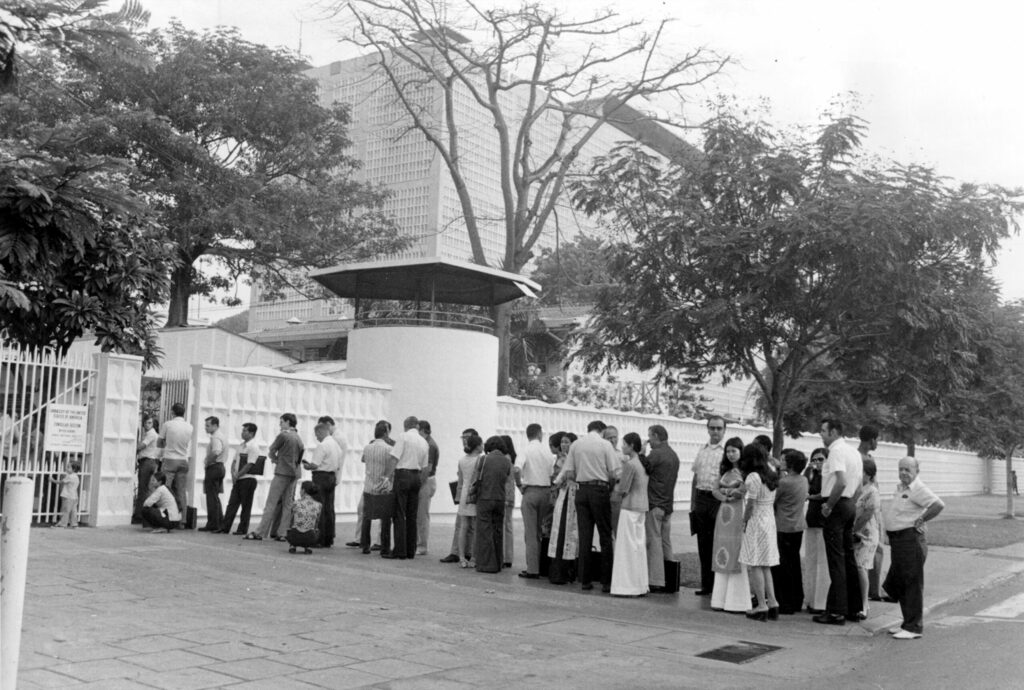
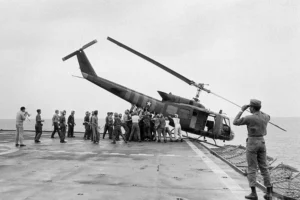
The fall of Saigon was the culmination of the North Vietnamese spring offensive, which had begun in March 1975. By late April, North Vietnamese and Viet Cong forces had encircled the city, and the U.S. government had begun a massive evacuation of American personnel and at-risk South Vietnamese. The evacuation, code-named Operation Frequent Wind, reached its peak on April 29–30, 1975.
- April 29, 1975: Rocket and artillery attacks hit Tan Son Nhut airbase, disrupting fixed-wing evacuations. Helicopters began shuttling evacuees from the U.S. Embassy and other collection points to ships offshore. The C-119 “Puff” gunship was shot down by a surface-to-air missile, as witnessed by reporters on the roof of the New Palace Hotel (Halstead, White Christmas).
- April 29–30: The last U.S. Marines departed from the embassy roof in the early hours of April 30. The embassy compound was left to the South Vietnamese and the approaching communist forces.
- April 30, 1975: North Vietnamese tanks crashed through the gates of the Presidential Palace in Saigon, and President Duong Van Minh announced an unconditional surrender. Communist troops streamed into the city, and the remaining reporters in the AP office heard the squeak of rubber sandals on the stairs (AP News, 2025).
The evacuation had been chaotic and incomplete. Thousands of South Vietnamese who had worked with the Americans were left behind, and the city fell into a stunned silence. The New Yorker’s Neil Davis, writing in October 1975, described Saigon as “a city stunned by sudden peace” (Davis, Letter from Saigon).
How It Was Seen at the Time
For the reporters who stayed, the fall of Saigon was both a professional assignment and a deeply personal experience. They had covered the war for years, and many had Vietnamese friends and colleagues. The mood was a mixture of exhaustion, apprehension, and a strange calm. Dirck Halstead, a photographer, described the scene on the rooftop: “The streets of Saigon lay deserted. The curfew begun at sunset the previous evening remains enforce. It is as if the capital has become a ghost city” (Halstead, White Christmas).
When the North Vietnamese soldiers entered the AP office, the reporters expected the worst. As the AP later recounted, “they weren’t surprised, and braced themselves for possible detention or arrest. But when the two young soldiers who entered showed no signs of malice” (AP News, 2025). This moment of relief was captured in the reporters’ own words and became a defining image of the day.
“We had watched the last Americans leave, and we knew the communists were coming. We didn’t know if we would be taken away or shot. But the soldiers just looked around and left.” — AP reporter, as recalled in AP News, 2025.
The prevailing interpretation among contemporaries was that the fall of Saigon marked the end of a long and divisive war, but also the beginning of an uncertain future for the Vietnamese people. Many feared a “bloodbath” as the communists consolidated power, though the immediate aftermath was surprisingly orderly.
Historical Snapshot
| Aspect | Detail |
|---|---|
| Date | April 29–30, 1975 |
| Place | Saigon, South Vietnam (now Ho Chi Minh City) |
| People | North Vietnamese and Viet Cong troops; South Vietnamese government and military; U.S. Embassy personnel; foreign journalists including Dirck Halstead, Neil Davis, and AP reporters |
| What Happened | The North Vietnamese captured Saigon, ending the Vietnam War; the U.S. evacuated its personnel and many South Vietnamese allies by helicopter |
| Why It Mattered | The fall of Saigon marked the collapse of South Vietnam and the reunification of Vietnam under communist rule, ending a conflict that had lasted over two decades |
Eyewitness Accounts
The most vivid records of the fall of Saigon come from the journalists who remained. Dirck Halstead, a photographer for Time and later a documentary filmmaker, kept a detailed account of the final day. His description of the SAM attack on the C-119 is a classic piece of war reporting:
“Suddenly, we see the plane explode in a brilliant flash, then parts of it slowly fall to earth, twisting and smoking. ‘Jesus,’ Neil Davis exclaims, ‘that was a SAM!’” — Dirck Halstead, White Christmas (Digital Journalist).
Fox Butterfield, a reporter for The New York Times, wrote a “Reporter’s Notebook” published on May 5, 1975, describing the six days of evacuation. He detailed the chaos at the embassy, the desperate crowds, and the final helicopter lifts. His account captures the confusion and fear of those last days.
The AP reporters who stayed in the office until the end provided a quieter but equally powerful testimony. They described the moment the North Vietnamese soldiers entered: “They’d watched overnight as the bombardments grew closer, and observed through binoculars as the last U.S. Marines piled into a helicopter on the roof of the embassy to be whisked away from Saigon” (AP News, 2025). The soldiers’ lack of hostility was a surprise and a relief.
Contemporary Newspaper Coverage
American newspapers covered the fall of Saigon extensively, but the reporting was often fragmented and contradictory. The New York Times published Fox Butterfield’s “Reporter’s Notebook: Six Days In the Evacuation From Saigon” on May 5, 1975, providing a first-person account of the evacuation. The article described the desperation of South Vietnamese civilians trying to board helicopters and the final departure of the Marines.
The Associated Press, which had maintained a bureau in Saigon throughout the war, filed dispatches up to the moment the city fell. One of the last AP stories described the arrival of communist troops and the reaction of the reporters. The tone was factual but tinged with uncertainty about what would happen next.
“As communist troops streamed into Saigon, a few remaining reporters kept photos and stories flowing.” — AP News headline, 2025 (retrospective).
The New Yorker published Neil Davis’s “Letter from Saigon” in its October 6, 1975 issue, offering a longer reflection on the city’s transformation. Davis described the “sudden peace” and the uneasy waiting for Hanoi’s next move. These contemporary reports, written in the immediate aftermath, remain essential primary sources for understanding how the event was perceived at the time.
What People Feared
In the days before and after the fall, many feared a violent bloodbath. The Nixon administration had long warned that a communist victory would lead to mass executions of South Vietnamese officials and military personnel. These fears were widely reported in the American press and shared by many South Vietnamese. The reporters in Saigon braced for detention or arrest, as the AP account makes clear.
There were also fears of a last-minute military confrontation in the city itself. The rocket attacks on Tan Son Nhut and the downing of the C-119 suggested that the North Vietnamese might fight their way into Saigon. But in the end, the takeover was relatively peaceful. The New Yorker’s Neil Davis noted that the city was “stunned by sudden peace,” and the immediate aftermath was marked by confusion rather than violence.
Other fears centered on the fate of the thousands of South Vietnamese who had worked with the Americans. Many were left behind, and their fate remained uncertain. The evacuation had been incomplete, and the fear of reprisals was real, though the full extent of the communist crackdown would only become clear in the following years.
Aftermath
In the weeks and months after April 30, 1975, Saigon—renamed Ho Chi Minh City—underwent a rapid transformation. The new communist government began to dismantle the old South Vietnamese state, imposing new economic and social policies. The New Yorker’s Neil Davis, writing in October 1975, described a city “improvising, resisting, and waiting uneasily for Hanoi’s next move.” The initial calm gave way to a more systematic consolidation of power.
For the journalists who had stayed, the aftermath was a time of reflection and, for some, departure. Many left Vietnam in the following months, but their reports and photographs became the historical record of the event. The AP reporters who had witnessed the arrival of the North Vietnamese troops continued to file stories, but under new constraints. The fall of Saigon marked the end of a long chapter in American journalism, as the press corps that had covered the war dispersed.
The immediate aftermath also saw a wave of Vietnamese refugees fleeing the country, many by boat. The U.S. accepted over 100,000 Vietnamese refugees in the following months, and the fall of Saigon became a symbol of the limits of American power and the human cost of the Vietnam War.
The fall of Saigon, as seen through contemporary reports, is a story of endings and beginnings. The journalists who stayed behind captured not only the military collapse but also the human emotions of fear, relief, and uncertainty. Their dispatches, photographs, and notebooks remain invaluable primary sources, reminding us that history is not just a sequence of events but a lived experience. The rubber sandals on the stairs, the empty streets, the sudden peace—these details bring us closer to understanding what it meant to be in Saigon in those final days.
FAQ
What was the role of journalists during the fall of Saigon?
Journalists who remained in Saigon provided the last eyewitness accounts of the city's fall. They reported on the evacuation, the arrival of North Vietnamese troops, and the immediate aftermath. Their dispatches, photographs, and notebooks became primary sources for historians and the public.
Did the North Vietnamese soldiers harm the reporters?
According to the AP account, the soldiers who entered the AP office showed no signs of malice. The reporters had braced for detention or arrest, but the soldiers simply looked around and left. This was a relief and a surprise to the journalists.
What happened to the South Vietnamese who were left behind?
Many South Vietnamese who had worked with the Americans were left behind during the evacuation. Their fate varied; some were sent to re-education camps, while others faced discrimination. The full extent of the communist crackdown became clear in the following years.









Leave a Reply