
Short Answer
On the last day of March 1975, the airfield at Da Nang in South Vietnam had become a scene of sheer desperation. As North Vietnamese forces closed in on the nation’s second-largest city, thousands of civilians and soldiers fought for the few remaining seats on departing aircraft. A United Press International (UPI) correspondent on the scene described a “flight out of hell” aboard a Boeing 727 overloaded with refugees, its flaps jammed and wheels extended, saved only by a “good tough American pilot and a lot of prayers.” The city was falling, and the world was watching the beginning of the end of South Vietnam.
What Happened?
The fall of Da Nang was a swift and chaotic collapse that took place over a few days in late March 1975. The city had been a major U.S. military base during the Vietnam War and was a key stronghold of the South Vietnamese government. In early 1975, the North Vietnamese People’s Army launched a massive offensive, sweeping through the Central Highlands and the northern provinces. By the third week of March, Da Nang was threatened.
- March 29–30, 1975: North Vietnamese forces attacked Da Nang, but resistance collapsed quickly. The city fell on March 30, according to UPI reporting.
- March 30, 1975: A UPI correspondent described a desperate refugee evacuation at Da Nang airport. Only the “fastest, the strongest and the meanest” could board the last planes.
- March 31, 1975: The New York Times reported that “Hanoi forces move south after occupying Da Nang,” noting that U.S. ships were positioned to avoid combat.
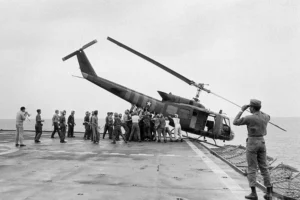
The South Vietnamese military, which had been expected to defend Da Nang, disintegrated in the face of the offensive. Soldiers and civilians mixed together in a panicked rush to flee. The U.S. Navy, meanwhile, stood by off the coast to conduct a maritime evacuation of South Vietnamese refugees, a mission that would become known as the “End of the Saga.”
How It Was Seen at the Time
Contemporary reporting captured the raw panic and brutality of the evacuation. The UPI correspondent, who flew out on the last refugee plane, wrote:
“I saw a South Vietnamese soldier kick an old woman in the face to get aboard. In the movies somebody would have shot the soldier and helped the old lady on the plane. But this was no movie he flew and the old lady tumbled down the tarmac, her fingers clawing toward the plane that was already rolling.”
The language used by reporters was that of a rout and a catastrophe. The UPI report described people “fighting one another and died trying to get aboard,” and others falling to their deaths from the plane’s undercarriage. The New York Times headline, “Hanoi Forces Move South After Occupying Da Nang,” reflected the strategic shift, but the human drama was the focus of the wire services. The mood among correspondents was a mix of horror and resignation, as it became clear that the fall of Da Nang was a turning point in the war.
Eyewitness Accounts
The most detailed contemporary eyewitness account came from the UPI correspondent who was on the last refugee flight out of Da Nang on March 30, 1975. His report, filed from Saigon, described the chaos at the airport:
Only the fastest, the strongest and the meanest got out on what may be the last refugee plane from Communist-threatened Da Nang Saturday. I saw a South Vietnamese soldier kick an old woman in the face to get aboard.
The correspondent also described the flight itself:
People fought one another and died trying to get aboard. Others fell thousands of feet to their deaths in the sea because even desperation could no longer keep their fingers welded to the undercarriage. It was a flight out of hell and only a good tough American pilot and a lot of prayers got us back to Saigon’s Tan Son Nhut airbase alive with the Boeing 727’s flaps jammed and the wheels fully extended.
This account is a primary source of the last minutes of the city’s fall, capturing the terror and the failure of the evacuation effort. It also reveals the role of American pilots and crew in the rescue, as well as the desperation of the Vietnamese people.
Contemporary Newspaper Coverage
The fall of Da Nang was covered extensively by the world’s press. The New York Times reported on March 31, 1975, with the headline:
HANOI FORCES MOVE SOUTH AFTER OCCUPYING DA NANG; U.S. SHIPS TO A VOID COMBAT
The article noted that the North Vietnamese forces were moving southward after taking Da Nang, and that U.S. Navy ships were positioned to avoid combat, indicating that the American military would not intervene. The UPI wire report, filed on March 30, was more visceral, focusing on the human tragedy at the airport. The tone of the wire service coverage was that of a disaster, with words like “hell” and “desperation” used to describe the scene. The press also emphasized the collapse of the South Vietnamese army, which had been expected to fight but instead disintegrated in the face of the advance.
What People Feared
The primary fear among civilians in Da Nang was the prospect of being left behind and falling under the control of the North Vietnamese forces. The UPI report described the desperation to board any plane, regardless of the danger. People feared both the communist takeover and the chaos of the evacuation itself. The panic was so extreme that people fought and died in the rush to leave. Another fear was the potential for a massacre or reprisals by the North Vietnamese, though the UPI report did not explicitly state this. The atmosphere was one of terror, as the city’s defenses collapsed and no one knew if they would escape.
Aftermath
The immediate aftermath of the fall of Da Nang was the continued North Vietnamese advance southward. As reported by The New York Times on March 31, 1975, the North Vietnamese forces moved south after taking the city. The U.S. Navy, as documented by the Naval History and Heritage Command, conducted a maritime evacuation of South Vietnamese refugees and military personnel from the coast. The evacuation from Da Nang was part of a larger operation that would continue until the fall of Saigon in late April 1975. The fall of Da Nang was a decisive blow to the South Vietnamese government, leading to the eventual collapse of the entire country.
How Historians See It Today
Modern historians view the fall of Da Nang as a critical turning point in the Vietnam War. The Naval History and Heritage Command’s 2017 publication, End of the Saga: The Maritime Evacuation of South Vietnam and Cambodia, provides an official account of the U.S. Navy’s role in the evacuation. This modern interpretation emphasizes the collapse of the South Vietnamese military and the logistical challenges of the evacuation. Historians now understand that the fall of Da Nang was not just a military defeat, but a political and moral catastrophe that foreshadowed the final fall of Saigon. The primary sources, including the UPI and New York Times reports, are used to illustrate the human cost and the chaos that accompanied the strategic defeat. The fall of Da Nang is often cited as a case study in the failure of a nation’s military and the human tragedy of a rapid regime collapse.
Common Misconceptions
The U.S. military actively fought to defend Da Nang.
In fact, U.S. ground forces had been withdrawn in 1973, and the U.S. Navy only conducted an evacuation, not combat, as reported by the New York Times on March 31, 1975.
The evacuation was orderly.
The UPI eyewitness account reveals that the evacuation was extremely chaotic, with people fighting and dying to board planes.
The South Vietnamese army fought to the last.
The collapse was so rapid that the army disintegrated, leading to panic and a mass refugee flight, as described in the UPI report.
Conclusion
The fall of Da Nang, as captured in the contemporary reports and eyewitness accounts, was a moment of profound human tragedy and strategic collapse. The UPI correspondent’s description of the “flight out of hell” and the New York Times report of the North Vietnamese advance provide a raw, unfiltered view of the end of South Vietnam. These primary sources reveal not only the military defeat but also the desperation of the people, the failure of the evacuation, and the beginning of the end of a nation. The fall of Da Nang is a reminder of the human cost of war and the fragility of political institutions when faced with overwhelming force.
FAQ
When did Da Nang fall to North Vietnamese forces?
Da Nang fell on March 30, 1975, according to contemporary reports. The New York Times reported the occupation on March 31, 1975.
What was the role of the U.S. Navy in the fall of Da Nang?
The U.S. Navy conducted a maritime evacuation of refugees and civilians from Da Nang and other locations, as documented by the Naval History and Heritage Command. The Navy did not engage in combat.
How did the evacuation at Da Nang airport unfold?
The evacuation was chaotic and violent, as described by a UPI correspondent on the scene. People fought to get aboard planes, and some died in the process. The correspondent described it as a 'flight out of hell.'













Leave a Reply