
Short Answer
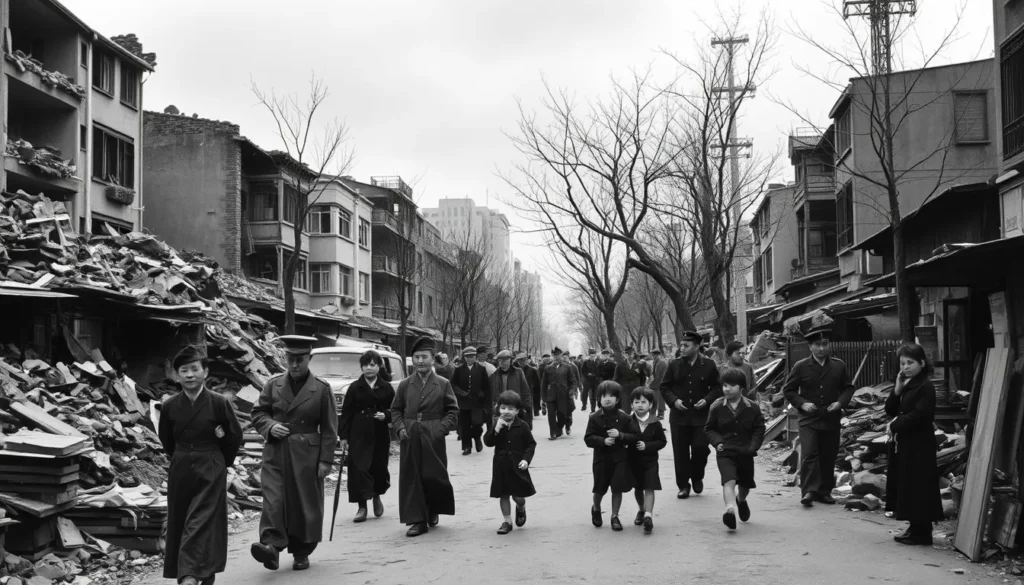
In the autumn of 1945, Tokyo was a city of ashes and queues. The Ginza, once a bright promenade of department stores and cafés, had been firebombed into block after block of rubble. Women in baggy monpe trousers and worn kimono stood in ration lines; demobilized soldiers in greatcoats and forage caps hawked family treasures from street stalls; children in dark school uniforms picked through the ruins. The war had ended with Emperor Hirohito’s radio broadcast on August 15, but peace did not arrive as plenty. It arrived as occupation. For the next six years and eight months, Japan would be governed by the Allied powers, chiefly the United States, through the Supreme Commander for the Allied Powers, General Douglas MacArthur. For ordinary Japanese, the occupation was not first a diplomatic story. It was a daily struggle for rice, fuel, shelter, clothing, medicine, and dignity. This article reconstructs that everyday world from contemporary magazines, eyewitness testimony, and official records—what people saw, queued for, feared, and hoped.
What Happened?
The Allied Occupation of Japan began in August 1945 and formally ended on April 28, 1952. It was a military occupation designed to demilitarize and democratize a defeated empire, but its impact was felt most intimately in kitchens, ration lines, black markets, and crowded tenements.
- August 15, 1945: Emperor Hirohito’s recorded broadcast announces Japan’s surrender.
- August 28, 1945: First Allied troops land at Atsugi Airfield.
- September 2, 1945: Japanese officials sign the instrument of surrender aboard the USS Missouri in Tokyo Bay.
- September 1945: MacArthur establishes headquarters in Tokyo; GHQ/SCAP begins directing demobilization, repatriation, and food relief.
- 1945–1946: Food crisis deepens; rationing, black markets, and inflation dominate daily life. Millions of soldiers and civilians return from overseas.
- 1946–1947: Land reform and a new constitution are promulgated; the constitution takes effect May 3, 1947.
- 1949: The Dodge Line austerity program stabilizes prices but deepens unemployment.
- 1950: Korean War procurement begins to revive Japanese industry.
- April 28, 1952: San Francisco Peace Treaty takes effect; occupation ends.
Throughout, SCAP issued directives on food, education, labor, women’s rights, and public health. Yet the sources show that ordinary people experienced occupation less as a coherent program than as a series of shortages, regulations, and improvised survival strategies.

How It Was Seen at the Time
Contemporary observers described a world turned upside down. Japanese magazines ran articles on “the ecology of the black market,” “the reality of rationed eating,” “the housing shortage,” and “the ecology of street orphans.” The language was practical and anxious: yakeato (burnt ruins), yamiichi (black market), takenoko seikatsu (bamboo-shoot life, peeling off possessions layer by layer to sell). For many Japanese, the Americans were liberators and occupiers at once—sources of chocolate, nylon stockings, and jazz, but also of humiliation and uncertainty.
“Everything was being sold—the products of a dead civilization.” — Donald Richie, January 1947
Allied personnel often saw Japan through a lens of ruin and exoticism. The Japanese saw them through a lens of power. The prevailing mood was not simple resentment or gratitude but a fatigued pragmatism: the war was lost, the emperor had spoken, and survival came first.
Daily Life
Food was the central fact of existence. The official ration was nominally two go (about 330 grams) of rice per adult per day, but supplies were often late, short, or mixed with barley, sweet potatoes, and substitute grains. Contemporary magazines printed recipes for daiyōshoku (substitute foods), using wild plants, acorns, and artificial sweeteners. People queued for hours at ration stations and then turned to the black market, where prices ran many times official rates. LARA and CARE relief goods—powdered milk, canned meat, wheat flour—became part of school lunches and family meals.
Housing was equally desperate. American bombing had destroyed about 2.2 million dwellings. Families doubled up in surviving houses, moved into barracks, or built shacks from scavenged wood and tin. The “bamboo-shoot life” described in contemporary magazines meant selling clothes, kimonos, watches, and family heirlooms one layer at a time to buy food. Housing shortages were so severe that magazines ran designs for tiny fifteen-tsubo houses and debated a “spare-housing tax.”
Clothing reflected scarcity. Women wore monpe, the baggy work trousers promoted during the war, or simple kimono and yukata; men wore worn army uniforms, padded kimono, and wooden geta. Cosmetics and permanent waves were luxuries. Near Yurakucho station, some women wore dirndl skirts and platform shoes, with seams painted on their legs in strong tea because silk stockings were unobtainable. By 1948, kimono advertisements reappeared, and Allied wives became customers for Japanese silk.
Work and health were precarious. Demobilized soldiers, widows, and repatriates crowded labor markets. Tuberculosis increased sharply, and malnutrition weakened children and the elderly. War orphans and street children—furōji—became a visible social problem, written about in magazines and handled by police and charities. The New Life Movement encouraged “rational” cooking, sewing, and household management, but for most families the goal was simply the next meal.
Historical Snapshot
| Aspect | Detail |
|---|---|
| Date | August 1945 – April 1952 |
| Place | Japan, especially Tokyo, Yokohama, Osaka, and other bombed cities |
| People | Japanese civilians, repatriates, war orphans, black-market traders, Allied occupation personnel under SCAP |
| What Happened | Allied military occupation, demilitarization, democratization, food rationing, black markets, housing shortages, social reform |
| Why It Mattered | Reshaped Japanese politics, economy, and daily life; set the framework for postwar Japan |
Eyewitness Accounts
Donald Richie, an American civilian who arrived in Japan in January 1947, left one of the most vivid descriptions of occupied Tokyo. Walking the Ginza, he found not a shopping boulevard but a bazaar of survival.
“The view was block after block of rubble.” — Donald Richie, January 1947
“And everyone was out of fashion. In peacetime they were still dressed for war.” — Donald Richie, January 1947
Richie described street stalls selling wartime medals, egret-feather tiaras, top hats, beaded handbags, bridles, damascene cufflinks, brocades, calligraphy, and battered woodblock prints. Around the stalls, uniforms were still everywhere: black student uniforms, army uniforms, forage caps, army boots, winter-issue overcoats, padded kimono, scarves, and face masks against the cold. His account captures the strange mixture of ruin, commerce, and dignity that shaped everyday life.
What People Knew at the Time
| What People Knew Then | What We Know Now |
|---|---|
| Japan had surrendered; Allied soldiers would occupy the country. | The occupation lasted six years and eight months, until April 28, 1952. |
| Food, housing, and clothing were scarce; black markets were illegal but necessary. | Rationing and black markets persisted well into the occupation; the Korean War helped revive the economy. |
| Reforms were announced in education, land tenure, labor, and women’s rights. | Reforms were far-reaching but uneven; the “reverse course” later softened labor and antitrust policies. |
| Americans dominated the occupation presence. | The occupation was Allied, including British Commonwealth forces, though American influence was decisive. |
What People Feared
Contemporary publications and official records show a cluster of concrete anxieties rather than abstract ideology. The worst fear was starvation. Ration delays, inflation, and crop failures made food shortage a daily threat, and magazines warned of “food shortage and social unrest.” Tuberculosis, already a major killer, spread in crowded and malnourished conditions. Families feared eviction and homelessness as housing shortages worsened. Parents feared for children drawn into street trading, prostitution, and petty crime. There were also widespread fears of sexual violence by occupation soldiers; documented cases existed, though estimates varied and rumor often outran evidence. Politically, authorities and commentators feared communist unrest and black-market disorder. These fears were not paranoid fantasy: they were rooted in the visible ruins of the war and the fragile new order of the occupation.
How Historians See It Today
Modern scholarship has moved beyond a top-down story of MacArthur’s reforms. John W. Dower’s Embracing Defeat (1999) emphasizes Japanese agency and the emotional and material work of rebuilding after surrender. Eiji Takemae’s The Allied Occupation of Japan (2002) treats the occupation as multinational and contested, not simply American. Social and cultural historians now read ration queues, black markets, monpe, and takenoko life as central to the occupation, not as background color. They also stress the “reverse course” of 1947–1950, when Cold War priorities softened labor reforms and encouraged economic recovery. Contemporary observers saw chaos and shortage; historians now see a transformative period in which ordinary Japanese negotiated, resisted, and adapted to occupation power.
The ashes of 1945 did not simply disappear. They were swept into ration lines, sold from street stalls, patched into clothing, and written into magazines. The primary sources of occupied Japan show a society under enormous pressure, but not passive. People queued, bartered, improvised, complained, and rebuilt. The occupation’s official history is one of demilitarization and democratization; its everyday history is one of hunger, housing, and small acts of persistence. Those sources remind us that great-power decisions are lived in kitchens and streets, and that survival itself can be a form of historical agency.
FAQ
How long did the Allied Occupation of Japan last?
From August 1945 to April 28, 1952, about six years and eight months.
What did Japanese people eat during the occupation?
The official ration was nominally two go of rice per adult per day, often mixed with barley and sweet potatoes; people relied on substitute foods, black markets, and LARA/CARE relief goods.
Was the occupation only American?
No. It was an Allied occupation under SCAP, dominated by the United States but including British Commonwealth forces and other Allied personnel.
What was “takenoko life”?
It meant selling off possessions layer by layer, like peeling a bamboo shoot, to buy food.

Leave a Reply