
Short Answer
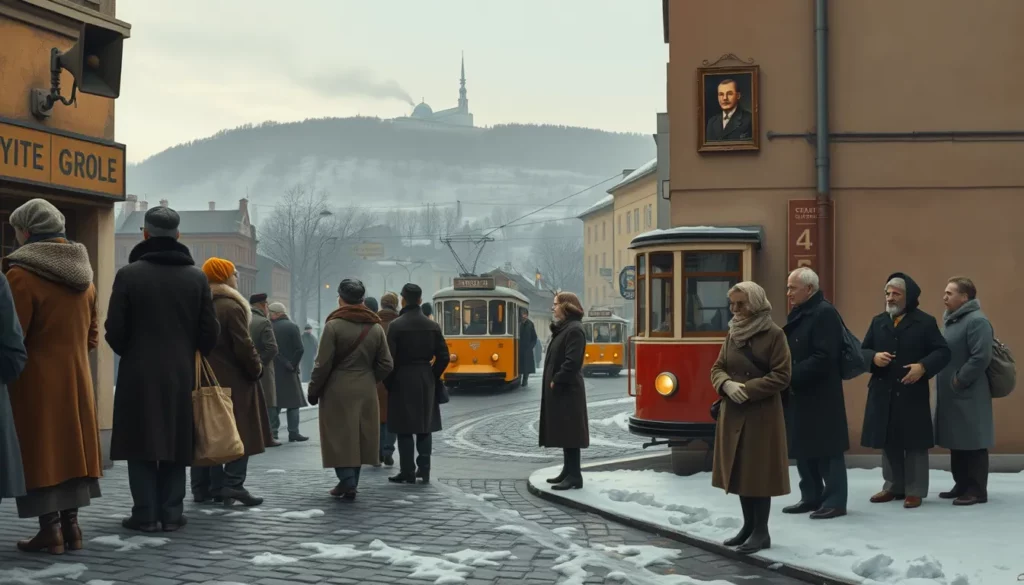
At six in the morning on a February day in 1962 the trams on Národní třída were already full. Men in padded coats and women in headscarves stood in the aisles, breathing the coal smoke that hung over the city from thousands of tile stoves, while a loudspeaker on the corner relayed the morning programme of Czechoslovak Radio. The večerka on the corner had sold its last milk the night before, and the queue outside the state food shop had already formed in the dark. Above the river, on the Letná plain, the granite Stalin monument — the largest Stalin statue in Europe — still watched the city, though the men who would dynamite it that autumn had already been chosen. A portrait of Klement Gottwald, dead nine years, hung above the counter where the women waited. This was Prague between the communist seizure of power in February 1948 and the eve of the Prague Spring in January 1968: a city of guaranteed work and missing goods, of compulsory optimism and private irony, of free medicine and free university places awarded by political vetting, of cheap flats and a state that listened at the door. This article concerns the everyday life of ordinary Praguers in that period rather than high politics — what they earned, ate, feared and said to one another.
What Happened?
The communist transformation of Prague did not begin with street fighting. It began with a resignation crisis. On 20 February 1948 twelve non-communist ministers of the National Front resigned, hoping to force President Edvard Beneš to call early elections. On 25 February the communist prime minister Klement Gottwald addressed a massed crowd from the balcony of the Kinský Palace, and Beneš, ill and isolated, accepted the resignations. The Communist Party of Czechoslovakia (KSČ), backed by Soviet pressure and by its control of the police, trade unions and factory militias, held undisputed power within a week. The following months erected the scaffolding of the new order: “action committees” purged workplaces and institutions, a law of 28 April 1948 nationalised enterprises employing more than fifty people, and the constitution of 9 May 1948 proclaimed a “people’s democratic” republic on the Soviet model.
- 1948–1950: Prověrky (screenings) of employees, the merger of the Social Democrats into the KSČ, and the beginnings of agricultural collectivisation through unified cooperatives (JZD).
- 27 June 1950: Milada Horáková, a former resistance fighter and Social Democratic deputy, is hanged after a televised and radio-broadcast show trial, despite international appeals.
- 20–27 November 1952: The Slánský trial in Prague — fourteen defendants, eleven of them Jewish, eleven hanged on 3 December, including the former party general secretary Rudolf Slánský and the deputy foreign trade minister Rudolf Margolius.
- March 1953: Stalin dies on 5 March; Gottwald dies on 14 March, nine days after attending Stalin’s funeral in Moscow.
- 31 May–1 June 1953: A currency reform is announced by radio on the evening of 31 May and takes effect the next morning, wiping out most private savings; strikes break out in Plzeň and elsewhere.
- 1 May 1955: The Stalin monument is unveiled on Letná and the first nationwide Spartakiáda gymnastic display is staged in Prague.
- 1956: Khrushchev’s “secret speech” is followed by only token de-Stalinisation in Prague; student unrest at the Strahov dormitories is quickly suppressed.
- 11 July 1960: A new constitution renames the state the Czechoslovak Socialist Republic, declares that socialism has triumphed, and is accompanied by a broad amnesty of political prisoners.
- 1962–1963: The Stalin monument is demolished; the Kolder Commission reports on the “errors and deviations” of the 1950s; Slánský’s surviving victims and the executed are quietly rehabilitated.
- 1965–1967: A cultural thaw gathers pace in film, theatre and the press; the Writers’ Union congress of June 1967 turns into an attack on the party leadership, and on 5 January 1968 Antonín Novotný is replaced by Alexander Dubček.
For the ordinary Praguer, however, the political calendar mattered less than its consequences: where one worked, whether one’s children could study, when a flat would be allocated, whether a relative would be permitted to travel, and what would be in the shops on Saturday.
How It Was Seen at the Time
Contemporaries were taught to see February 1948 as a liberation and a beginning. The official vocabulary of the period was rich and insistent: “Vítězný únor” (Victorious February), “building socialism,” “the socialist man,” “vigilance,” “the class enemy,” “the camp of peace and socialism.” Public space carried the message in paint and plaster. “Who is not with us is against us,” ran a slogan chalked on walls and printed on banners in the first years after 1948. The 1960 constitution announced the result in monumental prose:
The Czechoslovak Socialist Republic is a socialist state, based on the firm alliance of workers, peasants and intelligentsia, headed by the working class.
Many people, especially young workers who had risen fast through the new schools and factory cadres, genuinely believed in this narrative; the party’s ranks swelled after 1948 with careerists as well as converts. But the private register was different, and it was often ironic — the Czech tradition of Švejkian mockery proved remarkably durable. Milan Kundera’s novel The Joke, published in 1967 at the end of the thaw, caught the tone exactly when a student scribbles a joke on a postcard:
Optimism is the opium of the people!
Between the public and the private registers there was a third: silence. The prevailing mood of the early 1950s, as survivors recalled it, was not so much enthusiasm as a careful, watchful conformity, punctuated by relief at having work, a flat and a future at all.
Historical Snapshot
| Aspect | Detail |
|---|---|
| Date | February 1948 (communist takeover) to January 1968 (eve of the Prague Spring) |
| Place | Prague, capital of the Czechoslovak Republic, renamed the Czechoslovak Socialist Republic in 1960 |
| People | Roughly one million Praguers — factory workers, clerks, teachers, students, housewives, artists — alongside KSČ leaders Gottwald, Zápotocký and Novotný, and the security police (StB) |
| What Happened | A Soviet-aligned one-party state reorganised work, housing, education and culture; the 1950s brought show trials and political terror, the 1960s a gradual, uneven liberalisation |
| Why It Mattered | This was the formative experience of a generation; the grievances and expectations of these years produced both the reform movement of 1968 and the shape of everyday life for the next two decades |
Daily Life
Work and wages
Full employment was both a promise and a compulsion; “work is a matter of honour” ran a slogan painted in every factory yard, and idleness was a political offence rather than an economic one. Wage differentials were deliberately compressed, so that a surgeon and a skilled turner might earn broadly similar sums, and labour turnover was chronic because changing jobs was almost the only way to improve one’s pay. Trade unions, organised in the Revolutionary Trade Union Movement, administered subsidised canteens, holiday vouchers and the factory newspapers rather than bargaining over wages. Workplaces were also the primary site of political life: the morning meeting, the wall newspaper, the voluntary “brigáda” Saturday shift, the collective resolution endorsing whatever the party had decided.
The queue and the shop
Food rationing, introduced after the war, continued until 1953. Thereafter shortages were episodic rather than universal: bread and milk were usually obtainable, but meat, butter, coffee, oranges, good shoes and spare parts were not. Housewives built networks of mutual obligation, the currency of which was information — which shop had received a delivery, which assistant would hold something back. The phrase “pod pultem” (“under the counter”) entered everyday speech to describe goods sold discreetly to friends, relatives or useful acquaintances. State shops set low, subsidised prices on basics, so that money was plentiful and goods scarce; a tram ticket cost a single crown, but a pair of decent shoes might require a favour.
Home and the panel block
Flats were allocated, not bought, by local national committees and factory committees, and the wait for a young family could be years. Many households lived in sublet rooms or shared flats with strangers, and the address on one’s identity card was a matter of political as well as domestic consequence. From the late 1950s prefabricated concrete blocks — paneláky — began to rise on the outskirts, promising hot water, central heating and privacy after the crowded tenements of the inner city. The promise was powerful precisely because housing was the regime’s most tangible claim on gratitude.
Culture and leisure
Czechoslovak Television began broadcasting in 1953 and became a mass medium in the early 1960s; radio, piped into flats through the wired “rozhlas po drátě” system, never switched off entirely. Families took subsidised holidays in union chalets, built or inherited weekend cottages in the countryside, and filled the cinemas. From 1959 the Semafor theatre and the Theatre on the Balustrade offered a cabaret and absurdist alternative to official culture, and by the mid-1960s the films of the Czech New Wave — Miloš Forman’s Black Peter (1964) or Jiří Menzel’s Closely Watched Trains (1966) — were drawing audiences with an irony that officials only belatedly understood.
Eyewitness Accounts
The most detailed first-person record of these years is Heda Kovály’s memoir, published in Czech as Na vlastní kůži and in English as Under a Cruel Star. Kovály, a Prague Jew who had survived Theresienstadt and Auschwitz, married Rudolf Margolius, a rising communist official who became deputy minister of foreign trade. He was arrested in early 1951; she was dismissed from her profession and took manual work. In her account of the Slánský trial of November 1952 — broadcast on the radio, with loudspeakers rigged in factory halls so that work could stop for the confessions — she describes a city in which nearly everyone recognised the charges as absurd and nearly everyone behaved as though they believed them. Factory collectives passed resolutions demanding death sentences; colleagues who had known the accused for decades denounced them in the same breath. Her Czech title, meaning “on one’s own skin,” is a precise description of how the period was learned: not from newspapers but from the body.
The testimony of the writers who confronted the regime at the congress of the Czechoslovak Writers’ Union in June 1967 belongs to the other end of the period. Here the memories of the 1950s were no longer whispered but spoken into a microphone, in front of officials, by men and women who had themselves once conformed.
What People Feared
The fears of the 1950s were specific and rational. People feared the night knock, the unmarked car, the summons to the workplace committee, and above all the consequence that fell on the whole family: a child barred from secondary school or university because of “class origin,” a spouse dismissed, a flat withdrawn. Denunciation was not only possible but encouraged, and the phrase “bdělost” (vigilance) turned suspicion into a civic virtue. Informers were believed to be everywhere; in fact the files of the StB show a dense but not omnipresent network, and the uncertainty did much of the work.
Other fears were larger and vaguer: war with the West, which propaganda presented as imminent and nuclear; West German “revanchism”; and the return of capitalism and unemployment, which older workers remembered from the 1930s. Against these anxieties the regime offered itself as the only guarantee of order. By the 1960s the fears had thinned but not vanished. People still lowered their voices on the tram, still avoided certain topics in front of colleagues, still destroyed letters — and, in the same years, began to say more in public than they had for a decade.
What People Knew at the Time
| What People Knew Then | What We Know Now |
|---|---|
| That the great trials were fabricated, or at least that the confessions were extracted; few believed the charges against Margolius or Slánský. | Party and StB archives confirm that the trials were scripted in advance, with torture, drugs and family blackmail used to produce confessions. |
| That the currency reform of June 1953 was coming, though almost nobody knew its terms until the radio announcement the night before. | The decision was taken in strict secrecy by a handful of leaders; the conversion rates were deliberately concealed to prevent withdrawals. |
| That the West was richer; radio broadcasts from Vienna and Munich, jammed but audible, carried the evidence. | Comparisons of wages and consumption confirm a widening gap that the regime’s own statisticians privately acknowledged. |
| That the 1960 amnesty and the rehabilitations of 1963 marked a real relaxation. | The rehabilitations were partial and cautious, designed to preserve the party’s authority rather than to reckon with the past. |
How Historians See It Today
Cold War scholarship of the 1950s and 1960s described Czechoslovakia through the totalitarian model: a monolithic state imposing its will on a passive society. From the 1990s, historians working in the archives — and influenced by German Alltagsgeschichte — shifted attention to everyday life, arguing that the regime’s project was less the permanent mobilisation of the population than the reorganisation of ordinary existence: work, housing, consumption, family, health. Roman Krakovský’s State and Society in Communist Czechoslovakia (2020) treats this transformation of the everyday as the regime’s central ambition and its central problem, since daily practices also shaped and limited the state. Kimberly Elman Zarecor’s work on socialist housing shows how seriously planners pursued a modernist utopia of mass dwelling. Some historians now describe the system as a “welfare dictatorship,” which promised security and modernisation in exchange for political obedience. The result is a more complicated picture than either the propaganda or the dissident literature allowed: real social mobility and real terror coexisted, and the same citizens who queued and conformed also mocked, negotiated and, by 1967, spoke out.
The years before the Prague Spring left behind more than a political chronology. They left a set of habits — of irony, of mutual help, of reading between the lines — that outlasted the thaw that produced them and shaped how Czechoslovaks lived through the two decades of “normalisation” that followed 1968. Read against the grain, the primary sources of the period are a record of endurance as much as of oppression: a woman’s memoir of learning politics on her own skin, a student’s joke about optimism, a queue in the dark on a winter morning. They remind us that the great ideological struggles of the twentieth century were settled, or survived, in kitchens and tram aisles.
FAQ
What was everyday life like in Prague under communism before 1968?
Work was guaranteed and wages were compressed, but goods were often scarce. Families queued for meat, butter and shoes, relied on favours and acquaintances to obtain goods “under the counter,” waited years for a state-allocated flat, and lived with a constant awareness that colleagues and neighbours might report what they said. At the same time there was free healthcare, cheap public transport, subsidised holidays, mass literacy and real social mobility for workers’ children — which is why the period cannot be reduced either to terror or to nostalgia.
Was there censorship and surveillance in 1950s Prague?
Yes. Publishing, film, radio and theatre were subject to pre-publication censorship, and the Státní bezpečnost (StB) maintained a network of informers and files on citizens. The great political trials of 1950–1952 were scripted in advance and broadcast on radio. Surveillance was dense but not universal, and the uncertainty it created was as effective as its actual reach; the 1960s brought a visible relaxation, though the apparatus was never dismantled.
How did the 1953 currency reform affect ordinary people?
Announced by radio on the evening of 31 May 1953 and effective the following morning, the reform exchanged wages and small sums at one rate while converting larger savings at far worse rates, effectively destroying the savings of many households. Shops were closed while prices were re-marked, and protests broke out in Plzeň and other industrial towns. For many Praguers it was the moment when the regime’s promises about rising living standards lost credibility.
Could ordinary Praguers travel abroad before 1968?
Only rarely, and usually to other socialist states. Passports and exit permits were granted selectively, often as a reward for political reliability, and applications by people whose relatives had emigrated were routinely refused. Travel to the West remained exceptional throughout the period, though the cultural thaw of the mid-1960s made some trips and exchanges easier for artists and specialists.
Did living standards improve in the 1960s?
They did, unevenly. After the stagnation and crisis of the early 1960s, consumer goods such as televisions, refrigerators and the Škoda Octavia became more available, self-service shops appeared, and prefabricated housing offered modern amenities to hundreds of thousands of families. Growth was still hampered by shortages and by the inefficiencies of the planned economy, and the improvement helped create the expectations that the reformers of 1968 tried to meet.










Leave a Reply