
Short Answer
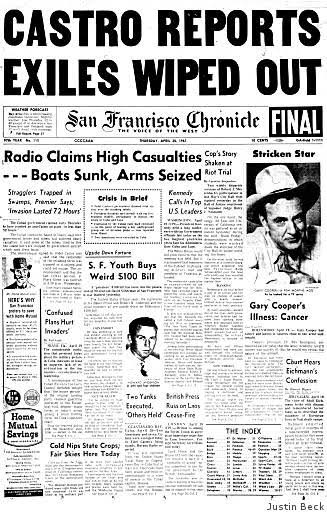
In the early hours of April 17, 1961, as most Americans slept, a rebel army of Cuban exiles landed on the southern coast of Cuba, at the swampy Bay of Cochinos. Within hours, the first wire-service dispatches crackled across the world, and newspaper readers in the United States and beyond woke to headlines of a violent waterfront battle just 90 miles from Havana. UPI correspondent Francis L. McCarthy filed a breathless account from the scene, describing a “long-awaited offensive” that had begun “by air and sea” (UPI Archives). The next day, the world’s press, still digesting the first reports, began to grapple with the implications of a proxy war in the Caribbean, a crisis that would test the limits of press freedom and public trust. This article, drawn entirely from period newspapers and contemporary accounts, reconstructs how the Bay of Pigs invasion was experienced, reported, and understood by those who lived through it.
What Happened?
The Bay of Pigs invasion unfolded over three days, from April 17 to April 19, 1961, though its origins stretched back months. According to the UPI dispatch of April 17, Cuban revolutionaries—trained in Guatemala, as the report noted—struck “into the swampy area around the Bay of Cochinos, south of Matanzas Province” shortly after midnight (UPI Archives). The invasion force, supported by planes and two gunboats, clashed with Fidel Castro’s military and militia forces. Castro immediately declared a state of national emergency, signed a proclamation as “commander-in-chief,” and promised to crush the invaders (UPI Archives).
By April 20, the Cuban government claimed it had “completely defeated” the invasion force, according to a New York Times dispatch by Tad Szulc. The rebels had abandoned their beachhead and reportedly merged with guerrillas in the Escambray Mountains. The Castro communiqué said the last strongholds of the “mercenary troops” had been overrun at 5:30 P.M. the previous day—less than seventy-two hours after landing. The communiqué also claimed that quantities of North-American military equipment, including Sherman tanks, were seized (New York Times, April 20, 1961).
How It Was Seen at the Time
Contemporary reporting framed the invasion as a dramatic, high-stakes conflict, but the full picture remained murky. The UPI article of April 17 described the invasion as a “long-awaited offensive” against Castro, with the rebels striking “from the sea shortly after midnight” (UPI Archives). The language was urgent and uncertain: “It was not known where the invaders came from,” though the report noted that revolutionary forces had long been known to be training in Guatemala. The New York Times headline on April 20 captured the tense mood: “Castro Says Attack Is Crushed; Cuba Rebels Give Up Beachhead, Report New Landings On Island” (New York Times). The press also reported persistent rumors of new rebel landings on the northern coast, even as Castro claimed victory.
“Cuban revolutionaries invaded their island homeland by air and sea today and clashed with Fidel Castro’s forces in a violent waterfront battle just 90 miles from Havana.” — UPI, April 17, 1961
The prevailing mood in the American press was one of uncertainty and anxiety. Editors and reporters struggled to verify details, as the Cuban government controlled internal communications. The New Yorker’s Washington correspondent, Richard H. Rovere, later wrote that the episode revealed “the new perils of invasion by proxy” (New Yorker, May 6, 1961). At the time, many Americans viewed the invasion as a decisive test of Cold War resolve, but the rapid collapse of the exile forces shocked many observers.
Historical Snapshot
| Aspect | Detail |
|---|---|
| Date | April 17–19, 1961 |
| Place | Bay of Cochinos (Bay of Pigs), southern coast of Cuba |
| People | Fidel Castro (Cuban Premier), Cuban exiles (invaders), U.S. government (covertly involved) |
| What Happened | A force of Cuban exiles, trained in Guatemala and supported by U.S. equipment, invaded Cuba, but was defeated by Castro’s forces in under 72 hours. |
| Why It Mattered | The failed invasion was a major Cold War episode, embarrassing the United States and strengthening Castro’s position. |
Contemporary Newspaper Coverage
The press covered the invasion with a mix of urgency and confusion. The UPI wire story of April 17 provided the first detailed account, describing the amphibious assault and the Cuban government’s response. The New York Times, in its April 20 report, provided a more sober assessment after the defeat, quoting Castro’s claims of victory and reporting on the rebels’ retreat to the Escambray Mountains. The tone of the coverage was dramatic and often contradictory, reflecting the fog of war.
“The Cuban radio said that five men were killed and three militiamen wounded in the initial attack.” — UPI, April 17, 1961
Notably, the UPI report also mentioned that the Cuban internal radio communications system had been commandeered by the army, a detail that hinted at the information war. The New York Times article of April 20 included a headline that captured the uncertainty: “Castro Says Attack Is Crushed; Cuba Rebels Give Up Beachhead, Report New Landings On Island” (New York Times). The press also noted that the invaders’ equipment was “of North-American make,” which raised questions about U.S. involvement, though the official U.S. stance was not yet clear.
What People Knew at the Time
| What People Knew Then | What We Know Now |
|---|---|
| The invasion was carried out by Cuban revolutionaries, possibly trained in Guatemala (UPI, April 17, 1961). | The invasion was planned and financed by the U.S. Central Intelligence Agency, with the approval of President Kennedy. |
| Castro declared a state of emergency and vowed to crush the invaders (UPI, April 17, 1961). | Castro’s forces were well-prepared and the invasion was defeated within days. |
| The Cuban government claimed it had “completely defeated” the invasion by April 19 (New York Times, April 20, 1961). | The defeat was real, but the rebels’ failure was due to lack of U.S. air support and tactical errors. |
| There were rumors of new landings on the northern coast (New York Times, April 20, 1961). | No further landings occurred; the rumors were false or unconfirmed. |
What People Feared
At the time, the public feared a wider war. The UPI article noted that the invasion occurred “just 90 miles from Havana,” underscoring the proximity to the U.S. mainland. Many Americans feared that a failure would embolden Soviet-backed Cuba and potentially trigger a superpower confrontation. The New York Times reported that the Cuban government was claiming the invaders were “mercenary troops,” which raised the specter of foreign intervention. The New Yorker’s Richard Rovere wrote of the “new perils of invasion by proxy,” reflecting a fear that such covert operations could spiral into a direct conflict with the Soviet Union. The press also reflected fears about the reliability of U.S. intelligence and the credibility of the government, as the invasion was seen as a U.S.-backed operation even though official denials were issued.
What People Expected Would Happen Next
In the immediate aftermath, many expected the invasion to be a turning point in the Cold War. The UPI report of April 17 described the invasion as a “long-awaited offensive,” suggesting that many believed the rebels could topple Castro. The New York Times of April 20 reported that the rebels had “merged with guerrillas” in the Escambray Mountains, implying that a prolonged guerrilla war might follow. However, Castro’s victory was swift, and within days the expectation shifted to a post-mortem of the failed invasion. Many observers expected the U.S. to face political fallout, both at home and abroad, and that the Soviet Union would use the episode to strengthen its ties with Cuba. The New Yorker noted that the episode would likely affect the Kennedy administration’s future foreign policy, with Rovere predicting a reassessment of “invasion by proxy” as a tactic.
Aftermath
The immediate aftermath of the Bay of Pigs was a propaganda victory for Castro, who used the invasion to consolidate his power and align Cuba more closely with the Soviet Union. The U.S. government, under President John F. Kennedy, faced intense criticism for the failed operation, and the CIA’s role was soon revealed, though not officially acknowledged at the time. The New York Times reported that the Cuban government seized “quantities of military equipment of North-American make,” which undercut U.S. denials of involvement. The invasion also led to a hardening of Cold War tensions, culminating in the Cuban Missile Crisis of 1962. For the press, the episode raised questions about the accuracy of wartime reporting and the limits of government secrecy. The New Yorker’s Richard Rovere wrote that the episode exposed the “new perils of invasion by proxy,” a theme that would resonate for decades.
How Historians See It Today
Modern historians view the Bay of Pigs invasion as a catastrophic failure of U.S. foreign policy and a classic example of the dangers of covert action. While contemporary newspapers reported on the invasion as a military battle, historians now emphasize the U.S. role, the poor planning, and the lack of air support. The primary sources—the UPI and New York Times reports—capture the confusion and propaganda of the time, but they do not reveal the full extent of the CIA’s involvement, which was only declassified later. Historians also note that the invasion strengthened Castro’s position and pushed Cuba closer to the Soviet Union, a development that would have major consequences during the Cuban Missile Crisis. The press coverage, while imperfect, provides a valuable record of how the public learned about the event, and the subsequent revelations highlight the gap between contemporary reporting and historical truth.
Common Misconceptions
Related Primary Sources
- UPI Archives, “Rebel army invades Cuba, battles for beachheads” (April 17, 1961) — https://www.upi.com/Archives/1961/04/17/Rebel-army-invades-Cuba-battles-for-beachheads/2815064548293/
- New York Times, “Castro Says Attack Is Crushed; Cuba Rebels Give Up Beachhead, Report New Landings On Island” (April 20, 1961) — https://archive.nytimes.com/www.nytimes.com/library/world/americas/042061cuba-invasion.html
- Richard H. Rovere, “Letter from Washington,” The New Yorker (May 6, 1961) — https://www.newyorker.com/magazine/1961/05/06/letter-from-washington-97
- Norbert L. Mintz, “The Cuban episode and the American press: April 9-23, 1961” (University of Central Florida, 1961) — https://stars.library.ucf.edu/cgi/viewcontent.cgi?article=1352&context=prism
FAQ
What did the newspapers report on the first day of the invasion?
The UPI report of April 17, 1961, described the invasion as a 'long-awaited' offensive by Cuban revolutionaries, who landed at the Bay of Cochinos and clashed with Fidel Castro's forces. It noted that Castro had declared a state of national emergency and promised to crush the invaders. The report also mentioned that the invaders were likely trained in Guatemala, but the U.S. role was not yet disclosed.
How did the New York Times cover the invasion's outcome?
On April 20, 1961, the New York Times reported that Castro claimed his government had 'completely defeated' the invasion force. The article described the rebels' retreat to the Escambray Mountains and mentioned reports of new landings on the northern coast, which were later unconfirmed. The Times also noted that the equipment seized was of North-American make, hinting at U.S. involvement.











Leave a Reply