

Short Answer
In the summer of 1950, as American troops landed in Korea, the United States stood at the summit of the world, as Winston Churchill had declared five years earlier. The economy was booming, and the fruits of prosperity—new cars, suburban houses, and consumer goods—were available to more people than ever before. Yet beneath the surface of this optimism lay deep anxieties: the Cold War, the threat of nuclear annihilation, and the stirrings of the Civil Rights Movement. Across the Atlantic, Britain was still recovering from the war, with rationing still in place and the coronation of Queen Elizabeth II in 1953 offering a moment of national celebration. This article reconstructs the everyday life of the 1950s through contemporary reports, diaries, and official records, revealing a decade of contrasts.
What Happened?
The 1950s opened with the Korean War (1950–1953), as the United States led United Nations forces against communist North Korea. At home, the postwar boom transformed American society. Millions of Americans left cities for the suburbs, where new housing developments sprang up “like crabgrass” across the country. The economy boomed, and consumer goods such as cars, televisions, and household appliances became widely available. In Britain, the decade was marked by recovery from the Second World War. Rationing of food and sweets continued into the early years, and the coronation of Queen Elizabeth II in June 1953 provided a moment of national unity. The decade also saw the rise of the Civil Rights Movement in the United States, as African Americans began to challenge segregation. Key events included:
- 1950–1953: Korean War
- 1953: Coronation of Queen Elizabeth II
- 1954: End of sweet rationing in Britain
- 1955–1956: Montgomery bus boycott and the emergence of Martin Luther King Jr.
- 1957: Harold Macmillan’s “You’ve never had it so good” speech
How It Was Seen at the Time
Contemporaries saw the 1950s as an era of unprecedented prosperity and stability. Winston Churchill’s 1945 declaration that “America at this moment stands at the summit of the world” captured the prevailing mood. In Britain, Prime Minister Harold Macmillan’s 1957 remark that “you’ve never had it so good” reflected a similar optimism. However, this optimism was tempered by the fear of communism and nuclear war. The sources describe a society that valued authority and conformity, with clearly defined gender roles: the father as breadwinner, the mother as homemaker. As one contemporary account noted, “Life was simple and ordered, and the cornerstone of society was authority.”
“America at this moment stands at the summit of the world.” — Winston Churchill, 1945
“You’ve never had it so good.” — Harold Macmillan, 1957
Historical Snapshot
| Aspect | Detail |
|---|---|
| Date | 1950–1959 |
| Place | United States and United Kingdom |
| People | American suburban families, British citizens recovering from war, civil rights activists, Cold War policymakers |
| What Happened | Post-war economic boom, suburbanization, consumer culture, Cold War tensions, Korean War, British recovery and coronation |
| Why It Mattered | Shaped modern consumer society, gender roles, and the geopolitical landscape of the second half of the 20th century |
Daily Life
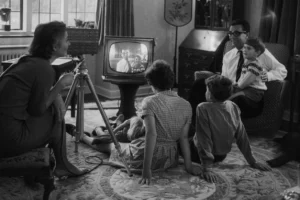
In the United States, the ideal family lived in a suburban home with a lawn, a car in the garage, and a television in the living room. The father donned his gray flannel suit and commuted to work, while the mother stayed home to raise the children. Meals often came from TV dinners, and entertainment included drive-in movies and fast-food restaurants. Suburban malls and the automobile reshaped how Americans shopped and socialized. In Britain, daily life was more austere. Rationing of food and sweets continued into the early 1950s, and many families lived in cramped housing. The coronation of Elizabeth II in 1953 brought a sense of celebration and hope for the future. As the National Archives notes, the decade saw the end of sweet rationing and the beginning of a consumer age, but also the persistence of class distinctions and regional inequalities.
Different Perspectives
American Perspective
For many white middle-class Americans, the 1950s were a golden age of prosperity and security. The suburbs offered space, privacy, and a sense of community. Consumer goods—refrigerators, washing machines, televisions—became symbols of success. However, this prosperity was not universal. African Americans faced segregation and discrimination, and the Civil Rights Movement began to challenge the status quo. The Cold War also cast a long shadow, with school drills for nuclear attacks and a pervasive fear of communist infiltration.
British Perspective
In Britain, the 1950s were a time of recovery and transition. Rationing continued into the early years, and many families still lived in pre-war housing. The coronation of Elizabeth II in 1953 was a moment of national pride and optimism. The end of sweet rationing in 1954 was celebrated as a sign of progress. However, the decade also saw the decline of the British Empire and the beginning of the Cold War, which brought its own anxieties. The phrase “You’ve never had it so good” captured the growing affluence, but also masked persistent poverty and social inequality.
What People Feared
The Cold War dominated fears in both the United States and Britain. Americans feared communist infiltration and nuclear attack, leading to the construction of fallout shelters and school drills. The Korean War was seen as a direct threat to the free world. In Britain, there was also fear of nuclear war, but additionally concerns about economic decline and the loss of empire. The sources reveal a society that was both optimistic and anxious, with the threat of annihilation never far from the surface.
What People Expected Would Happen Next
Many contemporaries expected continued prosperity and technological progress. The 1950s saw the rise of television, the expansion of the interstate highway system, and the beginning of the space race. Some predicted that the Cold War would lead to a hot war, while others hoped for peaceful coexistence. In the realm of civil rights, many expected gradual change, but the pace of the movement surprised many. The decade ended with the election of John F. Kennedy, who promised a “New Frontier” and a renewed sense of purpose.
How Historians See It Today
Modern historians view the 1950s as a time of conformity and consumerism, but also as a period that sowed the seeds of the 1960s social movements. The sources reveal a society that was both optimistic and anxious, and the decade’s legacy is complex. Historians now emphasize the contradictions: the prosperity of the suburbs coexisted with urban poverty and racial segregation; the celebration of family values masked the discontent of women and minorities. The 1950s are no longer seen as a simple “golden age,” but as a decade of transition and tension.
The primary sources of the 1950s paint a picture of a decade of contrasts—prosperity and poverty, optimism and fear, conformity and change. They remind us that everyday life is shaped by both material conditions and the anxieties of the age. The voices of the time, from Churchill to Macmillan, from suburban housewives to civil rights activists, speak to us across the decades, offering a vivid and complex portrait of a world that was both familiar and distant.
FAQ
What was the typical family structure in the 1950s?
In the United States, the ideal family was nuclear, with the father as breadwinner and the mother as homemaker. The father wore a gray flannel suit and commuted to work, while the mother stayed home to raise children. In Britain, similar gender roles prevailed, though rationing and housing shortages made daily life more challenging.
How did the Cold War affect everyday life in the 1950s?
The Cold War created a pervasive fear of nuclear war and communist infiltration. Americans built fallout shelters and practiced school drills. In Britain, there were similar anxieties, compounded by the decline of the empire. The Korean War (1950–1953) was seen as a direct threat to the free world.











Leave a Reply