
Short Answer
It is a gray February morning in 1937, and the front page of the Los Angeles Times carries a cartoon by Bruce Russell titled “Noah Without an Ark.” President Franklin D. Roosevelt stands on a sinking ship, a huge bundle of “New Deal” laws under his arm, while a Supreme Court justice stands on a rock labeled “Constitution” and waves him away. The image captures the mood of a nation that has been reading about the New Deal for four years, and now faces its most dramatic confrontation yet: the president’s attempt to pack the Supreme Court. In the 1930s, newspapers were not just recorders of events; they were the arena where the future of the nation was argued, with editorials, cartoons, and letters to the editor shaping public opinion.
What Happened?
From 1933 to 1938, President Franklin D. Roosevelt’s New Deal transformed the federal government. The First New Deal (1933–1934) brought the National Recovery Administration (NRA), the Agricultural Adjustment Act (AAA), and the Tennessee Valley Authority. The Second New Deal (1935–1936) added Social Security, the Works Progress Administration, and the National Labor Relations Act. The 1936 election was a landslide for Roosevelt, but the Supreme Court’s opposition to New Deal laws created a crisis. On February 5, 1937, Roosevelt sent Congress a bill to reorganize the federal judiciary—a thinly veiled attempt to add six new justices to the Supreme Court. The fight over this “court-packing” plan dominated the press.
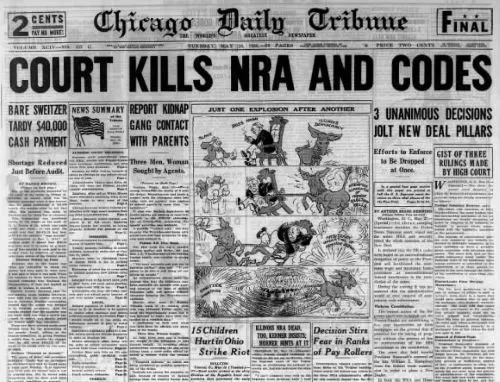
Newspaper reactions evolved over time. A 1977 dissertation on Texas dailies found that all nine Texas newspapers supported Roosevelt in the 1932 campaign and during the First New Deal, but criticism emerged during the Second New Deal. By 1936, only one Texas newspaper opposed him. The Chicago Tribune, however, was a relentless critic from the start. A 1935 Marquette University thesis cataloged the Tribune’s attacks on presidential advisors, spending, and the very principles of the New Deal, covering April, May, and June 1934. The court-packing fight of 1937 brought the debate to a fever pitch, with newspapers like the Kansas press taking sides. The Los Angeles Times cartoon “Noah Without an Ark” on February 28, 1937, became a symbol of the anti-New Deal movement.
How It Was Seen at the Time
Contemporaries understood the New Deal as a struggle over presidential power. The critical press, led by the Chicago Tribune, saw Roosevelt as a threat to constitutional government. The Tribune’s editorials attacked “presidential advisors” as dangerous men behind the throne, and denounced spending as reckless. The Texas press, while initially supportive, began to echo these fears in the Second New Deal. The court-packing plan was seen by many as a coup against the judiciary. In a famous quote from a later Supreme Court case, Justice Felix Frankfurter said, “The Devil himself knoweth not the mind of man,” a phrase that captured the uncertainty of the era. The Los Angeles Times cartoon “Noah Without an Ark” visually depicted the belief that Roosevelt was abandoning the Constitution.
Contemporary Newspaper Coverage
The Chicago Tribune’s coverage during April, May, and June 1934 was a sustained assault. A 1935 Marquette University thesis summarized its themes: “The Attack on the Presidential Advisors,” “The Attack on Spending,” “The Attack on the New Deal Principles,” “Wallace and the Agricultural Policies,” “Radio and Telegraph Control,” “The Attack on Transportation Regulation,” and “Darrow’s attack on the NRA.” These were not just news reports; they were editorials and cartoons that framed the New Deal as an overreach of federal power. In contrast, the Texas newspapers initially offered widespread support. A 1977 dissertation noted that “all newspapers supported Roosevelt” in 1932, and during the First New Deal, “widespread support was evidenced.” But by the Second New Deal, “criticism appeared.” The court-packing fight was covered with intense partisanship. The Kansas press, as described in a 1960s article, was split, with some papers calling the plan a “battle to save the court” and others calling it a “power grab.”
Different Perspectives
The Critical Press
The Chicago Tribune represented the most vocal opposition. Its editorials and cartoons attacked the New Deal’s spending, its advisors, and its principles. The Tribune saw the New Deal as a step toward dictatorship. A 1935 thesis noted that the paper’s “Attack on the Presidential Advisors” was a central theme, suggesting that Roosevelt was surrounded by unelected men who were pulling the strings.
The Supportive Press
Many Texas newspapers, at least initially, supported the New Deal. The 1977 dissertation found that all nine Texas papers supported Roosevelt in 1932 and during the First New Deal. They saw the New Deal as a way to combat the Great Depression. Even when criticism emerged later, only one Texas paper opposed Roosevelt in the 1936 election.
The Administration’s View
Roosevelt’s administration insisted the court plan was about efficiency, not power. The president’s message to Congress on February 5, 1937, argued that the federal judiciary was overworked and that new judges would speed up the courts. This view was echoed by pro-New Deal papers, but the critical press saw through it.
What People Feared
At the time, many Americans feared that the New Deal was leading to dictatorship. The Chicago Tribune’s constant attacks on “presidential advisors” reflected a fear of an unelected “brain trust” making decisions. Others feared that the court-packing plan would destroy the independence of the judiciary. The Los Angeles Times cartoon “Noah Without an Ark” implied that Roosevelt was abandoning the nation’s constitutional foundations. There was also fear that the New Deal’s spending would bankrupt the country. The Tribune’s “attack on spending” was a recurring theme, warning of fiscal ruin. These fears were not entirely unfounded, but they were often exaggerated.
What the Sources Got Wrong
The Chicago Tribune’s attacks on the New Deal were often based on exaggeration. For example, the Tribune claimed that the NRA was a “dictatorship” and that the New Deal was a “socialist” plot. Later evidence shows that the New Deal did not destroy American capitalism; in fact, it helped stabilize it. The Tribune also predicted that the court-packing plan would be a disaster, but the plan failed in the Senate, and the Court eventually began to accept New Deal laws. The Texas dissertation’s central hypothesis—that urban newspapers were more critical of urban measures and rural papers of rural measures—was rejected by the evidence. This shows that the press’s reactions were more complex than simple geographic lines.
How Historians See It Today
Modern historians view the 1930s press as a key player in shaping the New Deal’s fate. They no longer see the press as simply “for” or “against” the New Deal. Instead, they recognize that newspapers like the Chicago Tribune represented a genuine conservative critique that had deep roots in American politics. The critical press’s fears of presidential power were not entirely wrong; the New Deal did expand the presidency. However, historians also note that the press’s opposition was often based on class and regional interests, not just principle. The court-packing fight is now seen as a turning point, where the press’s opposition helped defeat the plan. The primary sources—the editorials, cartoons, and letters—show that the New Deal was not a monolithic program but a contested, living debate that played out in every American home.
The pages of 1930s newspapers reveal a nation in the middle of a great argument about its future. The Chicago Tribune’s attacks, the Texas papers’ shifts, and the cartoons of the Los Angeles Times all show that the New Deal was not just a series of laws but a fundamental debate about the role of government. The primary sources of the era—the editorials, the letters to the editor, the political cartoons—are not just records of the past; they are the voices of Americans who lived through the worst economic crisis in the nation’s history and who argued about the way forward. They remind us that history is not a single story but a conversation, and that the pages of newspapers are where that conversation is preserved.











Leave a Reply