
Short Answer
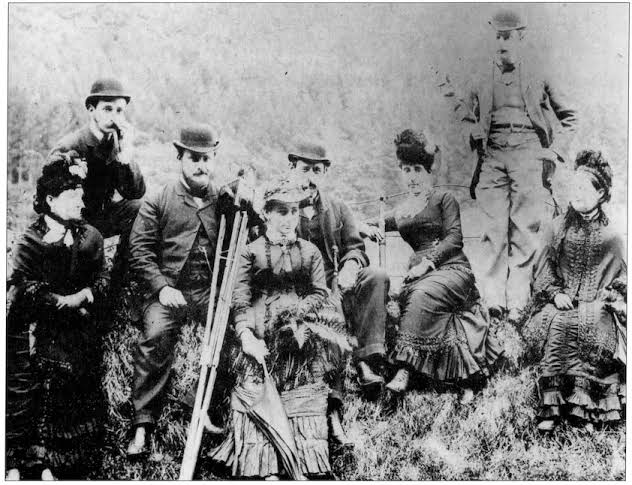
In the autumn of 1893, a photographer working for the British National Board set up a camera before a group of twenty-seven girls and two boys at a coal mine in the Midlands. The resulting image, now preserved in the National Archives as COPY 1/412, shows the so-called “Pit Brow Girls” in their work clothes, standing in a row before beginning their shift. For decades, photographs like this one were treated as unassailable windows onto the past. Yet as the National Archives cautions, “Seeing is not necessarily believing!” The photograph does not simply show us the past; it shows us a moment that someone chose to frame, stage, and preserve. Understanding what that frame hides is the task of the historian.
What Happened?
The history of photography as a historical source begins with the invention of the daguerreotype in 1839 and the rapid spread of photographic reproduction throughout the 19th century. By the 1860s, photographic archives were being assembled by governments, institutions, and private collectors. The National Archives in the United Kingdom holds millions of images, including the 1893 Pit Brow Girls photograph, which is part of the Copyright Office records (COPY 1/412). These photographs were often created for official purposes—documenting people, places, and events—but they were also the products of human choices.
As the Library of Congress explains in its Teacher’s Guide to Analyzing Photographs & Prints, the first step in reading a photograph is to observe. Historians ask: “What do you notice first? What people and objects are shown? How are they arranged? What is the physical setting?” Then they move to reflection: “Why do you think this image was made? What’s happening in the image? When do you think it was made?” Finally, they question: “What do you wonder about who, what, when, where, why, how?”
These questions are not arbitrary. They reflect a critical shift in how historians treat photographs. As the History of Virginia Tech module explains, “Although photographs may seem to capture a moment in time, they are, in fact, usually deliberately framed images that we must carefully contextualize in order to understand what they convey.”
How It Was Seen at the Time
Contemporaries in the 19th and early 20th centuries largely believed that photographs were objective truth. A photograph seemed to be a mechanical reproduction of reality, untouched by human hand. This belief was so strong that photographs were used as evidence in courts of law, in newspapers, and in government reports. The Pit Brow Girls photograph, for example, was likely taken to document the conditions of women working on the surface of coal mines—a subject of intense public debate in the 1890s about the propriety and safety of female industrial labor.
The National Archives advises that “just like documents they must be treated with caution.” This caution was not always present in the era. Photographers themselves understood that they could choose the angle, the lighting, the arrangement, and even the moment of exposure. The result was that a photograph might show what the photographer wanted the audience to see, not what an impartial observer would have seen. As the History of Virginia Tech module explains, “Photography is a valuable source of historical data, but we must scrutinize and question photographs the same way we do written documents.”
Historical Snapshot
| Aspect | Detail |
|---|---|
| Date | 1893 |
| Place | Coal mine, Midlands, England |
| People | 27 girls and 2 boys, pit brow workers |
| What Happened | Photograph taken just before the workers started their shift |
| Why It Mattered | Documented women’s industrial labor, a subject of contemporary political debate |
What People Knew at the Time
| What People Knew Then | What We Know Now |
|---|---|
| Photographs were considered reliable, objective records of reality. | Photographs are deliberately framed and may be staged, selected, or captioned to convey a specific message. |
| The Pit Brow Girls image was taken to show the reality of women’s work. | We know that the photographer chose the arrangement, the angle, and the moment, and that the girls may have been posed. |
| Captions were trusted as descriptions of the image. | Captions can be added later and may change the meaning of the same image. |
What the Sources Got Wrong
One of the most common errors in reading historical photographs is to assume that they are neutral. The National Archives warns that captions can change meanings, and that photographs must be treated with caution. For example, the Pit Brow Girls photograph might have been used to argue either for or against women’s labor, depending on the caption and the context. The same photograph could be presented as evidence of the dignity of workers or as evidence of the degradation of women in mines.
Another error is the assumption that the photograph shows the entire scene. The National Archives asks, “What’s missing from this image?” The photographer’s frame excludes everything outside the edges. In the case of the Pit Brow Girls, we do not see the mine itself, the conditions of the work, or the expressions of the girls beyond what was captured. The photograph is a fragment, not a complete record.
Common Misconceptions
How Historians See It Today
Modern historians no longer treat photographs as simple evidence of what happened. Instead, they ask what the photograph can tell us about the people who made it, the audience for which it was intended, and the values it suggests. The Library of Congress guide encourages students to ask: “Why do you think this image was made?” and “What can you learn from examining this image?” The National Archives similarly suggests asking: “What values or attitudes does the photograph suggest?”
This shift is part of a broader historiographical movement that began in the late 20th century, when historians became more interested in the construction of historical memory. As the History of Virginia Tech notes, “Historians have become much more interested in what photographs actually reveal and how we should go about ‘reading’ them.” The photograph is now understood as a primary source that reveals the photographer’s perspective, the cultural assumptions of the era, and the intended audience, as much as it reveals the subject itself.
Related Primary Sources
- National Archives (UK) — What can a photograph tell us? Educational resource with the Pit Brow Girls photograph and analysis questions.
- Library of Congress – Teacher’s Guide: Analyzing Photographs & Prints — A printable PDF with sample questions for observing, reflecting, and questioning.
- Digital History Reader (Virginia Tech) – Evidence: Photographs — A module on using photographs as historical evidence in European history.
- National Archives (UK) – Working with Photographs — A resource with tips and questions for using photographic sources, including examples like the Gold Coast photograph from 1957.
FAQ
How do historians know if a photograph is reliable?
Historians examine the context of the photograph: who took it, why, and for what audience. They also compare it with other sources. The National Archives suggests asking about the type of source, the producer, the date, and the values it suggests.
Can a photograph be used as evidence of what happened?
Yes, but only with careful analysis. A photograph is evidence of what the photographer chose to record and how they chose to frame it. It is not an objective view of the past.






Leave a Reply