
Short Answer
Quick Snapshot
In 1886 New York was a city of ships, tenements, street railways, and smoke. The pre-consolidation City of New York, centered on Manhattan and the annexed districts to the north, was the busiest port in the United States and the principal gateway for European immigrants. This article treats New York as that municipal entity, not the Greater New York created by the 1898 consolidation, which later joined Brooklyn, Queens, Staten Island, and the Bronx into one city.
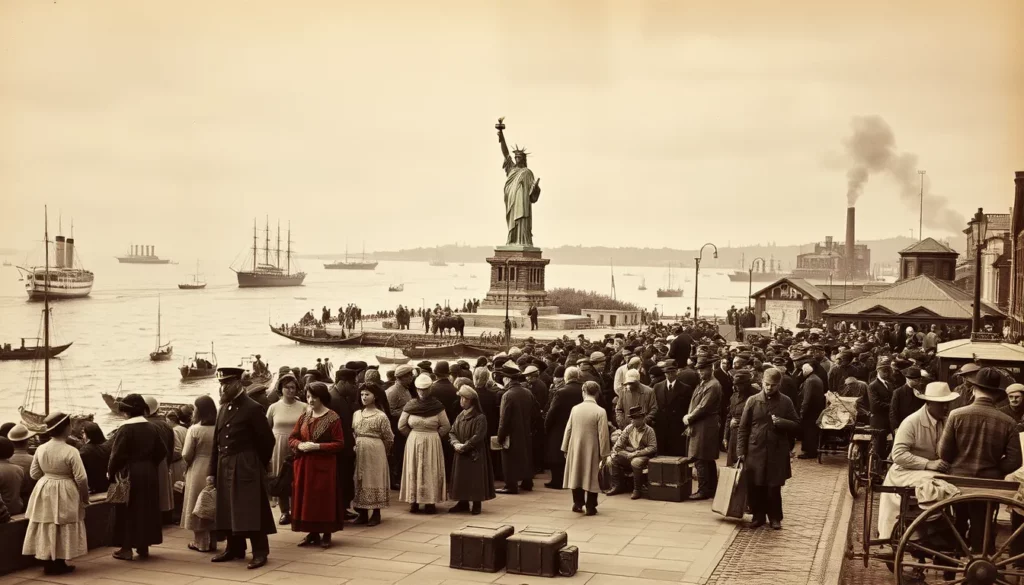
The year was one of contrasts. On October 28, dignitaries and crowds gathered in New York Harbor for the dedication of the Statue of Liberty, a French gift formally titled Liberty Enlightening the World. President Grover Cleveland accepted the monument in a speech that celebrated Enlightenment ideals and said nothing about immigration. Yet the statue stood beside the immigrant processing station at Castle Garden, and for many newcomers its raised torch already seemed to say welcome rather than enlightenment.
On land, 1886 was a year of labor ferment. The nationwide eight-hour movement, the Haymarket bombing in Chicago, and New York’s own mayoral campaign made class and immigration central public questions. The city was both a symbol of opportunity and a workshop of hardship.
New York in 1886
New York’s geography shaped everything. Manhattan was a narrow island between the Hudson and East rivers, with one of the finest natural harbors in the world. Ferries tied Manhattan to Brooklyn, Jersey City, and Staten Island; steamships crossed the Atlantic; sailing vessels and barges crowded the waterfront. The Brooklyn Bridge, opened in 1883, was still a wonder, carrying traffic above the East River and drawing sightseers as much as commuters.
The climate was seasonal and often punishing. Summer heat turned tenement blocks into ovens, while winter cold made the poor dependent on coal, charity, and crowded indoor work. Horse manure, coal smoke, and factory fumes mixed with harbor mist. The city’s atmosphere was energetic, abrasive, and unequal: fashionable avenues and new department stores stood within walking distance of rear tenements and sweatshops.
New York was also a city of newcomers. Immigrants arrived by steamship and passed through Castle Garden at the Battery, the federal immigrant landing station that operated from 1855 until 1890. From there they dispersed into German, Irish, Jewish, Italian, and other neighborhoods, looking for work near the docks, workshops, and markets.
Population & Economy
The 1880 federal census counted 1,206,299 residents in the City of New York; by 1890 the figure had risen to 1,515,301. A mid-1880s estimate of roughly 1.35 million is therefore reasonable. Roughly four in ten residents were foreign-born, and many more were the children of immigrants. Population growth strained housing, schools, sanitation, and transit.
The economy rested on the port. Shipping, wholesaling, insurance, banking, and the stock exchange made New York the financial capital of the nation. Manufacturing was equally important: garment sewing, cigar making, printing and publishing, sugar refining, ironwork, furniture, and construction employed thousands. The garment trades ranged from large workshops to tiny sweatshops in tenement rooms.
Conditions varied sharply. Skilled workers in printing or building trades could earn a modest competence, while unskilled laborers, seamstresses, and sweatshop hands often worked long hours for low pay. A penny newspaper, a few cents for bread, and several dollars a month for a tenement flat were common reference points. Rent, food, coal, and carfare consumed most wages, and many families took in boarders to survive.
Government & Politics
In 1886 William R. Grace was mayor of New York, and David B. Hill was governor of New York State. City politics revolved around Tammany Hall, Democratic ward organizations, and reform groups that denounced corruption but often disagreed on remedies. Police, health inspectors, street cleaners, and building inspectors all mattered intensely in a crowded port city.
The mayoral election of 1886 became a national spectacle. Abram S. Hewitt ran as the Democratic candidate, Theodore Roosevelt as the Republican, and Henry George as the United Labor candidate. George, the author of Progress and Poverty, campaigned on the single tax and on labor reform. Hewitt won, but George’s strong showing revealed how deeply labor questions had entered city politics.
The campaign took place amid fears of radicalism after the Haymarket bombing in Chicago. Newspapers debated whether labor organization meant reform or revolution. For immigrants, politics was also a matter of protection: ward bosses could help with jobs, permits, and citizenship papers, even as reformers condemned the machine.
Industry
New York was a workshop as much as a gateway. Along the East River and the Hudson, piers, warehouses, shipyards, and coal yards employed dockworkers and teamsters. Steamship companies, railroad offices, and export merchants made the city a hinge between Europe and the American interior.
The garment industry was the largest employer of immigrants, especially Jewish and Italian women and men. Work was subdivided into cutting, sewing, pressing, and finishing, often in small shops or tenement apartments. Cigar making, printing, brewing, baking, and food processing also relied on immigrant labor. The city’s newspapers and publishers formed an industry of their own, feeding a literate and argumentative public.
Finance and commerce grew alongside manufacturing. Banks, brokers, insurance offices, and commodity markets clustered downtown. The elevated railways carried workers between home and factory, while the harbor carried goods to and from the world.
Education
Public schooling expanded in the 1880s but struggled to keep pace with immigration and population growth. Elementary schools were free, but classrooms were overcrowded and many children left early to work. Compulsory schooling laws existed, though enforcement was uneven, especially among poor families who needed children’s wages.
Evening schools and charity classes taught English and citizenship to adult immigrants. The College of the City of New York, Cooper Union, Columbia College, and the University of the City of New York provided higher education for a small minority. Cooper Union’s free lectures and reading rooms were especially important for working people seeking self-improvement.
Literacy was high by the standards of the era, but access varied by class, gender, and language. Newspapers in German, Yiddish, Italian, and other languages served immigrant communities and helped newcomers navigate the city.
Transportation
New Yorkers moved by foot, horse, rail, and water. Horse-drawn streetcars and omnibuses clattered along major avenues, while elevated steam railways ran above parts of Manhattan. The El was noisy, sooty, and crowded, but it allowed workers to live farther from downtown jobs.
Ferries were essential. Before the subway, the harbor and rivers were crossed by ferryboats carrying passengers, wagons, and goods. The Brooklyn Bridge offered a dramatic new link, and its promenade became a popular excursion. Steamships brought immigrants and travelers into the port, while coastal schooners and barges moved freight.
Traffic was slow and dangerous. Horses, carts, pedestrians, and streetcars shared narrow streets. In wet or snowy weather, manure and mud made walking unpleasant, and accidents were common.
Everyday Life
Daily life depended on neighborhood and income. In tenement districts such as the Lower East Side, families crowded into small rooms, often with boarders, and used shared water closets and rear yards. Dumbbell tenements, designed under the Tenement House Act of 1879, provided narrow air shafts but little real light or ventilation. Better-off families lived in brownstones, flats, or suburban homes reached by train and ferry.
Food was varied but often plain: bread, potatoes, cabbage, beans, corned beef, fish, oysters, and cheap cuts of meat. German beer gardens, Irish saloons, Jewish delicatessens, and Italian groceries gave the city a rich food culture. Pushcart markets sold produce and household goods in the streets.
Entertainment ranged from saloons and music halls to theaters, vaudeville, lectures, and baseball. Central Park offered carriage drives and promenades, while Coney Island drew summer crowds by rail and steamer. Families marked births, marriages, and deaths through churches, synagogues, fraternal societies, and neighborhood networks.
Major Events
The defining event of 1886 was the dedication of the Statue of Liberty on October 28. President Grover Cleveland presided, and a naval parade filled the harbor. The statue was a gift from the people of France, designed by Frédéric Auguste Bartholdi with an iron framework by Gustave Eiffel. Its official name, Liberty Enlightening the World, reflected republican and Enlightenment ideals rather than immigration policy.
Labor conflict gave the year a harder edge. On May 1, workers across the country struck for an eight-hour day. On May 4, a bomb exploded at Haymarket Square in Chicago during a labor protest, leading to a nationwide crackdown on radicals. New York’s unions, socialists, and reform clubs debated the meaning of Haymarket and the limits of free speech.
On November 2, Abram S. Hewitt defeated Henry George and Theodore Roosevelt in the mayoral election. The result reassured business interests but did not settle the city’s labor and housing questions.
What Newspapers Were Reporting
New York’s press was fiercely competitive. The New York Times, the New York Tribune, the New York World, the New York Herald, and The Sun covered the statue, labor meetings, the Haymarket aftermath, and the mayoral campaign. Illustrated weeklies such as Frank Leslie’s Illustrated Newspaper and Harper’s Weekly gave readers engravings of harbor celebrations and crowded streets.
At the dedication, President Cleveland’s acceptance speech struck a note of national pride and Enlightenment optimism:
“We will not forget that Liberty has here made her home; nor shall her chosen altar be neglected.”
Newspapers also printed Emma Lazarus’s poem The New Colossus, written in 1883 to help fund the statue’s pedestal. Its famous lines were not yet inscribed on the monument, but they gave voice to the statue’s later association with immigration:
“Give me your tired, your poor, / Your huddled masses yearning to breathe free.”
Labor reporting told a different story. Readers followed strike meetings, police precautions, and denunciations of anarchists. The mayoral campaign produced charges and countercharges about taxation, corruption, and the loyalty of foreign-born voters.
What People Were Talking About
Conversations in 1886 turned on immigration, work, and the meaning of liberty. Nativists warned that unrestricted immigration brought poverty, disease, radicalism, and political corruption. Labor reformers argued that immigrants were not the problem but rather the victims of low wages and exploitative landlords. Church leaders, charity workers, and settlement-house pioneers debated how to Americanize newcomers without destroying their cultures.
The Haymarket bombing intensified fears of anarchism and socialism. Employers and conservative newspapers linked labor agitation to foreign radicalism, while unionists insisted that the eight-hour day was a reasonable reform. Henry George’s campaign gave these arguments a municipal focus: should the city tax land values more heavily, improve housing, and protect workers?
Many immigrants, meanwhile, looked at the Statue of Liberty and saw welcome. As the National Park Service notes, the torch that her creators intended as enlightenment became for anxious newcomers a reassuring sign that they had arrived in the land of their dreams. That meaning was not official policy, but it was already taking root in popular feeling.
Historical Photographs
Photographs and stereographs from 1886 document the Statue of Liberty’s dedication, the harbor crowded with vessels, and the dignitaries on Bedloe’s Island. Photographers also recorded street scenes, docks, elevated railways, and tenement districts, though the most famous tenement photography of Jacob Riis belongs mainly to the late 1880s and 1890s. Frank Leslie’s illustrations provide vivid visual evidence of immigrant arrivals and working-class life.
These images are significant because they show a city in transition: the statue still new and pale, the harbor full of sail and steam, the streets jammed with horses and pedestrians. They also reveal the limits of the visual record, since respectable photographers often favored monuments and public events over the interior lives of the poor.
Documents & Primary Sources
- Federal censuses of 1880 and 1890 and the New York State census of 1885, which record population, birthplace, occupation, and household structure.
- Castle Garden immigration records and steamship passenger manifests, now partly available through national archives and genealogical databases.
- New York City directories, maps, and ward atlases that show streets, businesses, and neighborhoods.
- Annual reports of the New York City Board of Health, police reports, and mayoral messages on housing, sanitation, and vice.
- Newspapers such as The New York Times, New York Tribune, New York World, and Frank Leslie’s Illustrated Newspaper.
- Emma Lazarus’s manuscript of The New Colossus, Statue of Liberty dedication programs, and photographs held by the National Park Service and Library of Congress.
1886 Timeline
| Date | Event |
|---|---|
| Throughout 1886 | Immigrants continue to arrive through Castle Garden and settle in Manhattan neighborhoods. |
| May 1 | Nationwide eight-hour-day strikes and demonstrations; New York workers hold meetings and walkouts. |
| May 4 | Haymarket bombing in Chicago; backlash against radicals spreads to New York. |
| October 28 | Statue of Liberty dedicated on Bedloe’s Island; President Grover Cleveland accepts the gift from France. |
| November 2 | Abram S. Hewitt elected mayor over Henry George and Theodore Roosevelt. |
| Late 1886 | City charities and newspapers report winter distress, overcrowded tenements, and continuing labor organizing. |
What Changed Next
The Statue of Liberty became more closely linked to immigration after 1886. Ellis Island opened in 1892, and between 1886 and 1924 almost 14 million immigrants entered the United States through New York. In 1903, Emma Lazarus’s poem was engraved on a bronze plaque and affixed to the statue’s base, fixing the image of Liberty as the Mother of Exiles.
New York itself changed rapidly. The 1898 consolidation created Greater New York and made the city one of the largest in the world. Tenement reform, labor legislation, and public health campaigns slowly addressed some of the abuses of the 1880s. The Haymarket affair damaged the Knights of Labor and deepened divisions between labor and capital, while Henry George’s campaign influenced later progressive and municipal reform movements.
Sources
- National Park Service, Statue of Liberty National Monument, ‘The Immigrant’s Statue,’ https://www.nps.gov/stli/historyculture/the-immigrants-statue.htm
- Smithsonian National Museum of American History, Susan Laudicina, ‘New Americans and the inspirational lady in New York harbor,’ https://americanhistory.si.edu/explore/stories/new-americans
- Burrows, Edwin G., and Mike Wallace. Gotham: A History of New York City to 1898. Oxford University Press, 1999.
- Berenson, Edward. The Statue of Liberty: A Transatlantic Story. Yale University Press, 2012.
- Lazarus, Emma. The New Colossus (1883), Statue of Liberty National Monument, National Park Service.
FAQ
What was the population of New York in 1886?
The pre-consolidation City of New York had roughly 1.35 million residents in 1886, between the 1880 census count of 1,206,299 and the 1890 count of 1,515,301.
What major events happened in New York in 1886?
The Statue of Liberty was dedicated on October 28, 1886. The year also saw nationwide eight-hour-day strikes, the Haymarket bombing’s aftermath, and the mayoral election in which Abram S. Hewitt defeated Henry George and Theodore Roosevelt.
What primary sources are available for studying New York in 1886?
Researchers use federal and state censuses, Castle Garden immigration records, city directories, Board of Health reports, mayoral messages, maps, newspapers, photographs, and Emma Lazarus’s manuscript of The New Colossus.
How did daily life in New York in 1886 differ from today?
Daily life depended on horse-drawn transport, ferries, and elevated steam railways rather than subways and automobiles. Tenement housing, sweatshop labor, limited sanitation, and immigrant processing at Castle Garden shaped everyday experience in ways that differ sharply from modern New York.










Leave a Reply