
Short Answer
Quick Snapshot
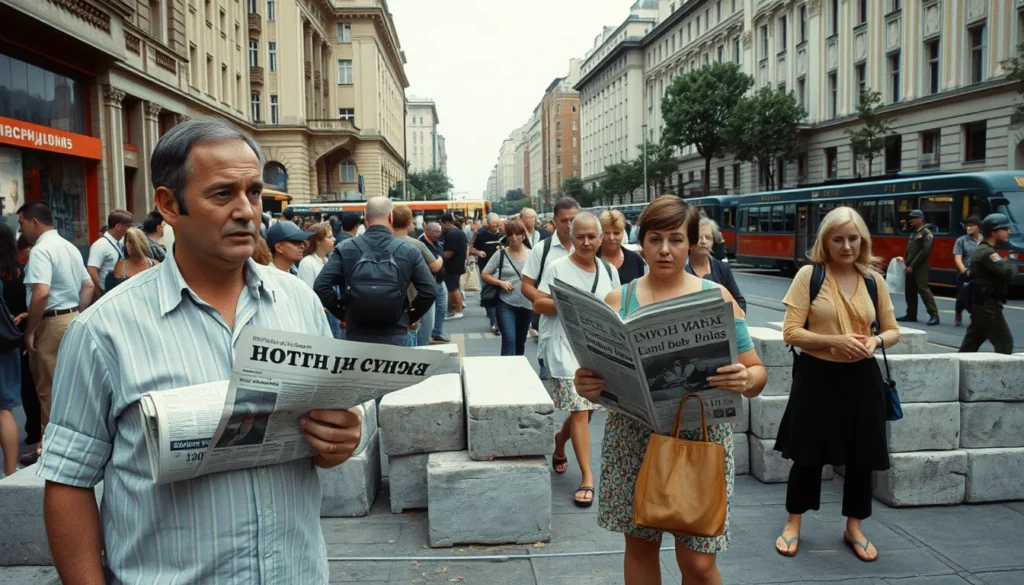
Moscow in 1991 was the capital of a state that was coming apart in public. The city of roughly nine million people remained the administrative heart of the USSR and the Russian republic, but its streets, newspapers, and kitchens were filled with arguments about sovereignty, shortages, and the future. The year began with party rule still intact and ended with the Soviet flag lowered over the Kremlin. Between those moments came the August coup attempt, when central newspapers were restricted and Muscovites turned to underground sheets, photocopies, and rumor.
Newspapers and diaries are especially revealing because they capture the double rhythm of the year: official language continued to speak of socialist construction, while private notes and letters described empty shelves, coupon books, anxious relatives, and sudden political hope. The collapse was not only a diplomatic event. It was experienced at newspaper kiosks, metro stations, factory gates, and kitchen tables.
This article treats Moscow as the city within its 1991 boundaries and focuses on the collapse as seen through the press and personal testimony. It does not attempt a full history of the Soviet Union, but rather asks how Muscovites learned what was happening and how they made sense of it.
Moscow in 1991
Moscow lies on the Moskva River in the western part of the Russian plain, a radial city of boulevards, ring roads, and monumental Soviet architecture. In 1991 the Kremlin and Red Square remained the symbolic center of the state, while the White House on the river embankment had become the seat of the Russian republic’s government and a new focus of political loyalty. The city’s climate was continental, with a long winter and a warm summer, but the weather that mattered most to contemporaries was political: uncertainty hung over every forecast.
The atmosphere of 1991 was tense and talkative. Queues formed outside shops before opening; newspaper kiosks sold out quickly; political rallies drew crowds in the center; and the metro carried millions of commuters through a city whose routines were still Soviet but whose assumptions were dissolving. The old language of planned economy and party discipline no longer matched what people saw around them.
Moscow was also a media city. It housed the central press, radio and television, publishing houses, and the offices of foreign correspondents. What happened to newspapers in Moscow therefore shaped what much of the country could read, and the August coup made that fact unmistakable.
Population & Economy
The 1989 census counted 8,967,332 residents in Moscow, and by 1991 the population was still commonly estimated at near nine million. The city was ethnically diverse, though Russians formed the large majority, and it included industrial workers, scientists, teachers, doctors, students, party officials, and a growing cooperative sector. Migration and housing shortages remained major social issues.
The economy was still dominated by state enterprises, ministries, and research institutes. Muscovites worked in machine building, metalworking, electronics, printing, food processing, textiles, transport, education, and government administration. Yet the planned economy was visibly failing to deliver. Supply chains broke down, factories faced shortages of components, and many consumer goods disappeared from state shops. Ration coupons, local limits, and informal exchange became part of daily economic life.
Prices for basic goods remained officially low, but the nominal price told only part of the story. Bread and rent were heavily subsidized, while queues, rationing, and black-market prices determined whether a family could actually obtain what it needed. Salaries lagged behind growing scarcity, and savings lost value as inflationary pressure mounted. For many Muscovites, 1991 was a year of making do: borrowing, trading, using dachas, and relying on relatives.
Government & Politics
Moscow’s local government was in transition. Gavriil Popov was elected mayor of Moscow in June 1991, with Yuri Luzhkov as his deputy, as the city began to move away from the old executive committee system. The Moscow City Soviet and district councils still existed, but real authority was increasingly contested between city institutions, the Russian republic’s government, and the remains of Soviet central power.
National politics dominated the city’s mood. In March 1991 voters took part in a referendum on preserving the union; in June Boris Yeltsin was elected president of the Russian republic; and through the summer the rivalry between Soviet President Mikhail Gorbachev and Russian leaders sharpened. When the August coup attempt began, Moscow became its decisive stage. Yeltsin and his supporters rallied at the White House, while the State Committee for the State of Emergency tried to impose control.
After the coup failed, the political landscape shifted rapidly. The Communist Party’s role was curtailed, party property was seized or sealed, and the symbols of Soviet authority lost legitimacy. By December, the union itself was dissolved. For Muscovites, politics was no longer something conducted far away in party offices; it was happening in the streets, on television, and in the newspapers they fought to obtain.
Industry
Moscow’s industrial base was broad and closely tied to the state. Large plants such as the Likhachev automobile works, metalworking and machine-building enterprises, electronics and instrument factories, textile mills, food-processing combines, and printing houses employed tens of thousands. Printing was especially important in 1991: Moscow’s presses produced central newspapers, city papers, journals, and leaflets, and the struggle over access to those presses became part of the political struggle.
Defense-related research and production also shaped the city’s economy. Scientific institutes, design bureaus, and technical universities gave Moscow a large white-collar technical workforce. But cuts in state orders and disruptions in supply affected these sectors too. Factories that had once measured success by plan targets now faced unpaid bills, material shortages, and uncertain ownership.
The cooperative movement and small private businesses were growing, especially in services, trade, and publishing, but they operated in a gray zone between old rules and new opportunities. The year’s economy was thus not simply collapsing; it was being pulled apart and reassembled at the same time.
Education
Literacy in Moscow was near universal, and the city possessed one of the densest educational networks in the world. It had thousands of schools, specialized secondary schools, technical institutes, and universities, including Moscow State University, the Moscow Institute of Physics and Technology, the Plekhanov Institute, and the conservatory. The Academy of Sciences and numerous research institutes made Moscow a center of scientific and cultural education.
Education in 1991 was also subject to political change. The old requirement to teach party-approved interpretations of history and society was being challenged. Teachers, students, and parents debated how to teach the Soviet past, what to do with Lenin corners, and how to prepare young people for a market economy that did not yet fully exist. Paper shortages affected textbooks and newspapers, and students often learned about current events from photocopied articles and foreign broadcasts as much as from official materials.
Transportation
The Moscow Metro remained the backbone of city movement, carrying millions of passengers daily through a vast underground network. Surface transport included buses, trolleybuses, trams, and marshrutka-style shared taxis, while commuter trains brought workers and shoppers from the suburbs. Cars were still relatively uncommon, though traffic and parking were growing problems. The metro was also a social space: people read newspapers there, exchanged rumors, and watched the city’s mood shift from day to day.
Transport disruptions were less dramatic than the political ones, but they mattered. Fuel and spare-parts shortages affected some services, and crowded public transport made daily life exhausting. For historians, transport maps and schedules help reconstruct how Muscovites reached rallies, newspaper kiosks, workplaces, and the White House during the coup.
Everyday Life
Everyday life in 1991 was organized around scarcity and improvisation. Many families lived in communal apartments, older khrushchevka blocks, or newer residential districts on the city’s edge. Dacha plots provided food and a escape from the city; relatives and neighbors exchanged goods and favors. Housing remained controlled and scarce, and moving was difficult.
Food was a constant concern. State shops might have bread, milk, or sausage only intermittently, and queues formed when word spread that something had arrived. Ration coupons and local restrictions varied by district and workplace. Markets offered more goods at higher prices. Clothing was practical and often repaired rather than replaced; foreign goods were prestigious but rare. Entertainment included television, cinema, theater, books, and long kitchen conversations. The newspaper was not merely a source of information but a daily object of desire and dispute.
Diaries and letters from 1991 show how political events entered private life. A coup announcement could interrupt a family meal; a new ration rule could change a shopping plan; a rumor about troops could empty or fill a street. The year was lived in small decisions as much as in grand declarations.
Major Events
On March 17, 1991, a union-wide referendum asked whether voters wished to preserve the USSR as a renewed federation. In June, Moscow took part in the Russian presidential election that brought Boris Yeltsin to power, and Muscovites also elected Gavriil Popov as mayor. These votes gave the Russian republic and the city government new claims to legitimacy.
The defining event came on August 19–21, when hardliners formed the State Committee for the State of Emergency and tried to seize control from Gorbachev. Central and Moscow newspapers were restricted, and the coup leaders decreed a temporary limit on publication. Yeltsin’s supporters gathered at the White House, erected barricades, and used alternative media to spread news. The coup collapsed on August 21. In December, the Belovezha Accords and the subsequent resignation of Gorbachev led to the dissolution of the USSR on December 26.
What Newspapers Were Reporting
Moscow’s press in 1991 was diverse and increasingly politicized. Papers such as Pravda and Izvestia still carried official language, while Vechernyaya Moskva, Moskovskie novosti, Moskovskii komsomolets, Kuranty, Nezavisimaya gazeta, and Rossiiskaia gazeta offered more varied reporting and commentary. Headlines tracked the referendum, the election, shortages, crime, and the growing conflict between union and republican authorities.
At the outset of the 1991 coup attempt by conservative hardliners, the leaders of the coup decreed a ‘temporary limit’ on the publication of all central and Moscow newspapers, save for a handful of those obviously sympathetic to the putschists.
During August 19–21, underground and alternative papers appeared in Moscow, often reproduced on office copiers using whatever paper was available. The collection compiled by Frangulov, Lee, and Usachev includes Kuranty, Megapolis Express, Moskovskie novosti, Moskovskii komsomolets, Rossiia, Rossiiskie vesti, Ekspress-khronika, Obshchaia gazeta, Rossiiskaia gazeta, and Nezavisimaia gazeta. These sheets carried appeals, eyewitness reports, and practical information about the resistance.
The collection represents, in the editors’ words, ‘a complete collection of what was published during what has been called the “three days that shook the world.”’
Vechernyaya Moskva’s letters columns offer another kind of reporting: readers wrote about queues, housing, prices, health care, and the political crisis. The letters allow historians to ‘see life through the eyes of people themselves,’ as one study of the paper puts it, and they show how ordinary Muscovites connected national events to private worries.
What People Were Talking About
Conversations in Moscow in 1991 circled around uncertainty. Would there be food? Would salaries be paid? Would the union survive? What did the coup mean? Who was telling the truth? Diaries and letters record rumors about troops, emergency decrees, foreign aid, and impending price rises. The kitchen, the queue, and the workplace became informal newsrooms.
People debated whether the market would bring goods or ruin, whether Russian sovereignty would help or fragment the country, and whether democracy could survive economic collapse. Older Muscovites often spoke of stability and sacrifice during the war; younger people spoke of freedom, travel, and opportunity. Fears of crime, nationalism, and chaos mixed with hope that the end of party rule would open public life.
Historical Photographs
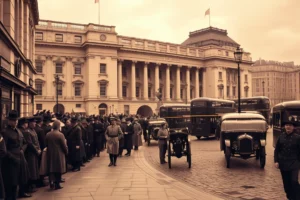
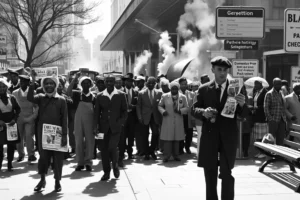
Photographs from Moscow in 1991 preserve the visual drama of the year: crowds and barricades near the White House, Yeltsin standing on a tank, soldiers and milling citizens, newspaper kiosks with hand-printed sheets, and queues stretching along winter streets. Press photographers and foreign correspondents captured the August days, while personal albums contain quieter images of family gatherings, ration coupons, and empty shop shelves.
These photographs are significant because they show how political events and everyday scarcity occupied the same streets. A barricade photograph may include a woman shopping bag; a queue photograph may show a newspaper tucked under an arm. Visual evidence from 1991 is scattered across newspaper archives, photographic agencies, museums, and private collections.
Documents & Primary Sources
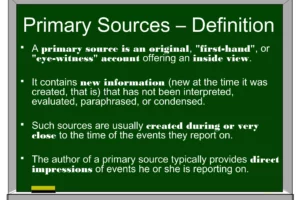
Historians of Moscow in 1991 rely on a wide range of primary sources. Newspapers are central, especially the central press, city papers, and the underground sheets of August. Letters to Vechernyaya Moskva provide a rare view of private concerns. Diaries, memoirs, and personal correspondence held in family collections and later archives record how individuals experienced the collapse.
- Newspaper collections: Pravda, Izvestia, Vechernyaya Moskva, Kuranty, Moskovskie novosti, Nezavisimaya gazeta, Rossiiskaia gazeta, and the August underground press.
- Archival records: Moscow city government files, Communist Party records, police and military documents, and press-censorship materials in GARF, RGANI, and the Central Archive of Moscow.
- Personal testimony: letters to editors, diaries, memoirs, photographs, ration coupons, and ephemera such as leaflets and appeals.
- Maps and statistics: city maps, census data, transport schedules, and price lists that reconstruct the material conditions of daily life.
1991 Timeline
| Date | Event |
|---|---|
| March 17 | Union-wide referendum on preserving the USSR; Moscow voters take part amid political tension. |
| June 12 | Boris Yeltsin elected president of the Russian republic; Gavriil Popov elected mayor of Moscow. |
| August 19–21 | Coup attempt by hardliners; newspapers restricted; resistance centered on the White House; underground papers appear. |
| August 22 | Coup collapses; crowds celebrate in Moscow; Soviet authority begins to unravel. |
| December 8 | Belovezha Accords signed, declaring the USSR effectively dissolved. |
| December 25 | Gorbachev resigns as Soviet president. |
| December 26 | The USSR is formally dissolved; Moscow becomes the capital of the Russian Federation. |
What Changed Next
After 1991 Moscow entered a new and difficult era. Price liberalization in January 1992 sent inflation soaring, savings collapsed, and many state enterprises struggled. Privatization created new owners and new inequalities. The city government under Yuri Luzhkov, who became mayor in 1992, gained greater control over urban development and social policy. Newspapers that had flourished in the political opening faced new economic pressures, and the old censorship gave way to market constraints.
The collapse also changed what could be studied. Archives opened, memoirs proliferated, and historians gained access to party and state records. The underground newspapers of August 1991 became historical documents almost immediately. For Muscovites, the year remained a dividing line: the end of one public world and the beginning of another that was freer, harsher, and far less certain.
Sources
- Frangulov, Vladimir G., Kent D. Lee, and Yuri V. Usachev. The Coup: Underground Moscow Newspapers from Monday, August 19 to Wednesday, August 21, 1991. East View Press. https://www.eastviewpress.com/resources/books/the-coup/
- Malysheva, O. G., and S. A. Perekhozhikh. ‘Letters from Muscovites as a source on the history of everyday life (based on the materials of the newspaper “Vechernyaya Moskva” for 1991).’ Historical Bulletin 8, no. 3 (2025): 127–133. https://journals.rcsi.science/2658-5685/article/view/369888
- Colton, Timothy J. Moscow: Governing the Socialist Metropolis. Cambridge, MA: Harvard University Press, 1995.
- Dunlop, John B. The Rise of Russia and the Fall of the Soviet Empire. Princeton: Princeton University Press, 1993.
- Kotkin, Stephen. Armageddon Averted: The Soviet Collapse, 1970–2000. Oxford: Oxford University Press, 2001.
FAQ
What was the population of Moscow in 1991?
The 1989 census recorded 8,967,332 residents, and the 1991 population was generally estimated at near nine million.
What major events happened in Moscow in 1991?
Key events included the March union referendum, the June election of Boris Yeltsin and Gavriil Popov, the August 19–21 coup attempt and resistance at the White House, and the December dissolution of the USSR.
What primary sources are available for studying Moscow in 1991?
Researchers use newspapers such as Vechernyaya Moskva and the August underground press, letters to editors, diaries, memoirs, photographs, ration coupons, city government records, and party and state archives.
How did daily life in Moscow in 1991 differ from today?
Daily life was marked by state-controlled prices, ration coupons, long queues, limited consumer goods, crowded public transport, and the absence of smartphones and the commercial media landscape familiar today.



Leave a Reply