
Short Answer
On the morning of December 7, 1941, Honolulu residents heard the drone of aircraft and the crump of anti-aircraft fire over Pearl Harbor. Within hours, Governor Joseph B. Poindexter declared martial law, suspended habeas corpus, and transferred executive authority to the U.S. Army. By nightfall, the city was under blackout: streetlights were dark, windows were curtained, radio stations carried military announcements, and armed sentries checked identification at intersections. The attack killed more than 2,400 Americans and plunged the islands into a garrison existence that would last nearly three years. For the roughly 179,000 people of Honolulu—Native Hawaiians, Asian immigrants, Japanese American citizens, Portuguese and Puerto Rican plantation workers, white business owners, and thousands of newly arrived soldiers—the war became a daily negotiation with curfews, ration books, censorship, and fear of invasion. This article reconstructs that experience from contemporary newspapers, oral histories, official orders, and other primary sources.
What Happened?
The attack on Pearl Harbor on December 7, 1941, transformed Honolulu into a military-controlled city almost overnight. Governor Poindexter’s proclamation of martial law gave the commanding general of the Hawaiian Department authority over the territory. After Lt. Gen. Walter C. Short was relieved, Lt. Gen. Delos C. Emmons became Military Governor and presided over the Office of the Military Governor (OMG). The OMG issued General Orders that regulated civilian life in minute detail—from curfews and blackouts to dog-leash violations, prostitution, labor, prices, and criminal procedure.
- December 7, 1941: Pearl Harbor attacked; Governor Poindexter declares martial law and suspends habeas corpus.
- December 1941: General Orders impose curfews, blackouts, mail and press censorship, travel restrictions, and identification-card requirements.
- 1942: Rationing expands to tires, gasoline, sugar, coffee, meat, butter, canned goods, and shoes; price controls and victory-garden campaigns begin.
- 1942–1944: Honolulu becomes a major staging area; defense jobs, housing shortages, and military police presence reshape daily life; selected Japanese aliens and citizens are interned.
- October 24, 1944: Martial law ends by presidential proclamation, though wartime controls and shortages persist.
The military government censored newspapers, radio broadcasts, and mail; required civilians to carry identification; restricted inter-island travel; and controlled labor, housing, liquor, and shipping. Rationing was administered through ration books and federal price ceilings, while civilian defense wardens enforced blackout and dimout rules. The result was a city that remained unmistakably American in its loyalties but was governed like an occupied zone—by soldiers, orders, and permits.

How It Was Seen at the Time
Contemporary accounts reveal a mixture of shock, patriotism, rumor, and resentment. Newspapers framed the attack as treachery and rallied readers to sacrifice; military authorities described martial law as a necessary shield against invasion and sabotage. Civilians, by contrast, often experienced the General Orders as a bewildering thicket of rules. Oral histories from the Center for Oral History’s An Era of Courage collection recall the humiliation of queuing for ration books, the inconvenience of blackout curtains, and the fear of being stopped by military police without proper identification. The language of the era was blunt: “blackout,” “dimout,” “ration book,” “victory garden,” “MP,” and “alien enemy.” Residents listened for sirens, carried gas masks, and swapped rumors about Japanese paratroopers or poisoned water. Many accepted restrictions as the price of survival; others quietly resented the Army’s control over local life. The prevailing mood was not panic but grim improvisation—a determination to keep families fed, businesses open, and neighbors safe while the war remained terrifyingly close.
Historical Snapshot
| Aspect | Detail |
|---|---|
| Date | December 7, 1941 – October 24, 1944 |
| Place | Honolulu, Territory of Hawaiʻi |
| People | Civilians, U.S. military authorities, Japanese American residents, defense workers, military police |
| What Happened | Martial law, General Orders, curfew, blackout, censorship, rationing, internment, and a garrison economy |
| Why It Mattered | It placed daily life under military control, transformed Hawaiʻi’s society and economy, and raised enduring questions about civil liberties in wartime |
Daily Life
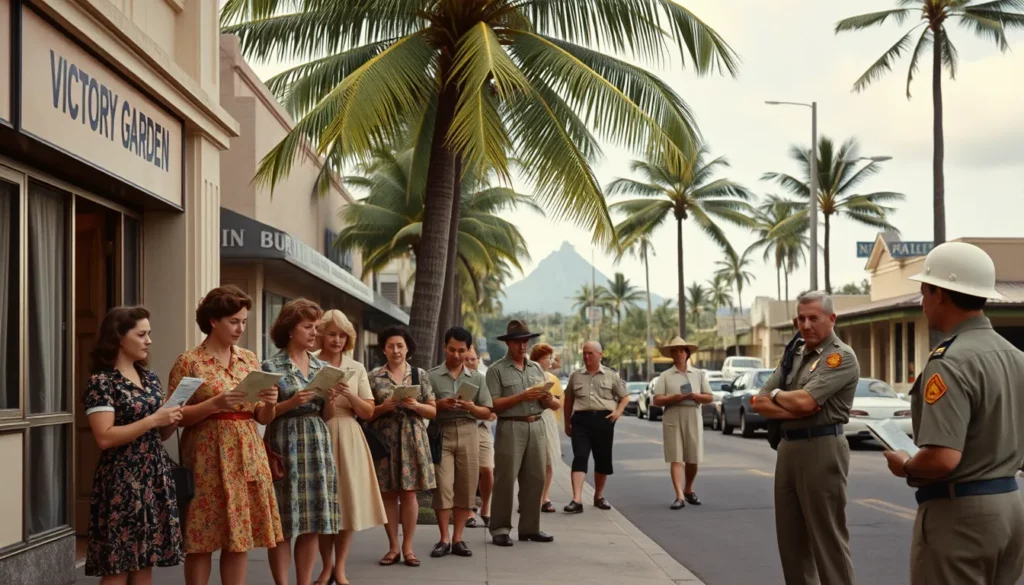
For Honolulu families, war became a matter of small, exhausting routines. Ration books determined how much sugar, coffee, meat, butter, canned goods, gasoline, and shoes a household could buy. Shoppers learned to hoard stamps, substitute ingredients, and queue early before shelves emptied. Victory gardens appeared in backyards and school lots; families canned produce and raised chickens. Blackout curtains had to be hung and checked each evening, and air-raid wardens patrolled neighborhoods to enforce dimouts. Many residents carried identification cards and gas masks, practiced drills, and avoided gathering in large crowds after dark.
Work changed too. The military buildup created thousands of defense jobs in shipyards, depots, offices, and construction sites, drawing workers from neighbor islands and the mainland. Wages rose, but housing grew scarce and rents climbed. Women entered clerical, industrial, and service jobs; USO clubs and canteens became social hubs for soldiers and local volunteers. Mail was censored, long-distance calls were restricted, and newspapers carried official notices alongside war news. On streets patrolled by military police, civilians navigated curfews, checkpoints, and the constant sense that the next air-raid siren might be real. Oral histories in An Era of Courage remember the war as a time of fear, improvisation, and unexpected opportunity—a period when ordinary routines became acts of patriotism.
Contemporary Newspaper Coverage
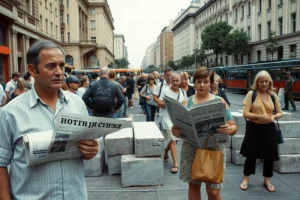
Honolulu’s two main dailies, the Honolulu Star-Bulletin and the Honolulu Advertiser, reported the attack and the new order under military censorship. Their pages mixed urgent headlines, official proclamations, instructions for blackouts and rationing, and appeals to civilian morale. Coverage was patriotic and carefully managed: editors avoided details that might aid the enemy, amplified warnings against rumor, and printed General Orders as public service announcements. The first extra editions carried the attack in stark, banner headlines.
“WAR! OAHU BOMBED BY JAPANESE PLANES” — Honolulu Star-Bulletin, December 7, 1941.
Later coverage focused on rationing schedules, bond drives, civilian defense drills, and the sacrifices expected of residents. The tone was resolute, sometimes boosterish, and rarely critical of martial law. Censorship meant that readers often learned more from rumors than from print, and newspapers themselves became instruments of military governance.
Different Perspectives
Military Authorities
Army and territorial officials viewed martial law as a necessary emergency measure. They feared invasion, sabotage, and espionage, and argued that only centralized military control could secure the islands. General Orders were portrayed as temporary, impartial, and essential to public safety.
Civilian Residents
Many Honolulu civilians accepted restrictions as the price of survival, but others resented the military’s reach into private life. Business owners chafed at price controls; workers welcomed higher wages but faced housing shortages; families worried about relatives in uniform and on the mainland. Oral histories record both patriotism and frustration.
Japanese American Residents
Japanese American citizens and Japanese aliens lived under intense scrutiny. Authorities interned about 1,500 to 2,000 selected individuals, imposed curfews and travel restrictions, and investigated loyalty. Yet Hawaiʻi did not carry out the mass incarceration seen on the mainland. Many Japanese American residents asserted loyalty through civil defense work, bond purchases, and military service, including the 100th Infantry Battalion and the 442nd Regimental Combat Team.
Women and Defense Workers
Women moved into clerical, industrial, and service jobs, volunteered for the Red Cross and USO, and managed households under rationing. Defense workers from the mainland and neighbor islands changed the city’s demographics, creating new social tensions and opportunities.
What People Feared
Fear was constant and often specific. Residents dreaded a second attack, a Japanese invasion, paratroopers landing on Oʻahu, gas bombardment, and sabotage of water, power, or harbor facilities. Rumors circulated about poisoned reservoirs, signal lights flashing from hillsides, and Japanese troops disguised as civilians. Some fears were rational: Honolulu was a prime military target, and the harbor had already been devastated. Others were unfounded or exaggerated, fueled by censorship and racial suspicion. Families feared arbitrary arrest, separation, and the loss of jobs or homes. Military authorities feared espionage and sabotage more than they feared public disorder, and that anxiety shaped the surveillance and internment policies that fell heavily on Japanese American residents.
How Historians See It Today
Contemporary accounts usually presented martial law as a temporary military necessity. Modern historians take a broader view. Harry N. Scheiber and Jane L. Scheiber describe Hawaiʻi’s wartime government as an extraordinary experiment in military rule over civilian life, one that tested the boundaries of American constitutional law. Beth Bailey and David Farber show how race, gender, and sexuality shaped wartime Hawaiʻi, from the policing of Native Hawaiian and Asian women to the tensions between soldiers and locals. Scholars now emphasize that the war accelerated Hawaiʻi’s integration into the federal system, expanded labor opportunities, and intensified debates over civil liberties and racial profiling. They also distinguish between the military’s stated security rationale and the political, economic, and racial interests that shaped specific orders. The result is a more critical picture: martial law was not merely a neutral emergency measure but a transformative system of control that left lasting marks on Honolulu’s society.
The wartime experience of Honolulu shows how quickly ordinary life can be reshaped by emergency. Primary sources—censored newspapers, oral histories, General Orders, ration books, and letters—reveal a city that endured blackouts, curfews, and shortages with a mixture of courage, complaint, and compliance. They also expose the costs of security: internment, surveillance, and the suspension of legal protections. Nearly eighty years later, the records of martial-law Honolulu remain a warning and a lesson, reminding us that the balance between safety and liberty is never settled in the abstract but always in the daily lives of ordinary people.
FAQ
What was martial law like in Honolulu during World War II?
After the Pearl Harbor attack, Governor Joseph B. Poindexter declared martial law and suspended habeas corpus. The commanding U.S. Army general became Military Governor and ruled through General Orders that imposed curfews, blackouts, censorship, travel controls, identification cards, and rationing. The territorial government continued in a subordinate role until martial law ended on October 24, 1944.
What goods were rationed in Honolulu during the war?
Rationing covered gasoline, tires, sugar, coffee, meat, butter, canned goods, shoes, and other scarce commodities. Residents used ration books issued under federal programs, while the Office of the Military Governor and the Office of Price Administration regulated prices and supplies.
Did civilians in Honolulu have to observe curfews and blackouts?
Yes. Curfews restricted movement during nighttime hours, and blackout or dimout rules required households and businesses to conceal lights. Civilian defense wardens and military police enforced these measures, and violations could lead to fines or arrest.
How were Japanese Americans treated in Honolulu during the war?
Unlike the mass incarceration of Japanese Americans on the U.S. mainland, Hawaiʻi did not remove the entire ethnic Japanese population. Still, authorities interned about 1,500 to 2,000 selected Japanese aliens and citizens, imposed surveillance and restrictions, and investigated loyalty. Many Japanese American residents served in the U.S. military, including the 100th Infantry Battalion and 442nd Regimental Combat Team.










Leave a Reply