
Short Answer
Quick Snapshot
In the summer of 1982 Beirut was both the centre of the world’s attention and a city under fire. On 6 June Israeli armoured columns crossed the Lebanese border in an operation named Peace for Galilee; within a week the ring had closed around West Beirut, and from 14 June to 21 August the Lebanese capital was besieged by land, sea and air. The declared targets were the Palestine Liberation Organization and Syrian forces inside the city. The people who endured the bombardment were, overwhelmingly, civilians.
Daily life did not stop; it contracted. Families moved into basements and stairwells, bread queues formed before dawn, generators replaced the severed mains, and the foreign press corps worked from the rooftop of the Commodore Hotel on Rue Hamra. On 21 August a multinational force began landing to supervise the evacuation of PLO fighters, and by 1 September Yasser Arafat had left Beirut for Tunisia. Three weeks later the city was shaken again: president-elect Bashir Gemayel was assassinated on 14 September, Israeli troops entered West Beirut the next day, and on 17–18 September Christian militiamen killed about a thousand people in the Sabra and Shatila refugee camps.
Scope. This article treats “Beirut in 1982” as the Lebanese capital and its immediate suburbs across the calendar year, with the weight of the narrative on June to September. Beirut is not used here as shorthand for the whole Lebanese Civil War, nor for Lebanon as a country.
Beirut in 1982
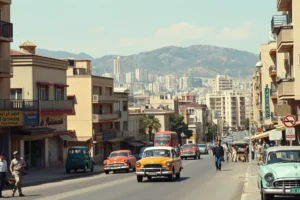
Beirut sits on a triangular promontory of the eastern Mediterranean, its oldest quarters clustered behind the port and its modern grid climbing the slopes of Ras Beirut to the American University. The city faced the sea on three sides and the mountains behind: a geography that had made it a trading emporium for a century and, in 1982, made it easy to encircle. The Green Line, the wartime demarcation that ran roughly from the port through the National Museum, split Christian East Beirut from the mainly Muslim and leftist West. West Beirut held the airport road, the refugee camps of Sabra, Shatila and Bourj el-Barajneh, and the government quarter.
The climate that summer was the usual Lebanese one: cloudless, dry and hot, temperatures in the low thirties Celsius, the sea flat and blue. It should have been a season of swimming and late dinners on balconies. Instead the haze over the city was dust and smoke, and the nights, when the shelling paused, were loud with generators and crickets.
Population & Economy
Beirut’s population was never easy to count even in peacetime. Before 1975 the city proper was usually put at roughly half a million to seven hundred thousand, with a metropolitan population well over a million; by 1982 those figures were informed guesses. The war had swollen the city with displaced families from the south and the Bekaa, and the siege then pushed thousands the other way, into the mountains, into East Beirut, or onto boats to Cyprus. Relief agencies and municipal offices alike worked without a reliable census.
The economy of 1982 Beirut was a war economy layered over a merchant economy. Banking, insurance, shipping and the port had made the city a regional financial centre before 1975; in 1982 branches still operated, but capital had long since fled to Paris, Geneva and the Gulf. The Lebanese pound, pegged at LL2.35 to the dollar before the war, changed hands at several times that rate on the parallel market. During the siege the port was closed, the airport seized, and trade collapsed into hoarding, barter and price gouging: bread, fuel, cooking gas, baby milk and antibiotics were the real currencies of West Beirut.
Government & Politics
Formal government barely reached the streets. President Élias Sarkis’s term was running out; the Council of Ministers under Prime Minister Shafic al-Wazzan had little authority over armed factions that answered to Damascus, to the PLO, or to the Phalange. Beirut’s own municipal administration was overwhelmed: the governor and city council retained responsibility for rubbish, water and roads, but real power in West Beirut lay with the PLO and its Lebanese allies, and in East Beirut with the Lebanese Front and the Kataeb militia. The city was, in effect, governed in two halves by two armed systems.
On 23 August, under Israeli pressure and after intense lobbying, the Lebanese parliament elected Bashir Gemayel president; on 14 September he was killed by a bomb at his Kataeb headquarters in Achrafieh. His brother Amin was elected on 21 September and inaugurated on 23 September, inheriting a capital occupied, divided and traumatised.
Industry
Beirut’s characteristic industries in 1982 were services rather than factories. The port of Beirut, the largest on the Levantine coast, handled transit trade for Syria, Jordan and Iraq; the international airport at Khaldeh was the hub of Middle East Airlines, still flying a reduced schedule until June. Printing and publishing were a genuine industry: the great Lebanese dailies were set and printed in Beirut and read across the Arab world. The city also held food processing, plastics, furniture workshops and the repair trades of the southern suburbs — Chiyah, Furn el-Chebbak, Bourj el-Barajneh — where small workshops supplied the militias and the market alike. Foreign journalists, relief agencies and arms dealers added their own invisible economy. Under siege, the largest employer in West Beirut was the black market.
Education
Beirut remained the intellectual capital of the Arab east, even in 1982. The American University of Beirut, founded in 1866, occupied its hilltop campus above the sea; the Université Saint-Joseph, run by Jesuits since 1875, served the Francophone elite; the Lebanese University, founded in 1951, and Beirut University College provided mass higher education. Haigazian College and International College completed a dense network of schools. Lebanese literacy was among the highest in the region.
The war did not close these institutions so much as bend them. Foreign faculty had largely departed; examinations were postponed, then held in improvised rooms; AUB’s Medical Center, its generators running and its surgeons working by torchlight when the power failed, treated wounded from every faction. University buildings became shelters, and the summer term of 1982 was taught, where it was taught at all, in basements.
Transportation
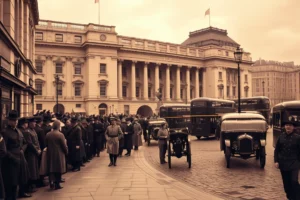
Beirut’s transport system was its roads. The coastal highway ran south to Sidon and the mountains east to Damascus — the road the Israelis deliberately cut in June to isolate the city. Within Beirut, movement depended on the famous shared Mercedes service taxis, on buses and on walking; during the siege drivers charged whatever the traffic would bear, and the crossings of the Green Line, particularly at the National Museum, became checkpoints of nerves and identity cards. Beirut International Airport was closed by the invading forces in the first days of June and did not return to civilian use for years. The railway station at Mar Mikhael was a relic: passenger services had already ended. Ships were the only uncut link to the outside world, and in late August they carried the PLO out of the harbour.
Everyday Life
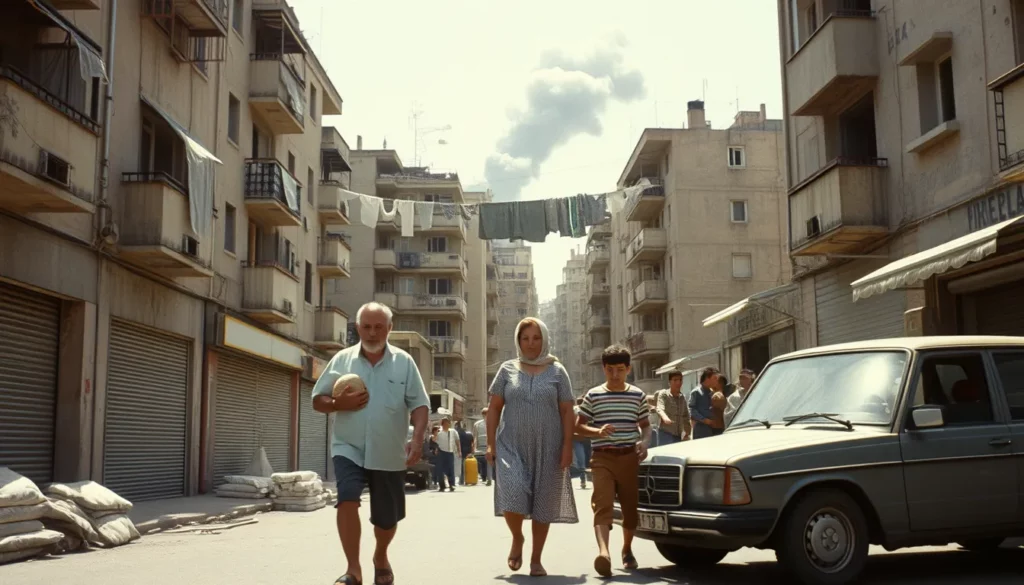
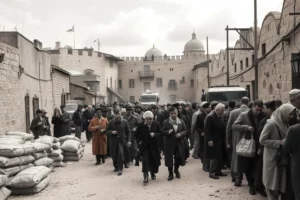
The texture of daily life in besieged West Beirut was defined by scarcity and noise. Water and electricity were cut for hours or days; families filled bathtubs, cooked on camping stoves and learned to read by candlelight. Shelter was a stairwell, a basement, or the ground floor of a concrete block, chosen for the thickness of its walls. In the lulls, life resumed with startling speed: shops opened, the vegetable stalls of Hamra appeared, children went to the beach at Ramlet el-Baida, weddings were held in borrowed halls. The Radio Orient and the Voice of Lebanon competed with Radio Monte Carlo for the household’s allegiance.
Food was the main conversation. Bread was queued for and occasionally unavailable; meat became a memory, and the staple diet was lentils, rice, tinned goods and whatever the vegetable gardens of the mountains could send. Clothing was practical and unremarkable — light summer cottons, jeans, the ubiquitous plastic sandal. Social custom bent but held: hospitality persisted, coffee was still offered, and neighbours organised informal watches to share news and to help dig survivors from the rubble of a collapsed building.
Major Events
The year’s events ran in a sequence few in Beirut could control. Israel’s stated war aims were to destroy the PLO’s military infrastructure in southern Lebanon and to install a friendly government in Beirut; the architect of the campaign, Defence Minister Ariel Sharon, took his troops far beyond the forty-kilometre limit originally presented to the Israeli cabinet. By 13 June the ring around Beirut was closed. A 27-day lull in early July ended in late July with intensified air and artillery attacks; by the first week of July some 500 buildings had been destroyed by shelling and bombing. On 14 July Sharon and Chief of Staff Rafael Eitan won Prime Minister Menachem Begin’s support for a full-scale assault on West Beirut; on 16 July the Israeli cabinet rejected the plan for fear of the casualties it would cost.
American envoy Philip Habib shuttled between the parties through July and August. On 19 August the Israeli cabinet accepted an evacuation plan; on 21 August French troops landed and the siege formally ended. PLO fighters left by sea between 21 August and 1 September under the supervision of American, French and Italian forces, and Arafat departed for Tunisia. The multinational force withdrew on 10 September. Then came September’s catastrophes: Gemayel’s assassination, the Israeli entry into West Beirut, and the Sabra and Shatila massacre, which prompted the return of the multinational force and a storm of international protest.
What Newspapers Were Reporting
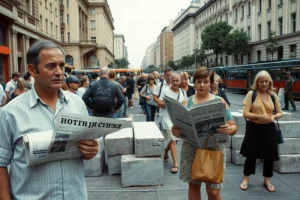
Beirut’s press, though reduced, did not stop publishing. An-Nahar, the capital’s paper of record, appeared through the siege with a skeleton staff; L’Orient-Le Jour continued in French; As-Safir spoke for the Arab nationalist and leftist readership; the English-language weekly Monday Morning chronicled the season for foreign readers. Distribution across the Green Line was irregular, and some days brought combined or single-sheet editions.
The front pages were dominated by casualty counts, diplomatic shuttles and evacuation terms. Reports tracked Habib’s arrivals and departures, the bombardment of the southern suburbs, the closure of the airport and the state of the bread supply. Photographs of the ruined Camille Chamoun Stadium and of gutted apartment blocks ran repeatedly. Leaflets dropped by the Israeli forces were themselves reported as news; the AUB archives preserve one that opens:
“To the residents of West Beirut — Command of the Israeli Defence Forces.”
The September editions then carried the assassination, the entry of Israeli troops and, from 18 September, the first eyewitness accounts of the camps.
What People Were Talking About
Conversation in Beirut that summer ran on rumour and arithmetic. Would Arafat leave, or would the Israelis storm the city? Would the Phalange enter West Beirut behind the army? What was a sack of flour costing this week, and could a family get to Cyprus by boat? Letters home from foreign residents and the notebooks of journalists record the same obsessive triangulation: the sound of a shell, the direction of the wind, which pharmacy still had insulin, which road was open.
The AUB libraries’ oral history and testimony collections preserve the quieter registers: fear for sons who had joined militias, guilt about leaving, and the small bargains of neighbours sharing a generator. The dominant public debate was about responsibility — who had brought this on the city, and whether anyone outside Lebanon cared. The answer, delivered in September, convinced many Beirutis that no one did.
Historical Photographs
The visual record of Beirut in 1982 is extensive and mostly the work of press photographers. The rooftop of the Commodore Hotel, where the international press corps lived and worked, produced a genre of its own: journalists typing under shellfire, sleeping on the roof, watching the horizon flash. Photographs from West Beirut’s streets show sandbagged balconies, laundry strung across ruined rooms, children playing in rubble and queues outside bakeries. The bombing of Camille Chamoun Stadium was photographed and printed widely. The September massacres were captured by photographers including Robin Moyer of Time, whose images of the aftermath in Sabra and Shatila circulated around the world within days. Institutional collections — above all the Archives and Special Collections at the Jafet Library, American University of Beirut — hold photographs, posters and leaflets from the summer of 1982 that record the city from inside.
Documents & Primary Sources
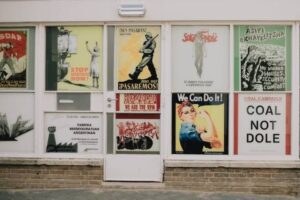
Historians reconstruct these months from a dense documentary base. The AUB Archives and Special Collections hold the political poster collection, the Israeli Arabic-language leaflets dropped on West Beirut, photographs and personal papers. The Institute for Palestine Studies in Beirut collected PLO documents and contemporaneous press. Diplomatic records, including the papers of Philip Habib and the published United States foreign relations volumes for Lebanon, document the negotiation. United Nations Security Council resolutions 508 and 509 (1982) set out the ceasefire and evacuation framework. The Israeli Kahan Commission report (1983) remains a central, contested primary document on the entry into West Beirut and the camps, and the records of the Palestinian Red Crescent Society and the International Committee of the Red Cross document casualties and relief. Personal diaries, journalists’ notebooks and oral testimony collections supply the texture official files lack.
1982 Timeline
| Date | Event in Beirut |
|---|---|
| 6 June | Israeli forces invade Lebanon; Beirut’s airport is closed |
| 13 June | The ring around Beirut is closed; the Beirut–Damascus road is cut |
| 14 June | Siege of West Beirut begins |
| Early July | Some 500 buildings destroyed by shelling and bombing |
| 16 July | Israeli cabinet rejects a full assault on West Beirut |
| Late July | Attacks intensify after a 27-day lull |
| 19 August | Israeli cabinet accepts the evacuation plan |
| 21 August | Siege ends; multinational force begins landing |
| 23 August | Bashir Gemayel elected president |
| 30 August – 1 September | PLO forces evacuate; Arafat leaves for Tunisia |
| 10 September | Multinational force completes withdrawal |
| 14 September | President-elect Bashir Gemayel assassinated |
| 15 September | Israeli forces enter West Beirut |
| 17–18 September | Sabra and Shatila massacre; about 1,000 killed |
| 21 September | Amin Gemayel elected president |
What Changed Next
The evacuation of the PLO removed a state-within-a-state from West Beirut and left a vacuum. The multinational force, which had come to supervise a departure, returned in late September as a peacekeeping presence and stayed until 1984, when it withdrew after a series of bombings; the American embassy had been destroyed in April 1983 and the Marine barracks in October 1983. Lebanon’s economy, already fragile, moved into the long slide that would end in hyperinflation in the late 1980s. The Lebanese army’s attempt to reassert control in 1983–84 failed, and West Beirut was again fought over by rival militias. What 1982 permanently changed was the city’s self-image: the Beirut that emerged from that summer was no longer the confident commercial capital of the eastern Mediterranean, but a place that had learned how quickly a modern city can be turned into a siege.
Sources
- Siege of Beirut, Wikipedia (overview with casualty estimates and chronology). https://en.wikipedia.org/wiki/Siege_of_Beirut
- LEBANON: Fifty Years of War Memory and Testimony — 1982, American University of Beirut Libraries Online Exhibits. https://online-exhibit.aub.edu.lb/exhibits/show/civil-war-50th-anniversary/1982
- Robert Fisk, Pity the Nation: Lebanon at War (Oxford University Press, 1990).
- Rashid Khalidi, Under Siege: PLO Decisionmaking During the 1982 War (Columbia University Press, 1986).
- State of Israel, Report of the Commission of Inquiry into the Events at the Refugee Camps in Beirut (Kahan Commission), Jerusalem, 1983.
FAQ
What was the population of Beirut in 1982?
No reliable census existed. The city proper was generally estimated at roughly 500,000 to 700,000, with a metropolitan population well over a million; wartime displacement in both directions made any figure approximate.
What major events happened in Beirut in 1982?
Israel invaded Lebanon on 6 June; West Beirut was besieged from 14 June to 21 August; a multinational force supervised the PLO evacuation at the end of August; Bashir Gemayel was elected president on 23 August and assassinated on 14 September; Israeli forces entered West Beirut on 15 September; and the Sabra and Shatila massacre took place on 17–18 September.
What primary sources are available for studying Beirut in 1982?
The AUB Libraries Archives and Special Collections hold photographs, political posters, Israeli leaflets dropped on West Beirut, and personal papers; newspapers such as An-Nahar, L'Orient-Le Jour and As-Safir are available on microfilm; diplomatic records, UN Security Council resolutions 508 and 509, the Kahan Commission report, Red Cross and Palestinian Red Crescent records, and journalists' notebooks and oral testimonies complete the documentary base.
How did daily life in Beirut in 1982 differ from today?
There was no reliable electricity or water, no functioning airport and no mobile communications; news moved by radio, newspaper and rumour, and families sheltered in basements from artillery. Travel across the Green Line required passing militia checkpoints, and the economy ran largely on cash, barter and hoarded goods.



Leave a Reply