
Short Answer
Quick Snapshot
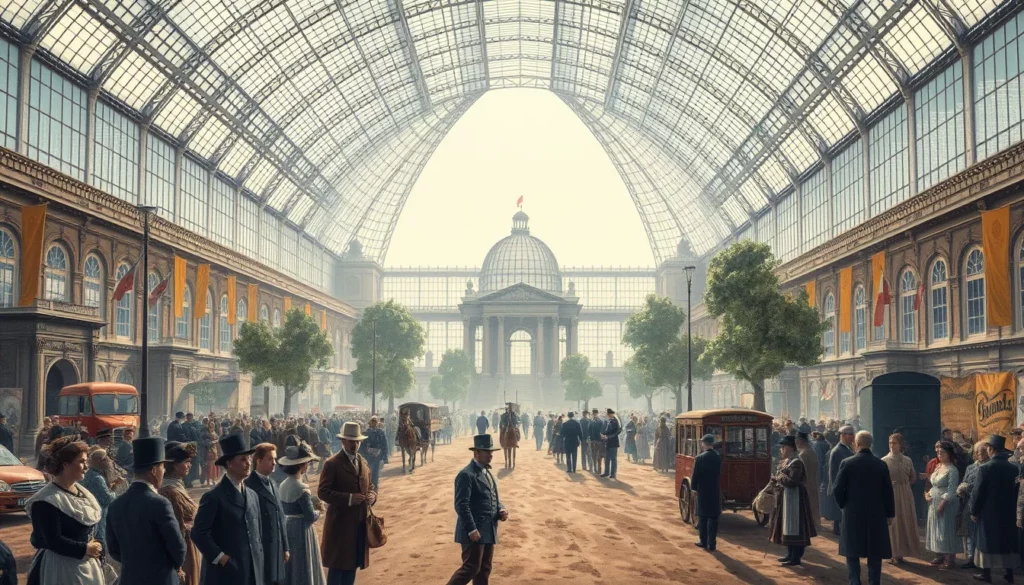
In 1851 London was the capital of the world’s foremost industrial and imperial power and the largest city in Europe. This article treats “London” as the metropolitan built-up area around the City of London, including the West End, the East End, the riverside districts and the expanding suburbs, rather than the small historic City alone. The year is dominated by the Great Exhibition of the Works of Industry of All Nations, held in Hyde Park from 1 May to 11 October 1851. Its home, the Crystal Palace—a vast glass-and-iron building designed by Joseph Paxton—became the most famous structure of the age.
The Exhibition drew over six million visits, an astonishing figure for a population of roughly twenty-one million in Britain and Ireland. It displayed more than 100,000 objects from nearly 14,000 exhibitors and 34 nations, together with territories of the British Empire. Londoners encountered locomotives, hydraulic presses, textiles, furniture, sculpture, raw materials and imperial trophies. The event was a spectacle of confidence, commerce and empire, but it also exposed anxieties about design, class, foreign competition and Britain’s place in the world.
Beyond Hyde Park, 1851 was a year of census-taking, railway expansion, crowded streets and hard work. The census recorded about 2.36 million people in metropolitan London. The city was a place of extreme contrasts: wealth and poverty, grandeur and sanitation problems, global trade and casual labour. The Exhibition became the lens through which contemporaries saw those contrasts.
London in 1851
London in 1851 was shaped by the Thames. The river was both artery and obstacle, carrying ships, barges and steamers while separating the prosperous West End from the industrial and riverside districts of the south bank and the East End. The City of London remained the financial and commercial core, but the metropolis had long since spilled beyond its ancient boundaries into a patchwork of parishes, vestries and sprawling suburbs. Hyde Park, where the Crystal Palace rose, still lay at the western edge of the built-up city, close to fashionable Belgravia and Kensington but within easy reach of the West End crowds.
The atmosphere was one of confidence and anxiety. London was the hub of a global empire, a centre of finance, shipping, publishing and government. New railway termini, warehouses, docks and gas-lit streets announced modern progress. Yet the city was also smoky, noisy and unhealthy. Coal fires produced the familiar yellow-black fogs, while inadequate drainage and overcrowded housing made disease a constant threat. The Great Exhibition presented a polished image of progress, but many Londoners knew the less polished realities of workhouse poverty, casual labour and cramped lodgings.
The year had its own ritual calendar. Parliament sat at Westminster, the Queen and Prince Albert were visible at Court and in public ceremonies, and the press reported the doings of fashionable society alongside the price of bread. The Exhibition gave the metropolis an international stage: foreign visitors, special trains, crowded omnibuses and souvenir sellers all contributed to the sense that London was, for one long season, the centre of the world.
Population & Economy
The 1851 census recorded approximately 2.36 million people in metropolitan London, making it far larger than any other British city. It had grown rapidly since 1841, by roughly a fifth, as migrants arrived from the countryside and from Ireland. The population was young and mobile, but mortality was high and housing was strained. Wealth and poverty existed side by side: Mayfair and Belgravia stood near courts and alleys in which several families might share a single house.
London’s economy rested on commerce, shipping, finance and manufacture. The docks at St Katharine, London, East and West India handled goods from every continent. The City provided banking, insurance, shipping services and commodity markets. Manufacturing was varied rather than concentrated in giant textile mills: clothing and bootmaking, furniture, printing, brewing, chemicals, precision instruments, shipbuilding and engineering all employed large numbers. Domestic service was a major employer, especially for women. Many workers depended on casual or seasonal labour, and the line between the respectable artisan and the poor was precarious.
Prices and wages varied sharply by trade and district. A four-pound loaf of bread cost roughly sixpence in ordinary times, while a skilled artisan might earn between twenty and thirty shillings a week; rent, fuel, food and clothing consumed most of it. The Great Exhibition itself became a commercial enterprise: admission was initially five shillings, later reduced to one shilling on certain days, and it generated a profit of about £186,000. That surplus was later directed towards the South Kensington cultural quarter, often called Albertopolis.
Government & Politics
London had no unified municipal government in 1851. The ancient City of London was governed by its Corporation and Lord Mayor, while the surrounding metropolis was administered by a confusing array of vestries, boards, commissions and Poor Law unions. The Metropolitan Police, established in 1829, patrolled the streets, but public health, paving, lighting and drainage remained fragmented responsibilities. The office of Mayor of London did not exist; the City’s Lord Mayor in 1851 was John Musgrove until November, followed by William Hunter.
National politics were dominated by Lord John Russell’s Whig ministry, with Queen Victoria and Prince Albert at the centre of Court life. The Great Exhibition was a royal and governmental project as much as a commercial one. A Royal Commission for the Exhibition of 1851 was established in January 1850, with Prince Albert as a driving force and Henry Cole as a key organiser. The project reflected free-trade politics and a belief that international competition would improve British design and manufacturing. It also provoked debate: some feared foreign spies or revolutionary contagion, others objected to the cost, and religious groups protested against Sunday opening, which was ultimately rejected.
Chartism, which had frightened authorities in 1848, was in decline by 1851, but radical and reformist currents remained. The Exhibition was designed to present a harmonious image of order, industry and empire. Yet it also became a public stage on which class mixing, imperial possession and national rivalry could be observed by millions.
Industry
The Great Exhibition was itself an industrial spectacle. The Crystal Palace was engineered by Fox, Henderson and Company and built in about nine months by over 2,000 workers. Its modular glass and iron construction was a triumph of prefabrication and rapid assembly. Inside, visitors walked past displays of fabrics, furniture, locomotives, hydraulic presses, musical instruments and raw materials. The building was tall enough to enclose mature elm trees, and it housed a pipe organ and an eight-metre glass fountain. The satirical magazine Punch dubbed it the Crystal Palace, and the name stuck.
London’s own industries were on display less as a single exhibit than as the infrastructure of the event. Printing and publishing produced catalogues, guides and illustrated newspapers. Brewing, clothing, furniture and luxury trades served the capital’s vast population. The docks and railways moved people and goods. The Exhibition also reflected a long-running anxiety about British taste. The French critic the abbé Le Blanc had complained in the previous century that “much as I admire their invention in mechanical arts, I am equally offended at all their productions in the arts of taste.” Prince Albert and Henry Cole hoped the Exhibition would correct that weakness by exposing manufacturers and the public to the best international design.
Among the most talked-about exhibits were the Koh-i-Noor diamond, acquired by Britain after the Anglo-Sikh Wars; a stuffed elephant bearing an Indian howdah; Hiram Powers’s marble nude The Greek Slave; and machinery that seemed to promise a new age of power and speed. The Exhibition celebrated British industrial superiority, but its imperial displays also presented colonial economies as sources of raw materials and exotic curiosities—a view that reinforced contemporary assumptions about race and empire.
Education
London was a centre of learning, but education remained uneven. University College London and King’s College London offered higher education, while the University of London examined candidates without teaching them directly. Professional bodies, learned societies and mechanics’ institutes provided lectures and libraries. For most children, however, schooling depended on charity schools, church schools, private adventure schools or family resources. Elementary education was not yet compulsory, and many working-class children received only irregular instruction before entering the labour market.
Literacy was rising, especially in the metropolis, but it varied by class, occupation and district. Newspapers, broadsides, cheap pamphlets and illustrated periodicals reached a large audience. The Great Exhibition had an explicitly educational purpose: it was meant to improve public taste and instruct manufacturers. Henry Cole’s Journal of Design and Manufactures campaigned for better design, and the Exhibition’s profits later helped establish the South Kensington museums as institutions of public instruction. In this sense, 1851 marked a stage in the Victorian belief that display, classification and example could educate both producers and consumers.
Transportation
London’s streets were dominated by horse-drawn traffic: private carriages, cabs, omnibuses and heavy goods wagons. The railway age had already transformed the city’s edges. Termini such as Paddington, Euston, London Bridge and Waterloo connected London to the provinces and the docks. King’s Cross would open in 1852, just after the Exhibition year. Steamers plied the Thames, and the docks were crowded with sailing ships and early iron steamships.
The Great Exhibition depended on this transport revolution. Special trains and excursion fares brought visitors from across Britain, while omnibuses and cabs carried them from stations to Hyde Park. The sheer volume of traffic created congestion, delays and profit for cabmen and lodging-house keepers. For Londoners, daily movement remained slow and weather-dependent; the underground railway would not arrive until 1863. The Exhibition demonstrated how railways could move masses of people for leisure as well as commerce, a lesson that shaped the later history of London tourism and suburban travel.
Everyday Life
Everyday life in 1851 was organised around work, family, neighbourhood and class. Wealthy households employed servants and moved between town houses and country estates. Middle-class families lived in terraces with parlours, nurseries and respectable routines. Working-class Londoners often rented single rooms in crowded courts or lodging houses, sharing water pumps and privies. Sanitation was primitive by later standards, and coal smoke permeated clothing, curtains and lungs.
Food was plain and seasonal: bread, beer, tea, sugar, potatoes, vegetables, cheese and occasional meat. Markets such as Smithfield for meat, Covent Garden for produce and Billingsgate for fish supplied the city. Clothing marked status sharply. Respectable men wore top hats, coats and trousers; women wore bonnets, shawls and wide skirts supported by petticoats. The cage crinoline had not yet arrived, but fashionable dress was already elaborate. Working people wore sturdy, patched and often second-hand clothes.
Entertainment ranged from pubs, music halls and theatres to panoramas, exhibitions and public lectures. The Great Exhibition became the great outing of the year. Visitors marvelled at the building, collected souvenirs and observed strangers from other classes and nations. Social customs were strict in public, especially for women, but the Exhibition created a rare space where a shilling ticket could bring together people from very different backgrounds. Religion, temperance and respectability shaped much public discussion, while crime, prostitution and poverty remained persistent concerns.
Major Events
The central event of 1851 was the Great Exhibition. Queen Victoria opened it on 1 May in a ceremony in Hyde Park, and it closed on 11 October. Over five and a half months it received more than six million visits and became a symbol of British industrial and imperial power. The 1851 census, taken on 30 March, provided an unprecedented statistical portrait of the metropolis. In December, news of Louis-Napoleon’s coup in France reminded Londoners that revolutionary and authoritarian politics were still unsettling Europe.
The Exhibition also generated smaller events and controversies: shilling days, special trains, commemorative medals and plates, lectures, sermons and satirical prints. Foreign visitors and exhibitors arrived from Europe, the United States and the empire. The Koh-i-Noor went on display, attracting curiosity and criticism. The closing ceremony was marked by press reflection on the crowds, the profits and the meaning of the spectacle. For many Londoners, however, the year’s major events were also personal: births, deaths, wages, rents and the daily struggle to make ends meet.
What Newspapers Were Reporting
London’s press covered the Exhibition intensively. The Times, the Illustrated London News, the Morning Chronicle and the satirical Punch reported on the building, the exhibits, the crowds, the royal ceremonies and the foreign visitors. Newspapers described the opening ceremony, the queues, the excursion trains and the behaviour of the crowd. They also debated admission prices, Sunday opening and the commercial value of the event. Punch mocked and celebrated the spectacle, while the illustrated press provided engravings of the palace and its displays.
When the Exhibition closed, The Times reflected on the change in the capital’s daily conversation: “The country will no longer pour into the town, Piccadilly will cease to be a thoroughfare of nations, and it will no more be asked at every breakfast table in the metropolis, ‘Who will go to the Exhibition,’ and when, and how, and with whom?” The same newspaper had earlier captured the excitement with the observation that “It will no more be asked at every breakfast table in the metropolis, ‘Who will go to the Exhibition’?” Such comments show how thoroughly the Exhibition had entered ordinary London speech.
What People Were Talking About
People talked about the Crystal Palace itself: its size, its glass, its trees, its organ and its fountain. They debated whether such a building could be safe, whether it was beautiful, and whether it was worth the money. They discussed the exhibits—the Koh-i-Noor, the stuffed elephant, the machinery, the sculpture and the foreign goods. They talked about the crowds, the pickpockets, the fashionable visitors and the surprising sight of working people on shilling days. Charlotte Brontë and Charles Dickens were among the celebrated visitors, and their impressions joined those of thousands of anonymous sightseers.
More serious conversations concerned empire, free trade and national competition. Supporters saw the Exhibition as proof that commerce and international exchange could promote peace and progress. Critics worried that foreign goods would expose British weaknesses or that the display of colonial wealth concealed exploitation. Religious groups argued over Sunday opening. Reformers asked whether the profits should support education and design. Working-class Londoners discussed wages, rents and whether a day at the Exhibition was worth the cost. Letters and diaries from the period record a mixture of wonder, fatigue, pride and scepticism.
Historical Photographs
Photography was still young in 1851, but the Exhibition was recorded by early photographers as well as by printmakers. Daguerreotypes, calotypes and stereographs captured some of the building and its exhibits, though mass photojournalism did not yet exist. The main visual record came from engravings and lithographs, especially Joseph Nash’s detailed views of the interior and Charles Burton’s aerial-style print of the palace from Kensington Gardens. These images show the vast nave, the transept around the elm trees, the crowded galleries and the elaborate displays.
The visual evidence is significant because it reveals how contemporaries wanted the Exhibition to be seen: orderly, brilliant, global and orderly. Photographs and prints also show the architecture of glass and iron, the uniforms of officials, the dress of visitors and the sheer scale of the event. Later photographs record the Crystal Palace after its removal to Sydenham, where it reopened in 1854 and was destroyed by fire in 1936. For historians, the combination of early photographs, lithographs and illustrated newspapers provides a rich but selective record of the spectacle.
Documents & Primary Sources
Historians of London in 1851 rely on a wide range of primary sources. The 1851 census returns provide household and occupational data, though they must be used carefully because of crowding and irregular addresses. The official catalogue of the Great Exhibition lists exhibitors, objects and classifications. The records of the Royal Commission for the Exhibition of 1851 document planning, finance, policing and visitor numbers. Newspapers such as The Times and the Illustrated London News supply daily detail, while Punch offers satire and visual commentary. Joseph Nash’s lithographs, commemorative medals, season tickets and souvenir plates show how the event was marketed and remembered. Queen Victoria’s journal, Henry Cole’s papers and the correspondence of visitors add personal perspectives. Ordnance Survey maps and street directories help reconstruct the physical city.
1851 Timeline
| Date | Event |
|---|---|
| 30 March | The 1851 census is taken in England and Wales, recording London’s population and households. |
| 1 May | Queen Victoria opens the Great Exhibition in the Crystal Palace, Hyde Park. |
| May–October | The Exhibition receives millions of visits; shilling days widen access to working-class visitors. |
| 11 October | The Great Exhibition closes after more than five and a half months. |
| November | William Hunter succeeds John Musgrove as Lord Mayor of the City of London. |
| December | London newspapers report Louis-Napoleon’s coup in France, heightening European political anxiety. |
What Changed Next
The Crystal Palace was dismantled after the Exhibition and rebuilt at Sydenham in south London, where it reopened in 1854 as a centre of entertainment and instruction. It burned down in 1936, but its name and image remained powerful. The Exhibition’s profits helped fund the South Kensington museums, including the Victoria and Albert Museum, the Science Museum and the Natural History Museum, and gave rise to the district known as Albertopolis. The event also inspired the international tradition of world’s fairs and reinforced London’s role as a showcase city.
In the longer term, 1851 marked a stage in the reform of London government and public health. The Metropolitan Board of Works was established in 1855, and the sanitary crisis of the 1850s eventually produced major sewerage works. Railway expansion continued, suburbs grew, and photography and the illustrated press changed how public events were recorded. The Exhibition did not solve poverty or design problems, but it made them visible on a national and international stage. Its combination of commerce, empire, spectacle and education set a template that later exhibitions and museums would follow.
Sources
- Victoria and Albert Museum, “The foundation of the V&A’s Collections: the Great Exhibition of 1851,” https://www.vam.ac.uk/articles/the-great-exhibition-of-1851.
- London Museum, “What was the Great Exhibition of 1851?,” https://www.londonmuseum.org.uk/collections/london-stories/what-was-great-exhibition-1851/.
- Royal Commission for the Exhibition of 1851, official records and catalogue (1851).
- The Times (London), 1851, contemporary reports on the Great Exhibition.
- Joseph Nash, The Great Exhibition of the Works of Industry of All Nations, 1851 (lithographs).
FAQ
What was the population of London in 1851?
The 1851 census recorded approximately 2.36 million people in metropolitan London, making it the largest city in Europe.
What major events happened in London in 1851?
The Great Exhibition of the Works of Industry of All Nations was held in Hyde Park from 1 May to 11 October. The 1851 census was also taken, and London newspapers reported the political upheaval in France at the end of the year.
What primary sources are available for studying London in 1851?
Key sources include the 1851 census, the official Great Exhibition catalogue, Royal Commission records, The Times and illustrated newspapers, Joseph Nash’s lithographs, commemorative objects, Queen Victoria’s journal, Henry Cole’s papers and Ordnance Survey maps.
How did daily life in London in 1851 differ from today?
Housing, sanitation and transport were far less developed: most people travelled by horse-drawn omnibus or on foot, coal smoke was pervasive, elementary education was not compulsory, and London had no unified municipal government or Mayor of London.










Leave a Reply