
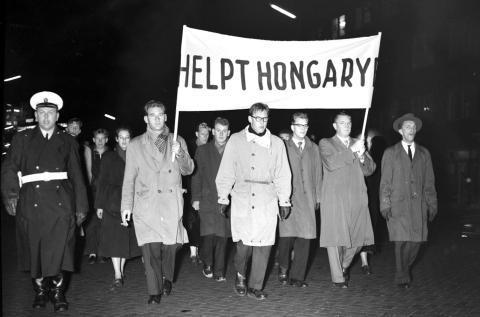
Short Answer
In late October 1956, Budapest was in flames. The Hungarian Revolution had erupted on October 23, when students and workers gathered in the streets to demand reform and an end to Soviet domination. Within days, the uprising had spread across the country, and the Soviet-backed government had collapsed. In the chaos, Hungarian revolutionaries looked to the West — to the United Nations in New York — believing that the international community would come to their aid. They trusted in the UN’s founding principles of justice and self-determination. But the world was distracted. The Suez Crisis was unfolding in the Middle East, and the Cold War superpowers were more concerned with their own strategic interests than with the fate of a small Eastern European nation. The UN would debate the “Hungarian question” for years — until 1963 — but Soviet tanks were already rolling through the streets of Budapest.
What Happened?
The Hungarian Revolution began on October 23, 1956, with student demonstrations in Budapest. The uprising quickly spread across the country, and the Soviet-backed government collapsed. A reformist government under Imre Nagy took power, announcing a series of democratic reforms and, most dramatically, Hungary’s withdrawal from the Warsaw Pact.
The United Nations Security Council took up the “Hungarian question” in late October 1956. The Soviet Union, holding a permanent seat and the power of veto, blocked any substantive action. The matter was then moved to the UN General Assembly, which passed resolutions condemning the Soviet intervention.
Key events:
- October 23, 1956: Student demonstrations in Budapest spark the Hungarian Revolution.
- October 26 – November 4, 1956: Secret negotiations take place among the Western great powers over how to respond, as documented in British Foreign Office records.
- November 4, 1956: Soviet forces invade Hungary, crushing the revolution.
- November 1956: The UN General Assembly passes resolutions on the “Hungarian question.”
- 1956–1963: The “Hungarian question” remains on the UN agenda.
- Aftermath: Trials, imprisonments, and executions of revolutionaries continue for years.
The concurrent Suez Crisis — unfolding in October and November 1956 — significantly complicated the international response. As the book Diplomacy and Disregard notes, “anxieties over the concurrent Suez crisis” influenced how UN member states responded to the Hungarian events, dividing Western attention and political capital.
How It Was Seen at the Time
Hungarians placed enormous faith in the United Nations. The revolutionaries believed that the international community would come to their aid, that the UN’s founding principles of justice and self-determination would prevail. As historian András Nagy writes, “The trust placed by some Hungarians in the UN may have done more harm than good.”
Many Hungarians came to believe that UN officials were “concerned less with responding to the ongoing tragic events in Hungary and more with jeopardizing the organization’s future ability to prevent or respond to disputes between the Cold War superpowers.” The UN’s response was characterized by what Nagy calls “the (mainly behind the scenes) activity and the (mainly demonstrative) passivity of the UN.”
The organization, “once built on moral principles,” had been reduced to “political pragmatism.” For Hungarians watching from Budapest, this was a profound betrayal. They had believed that the world would not stand by while a small nation was crushed by a superpower.
Historical Snapshot
| Aspect | Detail |
|---|---|
| Date | October 23 – November 4, 1956 (revolution); UN agenda continued until 1963 |
| Place | Budapest, Hungary; UN General Assembly, New York |
| People | Hungarian revolutionaries, Imre Nagy, Soviet leadership, UN Security Council members |
| What Happened | The Hungarian Revolution against Soviet rule was crushed by a Soviet invasion |
| Why It Mattered | The UN’s inability to act demonstrated the limits of international law during the Cold War |
What People Knew at the Time
| What People Knew Then | What We Know Now |
|---|---|
| Hungarians believed the UN would protect them from Soviet aggression | Declassified records show the UN was paralyzed by the Cold War and the Soviet veto |
| The West was seen as supportive of the Hungarian cause | Western powers were reluctant to act, distracted by the Suez Crisis |
| The “Hungarian question” was expected to be resolved quickly | The question remained on the UN agenda until 1963 |
| The UN was seen as a moral authority | The UN’s response was shaped by political pragmatism |
Different Perspectives
The Western Powers
The Western powers engaged in secret negotiations from October 26 to November 4, 1956, as documented in British Foreign Office records. These negotiations demonstrated a cautious approach: the West wanted to condemn Soviet intervention but was unwilling to take meaningful action. The concurrent Suez Crisis — in which Britain and France were themselves condemned by the UN — drew the West’s attention away from Hungary and complicated any moral high ground it might have claimed.
The Soviet Union
The Soviet Union used its veto in the Security Council to block any action on Hungary. From the Soviet perspective, the Hungarian events were an internal affair of the socialist bloc, and the intervention was presented as necessary to protect socialism against counter-revolution.
The Hungarians
Hungarians who placed their trust in the UN saw their hopes shattered. The revolution was crushed, and the years that followed brought trials, imprisonments, and executions. The UN’s response was seen as a betrayal of the organization’s founding principles — a lesson in the indifference of the international community.
Aftermath
The Soviet invasion of November 4, 1956, ended the Hungarian Revolution. In the years that followed, the Hungarian government carried out trials, imprisonments, and executions of revolutionaries. The “Hungarian question” remained on the UN’s agenda until 1963, but the organization’s response was largely ineffective.
The UN’s contradictory rhetorical and practical responses — documented in UN archival materials, Hungarian government and secret service papers, and personal collections held by UN officials across the globe — reveal an organization deeply conflicted. The UN condemned the Soviet intervention in words but took no action to stop it or to protect the Hungarian people from the consequences.
How Historians See It Today
Historians today view the UN’s response to the Hungarian Revolution as a case study in the limits of international organizations during the Cold War. The debate centers on whether the UN’s handling of the crisis was a “historical failure or political realism.” Some scholars argue that the UN had no real options given the Cold War context and the Soviet veto; others argue that the UN’s inaction reflects a fundamental failure of the organization’s founding ideals.
András Nagy’s research, based on recently declassified documents, reveals the extent of the UN’s behind-the-scenes activity and its demonstrative passivity. The organization, “once built on moral principles,” was driven by “political pragmatism.” The trust placed by some Hungarians in the UN “may have done more harm than good” — a sobering conclusion for those who believe in the power of international institutions.
Key Documents
- British Foreign Office documents, October 26 – November 4, 1956: Records of the secret negotiations among the Western great powers over the response to the Hungarian Revolution.
- UN Security Council records, October–November 1956: Records of the debates on the “Hungarian question” and the Soviet veto.
- UN General Assembly resolutions, November 1956: Resolutions condemning the Soviet intervention.
- Declassified UN archival materials: Documents revealing the internal deliberations of the UN on the Hungarian question.
- Hungarian government and secret service papers: Documents showing the Hungarian state’s perspective on the UN’s response.
The Hungarian Revolution of 1956 and the international response to its aftermath remain a powerful reminder of the gap between hope and reality. Hungarians placed their lives in the hands of the United Nations, believing the world would act on their behalf. Yet the UN was paralyzed by the Cold War, the Soviet veto, and the political pragmatism of its member states. The primary sources — the secret negotiations, the UN resolutions, the declassified documents — tell a story of an organization caught between moral principles and practical realities. The revolution was crushed, but the memory of Hungary’s hope and the world’s disregard endures.
FAQ
Why didn't the UN intervene in Hungary in 1956?
The UN was paralyzed by the Cold War. The Soviet Union, as a permanent member of the Security Council, used its veto to block action. The matter was moved to the General Assembly, which passed resolutions condemning the Soviet intervention, but no military or meaningful diplomatic action was taken. The concurrent Suez Crisis also distracted Western powers and complicated any coordinated response.
What was the 'Hungarian question'?
The 'Hungarian question' was the term the United Nations used to refer to the situation in Hungary after the 1956 revolution — the Soviet intervention, the crushing of the uprising, and the trials, imprisonments, and executions that followed. It remained on the UN agenda from 1956 until 1963.







Leave a Reply