
Short Answer
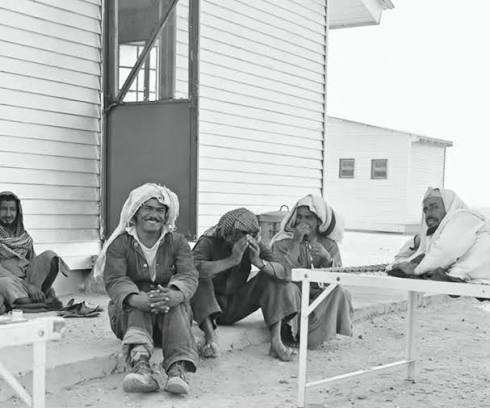
Kuwait City in the early 1960s was a city of cranes and fresh concrete. The old mud-brick walls that had once enclosed the town had been pulled down, and in their place rose a new skyline of boulevards, apartment blocks, and government buildings, paid for by oil that had been discovered in the 1930s and exported in earnest after the Second World War. The streets filled with new sounds—not just Arabic, but Malayalam, Persian, Hindi, and English. Labor crews from the Indian subcontinent, engineers from Europe, and clerks from the Levant poured in to build the highways, schools, hospitals, and refineries that the government had planned. The native population was too small to do the work. By 1965, the census recorded that foreigners had become the majority of Kuwait’s residents. A small Gulf sheikhdom had become a global crossroads, and the transformation was visible on every street corner.
What Happened?
Kuwait’s oil was discovered in the 1930s, but its export was taken up only after the end of the Second World War. As the oil revenues started to flow in, the Government of Kuwait took up the development of the country in a big way. Massive plans were drawn up to build highways and roads, schools and hospitals, residential and commercial complexes, oil refineries, and other infrastructure.
This development created a labor market that native Kuwaitis were unable to fill. The result was large-scale immigration. The population of Kuwait increased by more than five times between 1961 and 1985, from 321,621 to 1,697,301. Between the 1961–65 and 1965–70 intercensal periods, the growth rate of the population was around 9 percent per annum.
- 1961 — Kuwait gains independence. Population recorded at 321,621.
- 1961–1965 — Population growth rate peaks at approximately 9% per year, driven overwhelmingly by immigration.
- 1965 — The census records that foreigners constitute a majority of the country’s population for the first time.
- 1965–1970 — The growth rate remains around 9% per annum, continuing the demographic shift.
The official statistics, drawn from the quinquennial censuses conducted from 1957 onward, divided the population into “native” and “non-native” status. The data showed a steady increase in the non-native share. By 1985, migrants constituted over 60% of the total population and more than 80% of the labor force, but the pattern was already clear in the 1960s: the country was becoming a majority-expatriate state.
How It Was Seen at the Time
Contemporaries in the 1960s saw the transformation with a mixture of pride and unease. The economic boom was the envy of the region, and the new roads, schools, and hospitals were visible proof of progress. But the demographic shift raised questions that were discussed in official reports and academic studies. Habib Ishow, in his study of the population of Kuwait, examined the “economic, social, and political consequences” of the immigration, noting that the data showed a clear structural change.
“Since 1965 foreigners have constituted a majority of the country’s population.” — Habib Ishow, Changes in the population of Kuwait and their socioeconomic and political consequences, 1985.
The prevailing interpretation was that foreign labor was a necessary, temporary measure to build the country. The government’s development plans required hands that the native population could not supply. But the language of “native” and “non-native” in the censuses reflected a deeper concern about the future of Kuwait’s identity.
Historical Snapshot
| Aspect | Detail |
|---|---|
| Date | 1960s (with context from 1957 to 1975) |
| Place | Kuwait, West Asia, bordered by Saudi Arabia, Iraq, and Iran |
| People | Native Kuwaitis and a rapidly growing population of non-national migrants |
| What Happened | Oil wealth fueled a development boom that created a labor shortage, leading to large-scale immigration and a foreign majority by 1965. |
| Why It Mattered | It transformed Kuwait’s economy, society, and politics, creating a demographic structure that persists today. |
Numbers at the Time
| Statistic | Value | Source / Year |
|---|---|---|
| Total population | 321,621 | 1961 census |
| Total population | 1,697,301 | 1985 census |
| Population growth rate (1961–65) | ~9% per annum | Intercensal period |
| Population growth rate (1965–70) | ~9% per annum | Intercensal period |
| Foreigners as share of population | Majority (over 50%) | Since 1965 |
| Migrants as share of total population | Over 60% | 1985 |
| Migrants as share of labor force | Over 80% | 1985 |
What People Feared
As the foreign population grew, so did anxieties about the social and political consequences. Scholars and policymakers worried about the distribution of the native and non-native labor force across economic activities, and about the long-term implications of a society where the majority was not native-born. The census categories themselves—“native” and “non-native”—reflected a deep concern about who belonged to Kuwait.
There were also economic fears. The dependence on foreign labor meant that Kuwait’s development was vulnerable to the decisions of other countries and to the whims of individual workers. A sudden departure of the expatriate workforce could bring the economy to a standstill. The cultural and social changes were also a source of unease, as new languages, religions, and customs became part of everyday life.
What People Expected Would Happen Next
Many contemporaries expected that the reliance on foreign workers would be temporary. The assumption was that Kuwaitis would eventually fill the labor force as education and training expanded, and that the expatriates would return home once the infrastructure was built. The census data, however, showed the opposite trend. The non-native population continued to grow through the 1970s and 1980s, and by 1985 migrants constituted over 60% of the total population and more than 80% of the labor force.
The expectation of a return to a native-majority society proved to be wrong. The demographic shift of the 1960s set a pattern that would persist for decades, shaping Kuwait’s economy and politics in ways that the planners of the 1960s had not anticipated.
Aftermath
The 1960s established the demographic pattern that defined Kuwait for the rest of the century. The quinquennial censuses continued to record the growing share of non-nationals, and the labor market remained dependent on foreign workers. The political and social questions that scholars began to examine in the 1980s—citizenship, identity, and economic dependency—became central issues in Kuwaiti public life. The “native” vs. “non-native” distinction that appeared in the censuses of the 1960s remained a structural organizing principle of Kuwaiti society, and the economic boom that had attracted the expatriate workforce continued to rely on it.
How Historians See It Today
Modern historians and demographers view the 1960s as the decisive decade in which Kuwait’s demographic fate was sealed. Contemporary observers saw the migration as a necessary, temporary response to a labor shortage. Modern scholarship, however, emphasizes the structural and lasting consequences of the shift. The 2019 GLMM analysis, “Demography, Migration, and the Labour Market in Kuwait,” traces the continuation of the patterns established in the 1960s, showing how the labor market dynamics created then still shape Kuwait in the 21st century.
The shift in interpretation is significant. In the 1960s, the official view was that expatriate labor was a tool for development. Today, historians emphasize the social and political costs of the majority-expatriate society—the questions of citizenship, rights, and identity that were already visible in the “native” and “non-native” categories of the 1960s censuses.
Common Misconceptions
The 1960s in Kuwait were a time when the future of the country was being built on the backs of thousands of expatriate workers. The oil wealth transformed the desert, but it also created a demographic reality that would define Kuwait for generations. The primary sources—the censuses, the official reports, and the studies of the era—show us a society in the midst of an unprecedented change, grappling with the consequences of its own success.
FAQ
Why did Kuwait need so many expatriate workers in the 1960s?
Kuwait's oil revenues funded a massive development program—highways, schools, hospitals, refineries—that required a much larger labor force than the native population could supply. The government's development plans created a labor market that Kuwaitis were unable to fill, leading to large-scale immigration from Arab countries and the Indian subcontinent.
When did foreigners become the majority in Kuwait?
According to the census data, foreigners became the majority of the country's population in 1965. The trend continued, and by 1985 migrants constituted over 60% of the total population and more than 80% of the labor force.















Leave a Reply