Short Answer
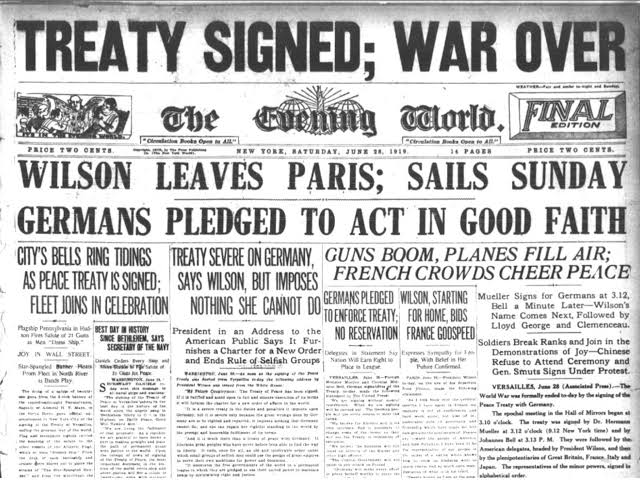
On June 28, 1919, crowds gathered outside the Palace of Versailles and around the world as newspapers proclaimed, “World War Ends as Pact is Signed.” Exactly five years after the assassination of Archduke Franz Ferdinand, the Treaty of Versailles was signed, ending the deadliest conflict in history—a war that had claimed over 35 million casualties. In Paris, in London, in Berlin, and in Washington, the press thundered with triumph, skepticism, and foreboding. The peace conference had been open since January, and the world had watched every twist and turn through the pages of their daily newspapers. This article reconstructs that moment as contemporaries saw it, using the very headlines, articles, and speeches that shaped public opinion in 1919.
What Happened?
The Paris Peace Conference opened on January 18, 1919, in Paris, bringing together representatives from over thirty nations to negotiate the terms of peace after World War I. The New York Tribune covered the opening session on January 19, 1919, and the Current History magazine later described it as “The Peace Conference: Opening Session of the Greatest World Tribunal in History.” The conference was dominated by the “Big Four”—President Woodrow Wilson of the United States, Prime Minister David Lloyd George of Britain, Premier Georges Clemenceau of France, and Prime Minister Vittorio Orlando of Italy—though the actual treaty terms were largely shaped by Wilson, Lloyd George, and Clemenceau.
Key events unfolded over the spring:
- January 1919: The conference begins; Wilson proposes his Fourteen Points and the League of Nations.
- February 1919: A tentative constitution for a League of Nations is agreed upon, as reported in Current History.
- March 1919: The conference shapes economic and military terms to be imposed on Germany.
- May 1919: The treaty is delivered to the German delegates at Versailles in a historic ceremony.
- June 28, 1919: The Treaty of Versailles is signed in the Hall of Mirrors, with crowds cheering and weeping.
The German delegation protested bitterly, but the treaty was imposed. The terms included territorial losses, military restrictions, and a war guilt clause that placed responsibility on Germany. The treaty also established the League of Nations, Wilson’s most cherished project.
How It Was Seen at the Time
Contemporary newspapers were filled with hope and anxiety. Headlines around the world proclaimed the end of the war, but many reporters and editors also expressed doubts about the treaty’s harshness. The New York Tribune ran a political cartoon on January 26, 1919, showing the Paris Peace Council creating the League of Nations, reflecting the idealistic hopes of the moment. Yet the same papers carried warnings from German officials that the terms would bring ruin.
“World War Ends as Pact is Signed” — headline in American newspapers, June 28, 1919.
Other papers focused on the ceremony itself. Current History reported on “Germany and the Peace Treaty; Historic Ceremony of Its Delivery to the German Delegates at Versailles” in its June 1919 issue, describing the event as both historic and solemn. In the United States, the debate over the League of Nations became a national controversy. Senator Henry Cabot Lodge of Massachusetts recorded a speech in 1919 stating his case against President Wilson’s League, and that recording was widely distributed. The mood was a mixture of relief, triumph, and foreboding.
Historical Snapshot
| Aspect | Detail |
|---|---|
| Date | June 28, 1919 |
| Place | Palace of Versailles, France |
| People | Woodrow Wilson, David Lloyd George, Georges Clemenceau, Italian Prime Minister Vittorio Orlando; German delegates led by Foreign Minister Ulrich von Brockdorff-Rantzau |
| What Happened | Signing of the Treaty of Versailles, ending World War I |
| Why It Mattered | Imposed harsh terms on Germany, created the League of Nations, and set the stage for World War II |
Contemporary Newspaper Coverage
Newspapers were the primary source of information for the public in 1919. The Chronicling America digital collection at the Library of Congress holds hundreds of newspapers from that era. The New York Tribune covered the opening of the Paris Peace Conference on January 19, 1919, and the Current History magazine published detailed accounts of each month’s proceedings, with titles like “The Peace Conference: A Month’s Progress at Paris in Shaping the Economic and Military Terms to Be Imposed upon Germany” (April 1919).
The coverage was not uniform. Many American papers championed Wilson’s League of Nations, while others, such as the Chicago Tribune and the New York Herald, were skeptical. The New York Times ran a series on the treaty’s details. In Germany, newspapers condemned the treaty as a “Diktat” (dictated peace). The Vossische Zeitung wrote that Germany had been “stabbed in the back.”
The press also covered the ceremony itself. Current History described the delivery of the treaty to the German delegates in May 1919 as a “historic ceremony.” The signing on June 28 was captured in photographs and film, but for most people the experience came through the words of reporters who described the scene: the long tables, the silk hats, the silence when the German delegation signed.
Different Perspectives
The American Perspective
American newspapers were divided. President Wilson saw the treaty as the cornerstone of a new world order, but the U.S. Senate, led by Senator Henry Cabot Lodge, opposed the League of Nations. Lodge’s recorded speech, now in the Library of Congress’s American Leaders Speak collection, captures the isolationist argument. The press covered this debate intensively, with some papers supporting Wilson and others backing Lodge.
The German Perspective
German newspapers were bitter. The treaty was handed to them without negotiation. The German delegation, led by Foreign Minister Ulrich von Brockport-Rantzau, protested that the terms were impossible to fulfill. The Berliner Tageblatt wrote that the treaty was “a death sentence.” The German public felt humiliated, and this resentment would later be exploited by Adolf Hitler.
The French Perspective
French newspapers, mindful of the war’s devastation, generally welcomed the treaty but worried that it was not harsh enough. Georges Clemenceau, the “Tiger,” was celebrated for securing reparations and security guarantees.
What People Expected Would Happen Next
At the time, many people expected the treaty to bring lasting peace. President Wilson declared that the League of Nations would make the world “safe for democracy.” The New York Tribune in January 1919 anticipated that the conference would create a new world order. Others, however, predicted trouble. Some American senators warned that the League would entangle the United States in foreign wars. German leaders predicted that the treaty would lead to another war. The Current History magazine in May 1919 noted that the German delegation had been given only three weeks to respond, a sign of the haste and coercion.
In the immediate aftermath, the treaty was signed, but the ratification process in the United States was far from certain. The Senate would eventually reject the treaty, and the United States never joined the League. In Europe, the treaty’s enforcement was met with resistance and resentment, and the world would see the seeds of the Second World War.
How Historians See It Today
Historians today largely agree that the Treaty of Versailles was a flawed peace. Many claim that its harsh terms set the stage for the Second World War, as the Library of Congress notes in its introduction. The treaty’s war guilt clause, reparations, and territorial losses humiliated Germany and created economic hardship that destabilized the Weimar Republic. The League of Nations, without the United States, proved too weak to prevent aggression. Contemporary observers, however, saw the treaty as the end of the war, a necessary step to punish the aggressor. The distinction between the hopes of 1919 and the historical consequences is stark. Modern scholarship emphasizes the treaty’s failures, but it also recognizes the difficult context of the time—the enormous human cost of the war and the pressure from publics that demanded retribution.
What the newspapers of 1919 reveal is a world at a crossroads, hopeful and fearful. The same headlines that celebrated the end of the war also contained the warnings that would echo for decades. The primary sources—newspapers, speeches, and recordings—show us that the people of 1919 were not passive; they were engaged, argued, and questioned the peace they had just won.
FAQ
How did newspapers report the signing of the Treaty of Versailles?
Newspapers around the world carried headlines such as 'World War Ends as Pact is Signed' on June 28, 1919. The New York Tribune and other papers provided detailed coverage of the Paris Peace Conference from January 1919 onward. The Current History magazine published monthly summaries of the proceedings.
What were the main reactions to the treaty in different countries?
In France, the treaty was largely welcomed as a security guarantee. In Germany, it was condemned as a 'diktat' and humiliating. In the United States, the League of Nations debate split the public, with Senator Henry Cabot Lodge leading the opposition.




Leave a Reply