
Short Answer
Paris, January 1919. The guns of the Great War had fallen silent barely two months before, and now the statesmen of the world descended upon the French capital to redraw the map of Europe. The city, still bearing the scars of four years of conflict, swelled with delegates, diplomats, journalists, and petitioners from a dozen nations. Current History, a contemporary monthly, described the opening session as “the greatest world tribunal in history”—a phrase that captured the enormous hopes and anxieties resting on the shoulders of the assembled leaders. For six months, the world watched Paris with a mixture of anticipation and dread, as the Allied powers wrestled with the economic, military, and territorial terms to be imposed upon Germany. The newspapers of the day carried daily dispatches from the conference, and the outcome would shape the postwar order for decades to come.
What Happened?
The Paris Peace Conference formally opened on January 18, 1919, with delegates from the victorious Allied and Associated Powers gathering to determine the terms of peace. The conference was dominated by the Council of Four: President Woodrow Wilson of the United States, Prime Minister David Lloyd George of Great Britain, Premier Georges Clemenceau of France, and Premier Vittorio Orlando of Italy.
The key events unfolded in a steady progression:
- January 18, 1919: The conference opened in Paris. Current History published the text of the first addresses, calling it the “Opening of the Greatest World Tribunal in History.”
- February 1919: The delegates agreed upon “a tentative constitution for a League of Nations” (as reported in Current History, March 1919).
- March–April 1919: The conference made “a month’s progress at Paris in shaping the economic and military terms to be imposed upon Germany,” according to the April 1919 issue of Current History. Lloyd George’s official summary of the proceedings was published in May 1919.
- May 7, 1919: The full treaty was delivered to the German delegates at Versailles in a historic ceremony. Current History reported the event as “Germany and the Peace Treaty; the Historic Ceremony of Its Delivery to the German Delegates at Versailles, How It Was Received.”
- June 1919: The German delegation, led by Count Brockdorff-Rantzau, submitted formal “German Observations on the Conditions of Peace.” The Allied and Associated Powers responded with a reply and an ultimatum.
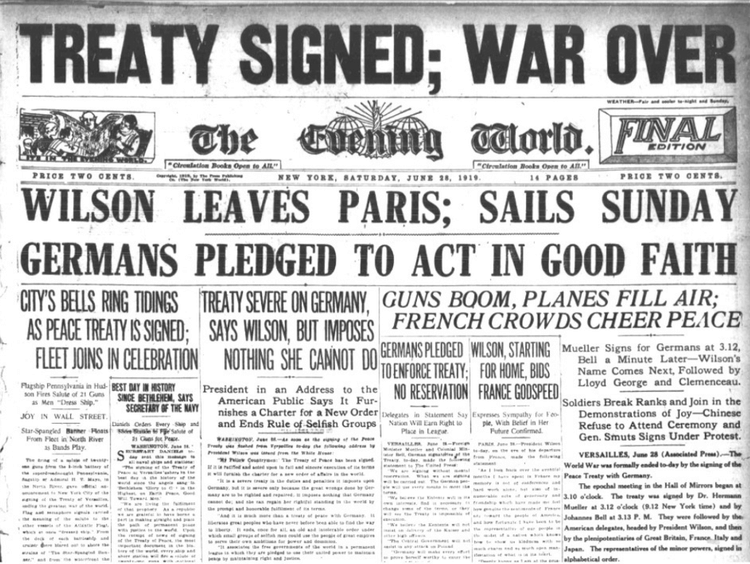
- June 28, 1919: The Treaty of Peace between the Allied and Associated Powers and Germany was signed at Versailles.
The treaty itself was a voluminous document. Part I established the Covenant of the League of Nations. Other sections addressed Germany’s frontiers, military provisions, reparations, and the military occupation of the territories of the Rhine. A separate agreement was concluded regarding the military occupation of the Rhine, and a treaty between France and Great Britain pledged British assistance to France in the event of unprovoked aggression by Germany. The United States ultimately declined to ratify the Treaty of Versailles, and instead concluded a separate treaty with Germany restoring friendly relations, signed at Berlin on August 25, 1921.
How It Was Seen at the Time
Contemporaries understood the treaty as the definitive settlement of the Great War, a document that would bring lasting peace to a shattered world. The language of the era was dramatic and optimistic. Current History described the conference as “the greatest world tribunal in history,” and the delivery of the treaty to the German delegates was widely reported as a “historic ceremony.”
But the mood was not uniform. The German delegation’s response was one of protest. Count Brockdorff-Rantzau, the German foreign minister, delivered a long statement of objections, and the German observations were formally submitted to the Allied powers. The Allied reply, however, was an ultimatum, leaving Germany little room for negotiation.
“Germany and the Peace Treaty; Historic Ceremony of Its Delivery to the German Delegates at Versailles, How It Was Received.” — Current History, June 1919
In the victorious countries, the treaty was widely celebrated as a just settlement. In Germany, it was viewed as an imposed peace—a Diktat—that did not permit genuine negotiation. The French, mindful of two invasions in a generation, were anxious about the security of their eastern border and sought guarantees against future German aggression, which explains the separate Franco-British treaty.
Historical Snapshot
| Aspect | Detail |
|---|---|
| Date | January 18 – June 28, 1919 |
| Place | Paris and Versailles, France |
| People | Woodrow Wilson, David Lloyd George, Georges Clemenceau, Vittorio Orlando, Count Brockdorff-Rantzau |
| What Happened | The Allied powers imposed peace terms on Germany, including the League of Nations and territorial and military provisions |
| Why It Mattered | The treaty redrew the map of Europe and established the postwar international order |
Contemporary Newspaper Coverage
The press of 1919 covered the peace conference with extraordinary intensity. Newspapers and periodicals on both sides of the Atlantic devoted immense space to the proceedings, printing full texts of speeches, official summaries, and detailed analyses.
The Brooklyn Daily Eagle published an official summary of the terms presented to the German delegates at Versailles, along with special articles on the League of Nations and the covenant for world labor. The Library of Congress holds this document, which reflects the period’s hunger for detailed information about the settlement.
Current History magazine ran a series of monthly reports throughout the conference. The February 1919 issue covered the opening session and printed the text of the first addresses. The March 1919 issue reported the agreement on a “tentative constitution for a League of Nations.” The April issue chronicled the progress on the economic and military terms. The May 1919 issue included Premier Lloyd George’s official summary of the proceedings. The June 1919 issue described the delivery of the treaty to the German delegates and how it was received.
“The Peace Conference: Records of a Month’s Proceedings at Paris, Introduced by Premier Lloyd George’s Official Summary.” — Current History, May 1919
Different Perspectives
The German View
The German delegation, led by Count Brockdorff-Rantzau, viewed the treaty as a dictated peace. The German government submitted formal “German Observations on the Conditions of Peace,” which were extensive and detailed. The Allied reply, however, was an ultimatum, leaving Germany with no real choice but to sign. The German press and public saw the treaty as a humiliation, a sentiment that would have lasting consequences.
The Allied Powers
Among the victors, the treaty was seen as a necessary settlement that would hold Germany accountable and secure the peace. But the Allies were not unified. The French, represented by Clemenceau, prioritized security and reparations. The British, under Lloyd George, sought a balance of power in Europe and were more cautious about weakening Germany. President Wilson’s central goal was the establishment of the League of Nations, which he saw as the key to preventing future wars.
The American Debate
The treaty became a subject of intense debate in the United States. The U.S. Senate ultimately refused to ratify the Treaty of Versailles, and the United States instead signed a separate treaty with Germany at Berlin on August 25, 1921, restoring friendly relations. This American decision had profound consequences for the League of Nations and the postwar order.
What People Expected Would Happen Next
In the spring and summer of 1919, there was a widespread hope that the treaty would bring a durable peace. The League of Nations was seen as the mechanism that would prevent another catastrophic war. The official documents of the conference reflect a genuine belief among many delegates that they were building a new world order.
Yet there were also anxieties. The German delegation had hoped that the treaty would be modified after their observations were submitted, but the Allied ultimatum shattered those hopes. The French, despite the treaty, remained deeply anxious about the future security of their country and sought to obtain guarantees against the possibility of German revenge. The separate treaty between France and Britain, concluded at the same time as the Treaty of Versailles, was a direct expression of this fear.
Aftermath
The Treaty of Versailles was signed on June 28, 1919, exactly five years after the assassination of Archduke Franz Ferdinand. In the immediate aftermath, the terms of the treaty began to be implemented: the military occupation of the Rhineland territories proceeded under the terms of the separate agreement, the League of Nations was established, and the reparations process began.
The United States, however, did not ratify the treaty. Instead, it concluded a separate peace with Germany at Berlin on August 25, 1921, which restored friendly relations between the two countries. This American absence weakened the League of Nations and the collective security system that Wilson had championed. The treaty’s long-term consequences would be the subject of intense debate for decades to come.
How Historians See It Today
Contemporaries in 1919 saw the treaty as the definitive settlement of the Great War—a triumph of justice and a foundation for lasting peace. Modern historians take a far more critical view. They emphasize the treaty’s role in creating a deep sense of grievance in Germany, which would be exploited by nationalist and revanchist movements in the years that followed. The treaty is often described as being both too harsh and too lenient: too harsh to be accepted by the German people as legitimate, and too lenient to permanently weaken Germany.
Historians also stress the significance of the United States’ failure to ratify the treaty. The absence of the United States from the League of Nations undermined the organization’s authority and its ability to maintain collective security. The official records of the Paris Peace Conference, published in the Papers Relating to the Foreign Relations of the United States (Volume XIII), and the full text of the treaty itself, now available in the Internet Archive, provide the primary evidence for these interpretations. The shift from the optimism of 1919 to the critical assessment of later generations is one of the most striking themes in the historiography of the treaty.
The Treaty of Versailles, as it appeared in the pages of 1919, was a moment of both triumph and trepidation. The newspapers and official records of the time capture a world that had just endured the most destructive war in history and was struggling to build a lasting peace. The primary sources—the Current History reports, the Brooklyn Daily Eagle summary, the German observations, and the treaty itself—preserve the voices of those who lived through the events. They show us a world that was hopeful, fearful, and divided, and they remind us that the peace of 1919 was not a single moment but a process of negotiation, protest, and compromise that continues to shape our understanding of the twentieth century.
FAQ
Why was the Treaty of Versailles signed at Versailles?
The treaty was signed in the Hall of Mirrors at the Palace of Versailles on June 28, 1919. The choice of location was symbolic, as the German Empire had been proclaimed there in 1871. The signing was the culmination of the Paris Peace Conference, which had been held in Paris since January 1919.
Did Germany have any say in the treaty?
The German delegation, led by Count Brockdorff-Rantzau, was presented with the completed draft of the treaty on May 7, 1919. They submitted formal 'German Observations on the Conditions of Peace,' but the Allied and Associated Powers responded with an ultimatum, leaving Germany with no meaningful choice but to sign. The treaty was therefore widely described in Germany as a 'Diktat'.
Why did the United States not ratify the Treaty of Versailles?
The U.S. Senate declined to ratify the treaty, primarily due to concerns about the League of Nations and the erosion of American sovereignty. Instead, the United States signed a separate treaty with Germany restoring friendly relations at Berlin on August 25, 1921.







Leave a Reply