
Short Answer
On the morning of October 22, 1962, the Washington Post landed on doorsteps across the capital with “big headlines about a crisis atmosphere in Washington, D.C.,” and stories describing “late-burning lights in the White House, Executive Office Building, Pentagon and State Department.” That evening, President John F. Kennedy announced a naval blockade of Cuba, revealing the presence of Soviet nuclear missiles ninety miles from Florida. For the next thirteen days, Americans and the world lived with the unprecedented reality of a nuclear confrontation. As one young reporter later recalled, “It would be hours more before we learned where the crisis was, what it was about and that it would push the planet as close as it has ever been to nuclear war.” This article reconstructs the crisis as it was experienced at the time, using contemporary newspapers, reporter memoirs, and eyewitness recollections to show what people knew, feared, and expected during those tense October days.
What Happened?
The Cuban Missile Crisis began with the discovery of Soviet missile sites in Cuba. On October 15, 1962, U.S. reconnaissance photographs confirmed the presence of medium-range ballistic missiles capable of striking the continental United States. President Kennedy was informed the next day. After a week of secret deliberations, on October 22 Kennedy addressed the nation, announcing the discovery and ordering a naval “quarantine” of Cuba to prevent further Soviet shipments. The quarantine went into effect on October 24. Soviet ships bound for Cuba turned back rather than challenge the blockade. On October 26, a secret back-channel communication from Soviet leader Nikita Khrushchev proposed removing the missiles in exchange for a U.S. promise not to invade Cuba. The next day, October 27, saw a U.S. U-2 spy plane shot down over Cuba and a second U-2 incident over Alaska; it was the most dangerous day of the crisis. On October 28, Khrushchev announced that the Soviet Union would withdraw its missiles from Cuba in exchange for a U.S. pledge not to invade the island and a secret agreement to remove U.S. missiles from Turkey. The crisis ended, but not before the world had come closer to nuclear war than at any other time in history.
How It Was Seen at the Time
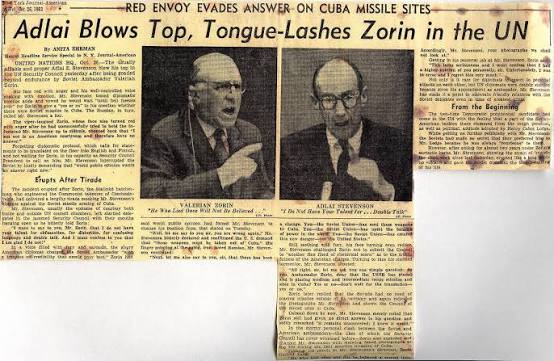
At the time, the American public and the world’s press understood the crisis as an immediate, existential threat. The language was one of confrontation and brinkmanship. Newspaper headlines from October 22–29, 1962, as recorded in a contemporary compilation, reflect the drama: the Oakland Tribune and Newport Daily News carried the first announcements on October 22; the Greeley Daily Tribune, Marion Star, Progress-Index, Times Record, and Gettysburg Times followed on October 23 with front-page stories. The Washington Post reporter described a city “in crisis” with official buildings lit all night. In New York, a young reporter who had flown from London six days earlier recalled that by October 28, “I believed that it was highly likely that I had no more than 48 hours left to live and that the same was true of the entire population of New York City.” That fear was not irrational; the crisis was real.
Historical Snapshot
| Aspect | Detail |
|---|---|
| Date | October 16–28, 1962 (thirteen days) |
| Place | United States, Soviet Union, Cuba; key events in Washington, D.C., New York, and the Caribbean |
| People | President John F. Kennedy, Soviet Premier Nikita Khrushchev, Cuban leader Fidel Castro, ABC News diplomatic correspondent John Scali, and millions of ordinary citizens |
| What Happened | The discovery of Soviet nuclear missiles in Cuba led to a U.S. naval blockade and a tense standoff that nearly escalated to nuclear war. |
| Why It Mattered | The crisis brought the world to the brink of nuclear annihilation and led to the first nuclear arms control agreements. |
Contemporary Newspaper Coverage
Newspapers across the country covered the crisis with unprecedented intensity. The compilation of front pages from October 22–29, 1962, lists dozens of papers—from the Oakland Tribune to the Gettysburg Times—that devoted their entire front pages to the story. The Washington Post on October 22 described “big headlines about a crisis atmosphere in Washington” and “late-burning lights” in government buildings. The Times Tower in New York flashed the news to pedestrians, as a photographer captured for the New York Daily News. The language of the headlines was direct and alarming: “Blockade,” “Crisis,” “Kennedy Acts.” The tone was one of urgency, with little speculation about the outcome. The press also reported the back-channel negotiations, though the public did not know about the secret Scali-Fomin lunch until later. In fact, John Scali, an ABC News correspondent, found himself at the center of a secret diplomatic exchange on October 26, when he was contacted by the Soviet embassy’s Alexander Fomin. Scali was torn between his duty as a journalist and his role as an informal messenger. As he later recalled, “Do you tell the world what you have learned, or do you sit on it?”
Eyewitness Accounts
Eyewitness accounts from reporters and ordinary citizens capture the emotional and psychological impact of the crisis. A young reporter in Washington, later writing for PBS, described the scene: “The Washington Post landed on my doorstep with big headlines about a crisis atmosphere in Washington, D.C., and pictures and stories describing late-burning lights in the White House, Executive Office Building, Pentagon and State Department.” He was a 20-year-old junior at George Washington University, working as a junior reporter in the National Press Building. He recalled that “it would be hours more before we learned where the crisis was, what it was about and that it would push the planet as close as it has ever been to nuclear war.”
Another journalist, writing in New York magazine, described the mood in Manhattan on the morning of October 28: “By mid-morning on Saturday, October 28, 1962, I believed that it was highly likely that I had no more than 48 hours left to live and that the same was true of the entire population of New York City.” He had flown from London to report on the confrontation, and he watched the Times Tower electric sign flash the news of Kennedy’s speech. The fear was not abstract; it was visceral and shared.
What People Feared
The dominant fear was nuclear war. The crisis brought the possibility of Soviet nuclear attack to the American homeland, and citizens responded with a mix of dread and preparation. The reporter in New York recalled that the entire population of the city could be destroyed within 48 hours. In Washington, the late-burning lights in the White House and Pentagon suggested a government working around the clock to avert catastrophe. The public also feared the unknown: what would happen if a Soviet ship refused to stop? What if the U.S. military acted? The fear was rational, not panic. Many families stocked food and water, and schools practiced air-raid drills, though these were not universally reported. The fear was amplified by the media’s dramatic coverage, but it was grounded in the real possibility of nuclear war. As the journalist later wrote, “I had no more than 48 hours left to live.”
What People Expected Would Happen Next
Most contemporaries expected the crisis to escalate, not to resolve peacefully. The reporter in Washington thought that the crisis would “push the planet as close as it has ever been to nuclear war,” and he expected that war was imminent. The journalist in New York expected to die within 48 hours. The official government statements were cautious, but the public’s expectation was grim. The New York Times reported that the blockade was a first step, and many analysts predicted a naval confrontation. The public did not know about the secret back-channel negotiations. When Khrushchev announced the removal of the missiles on October 28, the relief was palpable. But even then, the outcome was uncertain—the crisis had not yet officially ended. In fact, the U.S. did not remove its missiles from Turkey until later, and the crisis was not fully resolved until November 20, 1962, when the quarantine was lifted. But the immediate fear was that the world would not survive the weekend.
Aftermath
The immediate aftermath was a mixture of relief and exhaustion. The U.S. and the Soviet Union began negotiations for a nuclear test ban treaty, which was signed in August 1963. The crisis also led to the establishment of the Moscow-Washington hotline to prevent future misunderstandings. The newspapers of October 29, 1962, carried the news of the agreement, and the world began to breathe again. But the memory of those thirteen days remained vivid in the minds of those who lived through them. The reporter who had expected to die wrote that “the crisis was a turning point in the Cold War,” and the experience of that October taught the world that nuclear war was not only possible but also survivable—if the leaders could step back from the brink.
The primary sources of October 1962—newspapers, memoirs, and the recollections of ordinary citizens—reveal a generation that lived under the shadow of annihilation. They knew the facts, they feared the worst, and they expected the end. Yet they also witnessed a moment of human decision when leaders chose to avoid the ultimate catastrophe. The contemporary newspapers and eyewitness accounts are not just historical records; they are testimonies to the fragility of the nuclear age and the resilience of the human spirit.
FAQ
What was the role of the press during the Cuban Missile Crisis?
The press played a crucial role in informing the public, but it also became a participant. Journalists like John Scali of ABC News were involved in back-channel diplomacy. The press generally followed the government's lead, but also conveyed the urgency and fear of the crisis through headlines and continuous coverage.
Did the public know about the secret negotiations during the crisis?
No. The public was unaware of the secret back-channel communications between the U.S. and the Soviet Union, including the Scali-Fomin exchange. The public only learned of the details after the crisis was over. The public was told only of the blockade and the Soviet agreement to remove the missiles.



Leave a Reply