
Short Answer
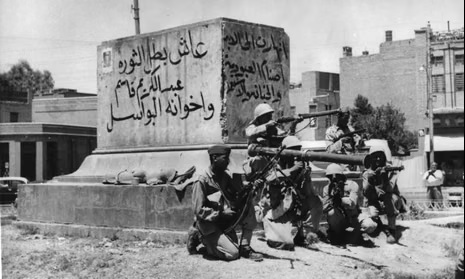
Baghdad, July 14, 1958. The city was still in the grip of a summer night when the sound of tanks shattered the silence. At 3 a.m., army officers had met at Baqubah, a prison north of the capital, forced open the gates, and released political prisoners. By daybreak, the streets of Baghdad were filled with soldiers, released prisoners, and crowds of citizens. The Hashemite monarchy, which had ruled Iraq since 1932, was about to fall. The royal palace was under fire, the Crown Prince was dead, and the King was in hiding. Baghdad Radio crackled with the announcement: “The Army has liberated the Iraqi people from domination by a corrupt group put in power by imperialism.” For the people of Baghdad, it was a day of chaos, hope, and fear. The old world of the British-backed monarchy was being swept away, and a new republic was being born.
What Happened?
At 3 a.m. on July 14, 1958, army officers commanding two separate units converged on Baqubah, a famous prison north of Baghdad. With their tanks, they forced open the prison gates, released the political prisoners, and handed out placards, flags, and instructions. By daybreak, the capital was in their hands. An American observer reported that the King’s Palace was under fire. The coup was supported by pro-Nasser civilian elements, according to the CIA.
The key events of the day unfolded rapidly:
- 3:00 a.m.: Officers at Baqubah prison release prisoners and assemble them for the march on Baghdad.
- Daybreak: Army units reach the capital; the palace comes under attack.
- Morning: Baghdad Radio announces that the army has “liberated the Iraqi people from the rule of a corrupt group put in power by imperialism.”
- Morning: Major-General Abdul Karim el-Qasim is named Prime Minister, Defense Minister, and Commander-in-Chief.
- Morning: Crown Prince Abdul Illah and Prime Minister Nuri es-Said are assassinated.
- Later: The 12,000 Iraqi troops based in Jordan are ordered to return home.
The coup was the culmination of years of mounting unrest. The Kingdom of Iraq had been a hotbed of Arab nationalism since the Second World War. Unrest grew amid economic malaise and widespread disapproval of Western influence, exacerbated by the formation of the Baghdad Pact in 1955 and Faisal’s support for the British-led invasion of Egypt during the Suez Crisis. Prime Minister Nuri al-Said’s policies were unpopular, especially within the military. Opposition groups had been organizing in secret, modeling themselves after the Egyptian Free Officers Movement that had overthrown the Egyptian monarchy in 1952. The creation of the United Arab Republic in February 1958 under Gamal Abdel Nasser further bolstered Pan-Arab sentiment in Iraq.
How It Was Seen at the Time
The coup was immediately framed as a liberation. Baghdad Radio announced that the army had “liberated the Iraqi people from domination by a corrupt group put in power by imperialism.” The new government declared that Iraq would be a republic and would “maintain ties with other Arab countries.” The language was that of the Arab nationalist movement, of Nasser’s Egypt, and of anti-imperialism.
The prevailing mood was a mixture of jubilation and anxiety. For many Iraqis, the fall of the monarchy was a long-awaited triumph. For Western observers, it was a shock. The CIA’s Director of Central Intelligence, Allen Dulles, described it as the overthrow of “the pro-West government of Iraq under Prime Minister Nuri” by “a military coup supported by pro-Nasir civilian elements.” The American embassy in Baghdad was “closely guarded by the military and tanks,” and Dulles noted that “the ability for independent reporting is restricted.”
Historical Snapshot
| Aspect | Detail |
|---|---|
| Date | July 14, 1958 |
| Place | Baghdad, Iraq |
| People | King Faisal II, Crown Prince Abdul Illah, PM Nuri es-Said, Maj. Gen. Abdul Karim el-Qas |
| What Happened | A military coup overthrew the Hashemite monarchy |
| Why It Mattered | Ended the Hashemite Arab Federation; established the Iraqi Republic; shifted Iraq away from the West |
Eyewitness Accounts
One of the most vivid eyewitness accounts comes from a foreigner who was outside the palace gates on the morning of the coup. He described the scene as:
“a hard core of thugs who had been released from the jail out at Baqubah and brought into Baghdad by trucks. In turn they had collected a crowd off the streets.”
This account, recorded by the academic Elizabeth Bishop, reveals the chaotic and violent nature of the revolution. The crowds of people who gathered nationwide transformed the military coup into what has been widely recognized as a revolution, ensuring Iraq’s political existence and unifying the separate legal systems that had been in force among urban residents and tribes.
Official Reports
The Director of Central Intelligence, Allen Dulles, briefed the US government on the day of the coup. His notes, dated July 14, 1958, state: “The pro-government government of Iraq under Prime Minister Nuri was overthrown at daybreak today, Baghdad time, by a military coup supported by pro-Nasir civilian elements.” He noted that the King’s Palace was reported to be under fire, and that the fate of King Faisal was unknown, with one report that he had been permitted to flee the country. Dulles also observed that the embassy was “closely guarded by the military and tanks, which limits the ingress and egress, so the ability for independent reporting is restricted.”
Different Perspectives
The Iraqi Army Officers
The officers who staged the coup saw themselves as liberators, echoing the Egyptian Free Officers Movement that had overthrown the Egyptian monarchy in 1952. Their radio broadcast announced that the army had “liberated the Iraqi people from domination by a corrupt group put in power by imperialism.” They were inspired by the Pan-Arab nationalism of Gamal Abdel Nasser and the United Arab Republic.
United States Intelligence
The CIA viewed the coup as a serious blow to Western interests in the Middle East. Dulles noted that the coup was “supported by pro-Nasir civilian elements,” reflecting the concern that Nasser’s influence was spreading. The CIA was also concerned about the fate of the monarchy and the stability of the region, as the embassy was under heavy guard and reports were fragmentary.
Foreigners in Baghdad
The foreigner who described the crowd as “thugs” revealed the fear and confusion of the foreign community in Baghdad. They saw the coup as a violent and chaotic event, not a liberation. This perspective contrasted sharply with the jubilant tone of the Iraqi army’s radio broadcasts, which presented the coup as a popular revolution.
What the Sources Got Wrong
The initial reporting was chaotic and contradictory. The CIA noted that the report that the Crown Prince was “torn limb from limb and carried through the streets” was “reported, but not confirmed.” The fate of King Faisal was initially unknown, with one report that he had been permitted to flee the country, but he was in fact killed. The BBC reported that the Crown Prince and Nuri es-Said had been assassinated, but the details of their deaths were not clear at the time. Dulles also noted that the reports were based on “cables from our Embassy, the attaches and radio broadcasts,” and that the embassy was closely guarded, limiting independent verification.
Aftermath
The immediate aftermath of the coup was the collapse of the Hashemite Arab Federation between Iraq and Jordan, which had been established just six months earlier. The new Republic of Iraq under Qasim declared that it would maintain ties with other Arab countries. The coup sent shockwaves through the Middle East and the world. The CIA and Western powers were deeply concerned about the spread of Nasser’s influence and the potential for Soviet involvement in the region. The fall of the Hashemite monarchy marked the end of the British-backed order in Iraq and the beginning of a new, turbulent era in the country’s history.
The fall of the Hashemite monarchy in Baghdad on July 14, 1958, was a turning point in the history of Iraq and the Middle East. The primary sources reveal a day of sudden violence, hope, and fear. The military coup, transformed by the crowds of Baghdad, became a revolution. But the future was uncertain, and the world watched with concern. The radio broadcasts, the CIA briefings, and the eyewitness accounts capture a moment of profound change, when the old certainties of the British-backed order were swept away, and the modern Middle East began to take shape.
FAQ
What happened to King Faisal II?
King Faisal II was killed during the coup. Initial reports were uncertain, with some suggesting he had been permitted to flee, but it was later confirmed that he was killed. The CIA's initial report noted his fate was unknown, with a report that he had been allowed to leave the country, but the palace was under fire.
Who was Abdul Karim Qasim?
Abdul Karim Qasim was a Major-General in the Iraqi army who led the 1958 coup. He was named the new Prime Minister, Defense Minister, and Commander-in-Chief of the Iraqi Republic. He was a pro-Nasser and Arab nationalist, but his rule was marked by instability.











Leave a Reply