
Short Answer
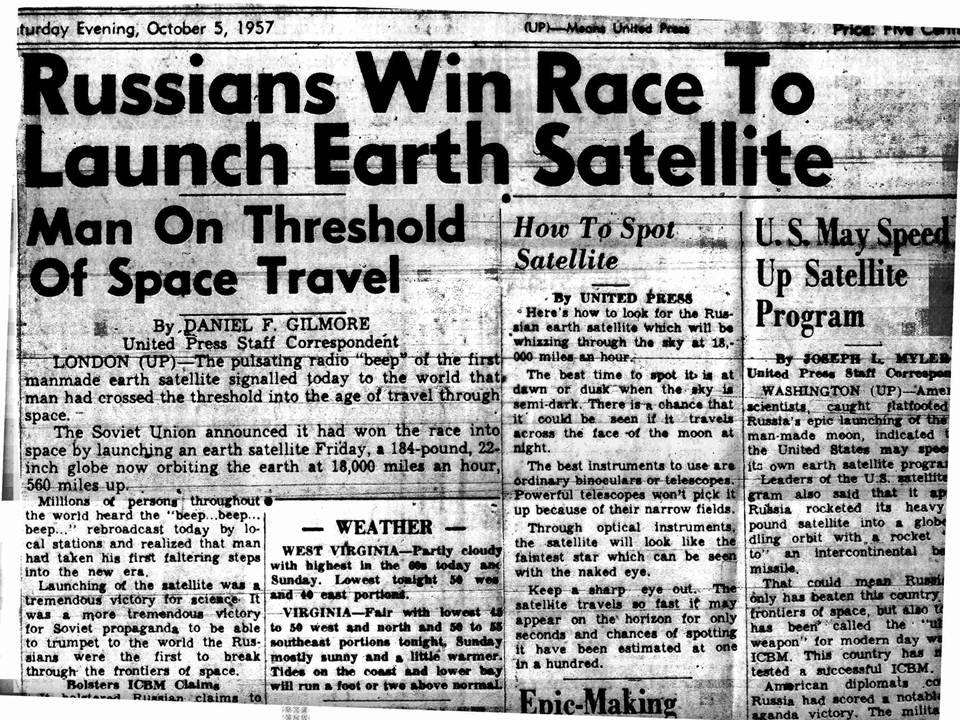
On the evening of October 4, 1957, radio listeners across the United States heard a strange, rhythmic beep—the sound of a 184-pound metal sphere orbiting the Earth. The Soviet Union had launched Sputnik, the world’s first artificial satellite, and the Space Race had begun. Americans, accustomed to technological supremacy, were stunned. Newspapers called it a “Red Moon.” The Cold War had moved into the heavens. In the months that followed, the beep of Sputnik became a constant reminder of Soviet prowess, while American officials scrambled to respond. This article reconstructs those early years through the eyes of contemporaries—using newsreels, diaries, and official documents to show what people knew, feared, and expected as the Space Race unfolded.
What Happened?
The Space Race emerged from the broader Cold War rivalry between the United States and the Soviet Union. During World War II, the two nations had been allies, but after 1945, tensions crystallized into a global struggle for influence. Space exploration became a central arena for demonstrating national strength and superiority, as both superpowers developed rockets capable of carrying nuclear warheads—and, potentially, satellites and humans.
The race began on October 4, 1957, when the Soviet Union launched Sputnik 1, the first artificial satellite, from the Baikonur Cosmodrome. The satellite transmitted radio pulses for three weeks before its batteries died, but its impact was immediate. A newsreel from October 7, 1957, titled “New Moon. Reds Launch First Space Satellite,” captured the moment for American audiences. The Soviet Union followed with Sputnik 2 in November 1957, carrying the dog Laika, and then with a series of lunar probes and manned flights.
The next milestone came on April 12, 1961, when Soviet cosmonaut Yuri Gagarin became the first human in space, orbiting Earth once aboard Vostok 1. His achievement, along with the earlier Sputnik launch, led President John F. Kennedy to propose that the United States and Soviet Union make space exploration a joint undertaking—a proposal that ultimately paved the way for the Apollo-Soyuz Test Project in 1975. But in the early 1960s, the race was fiercely competitive. The Soviets, as a contemporary diary reveals, often announced their successes only after they were certain of victory, hiding failures to maintain an image of unstoppable technical prowess.
How It Was Seen at the Time
Contemporaries understood the Space Race as a direct extension of the Cold War. The American public, shocked by Sputnik, feared that the Soviet Union had achieved a decisive technological and military advantage. The newsreel title “New Moon. Reds Launch First Space Satellite” reflected the alarmist tone of American media. In the Soviet Union, space feats were celebrated as proof of communist superiority. According to a diary kept by Soviet Air Force General Nikolai Kaminin, who trained cosmonauts, it became common practice for the Russians to announce their latest space conquests only after a mission succeeded—hiding mistakes and creating the illusion of an unstoppable juggernaut of technical prowess. This secrecy shaped how both sides perceived the race: Americans saw a monolithic Soviet threat, while Soviets saw a triumphant march toward the future.
“It became common practice for the Russians to announce their latest space conquests only after a mission succeeded — hiding mistakes and creating the illusion of an unstoppable juggernaut of technical prowess.” — from the diary of Nikolai Kaminin, as described in PBS’s Space Race Diary
The prevailing mood in the United States was a mixture of fear and determination. Editorials warned of a “missile gap” and called for increased investment in science education. In the Soviet Union, the launches were portrayed as inevitable victories of socialism. The Space Race was not merely a scientific competition; it was a battle for global prestige.
Historical Snapshot
| Aspect | Detail |
|---|---|
| Date | October 4, 1957 (Sputnik launch); April 12, 1961 (Gagarin flight) |
| Place | Baikonur Cosmodrome, Kazakh SSR, Soviet Union |
| People | Soviet engineers and cosmonauts (Yuri Gagarin); American officials (President Eisenhower, later Kennedy); General Nikolai Kaminin |
| What Happened | The Soviet Union launched the first artificial satellite and later the first human into orbit, sparking a technological rivalry with the United States. |
| Why It Mattered | Space achievements became symbols of national power and ideological superiority during the Cold War, influencing military strategy and public opinion. |
What People Knew at the Time
| What People Knew Then | What We Know Now |
|---|---|
| The Soviet Union appeared to be far ahead in space technology, with a series of successful launches. | The Soviet program experienced many failures and near-disasters, which were hidden from the public to maintain the illusion of invincibility. |
| Americans feared a “missile gap” and believed the USSR had a decisive military advantage. | Declassified documents show that the missile gap was exaggerated; the U.S. actually had more operational missiles by the early 1960s. |
| Space exploration was seen as a zero-sum competition between capitalism and communism. | Historians now recognize that both superpowers also pursued cooperation, as evidenced by Kennedy’s 1961 proposal for a joint lunar mission. |
Letters & Diaries
The most revealing personal account from the Soviet side is the diary of General Nikolai Kaminin, who served as the head of cosmonaut training. His diary, kept from the early 1960s, provides a candid look at the Soviet space program’s internal struggles. Kaminin recorded both triumphs and setbacks, including the pressure to conceal failures. His entries show that Soviet leaders were acutely aware of the propaganda value of space achievements. For example, after the success of Alexei Leonov’s spacewalk in March 1965, Kaminin noted that the leadership was “basking in the success,” but he also documented the technical risks and the toll on cosmonauts. The diary, which remained unknown in the West for decades, offers a rare counterpoint to the official Soviet narrative of flawless progress.
“In spring 1965, Soviet leaders were basking in the success of cosmonaut Alexei Leonov, who had completed the first spacewalk on March 18. But…” — from the diary of Nikolai Kaminin, as excerpted by PBS
On the American side, letters and memos from the Eisenhower and Kennedy administrations reveal a similar mix of anxiety and resolve. President Kennedy’s proposal for a joint U.S.-Soviet space mission, made in his 1961 address to Congress, was a direct response to Gagarin’s flight. The proposal, though not immediately accepted, laid the groundwork for later cooperation.
Different Perspectives
American Perspective
For Americans, Sputnik was a wake-up call. The newsreel “New Moon. Reds Launch First Space Satellite” framed the launch as a Soviet triumph and a potential threat. The American public and politicians feared that Soviet rockets could deliver nuclear weapons to U.S. soil. This fear led to the creation of NASA in 1958 and a massive investment in science education. The prevailing view was that the United States had to catch up and surpass the Soviet Union to ensure national security.
Soviet Perspective
For the Soviet leadership, space achievements were a powerful propaganda tool. The launches were presented as evidence that socialism was superior to capitalism. The secrecy surrounding failures was essential to maintaining this image. General Kaminin’s diary shows that Soviet officials were aware of the gap between public claims and reality, but they chose to emphasize successes. The Soviet people, meanwhile, were told that their nation was leading humanity into the cosmos.
Cooperation Advocates
Despite the rivalry, there were voices calling for cooperation. President Kennedy’s 1961 proposal for a joint lunar mission, as documented by the National Security Archive, was a genuine attempt to reduce Cold War tensions. Although the proposal was not accepted, it marked a shift in thinking that eventually led to the Apollo-Soyuz Test Project in 1975.
What People Feared
The most immediate fear in the United States was that the Soviet Union had achieved military superiority. Sputnik demonstrated that Soviet rockets could reach intercontinental distances, raising the specter of a nuclear attack. The “missile gap” became a political issue, with some politicians claiming that the U.S. was falling behind. There was also a fear of technological humiliation: that the United States, the world’s leading industrial power, had been beaten in a race that mattered for global prestige. In the Soviet Union, there was a different kind of fear—the fear of failure. The leadership worried that any public setback would undermine the regime’s credibility, which is why they hid failures so carefully.
These fears were not entirely rational. Declassified documents later showed that the missile gap was exaggerated, and that the U.S. had more operational missiles than the USSR by 1962. But at the time, the perception of vulnerability was real and shaped policy decisions.
How Historians See It Today
Modern historians view the Space Race as a complex phenomenon that was as much about perception as about actual technological achievement. While contemporaries saw a clear-cut competition, scholars now emphasize the role of propaganda and secrecy. The Soviet program, once thought to be a series of flawless triumphs, is now known to have had many failures, including the 1960 Nedelin catastrophe and the near-disaster of Voskhod 2. Historians also point out that the Space Race was not solely a rivalry; there were moments of cooperation, such as Kennedy’s proposal and the eventual Apollo-Soyuz mission. The primary sources—newsreels, diaries, and official documents—reveal that both superpowers were engaged in a delicate dance of competition and occasional collaboration, driven by the need to project strength while managing internal and external expectations.
The Space Race, as seen through contemporary sources, was a time of intense anxiety and ambition. The beep of Sputnik and the smile of Gagarin were not just scientific achievements; they were weapons in a psychological war. The primary sources remind us that history is not a simple narrative of progress, but a story of human hopes, fears, and the often-hidden realities behind public triumphs.
FAQ
What was the immediate reaction to Sputnik in the United States?
Americans were shocked and fearful. Newsreels called it a 'Red Moon,' and politicians warned of a 'missile gap.' The launch led to the creation of NASA and increased investment in science education.
Why did the Soviet Union hide its space failures?
Soviet leaders used space achievements as propaganda to demonstrate the superiority of communism. Publicizing failures would have undermined that narrative. General Nikolai Kaminin's diary confirms that successes were announced only after they were certain, while mistakes were concealed.















Leave a Reply