Short Answer
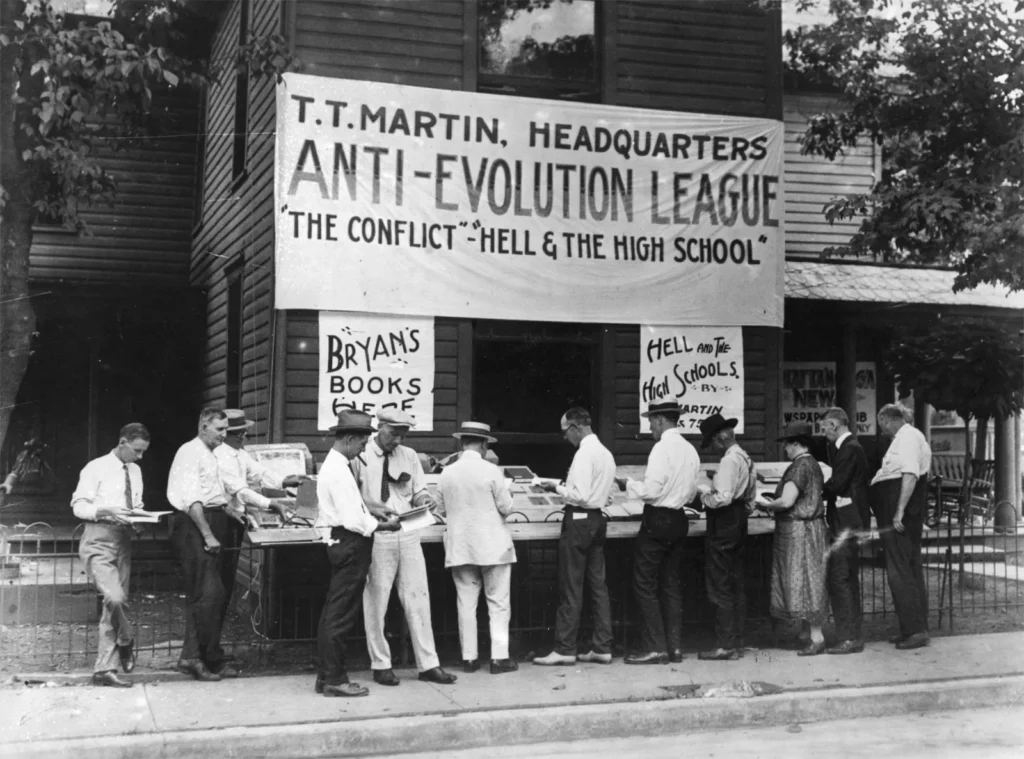
In July 1925, the small town of Dayton, Tennessee, became the focal point of a national spectacle. The quiet of dawn was split by the wailing scream of a steam siren from the sawmill, waking villagers and farmers for miles around. Along the main street, peddlers hawked “hot monkeys” (sausages), evangelists sold pamphlets with titles like “HELL AND THE HIGH SCHOOLS” and “GOD OR GORILLA,” and a barbecue concession on the courthouse lawn heaved half an ox onto the coals. The air was thick with dust, heat, and the hum of a thousand voices—reporters, curiosity seekers, and true believers. The occasion was the trial of John T. Scopes, a high school teacher accused of teaching evolution in violation of Tennessee law. For two weeks, the nation watched as science and religion clashed in a courtroom, and the press—still finding its modern footing—turned the event into a national spectacle that would redefine how science was reported.
What Happened?
The Scopes trial began as a publicity stunt. In April 1925, the American Civil Liberties Union (ACLU) placed an advertisement in Chattanooga newspapers seeking a teacher willing to challenge Tennessee’s Butler Act, which prohibited the teaching of human evolution in public schools. A group of Dayton businessmen, hoping to revive their town’s economy, saw an opportunity. They persuaded John T. Scopes, a 24-year-old football coach and substitute science teacher, to serve as the test case. Scopes was arrested and charged with violating the law.
The trial itself ran from July 10 to July 21, 1925, in the Rhea County Courthouse. The defense team, led by the famed lawyer Clarence Darrow, included the American Civil Liberties Union and a battery of scientists and educators. The prosecution was headed by William Jennings Bryan, a three-time presidential nominee and a devout fundamentalist, who had volunteered to assist the state. The courtroom was packed; the press had descended from across the nation, and the proceedings were broadcast live on radio—a first for a trial.
The central legal issue was narrow: whether Scopes had taught evolution in a public school. But the trial quickly expanded into a broader debate over the meaning of the Bible, the role of science in education, and the authority of the state to dictate curriculum. The most dramatic moment came when Darrow called Bryan to the stand as an expert witness on the Bible. Under Darrow’s cross-examination, Bryan’s literalist interpretation of the Bible was exposed to relentless questioning. The judge, however, ruled Bryan’s testimony inadmissible and later ordered it stricken from the record.
On July 21, the jury deliberated for just nine minutes and found Scopes guilty. Judge John T. Raulston imposed a fine of $100. The verdict was later overturned on a technicality by the Tennessee Supreme Court, but the law itself remained on the books for decades.
How It Was Seen at the Time
Contemporary observers described the trial as a “cross between a circus and a holy war.” The New York Times on July 15, 1925, reported “intense bitterness” in the courtroom, with “heated words” exchanged as the defense called for prayers. The judge overruled Darrow’s request to have alternate modernist and fundamentalist prayers. The paper warned of “contempt action” against the press for premature publication of rulings. The atmosphere was charged with religious fervor and scientific defiance.
“The quiet of dawn is split asunder by wailing screams from a steam siren. It is the Dayton sawmill, waking up villagers and farmers for miles around. From 5 until 6:30 the blasts continue. The hamlet and the fantastic cross between a circus and a holy war that is in progress there come slowly to life.” — Time magazine, July 20, 1925
For many, the trial was not just a legal battle but a moral one. The New York Times reported that the defense called the prosecution’s prayers “argumentative,” and the judge overruled Darrow’s motion. The press itself was a major player: reporters from major newspapers, wire services, and even new radio broadcasts filled the courtroom. The trial was one of the first to be covered nationally with such intensity, and it marked a turning point in science journalism.
Historical Snapshot
| Aspect | Detail |
|---|---|
| Date | July 10–21, 1925 (trial); arrest in May 1925 |
| Place | Dayton, Tennessee, Rhea County Courthouse |
| People | John T. Scopes (defendant), Clarence Darrow (defense attorney), William Jennings Bryan (prosecutor), Judge John Raulston |
| What Happened | Scopes was tried for teaching evolution in a public school, violating the Butler Act; found guilty and fined $100. |
| Why It Mattered | The trial became a national debate on science, religion, and education, and it transformed how the press covered science and legal battles. |
Contemporary Newspaper Coverage
The press played an unprecedented role in the Scopes Trial. The New York Times ran daily front-page stories, often with sensational headlines. On July 15, 1925, the headline read: “INTENSE BITTERNESS SHOWN; Heated Words Are Passed as Defense Calls Prayers Argumentative. JUDGE OVERRULES DARROW.” The paper also reported that the judge threatened contempt action against the press for premature publication of the ruling on the indictment.
“The judge overrules Darrow. Defense then fails in plan to have alternate modernist and fundamentalist prayers.” — New York Times, July 15, 1925
Meanwhile, Time magazine offered a vivid, almost literary description of the scene, painting the trial as a carnival. The Science News-Letter (now Science News) covered the trial from a pro-science perspective. The Science Service, a young nonprofit, sent its reporters to Dayton with an explicit decision to “reject neutrality, supporting the defense on the side of evolution,” as historian Marcel Chotkowski LaFollette later described. The Science Service’s Watson Davis and Frank Thone acted as journalists and informal assistants to the defense, seeking out top scientists to comment on the trial. This was a departure from the traditional journalistic ideal of neutrality—a move that would have lasting implications for science journalism.
What People Feared
At the time, many Americans feared that the teaching of evolution would undermine religious faith and social order. The anti-evolution movement, represented by Bryan, argued that Darwinism led to immorality and the breakdown of society. The field secretary of an anti-evolution society was reported by Time to have declared, “Shall we be taxed to damn our children?” This fear was not confined to the rural South; it resonated in many parts of the country. On the other side, scientists and liberal thinkers feared that the trial would set a precedent for state interference in scientific education, leading to a “dark age” of ignorance. The press itself feared being accused of bias or sensationalism; the judge threatened contempt for premature publication, and the courtroom was a battleground of competing narratives.
What People Expected Would Happen Next
Many contemporaries expected the trial to be a decisive victory for one side or the other. The defense hoped to get a verdict that would allow an appeal to the Supreme Court, where they could challenge the constitutionality of the Butler Act. The prosecution expected a quick conviction, which they got. After the verdict, Darrow announced he would appeal, and the case went to the Tennessee Supreme Court, which in 1927 overturned the conviction on a technicality (the judge had imposed a fine that exceeded the statutory limit). The law itself, however, remained in effect until 1967. The trial also fueled a national debate about the role of science in public education that continued for decades.
Daily Life
The Time magazine article from July 20, 1925, provides a vivid picture of daily life in Dayton during the trial. The steam siren woke the town at dawn, and the streets filled with peddlers, hucksters, and evangelists. The barbecue concession on the courthouse lawn sold “hot monkeys” (sausages). An evangelist-bookseller displayed billboards: “HELL AND THE HIGH SCHOOLS,” “GOD OR GORILLA,” and “BRYAN’S BOOKS FOR SALE HERE.” A preacher from Georgia in a bungalow on wheels drowsily put on his outlandish costume—an alpaca coat. The atmosphere was part carnival, part religious revival, part legal drama. The courtroom itself was crowded, with spectators often standing in the aisles, and the heat was oppressive. The trial was a social event, attracting people from all walks of life, and the press was everywhere, recording every detail for the nation.
Aftermath
The immediate aftermath of the trial was a bitter defeat for the defense. Scopes was found guilty and fined $100, but the verdict was later overturned. The trial had a profound impact on American culture: it deepened the rift between modernists and fundamentalists, and it made the teaching of evolution a polarizing issue for decades. The press coverage also had a lasting effect. The Smithsonian magazine notes that the trial “redefined science journalism” and shaped it to what it is today. The Science Service’s decision to take a pro-science stance was a precursor to the advocacy that some science journalists would later adopt. The trial also left a legacy of photographs and reports that historians continue to study.
How Historians See It Today
Modern historians, such as Marcel Chotkowski LaFollette, have examined the Scopes Trial through the lens of media and science. LaFollette’s book Reframing Scopes: Journalists, Scientists, and Lost Photographs from the Trial of the Century (2008) argues that the trial was a turning point in how science was communicated to the public. The Science Service’s coverage, which openly supported the defense, marked a departure from the idea of objective journalism. Historians also note that the trial was not simply a clash between science and religion, but also a contest between different versions of American identity. The photographs from the trial, including one taken from behind Darrow showing Bryan’s face, offer a unique perspective on the drama. The trial’s legacy is seen in the ongoing debates over evolution, education, and the role of the press.
In conclusion, the Scopes Trial of 1925 was a pivotal moment in American history, not only because of the legal question of teaching evolution but also because of how the press covered it. The primary sources—the New York Times reports, the Time magazine descriptions, and the Science Service’s dispatches—reveal a nation struggling to reconcile its religious heritage with the rise of modern science. The trial demonstrated the power of the media to shape public perception and the importance of accurate science communication. It remains a lesson for today’s journalists and citizens.
FAQ
Why did the Scopes Trial happen?
The trial was a deliberate test of the Butler Act, a Tennessee law that prohibited the teaching of evolution. The ACLU offered to defend a teacher who would challenge the law, and Dayton businessmen recruited John Scopes to be the defendant.
What was the verdict?
Scopes was found guilty and fined $100. The verdict was later overturned on a technicality by the Tennessee Supreme Court, but the law remained in effect until 1966.




Leave a Reply