
Short Answer
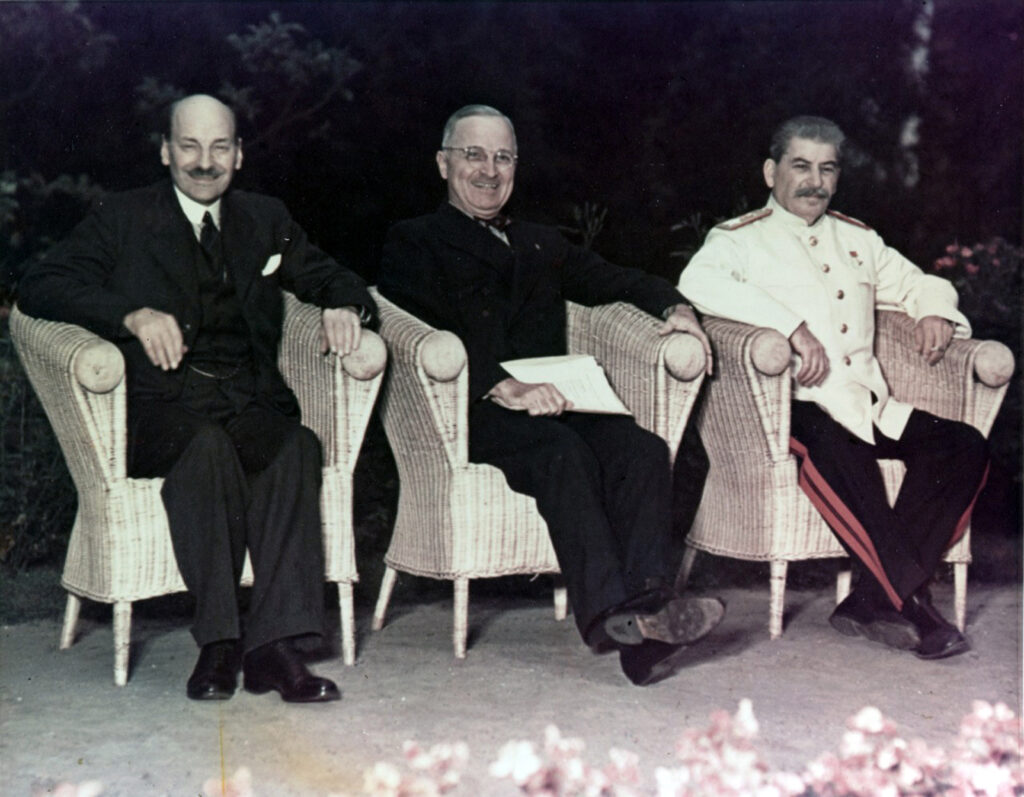
On the morning of July 17, 1945, the world of the Allied powers gathered in the ruined city of Potsdam, a suburb of Berlin still scarred by the war that had ended just two months earlier. The meeting at Cecilienhof Palace was to decide the fate of a defeated Germany and the shape of the postwar order. For the first time, President Harry S. Truman, who had taken office after Franklin Roosevelt’s death, sat across the table from Joseph Stalin, while Winston Churchill, the British leader who had led his nation through the war, would be replaced mid-conference by Clement Attlee. The atmosphere was a mixture of triumph and anxiety: triumph over the Axis, and anxiety over the growing mistrust between the Soviet Union and its Western allies. The decisions made here would resonate for decades, defining the borders of Europe and setting the stage for the Cold War.
What Happened?
The Potsdam Conference took place from July 17 to August 2, 1945, in the suburban of Berlin. The three principal participants were Joseph Stalin, Harry S. Truman, and Winston Churchill, who was replaced on July 26 by the new British Prime Minister Clement Attlee after the Labour Party won the general election. The conference was the third and final meeting of the “Big Three” wartime leaders, following the Tehran Conference in 1943 and the Yalta Conference in February 1945. The allies had agreed at Yalta to meet again after Germany’s surrender to determine postwar borders and administration. Germany surrendered on May 8, 1945, and the leaders convened at Potsdam to continue the discussions.
The agenda was broad: administering defeated Germany, defining Poland’s boundaries, establishing the occupation of Austria, determining the Soviet Union’s role in eastern Europe, and continuing the war against Japan. The conference produced the Potsdam Agreement, signed on August 2, 1945, which outlined the principles for Germany’s occupation and reconstruction. Key provisions included the complete demilitarization and denazification of Germany, the decentralization of its political structure, the reparation of the German economy, and the establishment of a temporary division of Germany into four zones of occupation (American, British, French, and Soviet). The agreement also confirmed the transfer of Germany’s eastern territories to Poland, with the new border along the Oder-Neisse line.
Beyond Germany, the conference issued the Potsdam Declaration on July 26, 1945, which called on Japan to surrender unconditionally or face “prompt and utter destruction.” This declaration was signed by Truman, Churchill, and Chiang Kai-shek of China, and it set the stage for the eventual atomic bombings of Hiroshima and Nagasaki. The conference also established the Council of Foreign Ministers to prepare the peace treaties for the former Axis powers.
How It Was Seen at the Time
Contemporaries saw the Potsdam Conference as the final act of the war in Europe, a chance to build a lasting peace. The language of the day was full of the “Big Three” and the “United Nations,” and many believed that the wartime cooperation could be extended into peacetime. The official report of the conference, published on August 2, 1945, declared that “The Allied armies are in occupation of the whole of Germany,” and that “the German people will have to atone for the terrible crimes committed under the leadership of the Nazi regime.” The mood among the public, as recorded in newspapers and letters, was one of hope that the war would truly be over, but also of anxiety about the future of Europe.
“The German people have begun to atone for the terrible crimes committed under the leadership of the Nazi regime, which, in the hour of their success, they openly approved and blindly obeyed.” — Potsdam Agreement, August 2, 1945
Yet even as the agreement was signed, observers noted the growing fissures. The lack of a common enemy in Europe after Germany’s surrender made consensus difficult. The American and British delegations pushed for free elections in Eastern Europe, while the Soviet Union insisted on security zones and reparations. The conference was thus seen not only as a peace conference but as a test of whether the wartime alliance could survive the peace.
Historical Snapshot
| Aspect | Detail |
|---|---|
| Date | July 17 – August 2, 1945 |
| Place | Cecilienhof Palace, Potsdam, Germany |
| People | Joseph Stalin (Soviet Union), Harry S. Truman (United States), Winston Churchill, later Clement Attlee (Great Britain) |
| What Happened | Allied leaders agreed on the occupation and reconstruction of Germany, the Oder-Neisse border for Poland, and issued the Potsdam Declaration to Japan. |
| Why It Mattered | Set the framework for the postwar division of Germany and Europe, and marked the beginning of Cold War tensions. |
Official Reports
The most important official document to emerge from the conference was the Potsdam Agreement, signed on August 2, 1945. This agreement was the definitive statement of Allied policy toward Germany. It established the principle of the “five D’s”: demilitarization, denazification, democratization, decentralization, and decartelization. The agreement also outlined the machinery of the Allied Control Council, which would govern Germany in the initial period of occupation. It declared that “the German economy is to be decentralized for the purpose of eliminating the excessive concentration of economic power.”
The official report also included the decision to create a Council of Foreign Ministers to prepare peace treaties for Italy, Romania, Bulgaria, Hungary, and Finland, and to deal with the question of the former Axis satellites. The report on the conference, published in the United States and other Allied countries, was widely read as the definitive statement of the Allied intentions. It was a document of hope and a document of compromise, and it would be the basis for the subsequent occupation policy.
Different Perspectives
American Perspective
The United States, led by President Truman, entered the conference with a sense of mission to secure the principles of the Atlantic Charter and the Yalta agreements. American officials believed that a free and democratic Europe was essential for lasting peace. Truman wrote in his diary that he was “getting along” with Stalin, but he was also wary of Soviet intentions. The American public, through newspapers, saw the conference as a test of whether the Soviet Union would honor its promises of free elections in Eastern Europe.
British Perspective
The British, initially under Churchill, sought to balance the Soviet power with the traditional European balance of power. Churchill was concerned about the expansion of Soviet influence into Eastern Europe and the Balkans. After Attlee took over, the British position remained focused on a stable Europe and the prevention of a future German aggression. The British press emphasized the need for a strong and united Germany, but also for reparations and the punishment of war criminals.
Soviet Perspective
For the Soviet Union, the Potsdam Conference was an opportunity to secure its western border and to obtain reparations from Germany for the enormous devastation it had suffered. Stalin sought to establish a sphere of influence in Eastern Europe, which he saw as a buffer against future invasions. The Soviet press presented the conference as a victory for the Allies and a step towards a democratic and peaceful Germany, while also emphasizing the Soviet Union’s role in the war against Japan.
What People Expected Would Happen Next
In the summer of 1945, many contemporaries expected that the Potsdam Agreement would lead to a stable peace. The war in Europe was over, and the occupation of Germany was to be a joint effort. Many people, particularly in the West, hoped that the cooperation of the Big Three would continue into the postwar world, and that the United Nations, established in June 1945, would maintain international order. However, there were also widespread fears that the Soviet Union would not honor its commitments. The German public, as recorded in the reports of the Allied occupation, was uncertain about the future, not knowing how the division of Germany would affect their lives.
There was also the expectation that the war against Japan would continue for some time. The Potsdam Declaration was issued to Japan, but it was not clear whether Japan would surrender. The American public expected a long and costly invasion of the Japanese home islands, and the atomic bomb was still a secret. The conference did not anticipate the end of the Pacific war within weeks, but the declaration set the stage for the final act.
Timeline
- February 4–11, 1945 — Yalta Conference: Roosevelt, Churchill, and Stalin agree on the division of Germany and the Soviet Union’s entry into the war against Japan.
- May 8, 1945 — Germany surrenders unconditionally.
- July 17, 1945 — Potsdam Conference opens at Cecilienhof Palace.
- July 26, 1945 — Potsdam Declaration issued to Japan; Clement Attlee becomes Prime Minister of Britain.
- August 2, 1945 — The Potsdam Agreement is signed.
- August 6, 1945 — Atomic bomb dropped on Hiroshima.
- August 9, 1945 — Atomic bomb dropped on Nagasaki; Soviet Union declares war on Japan.
- September 2, 1945 — Japan surrenders, ending World War II.
Aftermath
The immediate aftermath of the Potsdam Conference was the implementation of the occupation policy. Germany was divided into four zones, each controlled by one of the Allied powers: the United States, Great Britain, France, and the Soviet Union. The city of Berlin, located deep in the Soviet zone, was also divided into four sectors. The Potsdam Agreement also led to the expulsion of millions of ethnic Germans from the eastern territories, which were now part of Poland and the Soviet Union. This was one of the most far-reaching consequences, as it reshaped the population of Europe.
The conference also set the stage for the Cold War. The disagreements over Poland and Eastern Europe, the reparations issue, and the Soviet Union’s refusal to allow free elections in its zone all contributed to the growing mistrust. By 1947, the United States had adopted a policy of containment, and the division of Europe became permanent. The Potsdam Conference, therefore, is seen by historians as the point where the wartime alliance began to crack, and the postwar order of the Cold War emerged.
In the years that followed, the Potsdam Agreement became the legal foundation for the occupation and the eventual division of Germany. It was not until 1990, with the reunification of Germany, that the Potsdam Conference’s decisions were fully superseded. The primary sources from the conference, including the official reports, the agreements, and the personal letters of the leaders, provide a rich record of the hopes and fears of a world emerging from the most devastating war in history.
FAQ
Who were the 'Big Three' at the Potsdam Conference?
The Big Three were Joseph Stalin of the Soviet Union, Harry S. Truman of the United States, and Winston Churchill of Great Britain. Churchill was replaced by Clement Attlee on July 26, 1945, after the British Labour Party won the general election.
What were the main outcomes of the Potsdam Conference?
The main outcomes included the division of Germany into four occupation zones (American, British, French, and Soviet), the decision to demilitarize and denazify Germany, the establishment of the Oder-Neisse line as Poland's western border, and the issuance of the Potsdam Declaration demanding Japan's unconditional surrender.
How did the Potsdam Conference lead to the Cold War?
The conference revealed growing mistrust between the Soviet Union and the Western Allies over the future of Eastern Europe. The Soviet Union's insistence on a sphere of influence and the refusal to allow free elections in Poland and other occupied countries, combined with the Western desire for democratic governments, set the stage for the Cold War.





Leave a Reply