
Short Answer
Quick Snapshot
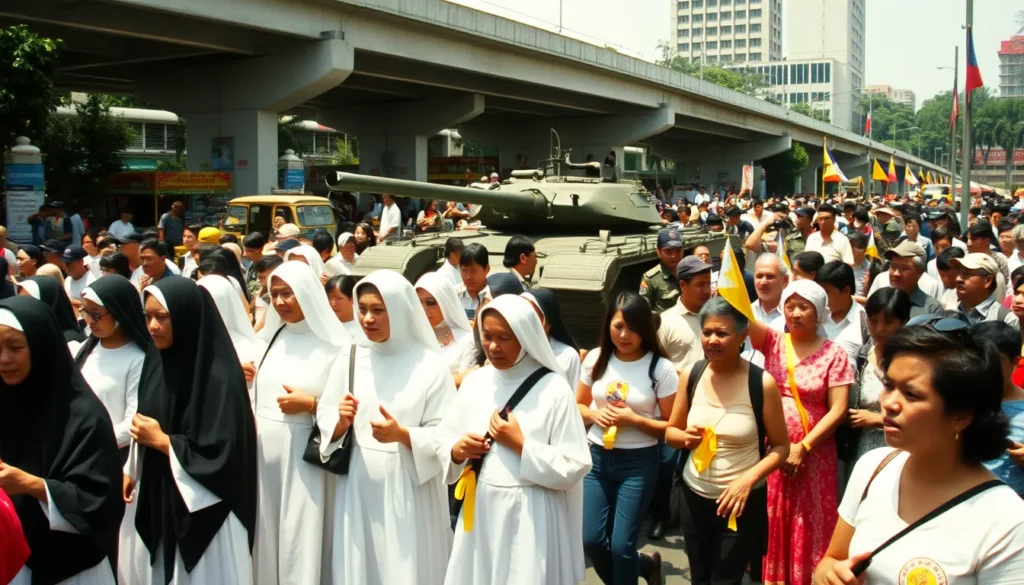
In February 1986, Manila and its surrounding metropolitan area became the center of the People Power Revolution. What began as a political crisis over the February 7 snap presidential election between Ferdinand Marcos and Corazon Aquino turned into a four-day confrontation after Defense Minister Juan Ponce Enrile and Lt. Gen. Fidel V. Ramos broke with Marcos on February 22. Radio appeals, newspaper dispatches, and eyewitness accounts drew hundreds of thousands of civilians to Epifanio de los Santos Avenue, where nuns, students, workers, professionals, and ordinary families placed themselves between rebel and loyalist forces.
This article uses "Manila" in the common metropolitan sense: the City of Manila and the contiguous National Capital Region. The revolution’s decisive site, EDSA between Camp Aguinaldo and Camp Crame, lay in Quezon City, while Manila proper was affected through its government offices, schools, media, port, churches, and residential districts. The chosen scope follows the phrase’s usual encyclopedic meaning while keeping the focus on the events, reports, and documents of February 1986.
Contemporary reports captured a city under tension but also a city acting collectively. Radio Veritas became the revolution’s informal information lifeline; newspapers and wire services tracked the election fraud charges, the military split, and the crowds on EDSA; and personal accounts recorded food lines, rosaries, white flags, rumors, and the fear of violence. The result was a revolution that was both intensely local and immediately global in its resonance.
Manila in 1986
Manila lies on the eastern shore of Manila Bay at the mouth of the Pasig River. In 1986 it was the capital of the Philippines and the core of a sprawling metropolitan region that included Quezon City, Caloocan, Pasay, Makati, San Juan, Mandaluyong, and other municipalities. Its landscape mixed Intramuros and the old government quarter with commercial districts such as Binondo, Quiapo, and Escolta; university zones in Manila and Quezon City; industrial areas; and dense working-class neighborhoods such as Tondo.
February falls in the dry season: hot, humid, and generally rain-free. The revolution took place under tropical sun by day and warm, crowded nights. The weather mattered to the crowds. Families camped on EDSA with mats, umbrellas, food, and water; priests and nuns moved among them; soldiers and armored vehicles faced civilians at close range. The atmosphere combined festival-like solidarity with the constant possibility of gunfire, especially after clashes near Camp Aguinaldo and at the government broadcasting complex in Quezon City.
Population & Economy
The City of Manila’s population was roughly 1.6 million in the mid-1980s, while Metro Manila as a whole was home to perhaps 6 million people. The metropolis was young and growing through in-migration from the provinces, but it was also marked by stark inequality. Wealthy enclaves and modern commercial centers stood near crowded tenements and informal settlements. Tagalog, English, and other Philippine languages filled the streets, with radio broadcasts switching between Filipino and English.
The economy in 1986 was under severe strain. The debt crisis, capital flight, political uncertainty, and the assassination of Benigno Aquino Jr. in 1983 had damaged investment and confidence. Inflation and peso devaluation made wages uncertain, while unemployment and underemployment were persistent. The Port of Manila, manufacturing, retail trade, banking, government services, and the media remained important employers. For many households, daily life involved careful budgeting, buying food in small quantities, and relying on extended family networks.
Government & Politics
National politics dominated Manila in 1986. Marcos had ruled under martial law from 1972 and then under a modified authoritarian system. The February 7 snap election was contested by Marcos and Corazon Aquino, widow of the assassinated opposition leader, with Salvador Laurel as her running mate. The Commission on Elections and the citizen watchdog NAMFREL produced conflicting counts, and the walkout of computer tabulators on February 9 deepened the legitimacy crisis.
On February 22, Enrile and Ramos announced their break with Marcos from Camp Aguinaldo. Cardinal Jaime Sin, archbishop of Manila, appealed over Radio Veritas for people to support the rebels and protect them from attack. The crowds that gathered on EDSA became a moral and physical shield. On February 25, Marcos was inaugurated in Malacañang while Aquino was sworn in at Club Filipino in San Juan. That evening Marcos left the palace and went into exile. Locally, Manila Mayor Ramon Bagatsing had held office through the Marcos years; after the revolution, Mel Lopez was appointed officer-in-charge mayor.
Industry
Manila’s economy was diverse but strained. The port and customs facilities handled imports and exports; nearby industrial estates produced food, textiles, chemicals, and consumer goods; banks and insurance companies clustered in Makati and the old downtown; and government offices employed large numbers of clerks, teachers, and service workers. Small-scale enterprise was everywhere: sari-sari stores, repair shops, bakeries, eateries, and transport operators.
The media industry became politically central. Radio Veritas, DZRH, DZRJ/DZRB Radio Bandido, and the government station Voice of the Philippines all figured in the crisis. Radio Veritas broadcast appeals, news, and prayers until its transmitter was destroyed on February 23; other stations and the captured government television facilities then became contested instruments of information. The Philippine News Agency, housed in the Office of Media Affairs building on Bohol Avenue in Quezon City, found its editorial operations halted when rebel soldiers and crowds seized the compound on February 24.
Education
Manila and its metropolitan area contained many of the country’s leading schools and universities, including the University of Santo Tomas, the University of the Philippines, Ateneo de Manila, De La Salle University, and Far Eastern University. Literacy was relatively high, and English was widely used in higher education and government. Catholic schools and religious orders had a strong presence, and many students and faculty were drawn into the protest movements of the 1980s.
During the revolution, classes were suspended in many schools and universities. Campuses became gathering points and temporary shelters. Students joined the crowds on EDSA, while teachers and religious educators helped organize prayer vigils and food collections. The events also became an immediate subject of campus discussion: what had happened, what the law allowed, and what kind of government would follow.
Transportation
Manila’s streets in 1986 were dominated by jeepneys, buses, taxis, private cars, and trucks. The Light Rail Transit Line 1 had opened in 1984 and ran along Taft Avenue and Rizal Avenue, but most commuters still relied on road transport. Traffic was already heavy, though contemporary accounts recall that early-morning travel during the crisis could be unusually quick before roadblocks and crowds formed.
EDSA became the revolution’s main stage. Military vehicles, checkpoints, and barricades disrupted normal movement. People walked long distances, rode jeepneys to the edges of the crowds, and brought supplies on foot. The seizure of the government broadcasting complex on Bohol Avenue cut off some routes and trapped media workers inside. In Manila proper, Roxas Boulevard, Taft Avenue, and the approaches to Malacañang were watched closely as rumors spread about troop movements.
Everyday Life
Daily routines were overtaken by the crisis. Families listened to the radio for hours, exchanged rumors with neighbors, and debated whether to join the crowds. Food vendors sold rice, fish balls, noodles, and snacks near the barricades. Women and men carried rosaries, images of the Virgin Mary, and yellow ribbons. White flags and flowers were used as signs of peace. Nuns in habits stood in front of soldiers and armored vehicles, while office workers and students linked arms across the avenue.
Housing ranged from gated subdivisions to crowded apartments and shanties. In the February heat, people slept on cardboard, mats, and blankets along EDSA. Clothing was informal: T-shirts, jeans, dresses, and religious habits, with yellow shirts and ribbons marking opposition to Marcos. Entertainment was interrupted; television was controlled or contested, so radio and newspapers became the main sources of information. Social customs of bayanihan and mutual help were visible in food sharing, sheltering of soldiers, and the care of the wounded.
Major Events
The decisive events unfolded rapidly. On February 7 the snap election was held amid reports of intimidation and fraud. On February 9 the COMELEC tabulators walked out. On February 15 opposition supporters held a large rally at Luneta. On February 22 Enrile and Ramos announced their break with Marcos. Radio Veritas broadcast Cardinal Sin’s appeal, and crowds began gathering on EDSA. On February 23 the Radio Veritas transmitter was destroyed, but the crowds continued to grow.
On February 24 government forces attacked or threatened rebel positions near Camp Aguinaldo, and rebel soldiers seized the government broadcasting complex and the Office of Media Affairs building. PNA staff were trapped inside during gunfire before being allowed to leave. On February 25 Marcos held his inauguration and then fled to Hawaii; Aquino was sworn in as president. The revolution had succeeded, but it was not entirely bloodless: clashes, shootings, and injuries occurred, and fear of a final military crackdown remained until Marcos departed.
What Newspapers Were Reporting
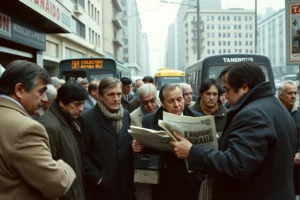
Newspapers and wire services in Manila and abroad struggled to keep pace with events. Bulletin Today, the Philippine Daily Inquirer, the Times Journal, and foreign correspondents reported the election results dispute, the NAMFREL and COMELEC counts, the military breakaway, and the enormous crowds on EDSA. Headlines shifted from election fraud to rebellion to the possibility of civil war and then to the collapse of the Marcos government.
Philippine News Agency staff later recalled the scale of the gathering. A PNA assignment summary noted that reporters were covering events where, according to reports, "at least a million people had converged following the announcement of the breakaway of Enrile and Ramos from the Marcos regime." The same memoir records the tension inside the OMA building, the gunfire outside, and the taunts of some crowd members toward government media workers. Such details show how contemporary reporting was produced under pressure, with rumors, eyewitness sightings, and official statements competing for credibility.
What People Were Talking About
Conversations in Manila centered on whether Marcos would use force, whether the United States would intervene, and whether the military would split further. People debated the authenticity of election returns, the role of Cardinal Sin, and the meaning of the crowds on EDSA. Rumors spread about Marcos’s health, about loyalist units moving toward the camps, and about planned arrests of opposition leaders. Radio bulletins were repeated and argued over in homes, jeepneys, offices, and markets.
Eyewitness accounts and oral histories also record more ordinary concerns: how to feed the children, whether to close the shop, whether it was safe to cross a checkpoint, and how to help the soldiers. Many participants described a sense of shared purpose and religious devotion. Others remembered fear, confusion, and exhaustion. The revolution was experienced not only as a political event but as a sudden disruption of daily life that demanded constant moral and practical choices.
Historical Photographs
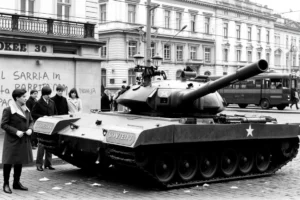
Photographs from February 1986 are among the most recognizable visual records of modern Philippine history. They show crowds filling EDSA, nuns kneeling or standing before tanks, civilians linking arms, soldiers surrounded by rosaries and flowers, yellow ribbons tied to gates and vehicles, and the two rival inaugurations. News agency photographers, local newspapers, and individual participants produced images that circulated widely and helped define the event as a peaceful uprising.
Television footage and radio recordings complement the still photographs. The visual record is strongest for the crowds on EDSA and the confrontations near the camps and broadcasting facilities. Fewer images document the interiors of homes, hospitals, and ordinary neighborhoods, so historians also rely on oral testimony and written accounts to reconstruct everyday life during the crisis.
Documents & Primary Sources
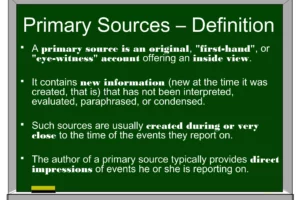
Key primary sources include the radio broadcasts of February 22-25, 1986, especially the Radio Veritas tapes nominated to UNESCO’s Memory of the World Register. These recordings preserve appeals, news bulletins, prayers, and the unedited sound of the crisis. Newspapers, PNA dispatches, COMELEC and NAMFREL tally sheets, photographs, and television footage provide additional contemporary evidence. Eyewitness books such as An Eyewitness History: People Power collect personal accounts from participants and observers.
Historians also use memoirs, oral history interviews, military records, Malacañang documents, and the records of religious and civic organizations. The PNA memoir of its own newsroom experience is useful for understanding how government media was caught between loyalist and rebel control. Together these sources allow a reconstruction that is richer than any single headline or official statement.
1986 Timeline
| Date | Event |
|---|---|
| February 7 | Snap presidential election between Marcos and Aquino; reports of fraud and violence multiply. |
| February 9 | COMELEC computer tabulators walk out, deepening the legitimacy crisis. |
| February 15 | Opposition rally at Luneta demands Marcos’s resignation. |
| February 22 | Enrile and Ramos announce break with Marcos; Cardinal Sin appeals over Radio Veritas; crowds gather on EDSA. |
| February 23 | Radio Veritas transmitter is destroyed; crowds continue to grow; rebel and loyalist forces maneuver. |
| February 24 | Clashes and seizures near Camp Aguinaldo and the government broadcasting complex; PNA operations halted. |
| February 25 | Marcos inaugurated and flees to Hawaii; Aquino sworn in as president; revolution succeeds. |
What Changed Next
The immediate aftermath brought a new government under Corazon Aquino, the restoration of press freedom, and the drafting of the 1987 Constitution. But the transition was difficult. The economy remained weak, communist and military insurgencies continued, and several coup attempts in the late 1980s tested the new democracy. The EDSA event became a national symbol and an international reference point for nonviolent change.
Manila itself changed gradually. The media landscape reopened, political prisoners were released, and new newspapers and broadcasters emerged. The PNA, which had been shut out of its offices during the transition, eventually resumed operations under the new government. The revolution also left a deep visual and oral archive: radio tapes, photographs, newspaper clippings, and testimonies that continue to shape how Filipinos remember February 1986.
Sources
- Severino Samonte, "Memories: PNA and the EDSA 1986 People Power Revolt," Philippine News Agency, February 25, 2018. https://www.pna.gov.ph/articles/1026450
- UNESCO Memory of the World Register, "Radio Broadcast of the Philippine People Power Revolution (22-25 February 1986)," nomination form. https://media.unesco.org/sites/default/files/webform/mow001/philippines_radio_broadcast.pdf
- Monina Allarey Mercado, ed., An Eyewitness History: People Power: The Philippine Revolution of 1986. Manila: James B. Reuter, S.J. Foundation, 1986.
- Cecilio T. Arillo, Breakaway: The Inside Story of the Four-Day Revolution in the Philippines, February 22-25, 1986. Mandaluyong: CTA Associates, 1986.
- Cynthia Sta. Maria Baron and Melba Morales Suazon, Nine Letters: The History of the 1986 Filipino Revolution. 1986.
FAQ
What was the population of Manila in 1986?
The City of Manila had roughly 1.6 million residents, while the wider Metro Manila area had an estimated 6 million people. Exact figures vary by census definition.
What major events happened in Manila in 1986?
The February 7 snap election, the COMELEC walkout, the February 22 military breakaway, the EDSA crowds, the seizure of government media facilities, and the February 25 inaugurations and Marcos departure.
What primary sources are available for studying Manila in 1986?
Radio Veritas and other broadcast tapes, newspapers, PNA dispatches, COMELEC and NAMFREL records, photographs, television footage, memoirs, oral histories, and documentary collections such as the UNESCO Memory of the World nomination.
How did daily life in Manila in 1986 differ from today?
People relied on radio, newspapers, landline telephones, and face-to-face communication rather than mobile phones and the internet; jeepneys and buses dominated transport; and political information was often controlled or contested by the state.



Leave a Reply