
Short Answer
Quick Snapshot
In 1989 Beijing was China’s political and cultural capital, a city of government ministries, universities, state factories, and dense courtyard neighborhoods. That year is remembered chiefly for the spring pro-democracy movement centered on Tiananmen Square and for the military crackdown of June 3–4. This article uses “Beijing in 1989” in its most common encyclopedic sense: the history of the capital during the year of the Tiananmen Square protests, with particular attention to diaries, photographs, and news reports.
From mid-April, after the death of former Communist Party general secretary Hu Yaobang, students gathered in Tiananmen Square to mourn and then to demand reform, press freedom, and an end to corruption. By May the square had become a huge encampment and a symbol of citizen protest. The visit of Soviet leader Mikhail Gorbachev in mid-May brought foreign journalists to Beijing, while martial law was declared on May 20. On the night of June 3–4, troops moved into central Beijing and cleared the square and surrounding streets.
No event in modern Chinese history is better documented by unofficial materials and more tightly controlled in official memory. Diaries, wall posters, pamphlets, photographs, and both Chinese and foreign newspaper reports allow historians to reconstruct the movement’s daily texture. They also reveal the limits of the record: censorship, fear, and later political restrictions have shaped what survives and what can be said inside China.
Beijing in 1989
Beijing lies on the northern China plain, with the Yanshan mountains to the north and west and the Yongding and Chaobai river systems nearby. Its climate is continental and monsoonal: dusty, windy springs give way to hot, humid summers and cold, dry winters. In 1989 the city still bore the marks of the Mao era and the early reform period. Broad avenues such as Chang’an Boulevard cut through old hutong neighborhoods of grey brick courtyard houses, while socialist-style apartment blocks and government compounds housed the growing urban population.
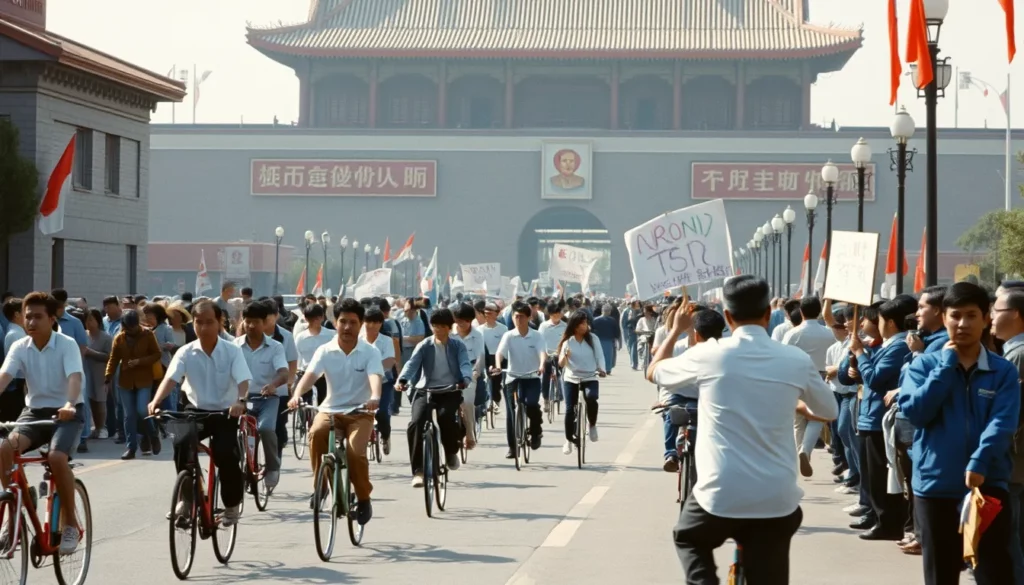
Tiananmen Square sits at the symbolic center of the city, south of the Imperial Palace and the Gate of Heavenly Peace. Foreign correspondents described it as vast and impersonal, without trees or benches, ringed by loudspeakers, lampposts, and security cameras. Its scale made it ideal for mass politics and difficult for individuals to control. During the protests, students divided the square into zones for universities, hospitals, and services, creating what one eyewitness called a temporary “small city” of tents, banners, and volunteer stations.
The atmosphere in early 1989 was tense but not uniformly revolutionary. University students, intellectuals, journalists, factory workers, and even some police and military personnel joined demonstrations or supported them. Inflation, official corruption, and frustration with limited political reform were widely discussed. At the same time, many residents worried that disorder could undo the economic gains of the reform era. The movement’s dominant tone, as several observers recalled, was peaceful and self-consciously orderly.
Population & Economy
Beijing municipality had an estimated population of about 10.3 million in 1989, with several million concentrated in the urban core. Household registration, or hukou, sharply limited rural-to-urban migration, but the capital still attracted students, officials, technicians, and temporary workers. The population was overwhelmingly Han Chinese, with small Hui and other minority communities, and urban life was organized largely through work units known as danwei, which allocated housing, medical care, and sometimes food.
The economy mixed state planning with market reforms. Large state-owned enterprises in machinery, electronics, chemicals, textiles, and construction dominated industry, while government administration, education, and services employed much of the urban workforce. Private shops and restaurants were returning, but shortages and queuing remained familiar. National inflation had reached double digits in the late 1980s, eroding fixed wages and fueling complaints about profiteering and official privilege. A typical urban monthly wage was often around 100–200 yuan; a bowl of noodles, a bus ride, or a cinema ticket might cost a few jiao.
Students and intellectuals were acutely aware of price reform, unemployment among youth, and the gap between official rhetoric and daily hardship. Factory workers joined the spring protests in significant numbers, but economic grievances were mixed with demands for political accountability, a freer press, and dialogue with the government.
Government & Politics
Beijing was governed by a municipal party committee and a city government under the national leadership of the Chinese Communist Party. In 1989 the Beijing mayor was Chen Xitong, while Li Ximing served as party secretary. Nationally, Premier Li Peng and paramount leader Deng Xiaoping shaped the response to the protests; General Secretary Zhao Ziyang was sympathetic to a softer line but was later purged. The city’s public security apparatus, party discipline organs, and work-unit leaders monitored and managed public behavior.
The political climate was shaped by a decade of reform and by the memory of earlier campaigns. Student activism had grown in 1986–87, and the 1989 movement began as mourning for Hu Yaobang, a reform-minded leader who had been forced out in 1987. On April 26, the People’s Daily published an editorial describing the unrest as “turmoil,” a term that hardened the government’s position and angered many students. After martial law was declared on May 20, the city became a contested space between citizens, troops, and party authorities.
Industry
Beijing’s industry in 1989 included major state enterprises such as the Shougang steel complex, electronics and machine-tool plants, textile mills, chemical works, and food-processing factories. The city was also a center of printing, publishing, and cultural production. Many industrial workers lived in danwei housing near their factories, and factory committees could mobilize or restrain participation in public events.
During the protests, workers from factories and service trades joined marches or donated food, money, and transport. Some factories slowed production or allowed employees to attend demonstrations. At the same time, the state’s control over large enterprises gave the government a powerful base for restoring order after June 4. The capital’s economy was not only productive but symbolic: control of central Beijing meant control of the party-state’s public face.
Education
Beijing was the center of Chinese higher education. Peking University, Tsinghua University, Renmin University, Beijing Normal University, and many specialized institutes drew elite students from across the country. Literacy in the urban population was relatively high, and the restoration of the national college entrance examination after the Cultural Revolution had made university admission intensely competitive. Campuses in the Haidian district became centers of debate, wall posters, and student organization.
The 1989 movement began with university students, but it spread beyond campuses. Students organized marches, hunger strikes, and negotiations, and they used the language of patriotism, democracy, and anti-corruption. Their demands were not uniform, but they shared a sense that the party-state needed greater accountability and that citizens deserved a voice. The crackdown that followed led to arrests, expulsions, and a long political chill in Chinese universities.
Transportation
Bicycles were the dominant form of personal transport in 1989 Beijing, flowing in vast streams along Chang’an Boulevard and through hutong lanes. Buses and trolleybuses carried workers and students, while the Beijing Subway’s Line 1 and the newly opened Loop Line provided limited but growing service. Long-distance trains arrived at Beijing Railway Station, and Capital Airport connected the city to international destinations.
During the protests, transport became political. Crowds blocked military convoys, buses were used as barricades, and citizens confronted troop trucks on the approaches to central Beijing. Traffic in the city center was repeatedly disrupted, and foreign journalists relied on bicycles, taxis, and hotel cars to move between the square, campuses, and official briefings.
Everyday Life
Daily life in Beijing in 1989 was shaped by scarcity, work-unit loyalty, and strong face-to-face networks. Families lived in courtyard houses, older apartment blocks, or danwei dormitories. Food was bought fresh from markets and state shops; cabbage, noodles, steamed buns, rice, and pork were staples. Clothing remained relatively plain, though younger urban residents were beginning to experiment with color and style. Television, radio, cinema, and newspapers were central sources of information, all subject to official control.
During the spring protests, ordinary routines were interrupted and partly transformed. Volunteers directed traffic, medical students staffed first-aid stations, and residents donated food and blankets. Eyewitnesses recalled that crime in the city center fell sharply and that many citizens felt an unusual sense of civic responsibility. Families debated whether the students should compromise or hold firm, and rumors about army movements and leadership divisions spread quickly by word of mouth.
Major Events
The year’s central events unfolded in rapid succession. Hu Yaobang died on April 15, prompting students to gather in Tiananmen Square. Marches and petitions followed, and the April 26 editorial escalated the conflict. On May 13, students began a hunger strike in the square. Mikhail Gorbachev’s state visit from May 15 to 18 drew the world’s press to Beijing. On May 19–20, martial law was declared and troops were ordered into the city, but crowds blocked many convoys. In the early hours of June 4, the People’s Liberation Army cleared the square and surrounding areas, killing and injuring an unknown number of civilians. On June 5, the image of a lone man facing a column of tanks became the movement’s most famous visual symbol.
What Newspapers Were Reporting
Chinese newspapers such as the People’s Daily and Beijing Daily initially carried official accounts of mourning and student demands, but coverage tightened after the April 26 editorial. The People’s Daily’s description of the unrest as “turmoil” became a key political marker. During May, some Chinese journalists marched to demand press freedom, and reporting briefly became more open before martial law and the crackdown restored strict censorship.
Foreign correspondents from the Toronto Globe and Mail, the New York Times, the Associated Press, Reuters, Agence France-Presse, and other outlets reported on the demonstrations, the Gorbachev visit, the martial-law confrontation, and the June 3–4 assault. Their dispatches described huge crowds, blocked troop convoys, and the eerie quiet after the crackdown. Chinese official media later framed the events as a “counter-revolutionary riot” that had to be suppressed, a formulation rejected by most independent historians and eyewitnesses.
What People Were Talking About
Diaries, letters, and collected testimonies from the period show that conversations centered on inflation, corruption, political reform, press freedom, and the proper limits of protest. Students debated whether to leave the square, workers discussed wages and official privilege, and intellectuals argued over the meaning of democracy and the risks of disorder. Many Beijing residents expressed sympathy for the students while fearing that a violent confrontation would set back reform.
The Chinese People’s Movement collection at the International Institute of Social History in Amsterdam preserves many of these voices through pamphlets, wall posters, unofficial publications, diaries, and press clippings. Because participants often had to remain anonymous, the collection is both rich and fragmentary. It records rumors about army movements, hopes for a peaceful resolution, and the shock that followed the night of June 3–4.
Historical Photographs
Photographs from 1989 Beijing form one of the most powerful visual records of late twentieth-century China. They show students in white shirts and headbands, hand-painted banners, hunger strikers lying under blankets, vast crowds on Chang’an Boulevard, soldiers in steel helmets, and citizens confronting tanks. The best-known image, often called “Tank Man,” was captured on June 5 by several photographers, including Jeff Widener of the Associated Press, Stuart Franklin of Magnum, Charlie Cole of Newsweek, and Arthur Tsang of Reuters.
The visual record is uneven. Chinese photojournalists and amateur photographers took risks to document the movement, but many images were confiscated or destroyed. The IISH collection includes photographs and slides that have not been digitized to protect participants. Foreign press images circulated globally, while inside China the event became a forbidden subject. These photographs are historical evidence, but they are also memory objects that shape how later generations understand the crackdown.
Documents & Primary Sources
Historians of Beijing in 1989 rely on a wide range of primary sources:
- The Chinese People’s Movement collection at the International Institute of Social History, Amsterdam: pamphlets, wall posters, unofficial publications, banners, T-shirts, photographs, slides, video and audio recordings, diaries, and Chinese and Western press clippings.
- Newspapers: the People’s Daily, Beijing Daily, China Daily, and foreign dispatches from the period, including the April 26 editorial and martial-law announcements.
- Official documents: martial-law orders, government statements, party circulars, and later internal accounts such as The Tiananmen Papers.
- Eyewitness accounts: interviews with journalists, students, workers, diplomats, and residents, including those collected by PBS Frontline and academic researchers.
- Photographs and film: press images, amateur photographs, and television footage, held in archives and private collections.
1989 Timeline
| Date | Event |
|---|---|
| April 15 | Hu Yaobang dies; students begin gathering in Tiananmen Square to mourn. |
| April 17–18 | Student marches and petitions reach the government quarter. |
| April 26 | People’s Daily editorial labels the unrest “turmoil.” |
| May 13 | Hunger strike begins in Tiananmen Square. |
| May 15–18 | Mikhail Gorbachev visits Beijing; foreign press coverage intensifies. |
| May 19–20 | Martial law is declared; troops move toward central Beijing but are blocked by crowds. |
| June 3–4 | Military crackdown clears the square and surrounding streets; civilians are killed and injured. |
| June 5 | A lone man confronts a column of tanks; the image becomes globally famous. |
| June 9 | Deng Xiaoping addresses martial-law troops and defends the crackdown. |
What Changed Next
After June 4, Beijing entered a period of political repression and tightened censorship. Arrests, expulsions, and loyalty campaigns followed, and Zhao Ziyang was removed from power. Jiang Zemin became general secretary and later president, consolidating a leadership that combined continued economic reform with strict political control. Economic liberalization slowed briefly but resumed powerfully after Deng Xiaoping’s 1992 southern tour.
The memory of 1989 was suppressed inside China, where public discussion of the events remains censored. Abroad, photographs, diaries, and press reports kept the story alive, and Tiananmen Square became a global symbol of protest and its limits. Beijing itself transformed rapidly in the following decades, but the events of 1989 remained a defining rupture in the city’s modern history.
Sources
- International Institute of Social History, “Tiananmen Square protests of 1989” collection guide, https://iisg.nl/collections/tiananmen/.
- PBS Frontline, “Eyewitness to Tiananmen Spring,” https://www.pbs.org/wgbh/pages/frontline/tankman/themes/eyewitness.html.
- Timothy Brook, Quelling the People: The Military Suppression of the Beijing Democracy Movement (New York: Oxford University Press, 1992).
- Jan Wong, Red China Blues: My Long March from Mao to Now (New York: Doubleday, 1996).
- Zhang Liang, Andrew J. Nathan, and Perry Link, eds., The Tiananmen Papers (New York: PublicAffairs, 2001).
FAQ
What was the population of Beijing in 1989?
About 10.3 million in the municipality, with several million in the urban core; figures vary by boundary and source.
What major events happened in Beijing in 1989?
The death of Hu Yaobang in April, student demonstrations and a hunger strike, Mikhail Gorbachev’s visit, martial law on May 20, and the June 3–4 military crackdown.
What primary sources are available for studying Beijing in 1989?
The IISH Chinese People’s Movement collection, diaries, wall posters, photographs, Chinese and foreign newspapers, official martial-law documents, and eyewitness interviews.
How did daily life in Beijing in 1989 differ from today?
Bicycles, danwei housing, state shops, limited media, and no internet dominated daily life; households relied on radio, television, newspapers, and face-to-face networks.










Leave a Reply