
Short Answer
Quick Snapshot
This article concerns Johnstown, Pennsylvania, in 1889, with particular attention to the May 31 flood and the ways survivors and newspapers recorded it. Johnstown was an iron-and-steel town in the Allegheny Mountains, set where the Little Conemaugh River, Stony Creek, and the Conemaugh River meet. In 1889 it was a busy industrial valley of mills, railroad yards, churches, schools, and crowded worker neighborhoods.
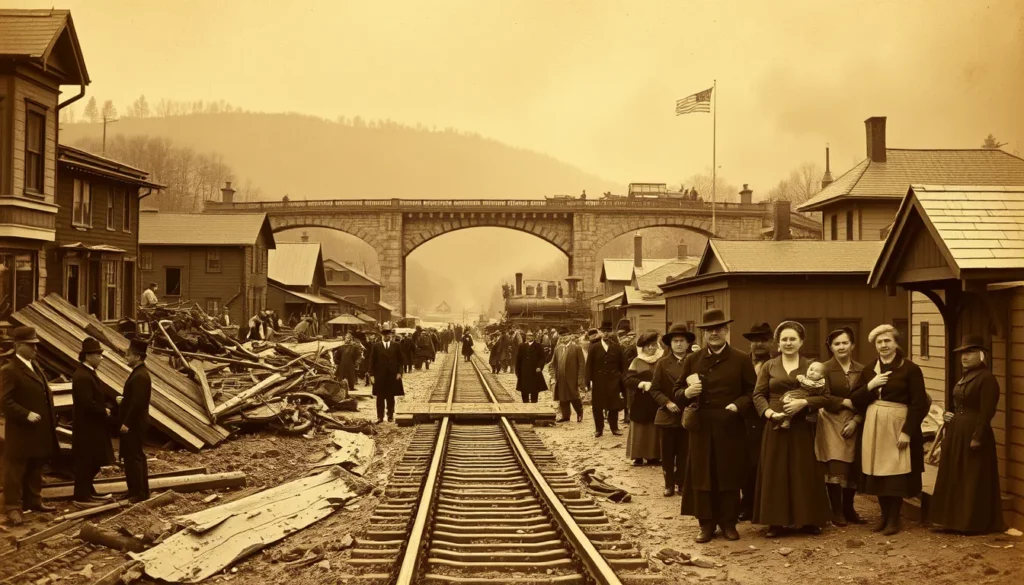
On the afternoon of May 31, the South Fork Dam failed after heavy rain. A massive wave of water, trees, wreckage, and railroad debris swept down the Little Conemaugh toward Johnstown. Contemporary accounts estimated more than 30,000 people in the valley; modern scholarship identifies 2,209 deaths. The disaster destroyed homes, factories, bridges, and whole streets. Fire broke out where debris piled against the stone railroad bridge, trapping people in a nightmare of water and flame.
Survivor narratives became central to how the flood was remembered. Anna Fenn Maxwell, Victor Heiser, the Waters family, and Rev. H. L. Chapman left accounts of rooftops, attics, floating houses, and rescue. Newspapers and relief agencies struggled to count the dead, identify the missing, and coordinate aid. The result is one of the most heavily documented disasters in nineteenth-century American history.
Johnstown in 1889
Johnstown lay in a narrow valley of southwestern Pennsylvania, surrounded by steep hills that made travel and drainage difficult. The Little Conemaugh and Stony Creek joined at the town, and the Conemaugh River continued westward. Spring rains could raise the streams quickly, but residents were accustomed to freshets and floods. The surrounding hills offered high ground, yet many neighborhoods sat directly on the floodplain near the mills and railroads.
The year 1889 found Johnstown in an industrial boom. Cambria Iron Company dominated the local economy, and the Pennsylvania Railroad carried coal, iron, steel, and passengers through the valley. Adjoining boroughs such as Conemaugh, Woodvale, Kernville, and Millville formed a dense urban corridor. The flood did not strike a single tidy municipality; it struck a connected industrial valley whose people depended on the same rivers, rails, and employers.
Population & Economy
Contemporary estimates placed the population of the Conemaugh Valley at roughly 30,000 people, including Johnstown and its neighboring boroughs. The population was mixed: older American families, Irish and German immigrants, and newer arrivals from eastern and southern Europe. Skilled ironworkers, laborers, clerks, shopkeepers, ministers, physicians, and railroad men all lived close to the mills.
The economy rested on iron and steel, coal, railroads, and local trade. Cambria Iron Company produced rails, iron products, and steel; related shops, foundries, machine works, and brick yards supported it. Wages varied by skill, but many families rented company housing or small frame houses near the works. A loaf of bread cost only a few cents, while rents and coal purchases consumed a large share of a laborer’s pay. The flood destroyed not only homes but also workplaces, tools, stores, and railroad equipment, turning an industrial boomtown into a relief camp within hours.
Government & Politics
Local government in 1889 was fragmented among borough officials, ward leaders, school boards, and county authorities. Johnstown was moving toward city incorporation, but the valley still reflected older borough boundaries. Cambria County officials and state authorities played a growing role after the disaster, as relief committees, coroners, police, and military units tried to restore order.
Pennsylvania’s governor, James A. Beaver, visited the stricken region and helped mobilize state assistance. National attention brought offers of money, clothing, food, tents, and medical supplies. Political debates soon followed: who was responsible for the dam, how relief should be distributed, and whether private owners of the South Fork Fishing and Hunting Club could be held accountable. Those questions entered newspapers, pulpits, and legal proceedings, though no sweeping legal liability followed.
Industry
The Cambria Iron Company was the valley’s great industrial power. Its works along the rivers produced iron and steel and employed thousands of men in furnaces, rolling mills, machine shops, and rail yards. The company’s Gautier Steel Department and related operations tied Johnstown to the national railroad boom. Coal mines and coke works in the surrounding hills fed the mills, while the Pennsylvania Railroad moved raw materials and finished products.
Smaller businesses were equally vulnerable. Blacksmiths, tanners, breweries, brick makers, carriage shops, grocers, and printers served the neighborhoods. The flood smashed machinery, carried away stock, and drowned workers. Industrial recovery was rapid in some respects because the railroads and iron trade demanded production, but it was uneven for families who lost homes, tools, and breadwinners.
Education
Johnstown’s children attended public schools and parochial schools tied to the valley’s churches. The public schools served the boroughs and wards, while Catholic, Lutheran, Methodist, Presbyterian, and other congregations maintained their own educational and charitable institutions. There was no university in Johnstown in 1889, but night classes, Sunday schools, libraries, and literary societies supplemented formal schooling.
Literacy was valued in an industrial town that depended on written instructions, newspapers, and business records. After the flood, schools became relief centers and temporary shelters. Teachers and clergy helped identify orphaned children and reunite families. The disaster also produced a new educational impulse: survivors and relief workers believed that accurate records, published accounts, and public lessons were necessary so that the catastrophe would not be forgotten.
Transportation
The Pennsylvania Railroad was the valley’s lifeline. Its tracks followed the rivers and connected Johnstown to Pittsburgh, Altoona, and the East. The stone railroad bridge below Johnstown became infamous during the flood when debris jammed against it and caught fire. Horse-drawn streetcars, wagons, and walking served local movement; bicycles were growing in popularity, but ordinary people relied on rail, foot, and horse.
The flood destroyed bridges, washed out tracks, and blocked roads. Relief trains could not reach every ruined neighborhood at once. Boats and improvised rafts moved across flooded streets, while workers cleared debris by hand and with locomotives. Transportation recovery became a military-like operation, with railroad crews and relief committees coordinating the movement of food, tents, coffins, and medical supplies.
Everyday Life
Daily life in Johnstown revolved around work, church, school, family, and neighborhood. Many families lived in frame houses or rented rooms near the mills. Breakfast might be bread, potatoes, coffee, and pork; dinner could include cabbage, beans, beef, or sausage. Women managed households, laundry, and child care, often taking in boarders or doing sewing for income. Men worked long shifts in heat and noise, and injuries were common even before the flood.
Clothing followed late-Victorian norms: dark suits, vests, hats, long dresses, aprons, and sturdy shoes for workers. Entertainment included church socials, fraternal lodges, saloons, baseball, lectures, and holiday parades. Decoration Day on May 30, 1889, brought observances honoring Civil War dead. Heavy rain that day and the next turned the rivers dangerous, but few residents imagined that an upstream dam would send a wall of water through town.
Major Events
The central event of 1889 was the May 31 flood. The South Fork Dam, a private structure associated with the South Fork Fishing and Hunting Club, had been altered and maintained under controversial conditions. After intense rain, it failed at about 3:10 p.m. The flood wave reached Johnstown around 4:07 p.m., carrying houses, trees, freight cars, and people. At the stone bridge, wreckage formed a temporary dam and then ignited, creating a horrific fire that killed many who had survived the water.
Relief followed swiftly but unevenly. Clara Barton and the American Red Cross arrived within days, alongside state officials, church groups, and private donors. Temporary morgues were established, orphaned children were sheltered, and bodies were recovered from mud and debris for weeks. Contemporary writers struggled to describe the scale. Rev. David J. Beale, a survivor and pastor, wrote in his 1890 account:
“Within a few minutes nearly four thousand human beings had been launched into eternity, twenty-five hundred houses had been utterly demolished, and property destroyed the worth of which has been estimated by millions.”
Later counts settled on 2,209 dead, but Beale’s estimate shows how overwhelming the disaster appeared to contemporaries.
What Newspapers Were Reporting
Local and regional newspapers, including The Johnstown Tribune, struggled to publish amid ruined offices, broken communications, and blocked railroads. Early reports mixed rumor with eyewitness testimony. Papers printed lists of the dead and missing, appeals for clothing and coffins, accounts of the dam failure, and descriptions of the fire at the stone bridge. Editors also published survivor narratives, relief announcements, and sermons interpreting the disaster as a moral warning or a call to charity.
Newspaper readers outside Pennsylvania learned of the flood through telegraph bulletins and special editions. Reports emphasized the suddenness of the catastrophe, the number of children killed, and the destruction of whole neighborhoods. They also recorded public anger toward the dam’s owners and demands for investigation. Some accounts were inaccurate, but the press created a shared narrative that shaped relief giving and later memory.
What People Were Talking About
Survivors talked about escape, loss, and providence. Anna Fenn Maxwell described holding her children as the house filled with water:
“The water rose and floated us until our heads nearly touched the ceiling. . .It was dark and the house was tossing every way. The air was stifling, and I could not tell just the moment the rest of the children had to give up and drown.”
Victor Heiser, sixteen, rode the flood wave and spent the night in an attic with other survivors. The Waters family balanced on attic joists and pulled children from the water. Rev. H. L. Chapman sheltered neighbors and reflected on the fragility of ordinary life. People also discussed rumors: Was the dam deliberately weakened? Who was responsible? Would disease follow? How would relief be distributed? These conversations appeared in letters, diaries, sermons, and interviews, and they reveal a community trying to make sense of a disaster that seemed almost biblical.
Historical Photographs
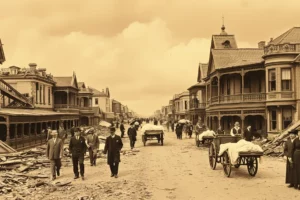
The flood is unusually well documented visually. Photographers and stereograph publishers recorded ruined streets, collapsed houses, the broken South Fork Dam, the stone bridge, relief trains, temporary shelters, and mounds of debris. Some images posed survivors amid ruins; others showed recovery workers, coffins, and orphaned children. The Johnstown Flood Museum and the Johnstown Area Heritage Association preserve many such photographs, glass negatives, and stereographs.
These images are not neutral. They reflect what photographers thought would sell or matter: destruction, human suffering, rescue, and order restored. Yet they also preserve details that written records miss—clothing, architecture, railroad equipment, and the texture of the mud-covered valley. Used with survivor accounts and newspapers, photographs help historians reconstruct both the event and its representation.
Documents & Primary Sources
Historians study the 1889 flood through a rich body of primary sources. These include survivor memoirs and interviews, such as the accounts preserved by Heritage Johnstown and the interview with Victor Heiser held in the Johnstown Area Heritage Association archives. Rev. David J. Beale’s Through the Johnstown Flood (1890) combines personal experience, pastoral reflection, and relief records. Local newspapers, especially The Johnstown Tribune, provide dated reports, lists of dead and missing, and relief appeals.
- Census records and city directories for population, occupations, and addresses.
- Maps of Johnstown, the Conemaugh Valley, and the South Fork Dam.
- Coroner’s records, cemetery registers, and Grandview Cemetery records.
- American Red Cross relief ledgers and state relief committee papers.
- South Fork Fishing and Hunting Club records and legal documents.
- Letters, diaries, sermons, and photographs in local archives.
1889 Timeline
| Date | Event |
|---|---|
| May 30 | Decoration Day observances take place amid heavy rain in the Conemaugh Valley. |
| May 31 | The South Fork Dam fails at about 3:10 p.m.; the flood reaches Johnstown around 4:07 p.m. |
| May 31–June 1 | Fire breaks out at the stone bridge; survivors are trapped or rescued; relief efforts begin. |
| June 1–5 | Recovery, morgue work, and relief distribution expand; Clara Barton and the Red Cross arrive. |
| June 1889 | Newspapers publish survivor accounts, death lists, and appeals for aid. |
| Later 1889 | Reconstruction proceeds; investigations and public debates over responsibility continue. |
What Changed Next
Johnstown rebuilt, but not unchanged. Relief agencies, railroads, churches, and employers reconstructed homes, factories, and tracks. The flood accelerated city incorporation and consolidation of the valley’s fragmented boroughs. It also strengthened the American Red Cross as a disaster relief organization, since Clara Barton’s work in Johnstown became a model for later emergencies.
Legal efforts to hold the South Fork Fishing and Hunting Club responsible largely failed, leaving a legacy of frustration. Memorials, cemeteries, museum collections, and annual commemorations kept the story alive. The flood also changed how Americans talked about industrial risk, private dams, and disaster relief. For historians, 1889 Johnstown remains a case study in how survivors, journalists, photographers, and officials create the record of a catastrophe.
Sources
- Heritage Johnstown, Survivor Stories, https://www.heritagejohnstown.org/attractions/johnstown-flood-museum/flood-history/survivor-stories/
- David J. Beale, Through the Johnstown Flood (1890), http://www.johnstowncafe.com/johnstownarchivebook1889floodthroughthejohnstownfloodscan.pdf
- David McCullough, The Johnstown Flood (New York: Simon & Schuster, 1968).
- National Park Service, Johnstown Flood National Memorial, https://www.nps.gov/jofl/index.htm
- Johnstown Area Heritage Association, Johnstown Flood Museum, https://www.heritagejohnstown.org/attractions/johnstown-flood-museum/
FAQ
What was the population of Johnstown in 1889?
Contemporary estimates placed the Conemaugh Valley population at about 30,000, including Johnstown and adjoining boroughs; modern scholarship focuses on the 2,209 people killed in the flood.
What major events happened in Johnstown in 1889?
The central event was the May 31 South Fork Dam failure and flood, followed by fire at the stone bridge, massive relief efforts, recovery of bodies, and debates over responsibility and reconstruction.
What primary sources are available for studying Johnstown in 1889?
Researchers use survivor memoirs and interviews, Beale’s 1890 account, local newspapers such as The Johnstown Tribune, cemetery and coroner records, Red Cross relief ledgers, maps, photographs, and South Fork Fishing and Hunting Club records.
How did daily life in Johnstown in 1889 differ from today?
Daily life was shaped by industrial shift work, railroad travel, church and fraternal societies, limited plumbing and electricity, and close-knit neighborhoods near mills; disaster relief and communication were far slower than modern systems.





Leave a Reply