
Short Answer
On the morning of October 23, 1956, Budapest began as an ordinary Tuesday. Schoolchildren wrote the date in their notebooks, mothers planned birthday parties, and streetcars slid along their familiar routes. Agnes Sylvester Fulop, a fourteen-year-old student on the Pest side of Budapest, left school at four in the afternoon and boarded the No. 6 streetcar for home on the Buda side. Everything seemed as it always had been—except that there were more pedestrians on the sidewalks than usual. At the Western Train Station, the traffic came to a halt. People were walking toward the Danube and the Margaret Bridge, not strolling but moving with purpose. The Hungarian Revolution of 1956 had begun. A student demonstration against Soviet rule would grow within hours into a nationwide uprising, and within weeks Budapest would become the site of a brutal Soviet counterattack. The witnesses who lived through those streets—students, soldiers, photographers, and ordinary citizens—left a remarkable record of what it felt like to be alive at a moment of both liberation and betrayal.
What Happened?
After Stalin’s death in 1953, the rigid political controls in Hungary were relaxed. Some patriotic reformers were willing to grant greater freedom to the spirit of nationalism and individual enterprise stirring among the people. In 1956, the year of Nikita Khrushchev’s attack on Stalin, the Hungarian yearning for escape from Soviet domination exploded. On October 23, a student demonstration in Budapest provided the spark.
- Throughout the country, communist officials were ousted and Soviet troops were forced to withdraw.
- A coalition government was formed to restore Hungary’s independence; it even appeared that the country would withdraw from the newly formed Warsaw Pact controlled by Moscow.
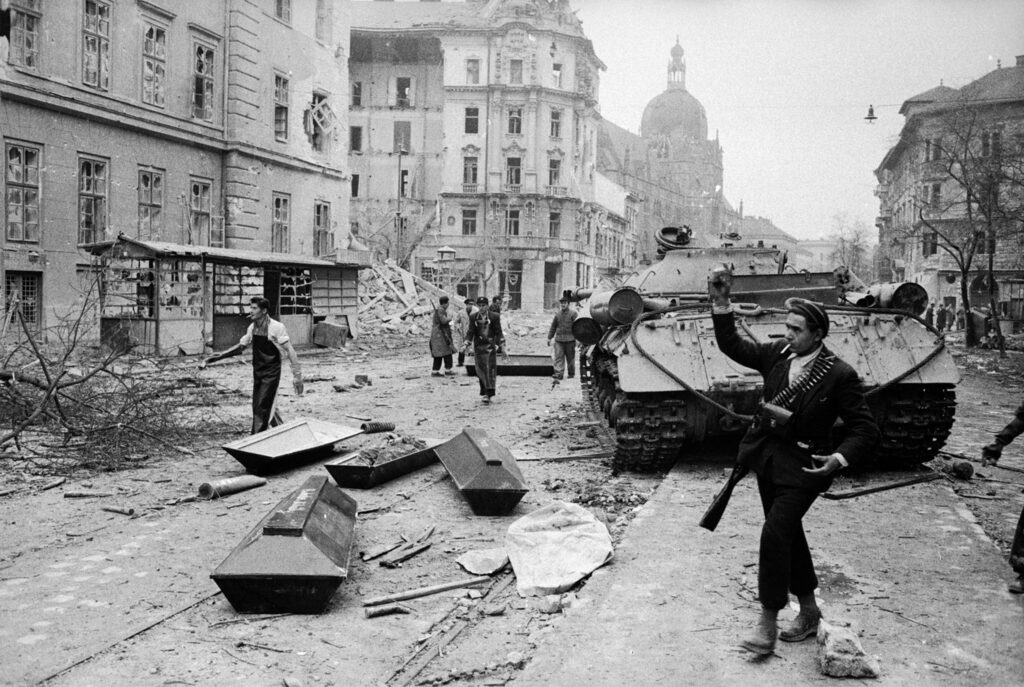
- In Budapest especially, the popular excitement over the country’s liberation from the Soviet yoke knew no bounds, as recorded by Hungarian news photographer Andor Heller.
- The Soviet Union then launched a counterattack, sending troops into Hungary to crush the revolution, and by early November the uprising was defeated.
- Thousands of Hungarians fled the country, including many of the revolution’s most active participants.
How It Was Seen at the Time
Contemporaries experienced the revolution as a period of extraordinary hope followed by devastating despair. Andor Heller, a Hungarian news photographer who documented the events and later fled to Western Europe with his photographs, captured the prevailing mood in his book No More Comrades (1957):
“In Budapest especially, the popular excitement over the country’s liberation from the Soviet yoke knew no bounds.”
Heller also recorded the emotional arc of the revolution: “Depression followed the anger caused by the Soviet counterattack.” The language of the time was charged with the vocabulary of liberation—”freedom,” “nationalism,” “independence”—and the revolution was understood by its participants as a struggle against foreign domination rather than a purely political dispute.
Historical Snapshot
| Aspect | Detail |
|---|---|
| Date | October 23 – November 4, 1956 |
| Place | Budapest, Hungary, and throughout the country |
| People | Students, workers, Hungarian revolutionaries, Soviet troops |
| What Happened | A student demonstration against Soviet rule grew into a nationwide uprising, which was then crushed by a Soviet military counterattack |
| Why It Mattered | The revolution was the most direct challenge to Soviet control in Eastern Europe before 1989, and it shaped the Cold War’s trajectory |
Eyewitness Accounts
The most powerful record of the revolution comes from the people who were on the streets. These accounts, gathered in the decades since, reveal both the raw hope of the first days and the grim reality of the Soviet invasion.
Vicky Bond was a fifteen-year-old student in 1956. “I was a 15-year-old student in 1956 and although not especially politically-minded, on 23 October I joined the demonstrators after school together with a lot of my friends,” she recalled. Her sister and she escaped Hungary on November 23, leaving their parents behind, and she later wrote her story for her children. “In my heart I will always be Hungarian and love going home.”
Agnes Sylvester Fulop was a student who experienced the revolution from the window of a streetcar. Her account captures the ordinary texture of the day: “It was a regular school day with regular class schedule for Tuesday. As I did at the beginning of every school day, I wrote the date in my note book. It was October 23.” She described how the streetcar became stuck at the Western Train Station, and how people were “walking toward the Danube and the Margaret Bridge”—a detail that shows how quickly the city’s ordinary rhythms were overtaken by events.
Charles Halasz, a seventy-three-year-old revolutionary from the town of Szeged, was a driving instructor for the Hungarian army. He recalled being present at the events with six of his colleagues, though the details of his account remain fragmentary. His testimony nevertheless underscores the fact that the revolution drew support from across Hungarian society, not only from students.
Andor Heller, a Hungarian news photographer, captured the revolution on film and fled to Western Europe with his photographs, publishing them in No More Comrades (1957). His work remains a crucial visual record of the uprising, showing both the jubilant crowds and the subsequent destruction.
Daily Life
The revolution did not erupt in a vacuum; it grew out of the texture of ordinary life. Agnes Sylvester Fulop’s account describes a school day that was both familiar and unsettled. She left school at 4 pm, boarded the No. 6 streetcar, and noticed “more pedestrians on the sidewalks” than usual. The streetcar was crowded, but the traffic came to a halt at the Western Train Station, and people were walking toward the Danube and the Margaret Bridge.
For Vicky Bond, the revolution interrupted her school routine. She joined the demonstrators after school “together with a lot of my friends,” a decision that would change her life. Her escape on November 23—leaving her parents behind—was a stark reminder of the human cost of the uprising. The ordinary world of school, family, and streetcars was torn apart, and the daily routines that had defined Hungarian life were replaced by barricades, gunfire, and flight.
What People Knew at the Time
| What People Knew Then | What We Know Now |
|---|---|
| The Soviet troops had withdrawn and a coalition government was formed | The Soviet Union was already preparing a military counterattack |
| The revolution seemed to be a triumph for Hungarian independence | The uprising was crushed by Soviet forces within weeks |
| Hungary’s withdrawal from the Warsaw Pact appeared possible | The Soviet Union was determined to prevent any Warsaw Pact departure |
Aftermath
The Soviet counterattack crushed the Hungarian Revolution. Andor Heller described the mood: “Depression followed the anger caused by the Soviet counterattack.” Thousands of Hungarians fled the country, including Vicky Bond, who escaped with her sister on November 23, leaving her parents behind. The revolution was defeated, but its memory endured and became a powerful symbol of resistance against Soviet rule. In the decades that followed, October 23 would be remembered as a day of national pride and mourning, and the revolution’s legacy would shape Hungary’s path toward independence, culminating in the fall of the Iron Curtain in 1989.
How Historians See It Today
Contemporary witnesses understood the revolution as a struggle for national liberation. Historians today view it as a pivotal moment in the Cold War, demonstrating the limits of Soviet tolerance for dissent and the willingness of ordinary people to risk everything for freedom. The primary sources—eyewitness accounts, photographs, and memoirs—remain essential to understanding the revolution’s human dimension. While modern scholarship has placed the events in the broader context of Soviet power dynamics and the Hungarian Communist Party’s internal crises, the voices of those who were on the streets remain the most powerful testimony to what the revolution meant to the people who lived it.
The Hungarian Revolution of 1956 was a moment when the world—students, workers, soldiers, and ordinary citizens—took to the streets of Budapest to demand freedom. The primary sources they left behind allow us to hear their voices, feel their hopes, and understand their fears. The revolution was crushed, but the record of those days in Budapest remains a vivid testimony to the human desire for freedom and the cost of seeking it.
FAQ
What sparked the Hungarian Revolution of 1956?
The revolution was sparked by a student demonstration in Budapest on October 23, 1956, which quickly grew into a nationwide uprising against Soviet rule. The demonstration was part of a broader wave of reformist sentiment that had been building since Stalin's death in 1953.
Why did the Soviet Union invade Hungary?
The Soviet Union invaded Hungary to prevent the country from leaving the Warsaw Pact and to stop the establishment of a coalition government that threatened Soviet control over Eastern Europe. The Soviet counterattack began in early November 1956 and crushed the revolution.
What was the outcome of the Hungarian Revolution?
The revolution was defeated by Soviet forces, leading to thousands of deaths and the flight of tens of thousands of refugees from Hungary. The Soviet Union installed a new, loyalist government, and Hungary remained under Soviet control until the late 1980s.




Leave a Reply