
Short Answer
On October 4, 1883, the Gare de l’Est in Paris was crowded with onlookers and journalists. Around two dozen intrepid passengers were preparing to board a train that would expand the frontiers of travel. Its destination was Constantinople (now Istanbul), and its name was the Orient Express—an intercontinental rail service that would soon become a global legend. The train was the brainchild of a Belgian engineer, Georges Nagelmackers, who had a dream of a luxury railway spanning Europe. At the time, the concept of “globe-trotting tourism” was still new; the ultra-rich were the only ones who could afford such a journey. The train promised not just a ride, but an experience: opulent dining, plush sleeping compartments, and a route that threaded through the heart of Europe into the mysterious East. This was the belle époque, a golden age of artistic flourishing and prosperity, and the Orient Express was its most glamorous symbol.
What Happened?
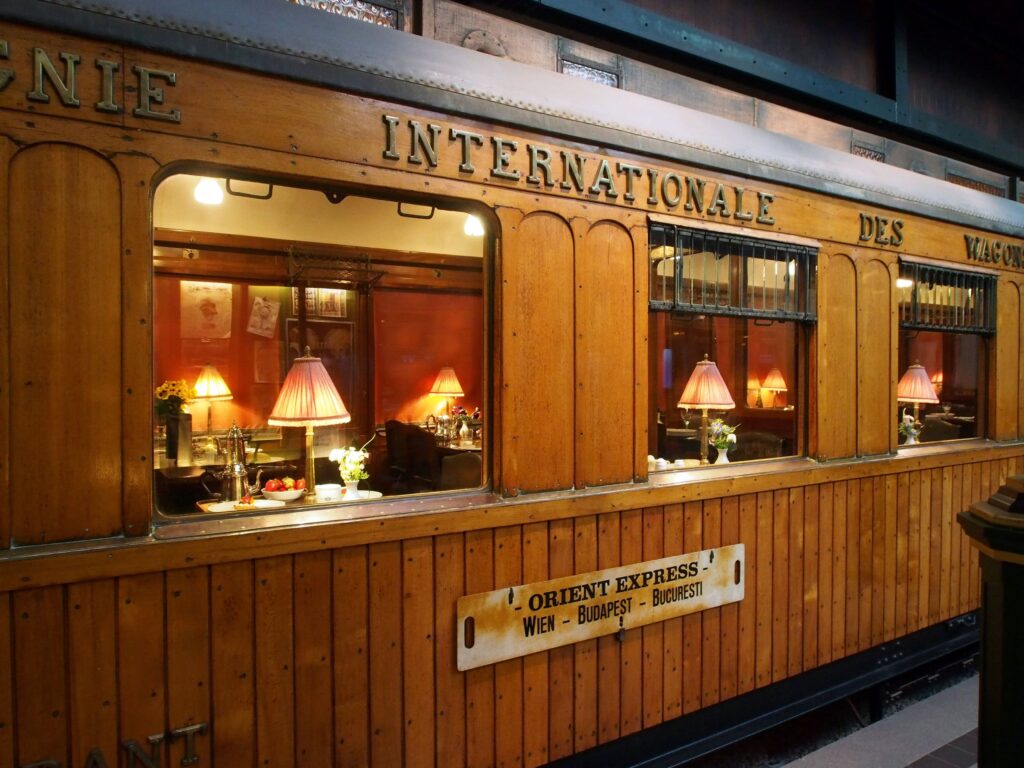
The Orient Express was the first transcontinental express train in Europe. It was inaugurated on October 4, 1883, and ran from Paris to Constantinople (Istanbul) for more than 80 years, until 1977. The initial route covered over 1,700 miles (about 2,740 km), with brief stopovers in cities such as Munich, Vienna, Budapest, and Bucharest. The service was a creation of the Compagnie Internationale des Wagons-Lits (CIWL), founded by the Belgian engineer Georges Nagelmackers, who was inspired by the American Pullman cars he had seen during a trip to the United States.
The train’s history was punctuated by interruptions. Its service was stopped by World War I but resumed in 1919, with a new route running from Calais and Paris to Lausanne, then via the Simplon Pass to Milan, Venice, Zagreb, Belgrade, and Sofia. This version was called the Simplon–Orient-Express. The train was interrupted again during World War II, but service resumed in 1947. The Orient Express was not a single train but a service that changed over time, with different routes and names, but the name “Orient Express” became synonymous with luxury and intrigue.
How It Was Seen at the Time
Contemporaries viewed the Orient Express as the epitome of glamour and adventure. It was a train that played host to spies, dignitaries, artists, and presidents. The train’s fame was amplified by the passengers it carried: Lawrence of Arabia, Mata Hari, Leo Tolstoy, and Marlene Dietrich were among the 20th century’s most fascinating figures, and each experienced the opulence of the Orient Express. The train was not merely a mode of transport; it was a symbol of the era’s cosmopolitanism and a stage for intrigue.
“A train that would span a continent, running on a continuous ribbon of metal for more than 1,500 miles,” is how one historian described Nagelmackers’ vision. The train was seen as a marvel of modern engineering and a symbol of a world becoming smaller and more connected.
The prevailing mood was one of awe and excitement. The train was a place where the elite could travel in comfort and style, but it was also a place of mystery, as the enclosed compartments and long journeys fostered an air of secrecy. The train’s reputation for intrigue was further enhanced by Agatha Christie’s 1934 novel Murder on the Orient Express, which was set on the train and made it a symbol of detective fiction.
Historical Snapshot
| Aspect | Detail |
|---|---|
| Date | October 4, 1883 (inaugural run); final service in 1977 |
| Place | Paris, France to Constantinople (Istanbul), Ottoman Empire |
| People | Georges Nagelmackers (founder), passengers including royalty, spies, artists, and the wealthy |
| What Happened | The Orient Express, Europe’s first transcontinental luxury express train, began service, connecting Paris to Istanbul with stopovers in major cities. |
| Why It Mattered | It symbolized the belle époque’s luxury and cosmopolitanism, and it became a cultural icon of glamour and mystery. |
Eyewitness Accounts
Eyewitness accounts from the early days of the Orient Express are rare, but they capture the sense of wonder and luxury. One account from a passenger on the first journey, as reported in the French press, described the train as a “rolling palace” with “a dining room, a smoking room, and a library.” The compartments were fitted with the finest upholstery, and the cuisine was prepared by a chef. The train’s first journey was a publicity triumph, and the passengers were often celebrities or journalists who wrote glowing reports of the experience.
“We are not traveling; we are floating in a dream,” wrote a passenger in an early account, describing the luxurious interiors and the smooth motion of the train.
Another account, from a 1920s traveler, described the journey as a “succession of exquisite landscapes, each more beautiful than the last, but the train itself was the most beautiful of all.” The Orient Express was not just a train; it was a destination in itself.
What People Expected Would Happen Next
At the time, contemporaries believed that the Orient Express would continue to expand and evolve. They expected that it would remain the premier way to travel between Europe and the East, and that it would become even more luxurious and efficient. The train was seen as a harbinger of a new era of travel, where the world was becoming more accessible. Some predicted that the train would eventually be replaced by air travel, but few expected that its final service would come as early as 1977. The rise of commercial airlines in the mid-20th century made the long overland journey less appealing, and the Orient Express could not compete with the speed of air travel. The train’s final service was in 1977, but its legacy continued to live on in the form of modern luxury trains that bear its name.
Common Misconceptions
How Historians See It Today
Modern historians view the Orient Express as more than just a train; it is a symbol of a bygone era. They see it as a product of the belle époque, a period of optimism and innovation before the First World War. The train is also seen as a symbol of colonialism and the privileged elite, as it was primarily used by the wealthy and the powerful. Historians note that the train’s reputation for mystery was partly created by the media and by the stories of famous passengers, but it also reflected the reality of a time when travel was slower and more contemplative. The Orient Express was a microcosm of the society of its time, with its strict class divisions and its allure of the exotic East. Today, historians use the Orient Express as a lens to examine the social, cultural, and political history of Europe from the late 19th to the mid-20th century.
Aftermath
The Orient Express’s final service ran in 1977, but its legacy did not end. The train was revived in the 1980s by a private company, the Venice Simplon-Orient-Express, which restored original carriages and resumed a luxury service between London, Paris, and Venice. This revival was not the original route, but it kept the name and the spirit alive. The original route to Istanbul was not restored, but the name remained a byword for luxury and adventure. The train’s story has been told in countless books, films, and documentaries, and its carriages are preserved in museums. The Orient Express remains a cultural icon, representing a time when travel was an event, not just a means of getting from one place to another.
The Orient Express is more than a train; it is a time capsule. It represents the glamour and the exclusivity of a world that was forever changed by war and technology. The primary sources—the newspapers that announced its first run, the diaries of its passengers, and the photographs of its interior—reveal a world of elegance and privilege, but also a world of change and uncertainty. The train was a symbol of the belle époque, but it also witnessed the upheavals of the 20th century. The story of the Orient Express is a story of human ambition, of the desire for luxury and connection, and of the end of an era.
FAQ
When did the Orient Express start and end?
The Orient Express started on October 4, 1883, with its first run from Paris to Constantinople (Istanbul). It operated for over 80 years, with interruptions during World War I and World War II, and its final service ran in 1977.
Who created the Orient Express?
The Orient Express was created by Georges Nagelmackers, a Belgian engineer and businessman. He founded the Compagnie Internationale des Wagon-Lits (CIWL), which operated the train, and he was inspired by the American Pullman rail cars.
What was the original route of the Orient Express?
The original route was from Paris to Constantinople (Istanbul), covering over 1,700 miles (about 2,740 km), with brief stopovers in cities such as Munich, Vienna, Budapest, and Bucharest.
Is the Orient Express a real train or just a story?
The Orient Express was a real train, but it is also a cultural legend. It was a luxury train that ran from 1883 to 1977. It inspired Agatha Christie's novel 'Murder on the Orient Express,' which is a work of fiction, but the train itself was real.











Leave a Reply