
Short Answer
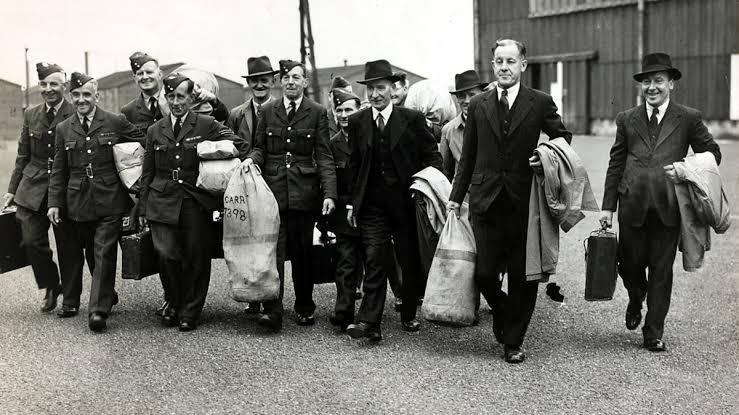
As September 1945 drew to a close, the docks of Liverpool, the Clyde, and the Thames became stages for one of the most dramatic mass homecomings in British history. Four million men and nearly half a million women in uniform were eager to shed their khaki and return to the lives they had left behind—but the Britain they came back to was not the one they had departed. Bombed streets, continued rationing, and a housing shortage awaited them. The demobilisation process, launched in June 1945, would release 3.8 million servicemen by the end of 1946. Yet the joy of reunion was often shadowed by uncertainty: Would their sweethearts still be waiting? Would their jobs still exist? Would their marriages survive the years of separation? This article reconstructs the experience of demobilisation from contemporary reports, official plans, and the voices of those who lived it.
What Happened?
The demobilisation of the British Armed Forces after the Second World War was one of the largest administrative and social tasks ever faced by the British government. At the end of the war, approximately five million men and women were serving in the military. Ernest Bevin, the Minister of Labour and National Service, had begun planning for their release as early as 1942, but his original scheme assumed that the war against Japan would continue for some time after Germany’s defeat, allowing a gradual transition. The sudden surrender of Japan in August 1945, following the atomic attacks on Hiroshima and Nagasaki, changed everything. The government was forced to accelerate the process.
The demobilisation plan, which received bipartisan support, was based on a system of release that prioritised age and length of service. The first releases began in June 1945, even before the Japanese surrender, and continued through December 1946. According to the University of Pennsylvania dissertation, “Between June 1945 and December 1946, around 3.8 million British servicemen were released from His Majesty’s Armed Forces to return to civilian lives that had been interrupted by the Second World War.”
Key milestones in the process included:
- June 1945: First releases under the demobilisation scheme begin, starting with the longest-serving personnel.
- August 1945: Japan surrenders; pressure mounts for rapid demobilisation.
- September 1945: The Labour government under Clement Attlee inherits the plan; the number of servicemen and women peaks at 4,243,000 men and 437,000 women.
- December 1946: The bulk of the release process is completed, with 3.8 million servicemen returned to civilian life.
The release process itself was often impersonal: men were given a “release book” and a suit of civilian clothes—the infamous “demob suit”—and sent home with little ceremony. The Royal British Legion notes that “By the end of the year in 1945, many troops were back home in the UK. But a UK that looked very different from the one they’d left when they sailed.”
How It Was Seen at the Time
Contemporaries saw demobilisation as a moment of hope and anxiety. The public mood favoured peace and disengagement, and the government’s plan was welcomed as a promise of a better life. The Conversation’s article on the subject notes that “the speed of its introduction was attributed to the tide of public opinion, which favoured slogans and policies that appealed to peace and disengagement.” The Labour Party’s 1945 election manifesto had promised immense change, and the return of the servicemen was seen as the first step.
Yet the joy was tempered by fear. The Royal British Legion recounts the questions that filled the minds of returning troops as they approached the home shores:
“Will my girlfriend or boyfriend still be waiting? Will my town have been changed much by bombing? Will I find a job?”
The University of Pennsylvania dissertation captures the mixed emotions: “For some, homecoming would be a joyful experience, and the restoration of peacetime life would be fairly straightforward. For others, repatriation and reunion would bring with them disappointment, resentment, and failure.” The language of the era—calling civilian life “civvy street”—reflected both a desire for normality and an awareness that the transition would not be easy.
Historical Snapshot
| Aspect | Detail |
|---|---|
| Date | June 1945 – December 1946 |
| Place | United Kingdom |
| People | British servicemen and women; Ernest Bevin, Minister of Labour; the Labour government |
| What Happened | 3.8 million servicemen were released from the armed forces and returned to civilian life |
| Why It Mattered | It reshaped the economy, family life, and the social fabric of post-war Britain |
Numbers at the Time
The following statistics were widely reported or recorded at the time:
| Statistic | Figure | Source/Year |
|---|---|---|
| Total servicemen and women at end of war | ~5 million | Royal British Legion, 1945 |
| Serving in September 1945 | 4,243,000 men; 437,000 women | The Conversation, 1945 |
| Released between June 1945 and December 1946 | 3.8 million | University of Pennsylvania dissertation |
| Unemployment in 1944 | Historically low | Royal British Legion |
| Rationing continued | Until 1954 | Royal British Legion |
What People Feared
The returning soldiers and civilians alike harboured fears that were both practical and emotional. The Royal British Legion lists the immediate questions: “Will my girlfriend or boyfriend still be waiting? Will my town have been changed much by bombing? Will I find a job?” These reflected the fear of unemployment, especially since the end of war contracts would eliminate many wartime jobs. The University of Pennsylvania dissertation points to a deeper anxiety: “Many tens of thousands of reunited couples would finish up in the divorce courts.” The fear of marital breakdown was widespread, as years of separation had taken their toll. There was also a fear that the “return to normal” would not be possible, that the war had changed people irreparably. The dissertation speaks of “years of mutual incomprehension, choked-up anger, and quiet disillusionment” that followed many homecomings.
What People Expected Would Happen Next
Contemporaries expected that the return of millions of workers would solve the labour shortage and fuel the post-war reconstruction. The Labour government’s manifesto had promised a new era of social welfare and full employment. The Conversation notes that “the speed of its introduction was also driven by the labour shortage due to post-war reconstruction.” Many soldiers expected to return to the jobs they had left, but they also expected a better world—a world with a National Health Service, council housing, and a more equal society. The demobilisation plan was seen as the first step in that transformation. However, the reality of the immediate post-war period was more chaotic: housing was scarce, and the government struggled to provide homes for the millions of returning servicemen and their families. The Royal British Legion mentions that “Three quarters of a million homes had been destroyed or were…” (the source is cut off, but it implies the scale of the housing crisis). The expectation of a smooth transition was not fully realised.
Aftermath
The immediate aftermath of demobilisation was a period of social and economic readjustment. The University of Pennsylvania dissertation describes the consequences: “It required the drastic reorganisation of the economy, the community, and the family.” Many veterans found that the jobs they had left had been filled, or that their skills were no longer needed. The housing shortage was acute, and many couples had to live with in-laws or in temporary accommodation. The divorce rate surged—the dissertation notes that “many tens of thousands of reunited couples would finish up in the divorce courts.” The psychological toll was also significant: “Years of mutual incomprehension, choked-up anger, and quiet disillusionment would follow.” The government responded with the New Towns Act of 1946 and the creation of the National Health Service in 1948, but these were later. In the short term, the demobilisation contributed to a period of austerity, as rationing continued and the country struggled to pay for the war. Yet the return of millions of civilians also created a labour force that would help rebuild the nation.
How Historians See It Today
Contemporary observers saw demobilisation as a logistical and administrative triumph, a necessary step to bring the country back to peace. But historians have since recognised the profound social and psychological consequences. The University of Pennsylvania dissertation, a recent scholarly work, argues that “the demobilisation process has gone largely unnoticed by historians of Britain after 1945,” yet its consequences were felt in every aspect of national life. Historians today emphasise the complexity of the homecoming: the joy was not universal, and the transition was often painful. They also note that the demobilisation was not merely a military administrative process but a social revolution that reshaped gender roles, family structures, and the economy. The official reports and contemporary accounts often glossed over the difficulties, but later evidence from divorce records, personal diaries, and oral histories reveals the hidden costs. The modern interpretation thus challenges the simple narrative of a triumphant return to a “land fit for heroes.”
The demobilisation of 1945–46 was a watershed in British history. The primary sources—the plans, the letters, the questions of returning soldiers—reveal a generation caught between hope and fear. They returned to a country that was exhausted and changed, and they themselves were changed. Their experiences, as recorded in official documents and personal accounts, remind us that the end of war is not the end of suffering. The return to “civvy street” was a journey that would take years, and its echoes are still felt in the social fabric of Britain today.



Leave a Reply