
Short Answer
In the spring of 1963, Birmingham, Alabama, was a city of stark contrasts. Its steel mills and downtown department stores hummed with commerce, yet Black residents navigated a daily labyrinth of segregation: separate entrances, separate water fountains, separate schools, and the ever-present threat of police violence. Known to some as “Bombingham” for the unsolved bombings that had rocked Black neighborhoods, the city was also a tightly knit community of churches, families, and small businesses. On a typical morning, domestic workers boarded segregated buses before dawn, children walked to all-Black schools, and white businessmen conducted affairs in a downtown that refused to hire Black clerks. But by April, the routine was shattered. The Southern Christian Leadership Conference, invited by the Rev. Fred Shuttlesworth, launched a campaign of sit-ins, marches, and boycotts. Young people skipped school to join the demonstrations. Police Commissioner Eugene “Bull” Connor answered with mass arrests, fire hoses, and police dogs. For the people of Birmingham, daily life became a battlefield—not in a distant war, but on the sidewalks, in the churches, and in the jails of their own city.
What Happened?
The Birmingham Campaign, code-named Project C (for “confrontation”), began on April 3, 1963, when the Southern Christian Leadership Conference (SCLC) and the Alabama Christian Movement for Human Rights (ACMHR) launched a series of sit-ins, kneel-ins, and marches. The campaign’s demands were specific: desegregation of downtown lunch counters and stores, fair hiring practices, the dropping of charges against arrested protesters, and the creation of a biracial committee to oversee desegregation. The Rev. Martin Luther King Jr., who had been invited by the Rev. Fred Shuttlesworth, arrived in Birmingham and was arrested on April 12 for violating a state injunction against protests. From his cell, King wrote the Letter from Birmingham Jail, a response to local white clergymen who had criticized the demonstrations as “unwise and untimely.”
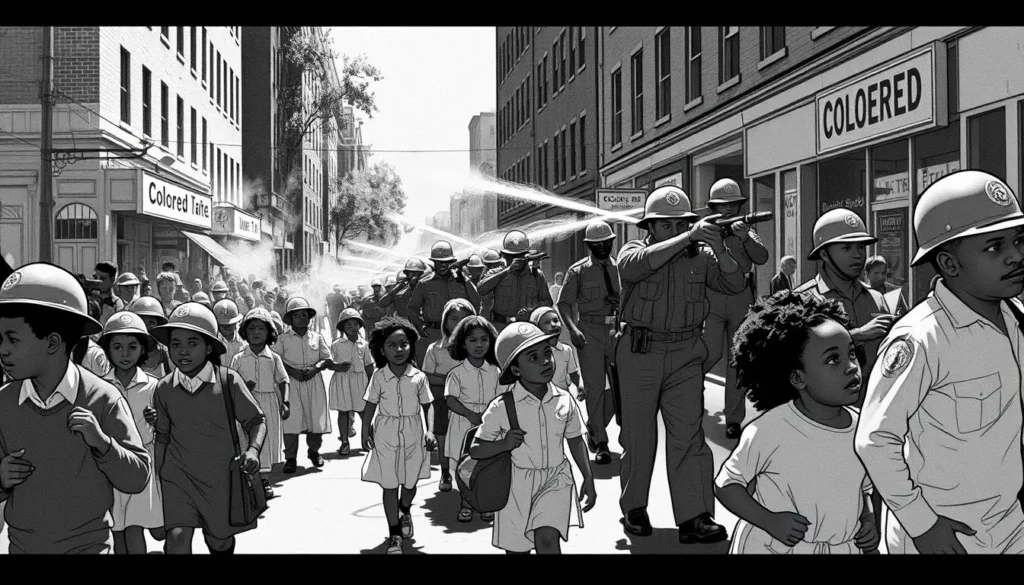
On May 2, the campaign escalated with the “Children’s Crusade.” More than 600 schoolchildren, some as young as six, marched from the 16th Street Baptist Church into downtown. They were met by police and arrested. The next day, May 3, Police Commissioner Eugene “Bull” Connor ordered the use of fire hoses and police dogs against the demonstrators. Photographs and newsreels of children being blasted by high-pressure water and attacked by dogs circulated nationally and internationally. On May 10, a tentative agreement was announced: downtown businesses would desegregate lunch counters and hire Black workers, and protesters would be released. But the agreement did not end the violence. On September 15, a bomb exploded at the 16th Street Baptist Church, killing four girls—Addie Mae Collins, Cynthia Wesley, Carole Robertson, and Carol Denise McNair—and injuring many others.

- April 3, 1963: Birmingham Campaign begins with sit-ins and marches.
- April 12: King arrested; writes Letter from Birmingham Jail (dated April 16).
- May 2: Children’s Crusade; over 600 arrested.
- May 3: Connor orders fire hoses and police dogs against demonstrators.
- May 10: Agreement announced to desegregate downtown businesses and release protesters.
- September 15: 16th Street Baptist Church bombing kills four girls.
How It Was Seen at the Time
Contemporaries interpreted the events through the language of their era. White segregationists often described the protests as the work of “outside agitators” and framed police action as necessary to preserve “law and order.” Local newspapers referred to “racial disturbances” and “demonstrations.” Many white moderates urged patience, arguing that change should come gradually through the courts. Black activists, by contrast, saw the campaign as a moral struggle against an unjust system. King’s Letter from Birmingham Jail became the definitive statement of that view.
“Injustice anywhere is a threat to justice everywhere. We are caught in an inescapable network of mutuality, tied in a single garment of destiny. Whatever affects one directly, affects all indirectly.” — Martin Luther King Jr., Letter from Birmingham Jail, April 16, 1963
King directly challenged the moderates’ call to “wait.”
“For years now I have heard the word ‘Wait!’ It rings in the ear of every Negro with piercing familiarity. This ‘Wait’ has almost always meant ‘Never.’” — King, Letter from Birmingham Jail
For many Black residents, the campaign was both hopeful and terrifying. The sight of children facing dogs and hoses drew sympathy from some white Americans, but it also deepened fears of retaliation. For segregationists, the protests confirmed their belief that the city was under siege. The mood of Birmingham in 1963 was not one of abstract debate; it was a daily contest over who could walk where, who could work where, and who could speak without fear.
Historical Snapshot
| Aspect | Detail |
|---|---|
| Date | April 3 – May 10, 1963; September 15, 1963 (church bombing) |
| Place | Birmingham, Alabama |
| People | Rev. Martin Luther King Jr., Rev. Fred Shuttlesworth, Eugene “Bull” Connor, hundreds of child demonstrators, four girls killed in the bombing |
| What Happened | Mass protests against segregation, mass arrests, police use of fire hoses and dogs, a negotiated agreement, and a deadly church bombing |
| Why It Mattered | The campaign exposed the brutality of Jim Crow to a national audience and helped build momentum for the Civil Rights Act of 1964 |
Daily Life
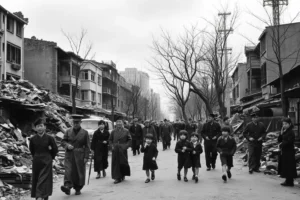
Daily life in Birmingham in 1963 was organized around the color line. Black residents lived in segregated neighborhoods such as Smithfield and Dynamite Hill, so named for the frequency of bombings. They attended all-Black schools and churches, shopped at Black-owned businesses, and worked in white homes and factories. Public accommodations were strictly segregated: there were “colored” and “white” entrances, water fountains, restrooms, and waiting rooms. Downtown department stores allowed Black customers to buy goods but not to try on clothes or eat at lunch counters. The city’s buses required Black riders to sit in the back and surrender their seats to white passengers.
Yet within these constraints, Black Birmingham had a rich institutional life. Churches like 16th Street Baptist, Bethel Baptist, and St. Paul United Methodist served as meeting places, schools, and organizing centers. The A.G. Gaston Motel, owned by a prominent Black entrepreneur, provided lodging for out-of-town activists and a safe space for strategy sessions. Radio stations played gospel and R&B; families gathered for Sunday dinners; children played in the streets until dark. The campaign disrupted these routines: schools emptied as students marched; parents worried about arrests and reprisals; workers faced pressure from employers to stay out of the movement. For white residents, daily life continued largely unchanged, though many followed the news with anxiety and some with anger. The juxtaposition of ordinary routines and extraordinary violence is what makes Birmingham in 1963 so compelling.
Eyewitness Accounts
The most famous eyewitness account from the campaign is King’s Letter from Birmingham Jail. Though written in confinement, it describes what he and other demonstrators experienced and believed.
“I am in Birmingham because injustice is here.” — Martin Luther King Jr., Letter from Birmingham Jail
“I don’t believe you would have so warmly commended the police force if you had seen its dogs sinking their teeth into unarmed, nonviolent Negroes.” — King, Letter from Birmingham Jail
Other eyewitnesses included the children who participated in the Crusade. In a 2024 Hoover Institution conversation, Condoleezza Rice, Mary Bush, and Freeman Hrabowski—classmates in segregated Birmingham—recalled the fear and determination of that year. Rice, who was eight years old in 1963, remembered the bombing of the 16th Street Baptist Church and the loss of friends. Their testimony, though retrospective, confirms that the events were experienced not as distant history but as immediate, personal trauma and community resilience. White police officers and segregationist officials also left accounts, often framing their actions as maintaining order. These perspectives are documented in court records, police reports, and newspaper interviews.
Contemporary Newspaper Coverage
National newspapers played a crucial role in shaping how the nation saw Birmingham. The New York Times sent reporters to cover the demonstrations, and its front-page stories brought the violence into living rooms across America. On May 4, 1963, the Times reported on the previous day’s events under a headline that read:
“Dogs and Hoses Used in Birmingham to Rout Negro Demonstrators” — The New York Times, May 4, 1963
The coverage emphasized the use of police dogs and fire hoses on children, a spectacle that shocked many readers. Photographs of a young boy being attacked by a dog and of children being knocked down by water became iconic. Local Birmingham papers, by contrast, tended to downplay the brutality and focus on police statements about “outside agitators.” The Birmingham News and The Birmingham Post-Herald generally supported the segregationist order, though they also reported on the economic damage caused by the protests. The contrast between local and national coverage illustrates how the same events could be seen as a necessary police action or as state-sanctioned violence, depending on the audience.
What People Feared
Fear pervaded Birmingham in 1963. Black residents feared police brutality, arrest, job loss, and bombing. The city had a long history of unsolved bombings targeting Black homes and churches, which earned it the nickname “Bombingham.” Parents worried about letting their children march, knowing they could be jailed or injured. Activists feared that the campaign would be crushed and that the meager gains would be rolled back. White residents feared racial violence, property damage, and what they called “mongrelization” of their neighborhoods and schools. Some believed that communists were behind the protests. Law enforcement feared a breakdown of “law and order.” These fears were not symmetrical: Black fears were grounded in a long experience of state violence and terrorism, while white fears were often rooted in prejudice and rumor. The bombing of the 16th Street Baptist Church in September confirmed the worst fears of Black Birmingham and shocked the conscience of the nation.
How Historians See It Today
Historians now view the Birmingham campaign as a turning point in the civil rights movement. At the time, many contemporaries saw it as a local disturbance or a dangerous provocation. Today, scholars emphasize how the campaign exposed the brutality of Jim Crow and pressured the Kennedy administration to act. The images of children facing dogs and fire hoses helped build public support for the Civil Rights Act of 1964. Modern historiography has also shifted attention from King to local activists like Fred Shuttlesworth, the women who organized the movement, and the children who marched. The Letter from Birmingham Jail is now recognized as a foundational text in American political thought. Historians also note that the campaign’s gains were limited and that violence continued, culminating in the church bombing. The Birmingham story is thus both a triumph of nonviolent protest and a reminder of the cost of white supremacy.
The primary sources from Birmingham in 1963—letters, newspapers, photographs, and eyewitness testimony—reveal a city where daily life and deadly conflict were inseparable. They show ordinary people making extraordinary choices: children marching into police lines, parents risking jobs, pastors opening their churches, and a community enduring bombings. These sources also expose the language of segregation and the fears that sustained it. To read them is to understand that the civil rights struggle was not an abstraction but a series of concrete, daily acts of courage and resistance. The legacy of Birmingham in 1963 endures in the laws that followed and in the continued fight for justice.
FAQ
What was the Birmingham Campaign?
The Birmingham Campaign was a series of nonviolent protests in 1963 led by the SCLC and ACMHR to end segregation and economic discrimination in Birmingham, Alabama.
Who was Bull Connor?
Eugene “Bull” Connor was Birmingham’s Commissioner of Public Safety; he ordered police to use fire hoses and dogs against demonstrators, and his actions became a national symbol of segregationist brutality.
What happened at the 16th Street Baptist Church?
On September 15, 1963, a bomb planted by white supremacists exploded at the church, killing four girls and injuring many others. The bombing shocked the nation and intensified support for civil rights legislation.




Leave a Reply