Short Answer
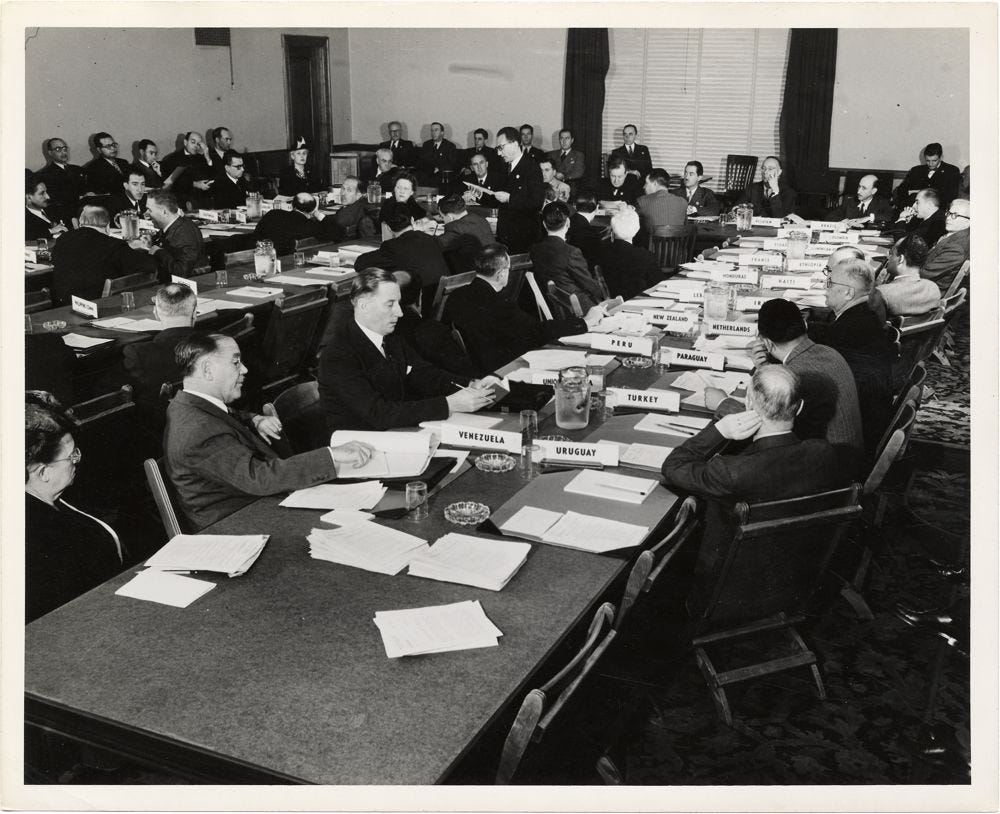
On April 25, 1945, as World War II entered its final months, delegates from dozens of nations gathered at the War Memorial Opera House in San Francisco with a single goal: to create an international body that would prevent another global catastrophe. The city, as E. B. White wrote in The New Yorker, was filled with “delegates, soldiers, lobbyists, and fragile hope.” But the conference was also a press spectacle of unprecedented scale. TIME magazine reported that 1,600 accredited correspondents—outnumbering delegates six to one—descended on the city, turning the event into what it called a “two-bit political clambake.” The birth of the United Nations was not just a diplomatic milestone; it was a global media frenzy, and the newspapers of the day captured both the promise and the pandemonium.
What Happened?
The United Nations Conference on International Organization, known as the San Francisco Conference, opened on April 25, 1945, at the War Memorial Opera House. Delegates from fifty nations (though some sources say “dozens” of nations) worked for two months to draft the UN Charter. The conference was a direct result of earlier wartime agreements, including the Yalta Conference, and the Declaration of the United Nations in 1942. The main issues included the structure of the Security Council, the veto power of permanent members, and the future of colonial territories.
- April 25, 1945: Conference opens at the War Memorial Opera House. Delegates from 50 nations (the official count) begin deliberations.
- May–June 1945: Committees negotiate the charter, with major debates over the veto and the role of regional organizations.
- June 26, 1945: The UN Charter is signed by delegates in the Herbst Theatre at the Opera House.
- July 24, 1945: The United States Senate ratifies the Charter by a vote of 89 to 2.
Alongside the diplomatic work, the conference was a massive journalistic event. According to TIME, “The United Nations Press Secretariat had handed out San Francisco credentials like tickets to a two-bit political clambake; accredited correspondents outnumbered delegates six to one.” The press section was designed for 600, but 1,600 reporters, columnists, and radio broadcasters jammed into the city.
How It Was Seen at the Time
Contemporaries saw the conference as a moment of both enormous hope and deep anxiety. The war was still raging in the Pacific, and the memory of the League of Nations’ failure was fresh. E. B. White, writing in The New Yorker on the eve of the conference (April 28, 1945), described the city as “the eve of St. Francis,” a time of fragile hope. He wrote: “The city is full of delegates, soldiers, lobbyists, and fragile hope.” The tone of coverage was often cynical about the political maneuvering but also recognized the historic stakes.
“Legmen, pundits, gossip columnists, hatchetmen, trained seals and freaks—1,600 of them, all classified as newsmen—fought for seats in a press section big enough for 600.” — TIME, May 7, 1945
The press itself was a subject of mockery and fascination. The San Francisco Chronicle dryly reminded Walter Winchell and actress Helen Hayes that Argentina, which had declared war on the Axis at the last minute, received “swanky suites” for its delegates, while some of the show’s cast members who had fought Axis supporters were being put out of hotels. Such incidents fueled a narrative that the conference was as much a spectacle as a serious diplomatic exercise.
Historical Snapshot
| Aspect | Detail |
|---|---|
| Date | April 25 – June 26, 1945 |
| Place | War Memorial Opera House, San Francisco, California, USA |
| People | Delegates from 50 nations; 1,600 accredited journalists; press secretariat |
| What Happened | Drafting and signing of the United Nations Charter |
| Why It Mattered | Established the United Nations, replacing the failed League of Nations and setting the framework for post-war global governance |
Contemporary Newspaper Coverage
The press coverage of the San Francisco Conference was intense and often sensational. TIME’s May 7, 1945, article “The Press: San Francisco Spectacle” offered a vivid snapshot of the journalistic chaos. The article described the Pied Piper bar at the Palace Hotel as a meeting place where “newsmen and pseudo-newsmen who couldn’t get into the conference sessions, or didn’t want to, mobbed… interviewing each other, exchanging rumors.”
“Walter Winchell breathlessly reported that Helen Hayes’s cast in Harriet had been given poor hotel accommodations and quoted her: ‘Argentina, which declared war against the Axis at the last minute, gets swanky suites for her delegates. But some of us in the show who have been fighting Axis supporters over here are being put out of hotels.’”
The San Francisco Chronicle and other local papers provided daily coverage, while major national dailies like The New York Times and Washington Post sent their top correspondents. The tone was a mix of excitement and skepticism, with many journalists focusing on the political infighting and the logistical chaos of the press arrangements.
Eyewitness Accounts
E. B. White, the celebrated essayist, covered the conference for The New Yorker in two pieces: “The Eve of St. Francis” (April 28, 1945) and “Beautiful Upon a Hill” (May 5, 1945). White’s accounts captured the mood of the city and the conference. He wrote about the “fragile hope” of the moment and the presence of soldiers, delegates, and lobbyists. He observed the press corps with a mixture of bemusement and awe.
“On the brink of the San Francisco Peace Conference, a wartime city fills with delegates, soldiers, lobbyists, and fragile hope.” — E. B. White, The New Yorker, April 28, 1945
White’s second piece, “Beautiful Upon a Hill,” published on May 5, 1945, reflected on the press corps’s power and its limitations. He noted that the press could shape the narrative of the conference, but also that the events themselves were beyond the control of any single journalist. His eyewitness accounts remain a vivid record of the daily life of the conference.
What People Feared
Among the most common fears expressed in the press and among the public was the possibility that the conference would fail, as the League of Nations had failed after World War I. Many worried that the great powers would not agree on the veto, or that smaller nations would feel excluded. There was also anxiety about the Soviet Union’s intentions and the future of colonial empires. The San Francisco Chronicle and other papers published editorials urging the delegates to succeed, warning that failure would doom the world to another conflict.
On a more mundane level, the press corps feared being left out of the story. With 1,600 reporters competing for 600 seats, many were shut out of the sessions, leading to rumors and speculation. The Pied Piper bar became a breeding ground for misinformation, as reporters interviewed each other and traded unverified tips.
What People Expected Would Happen Next
Most contemporaries expected that the conference would produce a charter, but the specifics were uncertain. Many hoped the United Nations would be a stronger version of the League of Nations, with the power to enforce peace. Some predicted that the veto would be a source of gridlock, while others believed the great-power unity would last. E. B. White’s “fragile hope” captured the prevailing mood: the desire for a lasting peace was strong, but the memory of the 1930s and the failures of diplomacy made many skeptical.
In the immediate aftermath, the signing of the Charter on June 26, 1945, was met with relief and celebration. The press coverage shifted from the chaos of the conference to the ratification process in national legislatures. The general expectation was that the UN would quickly become the central forum for international diplomacy, though no one could predict the Cold War tensions that would soon dominate the world.
Numbers at the Time
| Statistic | Figure (as reported in 1945) |
|---|---|
| Accredited correspondents | 1,600 |
| Ratio of correspondents to delegates | 6 to 1 |
| Press section capacity | 600 seats |
| Number of nations participating | 50 (delegates) |
| Duration of conference | April 25 – June 26, 1945 |
The San Francisco Conference of 1945 was a landmark not only in diplomacy but in the history of journalism. The overwhelming number of reporters, the chaos of the press rooms, and the mixture of hope and cynicism that characterized the coverage set a precedent for how the world would later witness global events. The primary sources from the time—TIME’s account, E. B. White’s essays, and the many newspaper articles—offer a vivid glimpse of a world on the brink of a new order, uncertain of what the future would hold but determined to document every moment.
FAQ
How many reporters covered the San Francisco Conference?
According to TIME magazine (May 7, 1945), 1,600 accredited correspondents were credentialed, outnumbering delegates six to one. The press section was designed for only 600, leading to overcrowding and chaos.
What was the mood of the press during the conference?
The press was both excited and cynical. Many reporters were frustrated by the lack of space and the difficulty of access, while others were deeply aware of the historical significance. E. B. White described the atmosphere as one of 'fragile hope,' while TIME called it a 'two-bit political clambake.'



Leave a Reply