
Short Answer
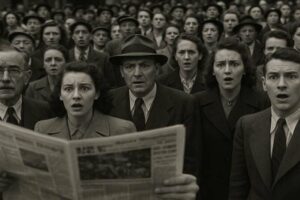
The year 1929 opened on a note of heady confidence. The stock market had climbed for years, and the phrase “permanent prosperity” was on the lips of financiers and factory workers alike. In New York, the ticker tape machines chattered through the autumn afternoons, and the city’s skyline was punctuated by the new skyscrapers of the age. But on October 24, 1929, the world of the Roaring Twenties began to shatter. Crowds gathered outside the New York Stock Exchange, their faces a mixture of disbelief and dread, as the ticker tapes fell behind. The crash that followed over the next few days would erase billions in paper wealth and usher in a decade of hardship. This article reconstructs that year through the eyes of those who lived it, using the words, figures, and images that survive from the period.
What Happened?
The stock market boom of the 1920s was unlike anything seen before. The Dow Jones Industrial Average had increased six-fold from 63 in August 1921 to a peak of 381 in September 1929. Speculation was rampant, with investors buying on margin and expecting ever-higher prices. But in late October, the bubble burst.
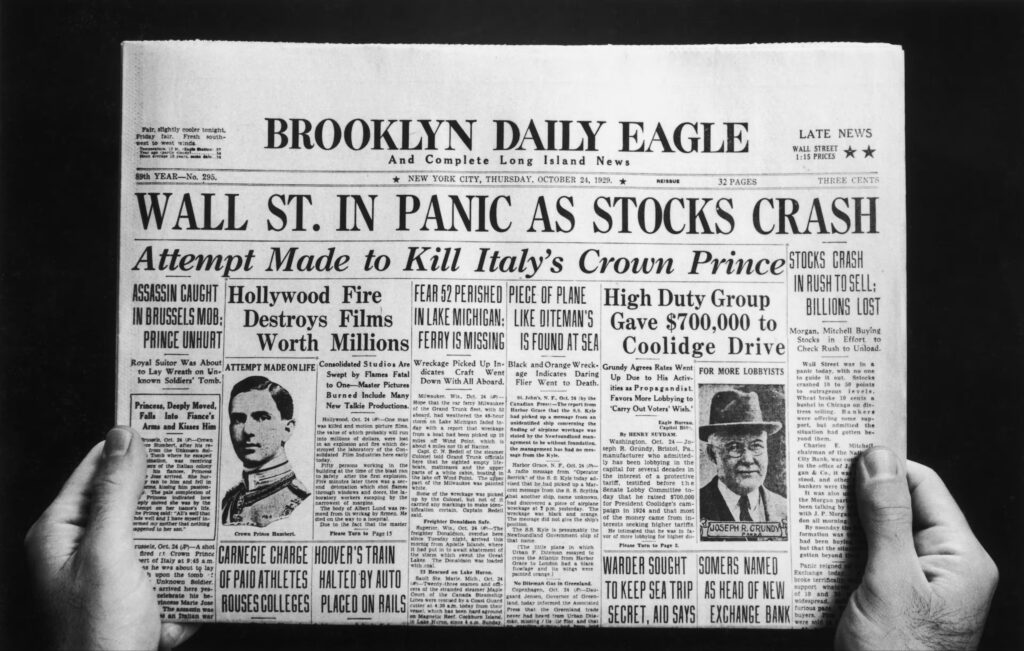
- Black Thursday (October 24): The Dow dropped sharply, losing 11% of its value in early trading. A panic selling wave hit the market, and a group of bankers attempted to stabilize prices by buying large blocks of stock.
- Black Monday (October 28): The Dow declined nearly 13%, a single-day record at the time.
- Black Tuesday (October 29): The market fell another 12%. Over the four business days from October 24 through October 29, the Dow dropped from 305.85 points to 230.07 points—a decrease of about 25%.
The crash was not a single day but a cascade. By mid-November, the Dow had lost almost half its value from its September peak. The slide continued into the summer of 1932, when the Dow closed at 41.22, its lowest point of the twentieth century—an 89% drop from the 1929 high.
How It Was Seen at the Time
Even as the market tumbled, many contemporaries refused to believe that the crash was permanent. The most famous expression of this optimism came from Yale economist Irving Fisher, who on the eve of the crash had proclaimed that “stock prices have reached what looks like a permanently high plateau.” His words were echoed by bankers and government officials who saw the decline as a necessary correction rather than a catastrophe. The mood among the public was a mixture of confusion and denial. In the days after Black Tuesday, many believed that the market would quickly recover, and that the “Roaring Twenties” would continue.
“Stock prices have reached what looks like a permanently high plateau.” — Irving Fisher, October 1929
Historical Snapshot
| Aspect | Detail |
|---|---|
| Date | October 24–29, 1929 |
| Place | New York Stock Exchange, Wall Street, New York City |
| People | Investors, brokers, bankers, and the American public |
| What Happened | Stock prices collapsed, wiping out billions in paper wealth |
| Why It Mattered | It marked the end of the Roaring Twenties and triggered the Great Depression |
What People Knew at the Time
| What People Knew Then | What We Know Now |
|---|---|
| Many believed the crash was a temporary correction and that the economy was sound. | The crash was the beginning of a decade-long global economic depression. |
| Investors were confident that stock prices would return to their September 1929 highs. | The market did not return to its 1929 peak until 1954. |
| The banking system was widely trusted, and few foresaw the bank runs that followed. | The crash exposed deep weaknesses in the banking system, leading to thousands of bank failures. |
Contemporary Newspaper Coverage
The press coined the terms “Black Thursday” and “Black Tuesday” to describe the panic. Newspapers across the country ran front-page stories of the crash, describing the “panic” and “hysteria” on Wall Street. A photo from October 1929 shows “panicked workers flooding the streets of New York City following the Black Tuesday stock market crash.” The coverage was sensational, with headlines such as “Wall Street in Panic” and “Millions Lost in Crash.” The press also reported on the efforts of bankers to stabilize the market, and the words of experts like Irving Fisher were widely quoted. The tone was a mix of alarm and reassurance, as journalists tried to make sense of the unprecedented events.
What People Feared
In the immediate aftermath of the crash, contemporaries feared a wave of bankruptcies and unemployment. Many had bought stocks on margin, and when prices fell, they were forced to sell at a loss or face margin calls. The fear of bank failures was particularly acute, as many banks had invested heavily in the stock market. Rumors of bank runs began to circulate, and people rushed to withdraw their savings. The fear was not unfounded: over the next few years, thousands of banks would collapse, wiping out the savings of millions of Americans.
Aftermath
The immediate aftermath of the crash was a period of deep uncertainty. The Dow continued to fall through November 1929, losing nearly half its value from the September peak. The Federal Reserve, which had been uncertain about how to respond, faced criticism for its handling of the crisis. The crash triggered a wave of margin calls, bankruptcies, and layoffs. By the end of 1929, the Great Depression was beginning to take hold, and the Roaring Twenties were over. The years that followed saw unemployment rise to 25% in the United States, and the global economy plunged into a decade of hardship.
How Historians See It Today
Modern historians and economists view the 1929 crash as a classic bubble-and-bust event. They point to the excessive speculation, the lack of regulation, and the Federal Reserve’s monetary policies as contributing factors. The Federal Reserve History notes that the stock market’s decline was not the sole cause of the Great Depression, but it was a decisive trigger that exposed deeper structural weaknesses in the American economy. Contemporary observers, by contrast, saw the crash as a sudden, unpredictable disaster. The shift in interpretation came with the hindsight of the Depression, which revealed that the boom of the 1920s was built on fragile foundations.
The story of 1929 is not just a story of numbers and dates. It is a story of human expectations and the devastating consequences of collective delusion. The primary sources from the time—newspapers, photographs, and the words of economists like Fisher—reveal a society that was caught between the exuberance of the present and the fear of the unknown. The crash ended the Roaring Twenties, but it also taught a lasting lesson about the fragility of economic prosperity.
FAQ
What caused the stock market crash of 1929?
The crash was caused by a combination of excessive speculation, buying on margin, and a lack of regulation. The stock market had risen to unsustainable levels, and when investors began to sell, the market collapsed.
How much did the stock market drop in 1929?
Over four days from October 24 to October 29, the Dow Jones Industrial Average dropped from 305.85 points to 230.07 points, a decline of about 25%. By November 1929, it had lost half its value from the September peak.







Leave a Reply